What Discord's Face Scans Mean for Professional Data Privacy in 2026
Discord's global age verification rollout raises important questions about data privacy for professionals using AI tools for research and analysis.
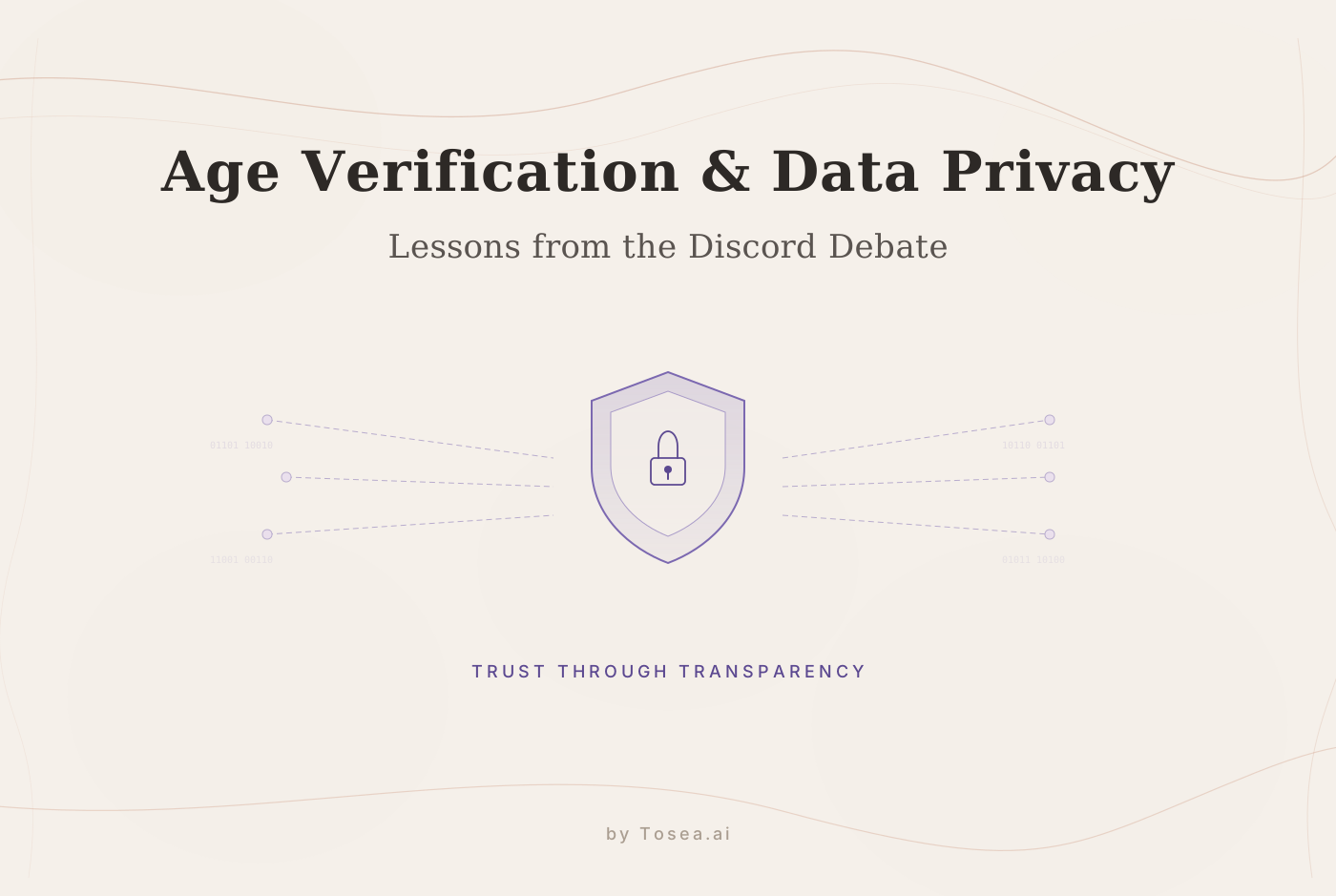
Starting March 1, 2026, Discord is rolling out mandatory age verification worldwide. What began as a pilot program in the UK and Australia is now a global requirement. Users face a clear choice: submit to a biometric face scan, upload a government-issued ID, or accept a restricted "Teen" status that limits their access to servers, voice channels, and direct messaging.
For casual users, this is an inconvenience. For professionals who've built research communities, academic collaboration spaces, and industry discussion groups on Discord, it's a significant shift that raises broader questions about how the tools we use handle our data — and what standards professionals should demand from the AI platforms they rely on.
How Discord's Verification Works
Discord's system uses three parallel methods to establish age:
AI Face Scan: Discord's partner Yoti uses "Facial Age Estimation" to analyze the geometry of your face through your camera. Discord states that the image is processed in real-time and deleted immediately — no facial data is stored.
Government ID Upload: Users can submit a photo of a driver's license or passport. Discord says the document is processed by a third-party verification service and not retained after verification is complete.
Backend Age Inference: For users who don't complete either verification step, Discord deploys an algorithmic model that estimates your age based on account activity patterns — message history, server participation, account age, and behavioral signals.
Why Privacy Experts Are Concerned
The "instant deletion" claim deserves scrutiny. While the facial image itself may be deleted, verification tokens and metadata about the verification event persist. The third-party relationship with Yoti introduces an additional data handling party with its own privacy policies and potential vulnerabilities.
The October 2025 breach of 5CA, a Discord customer support vendor, leaked over 70,000 user records — including support ticket details and account information. This incident demonstrated that even when the primary platform has strong security, the vendor ecosystem creates potential exposure points that users have no visibility into.
For professionals who maintain research communities on Discord — and many academic departments, open-source projects, and industry groups do — the mandatory verification requirement adds a new variable to their risk assessment.
The Training Data Question
Discord's verification rollout also surfaces a concern that extends to every AI tool professionals use: how is your data being used beyond the immediate task?
When you interact with a consumer platform, your conversations, uploads, and behavior patterns often contribute to model training. For most casual users, this is an acceptable trade-off — better AI in exchange for usage data. For professionals working with proprietary research, unreleased financial analysis, or confidential client data, the trade-off is different.
What to Ask About Model Training
Before uploading sensitive professional data to any AI tool, consider these questions:
Does the platform use your data to train its models? Some tools explicitly state that user data is not used for training. Others include broad data usage rights in their terms of service. The distinction matters if you're working with proprietary datasets or pre-publication research.
Can you opt out of data collection? Some platforms offer enterprise tiers with different data handling policies. If your work involves sensitive information, the consumer tier's data policies may not be appropriate.
What happens to your data after the session? "Deleted after processing" and "retained for 30 days" are very different commitments. For professionals in regulated industries, data retention policies can have compliance implications.
The Discord situation is a reminder that platform data practices aren't static. A tool that respected your data last year may have updated its terms of service this year. Regular audits of your AI tool stack — checking current privacy policies against your professional requirements — are a practical necessity, not a theoretical best practice.
The Broader Shift Toward Identity-Centric Computing
Discord's move isn't happening in isolation. The UK's Online Safety Act, the EU's Digital Services Act, and several US state laws are pushing platforms toward verified identity models. The pattern is clear: the era of pseudonymous online interaction is narrowing, particularly on major platforms.
What This Means for Professional Communities
Academic research communities have traditionally valued low-friction collaboration. A researcher in Nairobi can join a Discord server for statistical methods and participate in discussions alongside colleagues from MIT, the London School of Economics, and the University of Tokyo — no institutional affiliation check required. The biometric verification requirement adds friction that may exclude some participants, particularly in regions where government ID infrastructure is less standardized.
For enterprise teams, the concern is different. Companies with strict data governance policies may not want their employees submitting biometric data to consumer platforms as a prerequisite for internal collaboration. This creates an incentive to move professional communication to platforms that don't require identity verification beyond standard authentication.
Data Privacy Standards for Professional AI Tools
The Discord situation highlights a broader question that every professional should be asking about their AI tools: what data does this platform require, and what happens to that data?
The Minimum Data Principle
Professional AI tools should operate on a minimum data principle: they need only the data required to perform the requested task. For a presentation generation tool, that means your dataset, your analytical preferences, and your design specifications. It does not require your biometric data, your government ID, or behavioral profiling.
When evaluating AI tools for professional use, consider these questions:
What data does the platform collect beyond what's needed for the task? Some tools collect usage analytics, store conversation history, or retain uploaded files indefinitely. Others process data in real-time and don't retain it after the session.
Who has access to your data? Understand the vendor ecosystem. If your data passes through multiple third-party services, each additional party represents a potential exposure point.
What's the data residency policy? For researchers working with sensitive datasets or professionals in regulated industries, knowing where your data is stored and processed isn't optional — it's a compliance requirement.
Is the platform's privacy model aligned with your needs? Consumer platforms monetize attention and engagement, which creates incentives to collect and retain as much data as possible. Professional tools that charge for their service directly have fewer incentives to harvest data beyond what's needed for functionality.
How Tosea.ai Approaches Data Privacy
Tosea.ai is designed around the principle that your professional output should be judged on its quality, not gated behind biometric verification. The platform requires standard account authentication — not facial scans or government ID. When you upload data for analysis and presentation generation, the focus is on processing that data effectively, not on building a profile of the user.
The observable workflow feature also serves a privacy function: because you can see exactly what the AI agent is doing with your data at every step, you maintain visibility into data handling that most AI tools don't provide. You can verify that your data is being processed as expected, not routed through unexpected services or retained beyond the session.
The Rise of the "Private Professional"
The Discord verification rollout is part of a larger trend: the separation of professional and consumer digital identities. Professionals are increasingly seeking tools that respect the distinction between personal data and work product.
Building a Privacy-Conscious Workflow
For professionals who want to maintain data sovereignty while using AI tools effectively, here's a practical framework:
Separate your tools by sensitivity level. Use consumer platforms (Discord, social media, general chat) for low-stakes communication. Use specialized professional tools for work involving sensitive data, proprietary analysis, or high-stakes deliverables.
Audit your AI tool stack regularly. Review the privacy policies and terms of service for every AI tool in your workflow at least annually. Look for changes in data retention, third-party sharing, or usage of your data for model training.
Prefer tools that show their work. Observable workflows aren't just about quality assurance — they're about data accountability. When you can see every step the AI takes with your data, you have a record of how it was processed that you can reference if questions arise.
Consider self-hosted or on-premise options for the most sensitive work. For datasets that can't leave your organization's infrastructure, look for AI tools that offer local deployment or on-premise processing options.
The Practical Cost of Privacy Friction
Beyond the philosophical concerns, Discord's verification requirement has tangible costs for professional communities that are worth quantifying.
Community Attrition
When a platform adds friction — even well-intentioned friction like age verification — some percentage of users leave. For a gaming community, losing 5% of members to verification fatigue is an inconvenience. For a 200-person academic research server where participants come from 30 countries with varying ID infrastructure, losing 5% could mean losing key contributors who are difficult to replace.
Several open-source project maintainers have reported that their Discord communities saw measurable drops in participation following the verification announcement. Some have begun migrating to alternatives — Matrix, Zulip, or self-hosted Mattermost instances — that don't require biometric verification.
The Signal-to-Noise Problem
There's also a subtler cost: when a professional community migrates platforms, it often loses its accumulated history — pinned messages, archived discussions, shared resources, and the contextual knowledge that develops over months and years of conversation. This institutional memory is difficult to reconstruct and represents a real loss of professional value.
For professionals evaluating where to invest their community-building efforts, the lesson is to consider platform longevity and policy stability alongside current features. A platform that requires minimal personal data today and has a track record of stable policies is a safer long-term bet than one that periodically introduces new data requirements.
What Discord's Move Signals for the Industry
Discord's age verification isn't primarily about privacy — it's about regulatory compliance. The platform is responding to legal requirements that are becoming more stringent worldwide. But the downstream effects on professional communities are real.
The platforms that will win professional users in this environment are those that can offer:
- Strong security without excessive data collection. Authentication, not surveillance.
- Transparent data handling. Clear policies about what's collected, how long it's retained, and who has access.
- Professional-grade output. The ability to produce work product — presentations, reports, analyses — that meets professional standards without requiring users to surrender more data than the task requires.
Deliberate tool selection is becoming a form of professional risk management. Not every platform needs to be maximally private — a Discord server for casual industry chat is fine. But for the work that defines your reputation — the analyses you present, the research you publish, the recommendations you make — the data practices of your tools deserve the same scrutiny you'd apply to any other professional decision.
When you're evaluating your next AI tool, ask the question that Discord's rollout has made newly urgent: does this platform need my face, or just my data? For professional work, the answer should be clear. Tosea.ai operates on exactly this principle — your expertise and your data are the only inputs required to produce professional-grade output.
FAQ
Does Tosea.ai require identity verification to use?
No. Tosea.ai uses standard account authentication (email and password or SSO). No biometric data, government ID, or behavioral profiling is required.
How does Tosea.ai protect uploaded research data?
Data uploaded for analysis is processed using industry-standard encryption. The platform is designed around the minimum data principle — it collects only what's needed to perform the requested task.
Can I use Tosea.ai for work involving sensitive or regulated data?
Tosea.ai is designed with professional data handling standards. For specific regulatory requirements (HIPAA, GDPR, etc.), contact the team to discuss compliance details for your use case.