The Master Slide: How to Craft a High-Stakes Executive Summary
Learn the structural engineering behind a world-class executive summary slide using the SCQA+B framework and AI-powered workflows.
Why the Executive Summary Is the Slide That Decides Everything
In the modern corporate landscape, time is the ultimate gatekeeper. Senior decision-makers often operate under heavy cognitive loads, frequently deciding the fate of multimillion-dollar projects in the time it takes to review a single slide. This reality has given birth to the most critical component of any professional deck: the executive summary.
An executive summary is not merely a table of contents or a brief introduction. It is a standalone, high-impact synthesis of your entire proposition. If your audience only reads this one slide, they should have everything they need to make an informed, confident decision. The executive summary is where raw data meets strategic intent—the logical heartbeat of the presentation.
This guide explores the structural engineering behind a well-crafted executive summary and how to use modern workflows to ensure your first slide is also your most persuasive.
The Executive Summary as a Strategic Tool
A common mistake in professional reporting is treating the summary as an afterthought—something slapped together after the "real" slides are done. In reality, the executive summary serves as a contract between the presenter and the audience. It sets the tone, establishes authority, and provides a cognitive map for the detailed data that follows.
The Logic of the Single Glance
Whether you are delivering a sales pitch, a business report, or a research defense, the summary must be concise, well-organized, and information-dense. The emphasis shifts depending on context:
In a Sales Pitch: It highlights the pain point, the unique value proposition, and the ROI.
In a Strategic Report: It spotlights metrics, variances, and recommended pivots.
In a Technical Proposal: It emphasizes feasibility, risk mitigation, and commercial potential.
In an Academic Defense: It frames the research gap, methodology, and key findings within the broader scholarly conversation.
The objective is clarity over decoration. While visual balance matters, every design element must serve the narrative. The visual hierarchy should direct the eye to the most critical insights first—key metrics, decisions required, and the single most important takeaway.
The Six Essential Components of the Master Slide
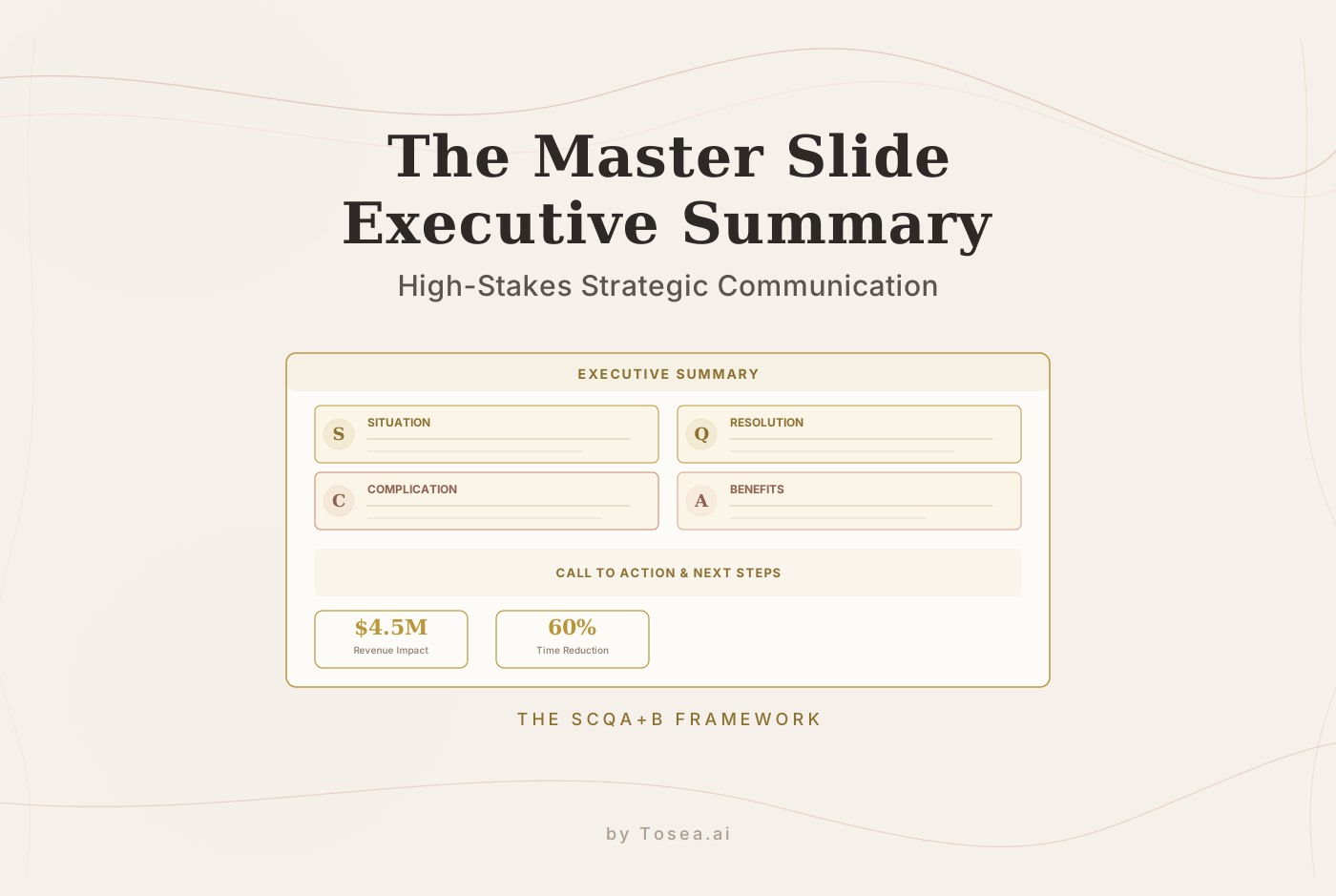
To achieve the rigor of a top-tier consulting firm, your executive summary should follow a disciplined structure. The SCQA+B (Situation, Complication, Question, Answer, and Benefit) framework, adapted for modern slide layouts, provides a reliable blueprint.
I. Objective and Purpose
Start with a definitive statement of intent. Avoid vague introductions; instead, state exactly why the room has gathered.
Example: "This presentation requests a $2M budget allocation for Q4 expansion into the APAC market."
II. Situation and Background
Provide the context required to understand the current state. This section outlines the historical factors and market conditions that led to the present moment. Keep it factual—two to three sentences at most.
Example: "Domestic market saturation has reached 85%, while secondary research indicates a 40% year-over-year growth in the targeted APAC territories."
III. The Complication (The Problem)
This is the core of the slide. You must articulate the specific challenge, threat, or missed opportunity that necessitates action. A strong executive summary focuses on the most pressing problem and makes the cost of inaction tangible.
Example: "Current logistics infrastructure is insufficient to support international shipping, leading to a 25% churn rate in overseas inquiries."
IV. The Resolution (Proposed Solution)
Directly follow the problem with your recommended path forward. The solution should be feasible and logically derived from the background provided. Avoid listing multiple options here—that belongs in the body of the deck.
Example: "Establish a regional distribution hub in Singapore using a Tier-1 3PL provider."
V. Quantitative Value and Benefits
Executives are driven by outcomes. Quickly highlight the projected results—whether they are cost savings, revenue growth, or risk reduction. Whenever possible, use hard percentages or currency values rather than qualitative language.
Example: "Implementation is projected to reduce shipping times by 60% and increase regional net revenue by $4.5M within Year 1."
VI. The Call to Action (Next Steps)
Every summary must end with an explicit request. This prevents the meeting from ending in ambiguity and gives the audience a clear decision point.
Example: "Approval of the 3PL vendor contract by Friday to ensure a Q4 launch."
Real-World Walkthrough: A SaaS Company Pitching APAC Expansion
To see the SCQA+B framework in practice, consider a mid-stage SaaS company—call it "DataFlow"—preparing a board presentation to secure funding for Asia-Pacific expansion.
Objective: DataFlow's VP of Growth needs to persuade the board to approve $2M in operational expenditure for a new sales office in Singapore and localized product development.
Situation: DataFlow has saturated its North American SMB market, with growth flattening to 4% quarter-over-quarter. Meanwhile, inbound interest from Southeast Asian enterprises has increased 120% in twelve months, driven by regulatory changes that favor cloud-native compliance tools—DataFlow's core product category.
Complication: Despite growing demand, DataFlow has no local sales team, no localized pricing, and no Mandarin or Bahasa product documentation. The company is losing deals to regional competitors who offer in-language support and local payment processing. Three enterprise pilots worth a combined $1.2M ARR stalled in the past quarter due to these gaps.
Resolution: Open a Singapore office with a four-person team (regional sales lead, two account executives, one solutions engineer). Partner with a local systems integrator for implementation support. Deliver localized product documentation within 90 days using existing translation infrastructure.
Benefits: Projected $4.5M in new ARR within 18 months. Payback period of 11 months. Secondary benefit: Singapore office positions DataFlow for follow-on expansion into Japan and Australia.
Call to Action: Board approval of the $2M OPEX allocation and authorization to begin recruiting the regional sales lead by end of month.
Notice how the slide tells a complete story in under 150 words. A board member who reads nothing else walks away understanding the opportunity, the risk of inaction, the plan, and the expected return.
Before and After: Weak vs. Strong Executive Summary
One of the fastest ways to improve your presentations is to compare a poorly constructed summary against a structured one.
The Weak Version
"We want to expand into Asia. The market is growing and we think there is a big opportunity. We have been getting more inquiries from that region. We would like to discuss next steps and get alignment on our go-to-market strategy. Our team has done a lot of research and we believe the timing is right."
What goes wrong: No specific metrics. No clear ask. No defined problem. No projected outcomes. The reader finishes with a vague sense of optimism but no basis for a decision.
The Strong Version
Objective: Secure $2M OPEX for APAC market entry via Singapore office.
Context: NA growth has flattened to 4% QoQ. APAC inbound interest up 120% YoY driven by new cloud compliance regulations.
Problem: No local sales presence or localized product. Three enterprise pilots ($1.2M ARR) stalled due to language and payment gaps.
Solution: Four-person Singapore office + local SI partnership. Localized docs in 90 days.
Impact: $4.5M new ARR in 18 months. 11-month payback.
Ask: Board approval of budget and recruiting authorization by month-end.
What works: Every sentence carries weight. The reader can evaluate the proposal without flipping to slide 14. The ask is unambiguous.
Industry-Specific Frameworks
Different sectors require different emphases. By selecting the right framework, you align your logic with the expectations of your specific audience.
The Sales Growth Strategy
In a sales context, the executive summary must link challenges directly to revenue. If the problem is a slowdown in enterprise deals, the solution must show a clear path to lead conversion. A strong slide here focuses on the Value Curve—showing how the proposed strategy outperforms current methods in speed and cost-effectiveness. Include pipeline metrics, conversion rates, and quota attainment data.
The Product Launch Proposal
For product managers, the summary focuses on market gaps. It highlights competitor weaknesses and aligns the new product's features with documented customer needs. The strength of this slide lies in its simplicity; it avoids technical jargon in favor of strategic outcomes like market share capture and retention rate improvements. Include TAM/SAM/SOM figures when available.
The Capital Raising Pitch
Whether for an independent project or a startup, this summary must balance creative vision with financial reality. It introduces the "hook," defines the target audience, and immediately pivots to the production timeline and budget range. This builds confidence that the project is both high-concept and grounded in execution realities. Include comparable transactions or comps to anchor valuation expectations.
The Operational Efficiency Review
In internal presentations to COOs or operations teams, the summary centers on process bottlenecks, cost overruns, and throughput metrics. The complication is typically a gap between current performance and a benchmark (industry standard or internal target). Solutions should include implementation timelines and resource requirements, not just recommendations.
How AI Workflows Streamline the Summary Process
The difficulty in writing an executive summary is that it requires mastery of both the "big picture" and the fine details. This tension is where AI-assisted workflows provide meaningful efficiency gains.
Ingestion and Synthesis
Modern AI tools can review raw data, research notes, and full-length reports to extract the core elements: the Situation, Complication, and Resolution. Tosea.ai's Analyst Agent, for instance, identifies signal from noise across uploaded documents, ensuring the summary reflects the data rather than the author's assumptions.
Narrative Structuring
Planning agents apply structured frameworks like SCQA+B automatically. They check that the Call to Action is logically supported by the Benefit statements, creating a coherent argument thread. This is particularly valuable when working under time pressure—you get a structurally sound draft in minutes rather than hours.
Precision Rendering
Design agents handle the visual execution: professional typography, visual hierarchy that draws the eye to key figures, and layouts that respect the Rule of One-Third (discussed in the FAQ below). When your summary states "$4.5M in Year 1 ARR," that figure should be the visual anchor of the slide—not buried in a paragraph.
Tosea.ai combines all three stages into a single pipeline. Upload your source document, and the platform produces a presentation where the executive summary slide follows the SCQA+B structure, with your key metrics visually emphasized and your call to action clearly stated.
The Executive Summary Checklist
Use this checklist before finalizing any executive summary slide. Each item should be verifiable by reading the slide alone.
- Single clear objective — The slide states exactly what decision or action is being requested
- Quantified context — The situation includes at least one specific metric (market size, growth rate, current performance)
- Defined complication — The problem is specific, not generic. It includes a cost of inaction (revenue lost, time wasted, risk exposure)
- Feasible resolution — The proposed solution is actionable and logically follows from the problem. It is a recommendation, not a menu of options
- Measurable benefits — Outcomes are expressed in numbers: dollars, percentages, time saved, risk reduced
- Explicit call to action — The slide ends with a specific request, including who needs to do what by when
- Visual hierarchy — The most important number or statement is the largest or most prominent element on the slide
- One-Third Rule — No more than one-third of the slide area is dense text. The rest is headline, white space, and visual call-outs
- Source traceability — Every claim can be traced to a data source within the deck or an appendix
- Standalone comprehension — A reader who sees only this slide can understand the proposal and make a decision
Ensuring Credibility: Verifiability in the AI Age
In the current professional environment, a well-designed slide is not enough on its own. To secure corporate buy-in or academic approval, your summary must be verifiable. Every claim needs a traceable source.
This is where AI-assisted platforms add a layer of rigor that manual workflows often lack. Tosea.ai maintains traceability by linking claims on the summary slide back to the source data within the platform. When a board member asks, "Where did this 15% ROI figure come from?" you can show the exact derivation from your raw data rather than scrambling through notes. This transparency builds the trust required for high-stakes decision-making.
Beyond traceability, credibility also comes from consistency. If your summary says revenue grew 40%, the chart on slide 7 should show the same figure. AI pipelines that generate slides from a single source document eliminate the copy-paste errors that undermine trust in manual workflows.
One Slide to Anchor the Room
If you had only one minute to save a project or close a deal, the executive summary slide is your strongest asset. When executed with the precision of a structured framework, it commands attention, simplifies complexity, and drives immediate action.
By adopting the SCQA+B approach—focusing on objectives, problems, and measurable benefits—you move from being a presenter to being a decision facilitator. The difference between a forgettable deck and one that closes is often just this single slide.
Tools like Tosea.ai can accelerate the process, but the strategic thinking starts with you. Define your ask. Quantify your problem. Make the cost of inaction impossible to ignore. Then let the structure do the persuading.
FAQ
Q: Should the executive summary be the first or last slide I create?
A: Strategically, it should be the first. It acts as your logical north star and forces you to clarify your core argument before building supporting slides. However, you should revisit and update it after the rest of the deck is complete, ensuring that any shifts in the data during the drafting process are reflected in the final summary.
Q: How much text is too much for an executive summary?
A: Follow the Rule of One-Third. No more than one-third of the slide should be dense text. The rest should be occupied by a clear headline, white space, and high-impact visual call-outs (like a summary table or a key metric). If you find yourself shrinking the font size to fit everything, you have too much text.
Q: Can AI tools handle summaries for academic research?
A: Yes. For academic presentations, the summary (often called an Abstract Slide) focuses on the research gap, methodology, and key findings. Tools like Tosea.ai adapt the tone and framework to meet the rigor required for thesis defenses and grant applications, emphasizing citations and methodological transparency.
Q: What is the most common mistake people make on executive summary slides?
A: Listing findings without stating a recommendation. Many presenters treat the summary as a report card—"here is what we found"—without telling the audience what to do about it. A strong summary always ends with a clear call to action.
Q: How do I handle sensitive or confidential data on a summary slide?
A: Use ranges instead of exact figures when the data is sensitive (e.g., "4.2M"). You can also reference an appendix or data room for detailed financials. The summary should give enough precision to support a decision without exposing proprietary detail unnecessarily.
Q: Should I use bullet points or full sentences?
A: For executive audiences, use concise fragments or short sentences rather than full paragraphs. Bullet points work well for the Situation, Complication, and Benefits sections. The Objective and Call to Action are typically better as single, direct sentences.
Q: How do I adapt the executive summary for different audiences in the same organization?
A: Keep the core structure (SCQA+B) the same, but adjust the emphasis. For the CFO, lead with financial metrics and payback period. For the CTO, emphasize technical feasibility and integration requirements. For the CEO, focus on strategic alignment and competitive positioning. Tosea.ai allows you to generate multiple summary variants from the same source data, making this adaptation faster.