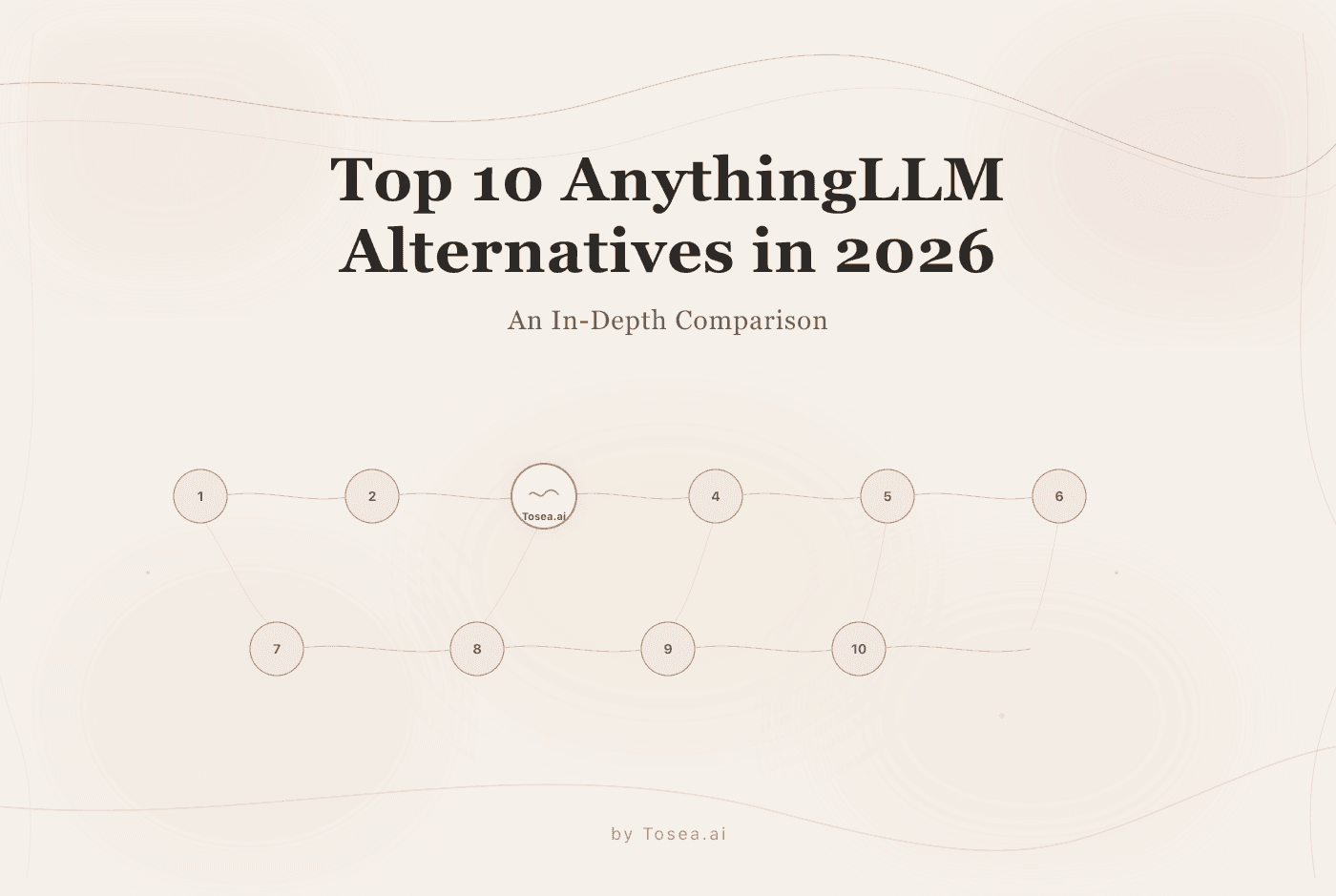
Top 10 AnythingLLM Alternatives in 2026
A hands-on comparison of the 10 best AnythingLLM alternatives in 2026, from agentic AI platforms to privacy-first local tools.
AnythingLLM earned its popularity for good reason. It brought local document Q&A to the mainstream, letting users chat with their PDFs, codebases, and research papers without sending sensitive data to external servers. For privacy-conscious professionals and researchers, it was a genuine step forward.
But the AI landscape has changed significantly since AnythingLLM first gained traction. In 2026, professionals don't just need a tool that "reads" a document—they need systems that analyze data, generate visualizations, produce presentation-ready output, and integrate into complex workflows. The shift from simple retrieval-augmented generation (RAG) to autonomous AI agents has created a new tier of tools that go well beyond document Q&A.
This guide evaluates the 10 strongest alternatives to AnythingLLM in 2026, covering a range of use cases from academic research to enterprise privacy to developer workflows.
Why Professionals Are Moving Beyond Basic Document Q&A
AnythingLLM remains a solid choice for local document chat. But the limitations of basic RAG are becoming clear for professional use cases:
The Analysis Gap: Traditional document Q&A can summarize and retrieve information, but it can't run statistical models, perform cohort analysis, or generate publication-quality visualizations. If you're a data scientist or researcher, you still need separate tools for analysis and separate tools for presentation—exactly the workflow fragmentation that AI should be solving.
The Output Problem: Getting an answer in a chat window is useful. Getting that answer formatted as a professional slide deck, a structured report, or an editable document is far more valuable. Most RAG tools stop at the chat interface, leaving the "last mile" of formatting to you.
The Workflow Gap: Modern AI agents don't just respond to questions—they plan multi-step workflows, execute code, self-correct errors, and produce finished outputs. This agentic capability is what distinguishes the tools on this list from simple document chat interfaces.
How We Evaluated These Tools
We assessed each alternative against six criteria:
- Document Processing: How well does it handle PDFs, research papers, and structured data?
- Analytical Depth: Can it go beyond summarization to perform actual data analysis?
- Output Formats: Does it produce presentation-ready output (slides, reports), or just chat responses?
- Privacy Options: Can it run locally or does it require cloud processing?
- Ease of Use: How quickly can a non-technical user get productive results?
- Pricing: Is there a viable free tier for individual users?
Each tool was tested with real research documents, datasets, and professional workflows to assess practical performance.
The Top 10 AnythingLLM Alternatives for 2026
1. Tosea.ai: The End-to-End Research Agent
Tosea.ai occupies a different category from AnythingLLM entirely. Where AnythingLLM lets you ask questions about documents, Tosea.ai takes your raw data and produces finished, analytically rigorous presentations.
The platform uses a multi-agent architecture where specialized agents handle different stages of the workflow. A planning agent outlines the analysis steps. A coding agent writes and executes the statistical models—including advanced econometric methods like DID, RDD, and IV estimation. A visualization agent creates charts and tables formatted for professional audiences. And a presentation agent assembles everything into a polished slide deck.
For a graduate student, this means uploading thesis data and getting a complete defense presentation in 20 minutes instead of spending an entire weekend on PowerPoint. For a corporate analyst, it means turning quarterly performance data into a board-ready deck without touching Excel.
The observable workflow sets it apart from generic AI tools: you can watch every step the agent takes, verify the code it writes, and intervene if the analysis doesn't match your intent. This transparency is critical in contexts where you need to defend your methodology.
- Best For: Academic researchers, data scientists, corporate analysts
- Privacy: Cloud-based with data encryption
- Output: Editable PPTX, analytical reports
- Free Tier: Yes, with monthly usage limits
2. Claude Opus 4.6 (Anthropic)
Claude 4.6 is the strongest general-purpose alternative for professionals who need deep reasoning over long documents. Its 1M token context window means you can upload an entire book, a full codebase, or years of financial reports and query across the complete corpus.
What makes Claude particularly valuable as an AnythingLLM alternative is its ability to maintain coherent reasoning across massive documents without the retrieval artifacts that plague RAG-based systems. Instead of chunking your documents and searching for relevant passages, Claude processes the full text, capturing nuances and cross-references that chunk-based systems miss.
Claude also supports agent teams—sub-agents that work on different parts of a project simultaneously. For coding tasks, this multi-agent architecture enables it to tackle complex projects that would overwhelm a single model.
- Best For: Long-document analysis, coding, nuanced reasoning
- Privacy: Cloud-based with enterprise privacy options
- Output: Text, code, structured analysis
- Free Tier: Yes, with usage limits
3. GPT-5.3-Codex (OpenAI)
If your primary need is an AI that can act on your computer—not just talk about it—GPT-5.3-Codex is the strongest option. It can navigate your OS, run terminal commands, use development tools, and execute multi-step deployment workflows.
As an AnythingLLM alternative, Codex is best suited for developers who need an AI that integrates into their actual development environment rather than sitting in a separate chat window. It excels at tasks like setting up project scaffolding, debugging complex issues across multiple files, and automating repetitive development workflows.
- Best For: Software development, DevOps, system administration
- Privacy: Cloud-based
- Output: Code, terminal operations, automated workflows
- Free Tier: Limited free usage via ChatGPT
4. LibreChat
LibreChat is the natural upgrade for AnythingLLM users who want to stay in the open-source ecosystem while gaining access to multiple AI providers. It's a self-hostable, open-source chat interface that connects to virtually any AI API—OpenAI, Anthropic, local models via Ollama, and more—through a single unified interface.
The key advantage over AnythingLLM is flexibility. You can switch between models mid-conversation, compare responses from different providers, and configure custom presets for different tasks. Teams can deploy it on their own infrastructure with full control over data flow and model selection.
- Best For: Teams wanting a unified interface across multiple AI providers
- Privacy: Self-hosted, full data control
- Output: Chat-based with plugin extensibility
- Free Tier: Open-source (self-hosted)
5. Open WebUI
Open WebUI is the closest direct competitor to AnythingLLM in philosophy: it's an open-source, privacy-focused interface for local AI models. Where it differentiates is in polish and user experience—Open WebUI offers a clean, modern interface that feels closer to ChatGPT than to a developer tool.
For professionals in healthcare, legal, and financial services where data cannot leave the local network, Open WebUI provides a practical way to use AI without cloud dependencies. It integrates with Ollama for local model management and supports document upload for RAG-based Q&A.
- Best For: Privacy-sensitive environments, local AI deployment
- Privacy: Fully local, no cloud dependency
- Output: Chat-based with document grounding
- Free Tier: Open-source
6. LM Studio
LM Studio is the most accessible entry point for anyone who wants to run AI models locally. It provides a graphical interface for downloading, managing, and running open-source models with support for various quantization levels to match your hardware capabilities.
While it lacks AnythingLLM's document Q&A features, it excels as a model experimentation platform. You can test how different models handle your specific use cases, compare performance across quantization levels, and find the best local model for your hardware before committing to a particular setup.
- Best For: Model experimentation, local AI beginners, hardware-constrained setups
- Privacy: Fully local
- Output: Chat-based
- Free Tier: Free (desktop application)
7. NotebookLM (Google)
NotebookLM takes a unique approach to document AI: it only knows what you tell it. By uploading your specific research papers or data, it becomes a specialized expert on your material while avoiding the hallucination problems that plague general-purpose models.
The "Audio Overview" feature is genuinely useful—it generates podcast-style audio summaries of your uploaded documents, which researchers find valuable for reviewing material during commutes. The source-grounding approach means every response is tied directly to passages in your documents, making it easy to verify claims.
- Best For: Academic researchers, students, literature review
- Privacy: Cloud-based (Google)
- Output: Grounded chat, audio summaries
- Free Tier: Free with Google account
8. Msty
Msty (formerly known in some circles as Nut Studio) is a lightweight, fast local AI interface designed for professionals who need quick answers from local documents without the overhead of a complex setup. It connects to local models via Ollama and provides a clean chat interface with minimal configuration.
Where Msty shines is in speed and simplicity. If you need a local AI assistant that starts up fast and answers questions about your documentation without internet latency, Msty delivers. It's not trying to be an all-in-one platform—it's a focused tool that does one thing well.
- Best For: Quick local document Q&A, developer documentation lookup
- Privacy: Fully local
- Output: Chat-based
- Free Tier: Free
9. Ollama
Ollama isn't a direct competitor to AnythingLLM—it's the engine that powers many tools on this list. It provides the runtime layer for downloading and running open-source LLMs locally, with a simple CLI and API that other applications build upon.
If you're comfortable with command-line tools, Ollama gives you the deepest control over local AI deployment. You can run multiple models simultaneously, create custom model configurations, and integrate local AI into your own applications via its REST API. Many developers use Ollama as the backend for custom AI workflows.
- Best For: Developers, custom AI integrations, model management
- Privacy: Fully local
- Output: API-based, CLI
- Free Tier: Free and open-source
10. Secret Llama
Secret Llama takes a radically simple approach: it runs AI entirely in your browser using WebGPU, with no server, no installation, and no data transmission. You visit the website, and the model runs on your device's GPU.
The practical result is an AI assistant you can use anywhere—including air-gapped networks or locked-down corporate machines—without installing anything. The trade-off is that browser-based models are smaller and less capable than server-based alternatives, but for quick drafting, summarization, and brainstorming, the convenience is hard to beat.
- Best For: Quick private conversations, air-gapped environments
- Privacy: Browser-only, zero data transmission
- Output: Chat-based
- Free Tier: Free
Comparison Table
| Tool | Best For | Privacy | Produces Slides | Free Tier |
|---|---|---|---|---|
| Tosea.ai | Research & presentations | Cloud | Yes (PPTX) | Yes |
| Claude 4.6 | Long-document analysis | Cloud | No | Yes |
| GPT-5.3-Codex | Development & coding | Cloud | No | Limited |
| LibreChat | Multi-provider interface | Self-hosted | No | Open-source |
| Open WebUI | Local private AI | Local | No | Open-source |
| LM Studio | Model experimentation | Local | No | Free |
| NotebookLM | Source-grounded research | Cloud | No | Free |
| Msty | Quick local Q&A | Local | No | Free |
| Ollama | Developer model runtime | Local | No | Open-source |
| Secret Llama | Browser-based privacy | Browser | No | Free |
Choosing the Right Tool for Your Workflow
The best AnythingLLM alternative depends on what you're trying to accomplish:
- If you need to turn research data into presentations: Tosea.ai is the only tool on this list that handles the full pipeline from data to finished slides.
- If you need deep reasoning over long documents: Claude 4.6's million-token context window outperforms any RAG-based approach for comprehensive document analysis.
- If privacy is your top priority: Open WebUI, LM Studio, or Ollama give you full local control with zero cloud dependency.
- If you want the simplest possible setup: NotebookLM requires nothing more than a Google account and some uploaded PDFs.
Many professionals find that the best approach is combining 2-3 tools. Use Ollama as your local model runtime, Open WebUI or LibreChat as your interface, and Tosea.ai when you need to produce presentation-ready output from your analysis.
FAQ
Does Tosea.ai handle messy raw data? Yes. The platform includes data-cleaning agents that standardize formats, handle missing values, and flag outliers before analysis begins. That said, extremely messy datasets may still require some manual preprocessing.
Can I customize the slide deck output? Yes. You can direct the AI through multi-turn dialogue to adjust styles, colors, content focus, and analytical methods. The output is also exported as editable PPTX, so you can make final adjustments in PowerPoint.
Which alternative is best for academic research? For turning research data into presentations, Tosea.ai is purpose-built for this workflow. For literature review and source-grounded Q&A, NotebookLM is excellent. For deep analysis of long documents, Claude 4.6 is the strongest option.
Can I switch from AnythingLLM without losing my existing setup? Most alternatives support the same underlying models (via Ollama). Your document collections may need to be re-imported, but your local models and configurations are generally transferable to tools like Open WebUI or LibreChat.
Is it suitable for enterprise teams? Several tools on this list—LibreChat, Open WebUI, and Tosea.ai—offer team features including shared workspaces, access controls, and self-hosting options for enterprise deployment.