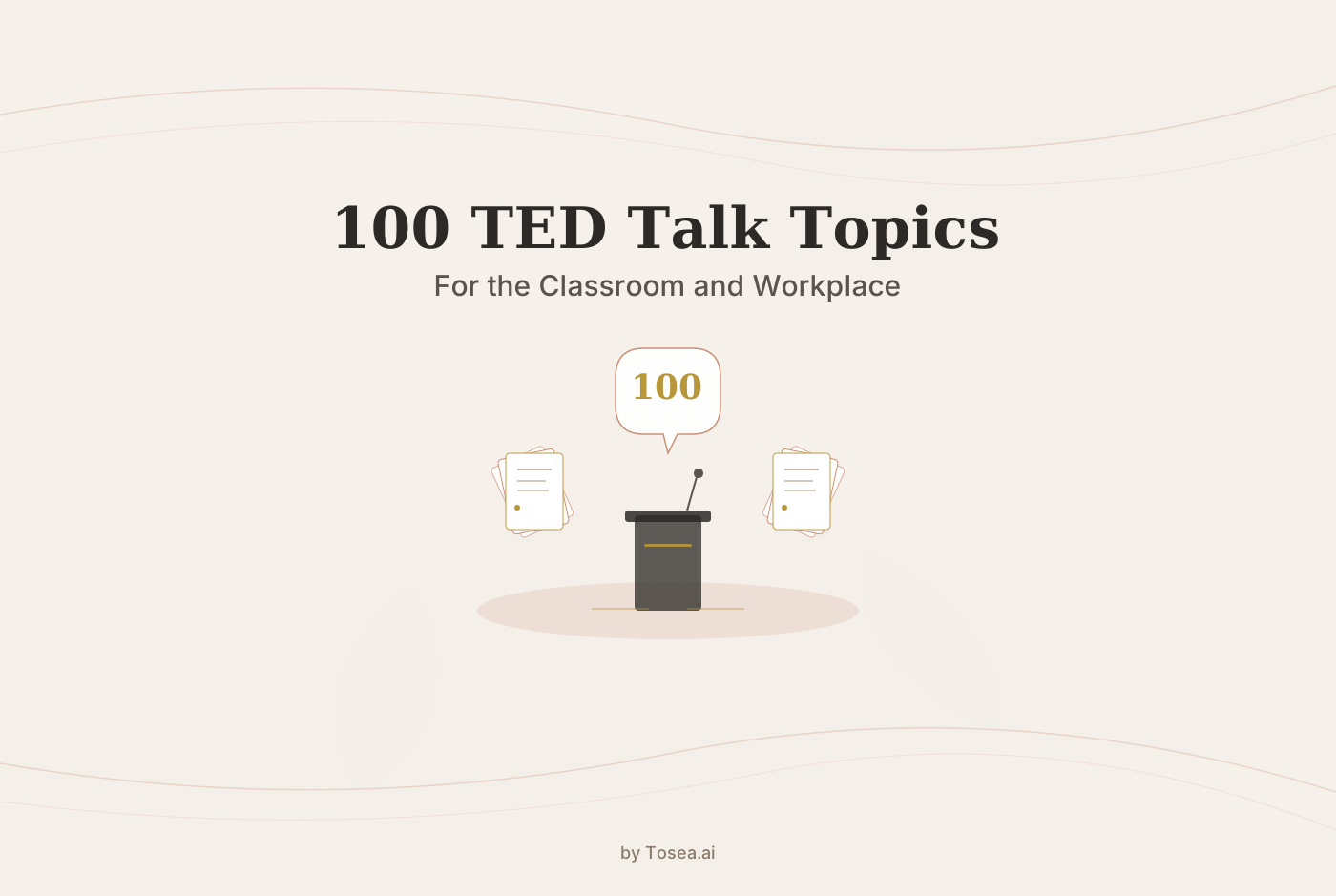
100 TED Talk Topics to Ignite Innovation in the Classroom and Workplace
100 practical TED talk topics for students, teachers, kids, and professionals, organized by audience with tips on topic selection.
Standing on a TED stage -- or even a local TEDx platform -- is less about the spotlight and more about the weight of the idea you carry. In the professional and academic worlds of 2026, synthesizing complex thoughts into a compelling narrative is a high-value skill. Yet most speakers don't stumble because of delivery. They stumble because of topic selection.
A strong TED talk needs more than surface-level interest in a subject. It needs a distinct vantage point. Whether you are a college student navigating a shifting economy, a teacher managing the emotional undercurrents of a classroom, or a professional adapting to an AI-integrated workforce, the right topic bridges your personal experience with something universally relevant.
A good presentation starts long before the first slide is designed. It starts with the clarity of the core premise. To help you find that starting point, here are 100 practical TED talk topics organized by audience.
How to Choose a Topic with Strategic Precision
Before browsing the lists below, filter your ideas through a simple framework. A topic worth speaking on should balance four factors:
Audience Resonance: Who is in the room? Your topic should address a problem or question they already care about.
The Purpose Test: Are you here to inform, to inspire, or to challenge? Clarity of intent keeps a talk from drifting into lecture territory.
Logical Scale: A five-minute briefing demands surgical focus, while an eighteen-minute keynote allows for a broader narrative arc.
The Credibility Factor: Why you? Choose a topic where your genuine experience provides a perspective that a search engine cannot replicate.
20 TED Talk Topics for College Students
For students in higher education, the strongest topics explore the transition from academic theory to real-world uncertainty.
- Degree Displacement: Why your major is only the starting line of your career.
- The Hidden Curriculum: Navigating the professional soft skills that universities rarely grade.
- Failure as Data: Moving beyond the binary of win or lose to a mindset of iteration.
- Digital Isolation: The paradox of being hyper-connected on social media while physically lonely.
- The Perfectionism Trap: How the pursuit of a 4.0 GPA can stifle actual innovation.
- Accidental Mentorship: Finding guidance in unconventional places outside of faculty offices.
- Financial Identity: Reclaiming self-worth from the weight of student debt.
- Constructive Dissent: How to disagree with peers in a polarized environment without losing respect.
- The Achievement Gap: Addressing the mental health epidemic among high-achieving students.
- The Internship Myth: Why professional experience is about more than a line on a resume.
- The Wisdom of Uncertainty: Why saying "I don't know yet" is a sign of intellectual maturity.
- Academic Recovery: The psychological journey of bouncing back from academic probation.
- Humble Confidence: Balancing personal authority with an openness to feedback.
- Community Drift: Managing the friendship recession that occurs after graduation.
- The Narrative Shift: Why your GPA is a metric, not your life story.
- Self-Advocacy: Practical communication skills for the modern professional world.
- Family Expectations: Navigating parental pressure while maintaining personal agency.
- Curiosity-Driven Careers: How to turn vague interests into a strategic professional path.
- The Self-Discovery Myth: Why "finding yourself" is a continuous process of creation, not a destination.
- Cognitive Resilience: Techniques to thrive under extreme exam and project pressure.
20 TED Speech Topics for High School Students
High school topics work well when they bridge social dynamics and the emerging awareness of adult responsibilities.
- The Kindness Barrier: Why empathy is harder in a high-pressure school environment.
- The 16-Year-Old Crisis: The absurdity of deciding your entire future before you can vote.
- Digital Norms: How social media has rewired the concept of a best friend.
- Belonging vs. Fitting In: The psychological cost of masking your true self for social acceptance.
- Strength in Vulnerability: Normalizing the act of asking for help from teachers and peers.
- Public Failure: Why sharing your mistakes openly is the fastest way to build resilience.
- Invisible Talents: Celebrating the high-value skills that standardized testing ignores.
- Digital Boundaries: The science of setting a screen time limit that actually works.
- Conflict Resolution: Practical strategies for handling drama within a friend group.
- The Application Mirage: Debunking the myth of the perfect college applicant.
- The Utility of Hobbies: Why pursuing something purely for joy is a productive act.
- Moral Courage: Speaking up when the consensus feels wrong.
- The Highlight Reel Gap: Navigating the space between digital presence and reality.
- Respectful Dissent: How to navigate disagreements with authority figures constructively.
- Individual Voice: Maintaining your personal opinion in the face of peer pressure.
- Comparison Culture: The mental health impact of constantly measuring yourself against a curated feed.
- The Sleep Deficit: The physiological necessity of rest for the teenage brain.
- The Art of Quitting: Having the courage to walk away from activities that no longer serve you.
- Supporting Peers: How to show up for friends experiencing a mental health crisis.
- Early Resilience: Building emotional strength before life gets truly complex.
20 TED Talk Ideas for Teachers
Educators bring a distinct authority to the stage, often highlighting the human elements that policy-makers overlook.
- The Asymmetrical Relationship: Reflecting on the students you remember versus those who remember you.
- The Invisible Curriculum: Teaching the emotional and social skills that aren't in the lesson plan.
- Compassion Fatigue: Addressing teacher burnout and the need for sustainable empathy.
- Trust-Based Discipline: Why classroom management is ultimately a form of relationship management.
- Reverse Mentorship: What students have taught me about the future.
- Selective Assessment: Moving toward grading what actually matters for long-term success.
- The Isolated Educator: Addressing the loneliness of standing in front of a crowd every day.
- Modeling Struggle: How to teach resilience by making your own visible.
- The Unspoken Questions: Identifying the concerns about belonging that students never ask aloud.
- The Limits of Differentiation: The reality of meeting diverse needs in a resource-strapped system.
- The Family Dynamic: How difficult parent-teacher interactions shape an educator's career.
- Stability in Crisis: Teaching and leading during times of social or local upheaval.
- Professional Humility: Moments when I was wrong about a student's potential.
- The Summer Myth: Debunking the idea that teaching is a part-time profession.
- The Abandoned Lesson: The courage to discard methods that are no longer effective.
- Intellectual Freshness: Staying curious after two decades in the same classroom.
- Career Doubt: Sharing the moments that made me question my path as an educator.
- Equity vs. Equality: Why treating everyone the same is often the least fair approach.
- Energy Preservation: How to protect your personal well-being while staying committed to your students.
- The Legacy of Mentorship: Redefining the teacher's role as a life-path guide.
20 TED Talk Topics for Kids
TED-style talks for younger children work best when they spark wonder and validate their observations of the world.
- Dream Logic: What happens in our brains while we sleep?
- Interspecies Talk: How animals communicate without words.
- Superpower Scenarios: The science of what would happen if humans could fly.
- Ocean Mysteries: Why is the seawater salty and what lives at the bottom?
- The Shyness Solution: Practical tips for making friends when you feel nervous.
- Community Pride: What is the coolest thing about where you live?
- Environmental Action: The real-world consequences of simple recycling.
- The Perfect Apology: How to say sorry and actually mean it.
- The Logic of Gaming: How video games teach us to solve complex problems.
- Mental Time Travel: Why reading books is the closest thing we have to a time machine.
- Animal Adaptation: The weirdest ways animals survive in the wild.
- Mood and Music: The science of how sound changes the way we feel.
- The Value of Questions: Why asking "why" is more important than knowing the answer.
- Invention Impact: How a single innovation changed everything for everyone.
- Kindness in Motion: Specific stories of how small acts change big lives.
- Fairness vs. Justice: How to handle situations that feel unfair.
- Life Skills: Why everyone -- regardless of age -- should learn to cook.
- The Kid Perspective: What adults often misunderstand about being young.
- Universal Rights: Understanding what everyone is free to do.
- The Solar Cycle: The basics of the sun, the stars, and our place in space.
20 TED Speech Topics for Work
Professional topics land well when they address the friction points of modern corporate life and the evolution of leadership.
- The Ambiguity Trap: Why clear expectations are the best tool for preventing workplace conflict.
- Performance vs. Presence: Challenging the metrics that equate being busy with being productive.
- The EQ Dividend: Using emotional intelligence to drive better data-driven decisions.
- Meeting Hygiene: Knowing when a gathering should have been a simple email.
- Psychological Safety: Why the freedom to fail is a prerequisite for genuine innovation.
- Upward Dissent: How to constructively disagree with leadership without risking your career.
- The Onboarding Gap: What new employees actually need to know but aren't told.
- Leadership Blindspots: Identifying what your team needs that you aren't providing.
- The Collaboration Tax: Challenging the assumptions that hold group work back.
- The Cost of Yes: How overcommitment destroys the quality of professional output.
- Integration vs. Balance: Why work-life balance is an outdated and unreachable goal.
- Unsolicited Feedback: Managing unwanted input as a professional growth opportunity.
- Hidden Burnout: Identifying the early warning signs before the crash occurs.
- Repetitive Meaning: Finding purpose in high-value tasks that never change.
- The Professional Apology: Staying accountable for mistakes without losing credibility.
- New Role Credibility: Establishing authority in unfamiliar territory during the first 90 days.
- Remote Leadership: Overcoming the isolation of managing digital-first teams.
- The Promotion Shift: How your relationship with peers changes when you become the boss.
- Accountable Diversity: Moving beyond performative training toward genuine organizational change.
- The AI Reshape: How to adapt your professional identity as AI takes over technical tasks.
From Topic to Talk: Building Your Presentation
A good TED talk lives or dies on delivery clarity. Once you have settled on a topic, the next challenge is turning that idea into a visual narrative that supports your speech rather than competing with it.
Think of your slides as scaffolding, not decoration. Each one should advance your argument by a single step -- a key statistic, a pivotal image, or a structural signpost that tells the audience where you are in the story. Avoid walls of text. The audience came to listen to you, not to read your screen.
Structure your talk in three phases: open with a specific story or question that earns attention, build your argument with two or three supporting points, and close with a single takeaway the audience can carry out the door. If your conclusion requires more than one sentence to summarize, your scope is probably too wide.
Rehearse with your slides, not separately from them. Timing transitions, knowing when to pause, and letting a visual breathe for a moment before speaking over it -- these details separate a polished talk from a rough one.
FAQ
Q: How do I know if my topic is too specific or too broad?
A good rule of thumb is the One-Insight Rule. If you can summarize your entire talk in a single sentence, your scale is likely correct. If you need a paragraph, narrow down. If your sentence feels generic, add specificity.
Q: Is the TED style appropriate for corporate boardrooms?
Yes. Corporate leaders increasingly prefer the narrative-driven, visually clean approach over dense, text-heavy slide decks. A TED-style talk prioritizes clarity and story, which translates well to executive audiences who are short on time and attention.
Q: What is the ideal length for a first-time TED or TEDx talk?
Most TEDx organizers assign slots between 5 and 12 minutes. For a first talk, aim for the shorter end. A tight 6-minute talk with a clear arc is far more effective than a rambling 15-minute one. Practice by timing yourself and cutting anything that doesn't directly support your core insight.
Q: Can I reuse a topic someone else has already covered at TED?
Overlap in subject matter is common and expected. What matters is your angle. Hundreds of speakers have talked about failure, but each one brings a different story and lens. The question isn't whether the topic is original -- it's whether your perspective on it is.
Q: How should I handle Q&A after a TED-style presentation?
Not all TED or TEDx events include Q&A, but if yours does, prepare for it the same way you prepare for the talk itself. Anticipate the three most likely questions and draft concise answers. If someone asks something you don't know, say so directly -- audiences respect honesty more than improvised guesswork.