100+ Best Economics Topics for Students, Research, and Classroom Presentations
100+ best economics topics for students, research, theses, and classroom presentations — organized by category, plus five methods working economists use to find original questions.
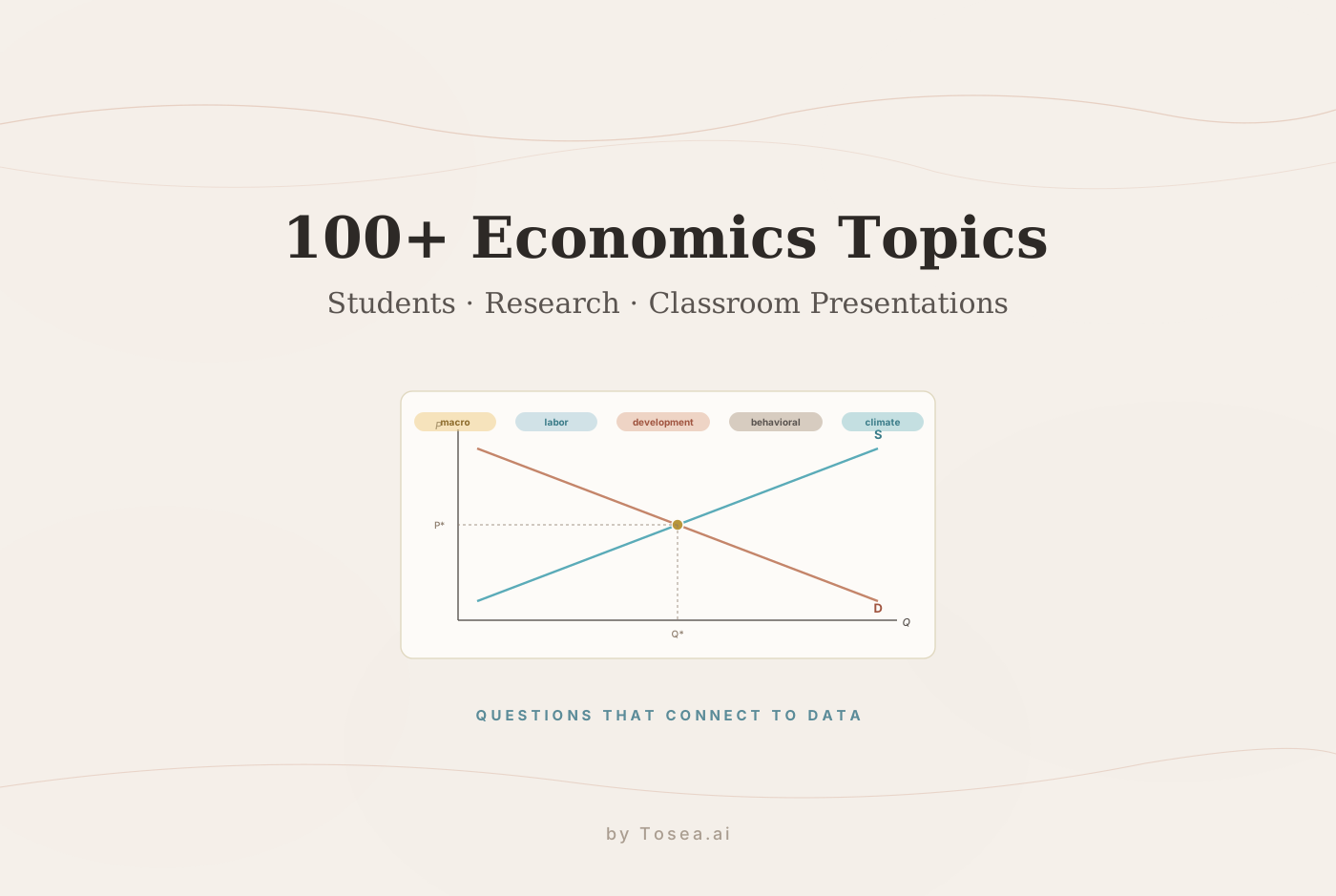
Economics is one of the most powerful lenses for understanding the world. It explains why wages rise and fall, why some countries develop faster than others, how policies shape behavior, and why markets sometimes fail. That scope makes economics fascinating — and it also makes choosing a focused topic surprisingly difficult.
Some economics topics are too abstract to present clearly. Some thesis topics sound original but lack the data to support an argument. Some essay topics have been so thoroughly covered that it is hard to find anything new to say.
This guide is built to solve that problem. Below you will find 100+ economics topics organized by category, alongside a methodology for finding strong research directions — drawn from how working economists at top institutions actually approach the problem of finding original ideas. If you are a graduate student preparing for a thesis defense or working from a research paper, our research-paper-to-slides workflow covers the downstream presentation step.
What Is Economics Research and Where Does Good Work Come From?
Economics research is the systematic study of how individuals, firms, and governments allocate scarce resources and make decisions under constraints. The field's top journals — the American Economic Review, Quarterly Journal of Economics, Journal of Political Economy, Review of Economic Studies, and Econometrica — set the standard for what counts as rigorous original work.
According to NBER's working paper database, the most active research areas in 2025 and 2026 include labor market disruption from automation, climate policy design, healthcare market inefficiencies, behavioral responses to taxation, development finance, and the macroeconomics of fiscal sustainability.

How to Find a Good Economics Topic: Five Methods Working Economists Actually Use
Before choosing from the list below, it is worth understanding how economists generate topic ideas. These five methods reflect how working researchers approach the problem.
Method 1: Find the gaps left by top journals. Every published top-journal paper leaves gaps. The authors covered the questions they could answer, but almost every paper opens new ones — about a different dataset, a different country, a different policy environment, or a different time period. Reading recent AER or QJE papers and asking what they could not do, or what would happen if you applied their framework to a different setting, is one of the most productive ways to find a strong thesis topic. This approach is especially useful for students: replicate a published study with a new dataset, then extend it.
Method 2: Follow the data. Data availability determines research quality. Rather than starting with a question and hoping data exists, scan data repositories — IPUMS, World Bank Open Data, FRED, administrative data from central banks or statistical agencies — for newly available datasets. Research questions tend to emerge naturally from rich, underexplored data.
Method 3: Bring in cross-disciplinary tools. Machine learning has unlocked entire categories of questions that were previously intractable. Text as data, causal inference at scale, high-dimensional prediction problems — these are now active frontiers precisely because new methodological tools make previously unanswerable questions answerable. If you have background in ML, computer science, or another quantitative field, applying those tools to economics problems often reveals genuine research gaps.
Method 4: Start from a real-world puzzle. Talk to practitioners — policymakers, business operators, healthcare administrators, financial regulators. The most interesting empirical questions often come from problems that people in specific industries actually face but that economists have not yet studied rigorously. The gap between what practitioners know from experience and what researchers can demonstrate with data is often where the most valuable research lives.
Method 5: Read policy documents and invert them. Government policy documents, central bank reports, and multilateral agency publications contain implicit hypotheses about how economies work. When a policy document asserts that a particular intervention will produce a particular effect, that is a testable claim. Taking the claim seriously and building the empirical or theoretical machinery to evaluate it properly is a legitimate and often highly productive research strategy.
What Makes a Good Economics Topic?
A good economics topic for a presentation, essay, or thesis should be:
- Specific enough that a clear research question is visible
- Connected to real data that could support or challenge an argument
- Relevant to decisions that governments, firms, or individuals actually face
- Narrow enough to argue convincingly within the scope of the paper or presentation
- Informed by existing literature without being entirely determined by it
The best economics topics connect abstract mechanisms to concrete real-world phenomena that your audience already cares about.
Best Economics Topics on Macroeconomics
Macroeconomics studies economy-wide phenomena — growth, inflation, unemployment, fiscal and monetary policy, and business cycles. These topics appear frequently in top journals and are strong choices for thesis work and classroom presentations.
- How central bank independence affects inflation outcomes
- The macroeconomic effects of fiscal stimulus during recessions
- Government debt and fiscal sustainability across different interest rate environments
- Monetary policy transmission in low-interest-rate environments
- Supply chain disruptions and inflation dynamics
- The role of productivity growth in long-run economic development
- Public investment mechanisms and endogenous growth — how government-led investment in frontier industries affects macroeconomic stability and fiscal sustainability
- Business cycle synchronization across countries
- The macroeconomics of climate transition — costs and growth effects of decarbonization
- Inequality and macroeconomic growth — does higher inequality slow the economy?
- Exchange rate regimes and economic stability in emerging markets
- The effects of demographic aging on savings, investment, and growth
Best Economics Topics on Labor Economics
Labor economics studies wages, employment, working conditions, and how people respond to labor market incentives. It is one of the most active areas in recent top-journal publications, particularly because automation and platform work have created new questions about labor market structure.
- Wage effects of minimum wage increases — evidence from recent policy experiments
- How automation affects employment and wages in routine-task occupations
- The gender wage gap — decomposition by industry, occupation, and firm
- Remote work and labor market geography — did the pandemic permanently change where workers live?
- Gig economy platforms and worker classification — labor market implications
- The labor market effects of immigration on native workers
- Returns to education in an era of credential inflation
- Monopsony power in local labor markets
- Parental leave policies and female labor force participation
- Racial wage gaps and the role of discrimination versus skill differences
- Trade exposure and regional labor market adjustment
- The effects of unionization on wages and firm productivity
Best Economics Topics on Development Economics
Development economics studies economic growth, poverty, inequality, and institutional change in lower-income countries. It draws on both theory and field experiments.
- Cash transfer programs and long-run human capital outcomes
- Microfinance and small business development — does credit access drive growth?
- The role of institutions in economic development — property rights, contract enforcement, corruption
- Agricultural productivity and rural poverty traps
- Urbanization and structural transformation in developing economies
- Foreign direct investment and technology transfer
- Mobile money and financial inclusion in Sub-Saharan Africa
- The development effects of infrastructure investment — roads, electrification, broadband
- Child health and human capital formation
- Education quality versus enrollment — what drives skill development?
- Climate vulnerability and economic development in tropical regions
- Trade policy and industrial development — lessons from East Asian success stories
Best Economics Topics on Behavioral Economics
Behavioral economics integrates psychological insights into economic models, studying how people actually make decisions rather than how idealized rational agents would.
- Present bias and retirement savings behavior
- Nudges and organ donation registration — the economics of default options
- How loss aversion affects investment decisions
- The psychology of pricing — how framing affects consumer choices
- Behavioral responses to health insurance design
- Status quo bias in energy consumption decisions
- Social comparisons and charitable giving
- Overconfidence and entrepreneurial failure rates
- How cognitive load affects financial decision-making
- Behavioral approaches to tax compliance
- The economics of misinformation — why people persist in false beliefs
- Time preferences across cultures and income levels
Best Economics Topics on Environmental and Climate Economics
Environmental economics analyzes how markets handle externalities, public goods, and long-run sustainability challenges. It is one of the fastest-growing fields in economics research.
- Carbon pricing mechanisms — cap-and-trade versus carbon taxes
- The economic costs and benefits of ambitious climate targets
- Stranded assets and the transition risk for fossil fuel industries
- Green industrial policy and comparative advantage
- The economics of biodiversity loss
- Energy transition financing in developing economies
- Local air pollution and its economic costs — labor productivity, health, and housing
- Climate migration and its economic effects on receiving regions
- The political economy of environmental regulation
- Insurance markets and climate risk pricing
- Ecosystem services and their valuation in economic models
- The economics of nuclear power in decarbonization scenarios
Best Economics Topics on Health Economics
Health economics examines healthcare markets, insurance, medical innovation, and the economics of health behaviors. For students moving from health economics into biology coverage, our companion list of biology and medical topics covers the upstream clinical side.
- Health insurance design and moral hazard — how coverage affects utilization
- Hospital market concentration and healthcare prices
- Drug pricing and pharmaceutical innovation incentives
- The economics of preventive care — why markets underprovide it
- Opioid epidemic economics — supply-side versus demand-side drivers
- Mental health and labor market outcomes
- Vaccination economics — externalities, public provision, and hesitancy
- How healthcare spending relates to health outcomes across countries
- The economics of aging populations and long-term care systems
- Health technology assessment and coverage decisions
- Medical debt and household financial fragility
- The labor market for physicians — supply constraints and wage effects
Best Economics Topics on Finance and Political Economy
These topics sit at the intersection of economics, finance, and political science — rich territory for thesis and research work.
- Bank regulation and systemic risk — lessons from recent banking stress
- The economics of central bank digital currencies
- Financial inclusion and the unbanked population
- Corporate governance and firm performance
- Sovereign debt restructuring and creditor coordination
- The political economy of redistribution — why some countries tax more than others
- Electoral cycles and economic policy — how elections affect fiscal decisions
- Media ownership and political economy
- Corruption and economic growth — causal mechanisms and policy responses
- The economics of populism — structural economic conditions and political backlash
- Trade policy as industrial policy — strategic motivations behind tariffs
- Financial sanctions as economic policy tools
Easy Economics Topics for Students
If you are looking for something accessible and clear, these topics are well-suited for introductory presentations.
- What causes inflation and how it is measured
- Supply and demand — why prices change
- What GDP measures and what it misses
- How interest rates affect the economy
- What causes unemployment
- The economics of minimum wage
- Why free trade is controversial
- What a recession is and how it happens
- How taxes affect behavior
- The basics of economic inequality
Best Economics Topics for Presentations and Debates
These work well for classroom presentations and structured debates because they have clear positions on both sides.
- Should governments implement a universal basic income?
- Is free trade good for workers in developed economies?
- Should central banks target employment alongside inflation?
- Does foreign aid help or hinder economic development?
- Should tech monopolies be broken up on economic grounds?
- Is economic growth compatible with climate sustainability?
- Should college tuition be free?
- Does immigration harm native workers?
- Are carbon taxes politically viable economic policy?
- Should governments forgive student debt?
Best Thesis Topics for Economics Students
These are strong thesis topics because they are specific, connected to live debates in the literature, and supported by available data.
- The effect of remote work adoption on urban-rural wage convergence
- How changes in union density affect wage inequality over the past four decades
- The impact of climate risk disclosure requirements on corporate investment
- Political polarization and fiscal policy outcomes across democracies
- Fertility responses to childcare subsidy design
- The long-run labor market effects of trade liberalization on displaced workers
- Financial literacy and retirement savings adequacy
- How housing supply constraints affect local labor market outcomes
- The economic effects of public investment in early childhood education
- Machine learning predictions of firm bankruptcy and their policy implications
How to Make Your Economics Presentation Better
A strong economics presentation should be clear, evidence-based, and connected to questions your audience already cares about. According to the American Economic Association's guidelines for communicating economic research, effective economic communication requires translating technical findings into language that non-specialists can evaluate — without losing the precision that makes the analysis credible. Our McKinsey way to present research findings covers the title-as-claim convention that translates particularly well to empirical economics.
Practical tips:
- Start with a question your audience finds genuinely puzzling
- State your argument early — do not build suspense
- Use one or two data visualizations rather than complex tables
- Define technical terms immediately when you use them
- Connect your findings to a policy decision or real-world implication
- End with a clear, memorable takeaway
If you are using an AI ppt maker or presentation generator to build your slides, the quality of your source material determines the quality of the output. A well-structured research outline converts into a well-structured presentation. A vague prompt produces generic slides. We unpack the underlying choice — code-driven HTML slides vs image-rendered slides — in our HTML vs image AI slide generation guide; for economics presentations, HTML mode is almost always the right call because of the citation discipline.
Simple Structure for an Economics Presentation
Most economics topics work well with this format:
- Title and research question
- Why this question matters
- What we already know from existing research
- Your data and methodology
- Key findings
- Policy implications or practical takeaways
- Open questions and next steps
- Questions and discussion
This structure works equally well for an informative essay, a thesis chapter, and a conference presentation.
Turn Your Economics Research Into a Professional Presentation
Once you have your topic and your research complete, the next challenge is presenting it clearly — whether for a thesis defense, a class presentation, or a policy briefing. Tosea.ai converts research papers, policy analyses, and structured notes directly into professional presentation decks. Drop your document in and the engine reads its logical structure — sections, claims, data tables, citations — and renders a slide deck with consistent design and content drawn directly from your source material, with every claim traceable back to its origin. We cover the underlying source-first architecture in our zero-hallucination AI slides guide, and for graduate-student-specific workflows, our academic researchers cutting presentation time with AI piece walks through the day-to-day pattern.
The output is a native .pptx file, fully editable in PowerPoint or Google Slides, with consistent design across all slides.
Final Thoughts
Economics offers some of the richest and most policy-relevant research topics available because it connects rigorous analysis to decisions that affect real people. The best thesis topics and presentation topics are not necessarily the most fashionable — they are the ones where you can find a clear question, credible data, and something genuinely new to say.
Use the topic list above as a starting point. Then use the five research methods at the top of this guide to develop your angle: find the gap left by existing work, follow the data, bring in a new methodological tool, start from a real-world puzzle, or invert a policy claim. That sequence is how most papers worth defending actually get written.