150 Best Machine Learning Topics for Students, Research, and Classroom Presentations
150 best machine learning topics for students, research, theses, and classroom presentations — from LLM reasoning and diffusion models to AI safety, causal ML, and ML systems.
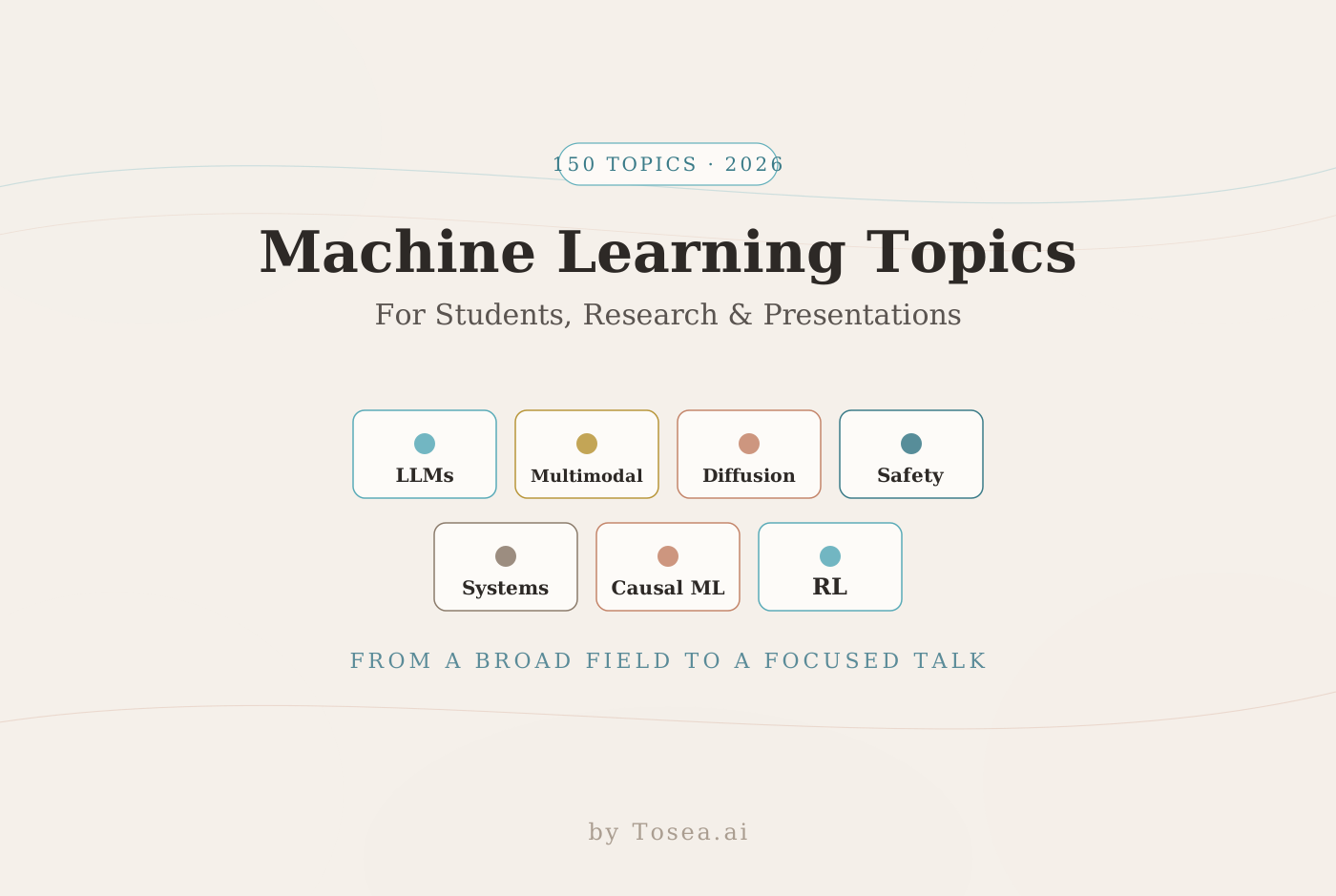
Preparing a machine learning presentation becomes much easier when you start with a topic that is specific, evidence-based, and connected to current research. This guide lists 150 machine learning topics for students, research, and classroom presentations, organized by difficulty and research area. The topics are informed by recent directions in top ML venues such as ICML, NeurIPS, ICLR, JMLR, MLSys, and open research platforms such as arXiv and Papers with Code. If your end goal is a talk rather than a paper, our research paper to slides workflow covers how to move from a chosen topic to a finished deck.
Quick Answer
The best machine learning topics for students and presentations in 2026 include large language model reasoning, multimodal AI, diffusion models, AI safety, model evaluation, efficient inference, graph neural networks, reinforcement learning, AI for healthcare, privacy, machine unlearning, causal machine learning, and ML systems. For a strong research paper presentation, choose a topic with a clear research question, recent papers, measurable evidence, and an open research gap.
What Makes a Good Machine Learning Topic?
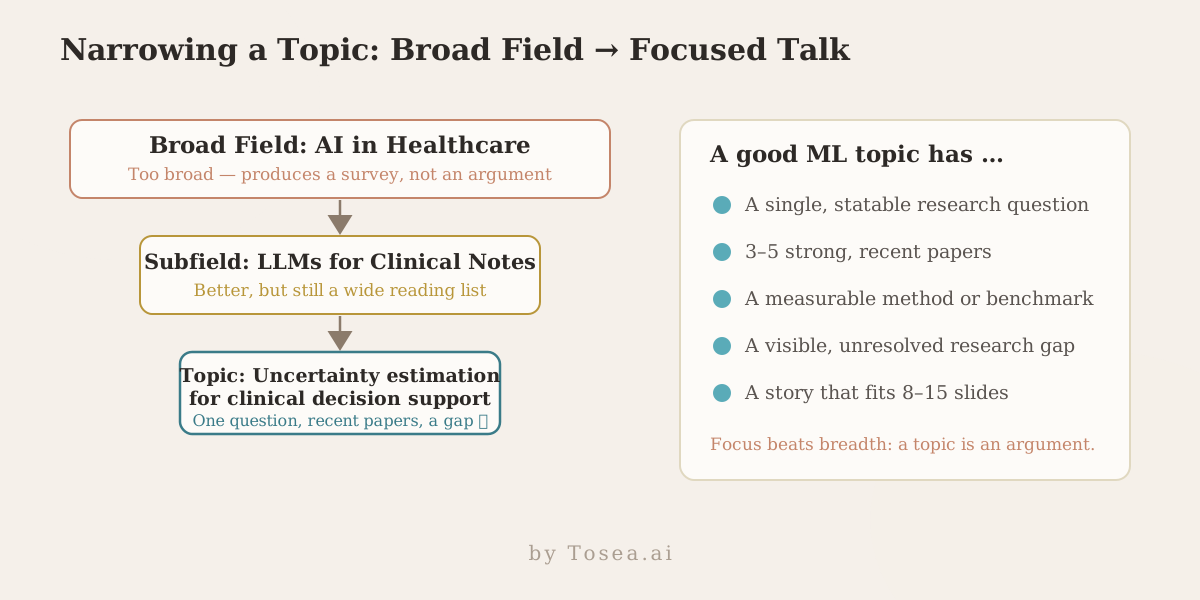
A good machine learning topic is not just trendy. It should be researchable, explainable, and presentable.
For student work, the best topic should have:
- A clear question
- A small enough scope for one paper or talk
- At least 3 to 5 strong sources
- A measurable method or benchmark
- A visible research gap
- A practical application or real-world implication
- A presentation structure that can be explained in 8 to 15 slides
Machine learning has become too broad for vague topics like "deep learning" or "AI in healthcare." A better topic is narrower, such as uncertainty estimation for large language models in clinical decision support.
The difference is focus. A broad topic creates a survey. A focused topic creates an argument.
How Current ML Research Hotspots Were Chosen
This list reflects patterns visible in current machine learning research.
ICLR 2026 lists subject areas including representation learning, reinforcement learning, generative models, causal reasoning, optimization, graph learning, fairness, safety, privacy, infrastructure, robotics, science applications, and neurosymbolic systems. The ICLR 2026 review retrospective also reported 19,525 valid submissions and 5,355 accepted papers, an acceptance rate of 27.4 percent, which shows how competitive and broad the field has become.
ICML 2025 and NeurIPS 2025 paper programs include many papers on diffusion models, multimodal models, LLM reasoning, reinforcement learning, quantization, machine unlearning, privacy, graph learning, AI safety, biological sequence design, and ML systems. JMLR's 2026 papers include work on transformers, causal models, uncertainty quantification in LLMs, attention optimization, Bayesian methods, and reinforcement learning.
In other words, the strongest student topics are not random. They come from the intersection of active research, available papers, and questions that still have unresolved gaps. If you are also weighing adjacent fields, our companion lists of best computer science topics and best economics topics use the same selection method.
Best Machine Learning Topics on Large Language Models
- How large language models reason under uncertainty
- Why reasoning models hallucinate and how to reduce factual errors
- Retrieval augmented generation for domain-specific question answering
- Long-context LLMs and the limits of attention
- LLM evaluation beyond benchmark scores
- Chain-of-thought prompting and its reliability problems
- Tool-using agents for scientific research workflows
- Multi-agent LLM systems for planning and collaboration
- Fine-tuning versus retrieval for enterprise AI systems
- Prompt injection attacks and defenses in LLM applications
- Model editing and lifelong knowledge updates
- Open-source LLMs versus closed-source LLMs for education
- LLMs for code generation and repository-level debugging
- LLM uncertainty quantification for high-stakes tasks
- Data contamination in LLM benchmarks
Research gap to explore: Many LLM papers show benchmark gains, but fewer explain when systems fail under real user workflows, noisy context, or domain-specific constraints.
Best Machine Learning Topics on Multimodal AI
- Vision-language models for chart and infographic understanding
- Multimodal reasoning in medical images and clinical notes
- Audio-language models for speech understanding
- Video-language models for safety-critical monitoring
- Multimodal hallucination detection
- Image-text retrieval for education and research
- Multimodal agents for robotics
- Cross-modal alignment in foundation models
- Chart question answering and visual data literacy
- Evaluating multimodal models on spatial reasoning
- Vision-language models for document understanding
- Multimodal AI for accessibility tools
- Multimodal misinformation detection
- Dataset bias in multimodal AI
- The role of synthetic data in multimodal training
Research gap to explore: Multimodal models can look impressive in demos, but evaluation remains weak when charts, diagrams, tables, and spatial layouts require precise interpretation.
Best Machine Learning Topics on Diffusion and Generative Models
- Diffusion models for image generation
- Flow matching versus diffusion models
- Few-step diffusion sampling for faster generation
- Diffusion models for robotics policies
- Diffusion models for molecule and peptide generation
- Text-to-image model safety and watermarking
- Creative generation versus memorization in diffusion models
- Diffusion models for tabular data synthesis
- Video diffusion and temporal consistency
- Generative models for 3D scene synthesis
- Generative models for music and audio
- Synthetic data generation for privacy-preserving ML
- Diffusion distillation for real-time applications
- Evaluation metrics for generative fidelity
- Copyright and memorization risks in generative AI
Research gap to explore: Generation quality has improved quickly, but evaluation, safety, memorization, and controllability remain open problems.
Best Machine Learning Topics on AI Safety, Fairness, and Privacy
- Machine unlearning and the right to be forgotten
- Membership inference attacks on generative models
- Privacy risks in large vision-language models
- Fairness in automated hiring systems
- Bias mitigation in healthcare ML
- Backdoor attacks in multimodal models
- AI safety policies for autonomous agents
- Red teaming LLM agents
- Data poisoning in foundation model training
- Differential privacy for deep learning
- Privacy-preserving synthetic text generation
- Explainability in high-stakes ML decisions
- Fairness metrics and their tradeoffs
- Model auditing for regulated industries
- Safety evaluation for open-weight AI models
Research gap to explore: Many safety papers identify failure modes, but practical deployment frameworks for monitoring, rollback, and governance are still underdeveloped.
Best Machine Learning Topics on ML Systems and Efficient AI
- Quantization for large language model inference
- Speculative decoding and faster LLM response time
- Mixture-of-experts model serving
- GPU-aware quantization methods
- Efficient attention mechanisms
- Model pruning for deployment
- Edge AI for mobile devices
- Federated learning under heterogeneous data
- Streaming machine learning systems
- AI accelerator kernel optimization
- Benchmarking LLM serving latency
- Cost-aware AI model deployment
- Energy-efficient machine learning
- Distributed training bottlenecks
- Monitoring production ML under data drift
Research gap to explore: Most students study model accuracy, but real AI systems are constrained by latency, memory, cost, throughput, energy, and reliability.
Best Machine Learning Topics on Causal ML and Uncertainty
- Causal inference with machine learning
- Hierarchical causal models
- Treatment effect estimation with neural networks
- Causal discovery from mixed data
- Uncertainty quantification in LLMs
- Conformal prediction for deep classifiers
- Bayesian deep learning in safety-critical systems
- Calibration errors in neural networks
- Distribution shift and model uncertainty
- Counterfactual explanations for dynamic graphs
- Causal representation learning
- Uncertainty-aware medical prediction
- Robust ML under missing data
- Explainable causal models for policy decisions
- Simulation-based calibration for approximate Bayesian inference
Research gap to explore: Many ML systems produce predictions, but fewer provide calibrated uncertainty or causal explanations that users can trust.
Best Machine Learning Topics on Reinforcement Learning and Agents
- Reinforcement learning from human feedback
- Reinforcement learning for LLM alignment
- Multi-agent reinforcement learning
- Offline reinforcement learning for robotics
- Diffusion-guided reinforcement learning
- World models for autonomous agents
- Hierarchical reinforcement learning
- Safe reinforcement learning
- RL for combinatorial optimization
- RL in multi-phase auction design
- Reinforcement learning for noisy label correction
- Agentic AI for scientific discovery
- Evaluation of autonomous AI agents
- Reward hacking and specification gaming
- Human-in-the-loop reinforcement learning
Research gap to explore: Agent benchmarks often reward task completion, but real-world agents also need reliability, safety, explainability, and recoverability.
Best Machine Learning Topics on AI for Science and Healthcare
- Foundation models for biology
- Protein and peptide generation with ML
- Single-cell representation learning
- AI for clinical risk prediction
- Medical image segmentation with vision transformers
- AI for drug discovery pipelines
- Graph neural networks for molecular property prediction
- AI for climate modeling
- Earth observation foundation models
- ML for gene regulatory network inference
- AI-assisted materials discovery
- ML for wearable health prediction
- Clinical benchmark design for AI models
- Bias in medical AI datasets
- Human-AI collaboration in scientific research
Research gap to explore: AI for science needs more than predictive accuracy. Strong projects should evaluate data quality, domain validity, reproducibility, and whether the model produces useful scientific insight.
Easy Machine Learning Topics for Students
- Supervised versus unsupervised learning
- Decision trees versus neural networks
- Why overfitting happens
- How gradient descent works
- What makes a dataset biased
- How recommendation systems work
- Why model evaluation matters
- What is a transformer model
- How image classifiers learn features
- What is reinforcement learning
- Why AI models hallucinate
- How spam filters use machine learning
- What is clustering
- How facial recognition works
- Why AI privacy matters
These are good for introductory classroom presentations because they can be explained without advanced mathematics.
Strong Thesis Topics for Machine Learning Students
- Evaluating hallucination in retrieval augmented generation systems
- Comparing quantization methods for small LLM deployment
- Measuring bias in multimodal datasets
- Machine unlearning for image classification models
- Uncertainty-aware LLM outputs for educational tutoring
- Data drift monitoring for production ML systems
- Benchmarking chart understanding in vision-language models
- Causal inference for personalized recommendation systems
- Privacy-preserving synthetic data generation
- Efficient transformer architectures for long documents
- Robustness of medical image classifiers under domain shift
- Human evaluation methods for AI-generated explanations
- Energy cost comparison of model compression techniques
- Graph neural networks for fraud detection
- Safe agent design for enterprise workflow automation
These topics are stronger than broad surveys because each can become a research question, experiment, or structured presentation.
How to Choose the Right Topic
Use this 5-part test.
-
Can you state the topic as a question? Good: How does quantization affect LLM latency and answer quality? Weak: Quantization in AI
-
Can you find recent papers? Use Papers with Code, arXiv, ICML, NeurIPS, ICLR, and JMLR.
-
Can you explain the topic in 10 minutes? If not, narrow it.
-
Can you show evidence? Use benchmarks, datasets, diagrams, experiments, or case studies.
-
Can you identify a gap? A good presentation does not only explain what exists. It explains what remains unresolved.
Simple Structure for a Machine Learning Presentation
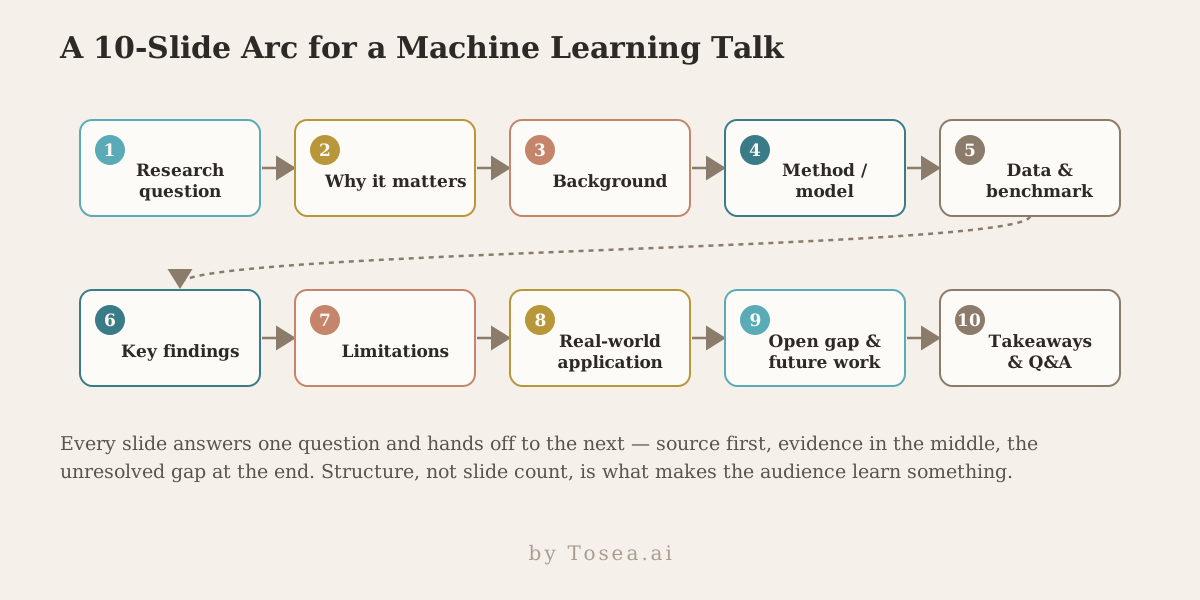
Most ML classroom presentations work well with this format:
- Title and research question
- Why the topic matters
- Background concept
- Recent research trend
- Main method or model
- Dataset or benchmark
- Key findings
- Limitations and open problems
- Real-world application
- Q&A
This is also a strong structure for research paper presentation projects because it forces you to connect source papers to a clear audience-facing narrative. For a discipline-tested way to sequence technical findings, see our breakdown of the McKinsey way to present research findings.
Turn Machine Learning Research Into Slides With Tosea AI
Once you choose a topic, the next challenge is turning papers, notes, and research findings into a deck. Machine learning papers are dense by nature — full of architectures, results tables, benchmark charts, and equations — and manually copying those sections into slides can take hours while the logical thread of the source quietly gets lost.
Tosea.ai is a source-grounded AI presentation tool that turns PDFs, research papers, financial reports, annual reports, 10-K filings, and complex documents into editable PowerPoint slides. For machine learning topics, it can convert papers, benchmarks, diagrams, results tables, and technical notes into a structured slide outline. Instead of starting from a blank deck, you upload a document and generate a first draft that preserves the key ideas, evidence, and flow of the source — then you verify the claims and refine the deck. For the mechanics of that pipeline, see our convert PDF to PowerPoint guide.
This document-to-PPT workflow is especially useful for research seminars, thesis defenses, journal clubs, reading groups, and classroom talks. Because every ML claim should be traceable to a source, a source-grounded generator matters more than a generic one — our zero-hallucination AI slides guide explains why, and students can start with the free trial guide for academics.
Q&A
What are the best machine learning topics for students?
The best machine learning topics for students include LLM hallucination, multimodal AI, diffusion models, AI safety, model evaluation, efficient inference, graph neural networks, causal ML, reinforcement learning, and AI for healthcare. Beginners should choose a narrow question rather than a broad field.
What is a good machine learning topic for a classroom presentation?
A good classroom topic is specific, visual, and explainable in 10 minutes. Examples include how transformers work, why AI models hallucinate, how recommendation systems learn, how diffusion models generate images, or how quantization makes LLMs cheaper to run.
How do I find a machine learning research gap?
Read recent papers from ICML, NeurIPS, ICLR, JMLR, arXiv, and Papers with Code. Look for limitations sections, weak benchmarks, missing datasets, unexplored domains, deployment constraints, safety concerns, or methods that work in labs but not real systems.
Which ML topics are trending in 2026?
Trending ML topics include LLM reasoning, multimodal models, diffusion and flow models, AI agents, efficient inference, quantization, machine unlearning, privacy, AI safety, causal ML, AI for science, and ML systems.
How do I turn a machine learning topic into a presentation?
Use a simple structure: research question, why it matters, background, recent papers, method, dataset, results, limitations, and discussion. For a credible research paper presentation, verify every claim against the original sources.
Can Tosea AI help make machine learning presentations?
Yes. Tosea AI can turn research papers, PDFs, notes, diagrams, tables, and technical reports into editable PowerPoint slides. It is useful for student presentations, research talks, thesis defenses, reading groups, and classroom presentations.
Final Thoughts
Machine learning is moving fast, but the best student topics are not always the flashiest. A strong topic is specific, researchable, evidence-based, and connected to an open problem.
Use the 150 ideas above as starting points. Then narrow your topic into a question, find recent papers, identify a gap, and build a presentation that explains both what the field knows and what remains uncertain. When you are ready to turn that research into slides, Tosea.ai can convert research papers, technical PDFs, notes, tables, and figures into editable decks — helping students, researchers, and classroom presenters move from topic selection to a clear, source-grounded presentation.
Sources
- ICML 2025 Papers — International Conference on Machine Learning
- NeurIPS 2025 Papers — Conference on Neural Information Processing Systems
- ICLR 2026 Call for Papers — International Conference on Learning Representations
- A Retrospective on the ICLR 2026 Review Process — ICLR Blog
- Journal of Machine Learning Research — JMLR
- Papers with Code
- arXiv — Cornell University