How to Generate Zero-Hallucination AI Slides: A Complete Guide (2026)
A complete guide to eliminating AI hallucinations in presentations: how source-first generation, citation traceability, and Tosea.ai cite every claim.
Five minutes before a major presentation, you spot something wrong. A market figure that does not match your source document. A statistic attributed to a study you cannot locate. A trend described as well-established that your data never actually showed. The AI tool that built your deck looked confident. The output looked polished. The data was fabricated.
This is a documented, repeatable failure mode of most AI presentation generators shipped today. In this guide, we walk through how hallucinations happen inside AI slide generators, how to evaluate a tool before trusting it with high-stakes decks, and how a source-first architecture — the approach Tosea.ai is built around — closes the gap between "looks credible" and "is verifiable."
The Hallucination Problem Is Worse in Presentations Than Anywhere Else
AI hallucinations — cases where a model generates information that is incorrect, fabricated, or unverifiable but presented with full confidence — are a known problem across AI applications. In presentations, the problem is qualitatively worse for one specific reason: design adds credibility that the underlying data does not deserve.
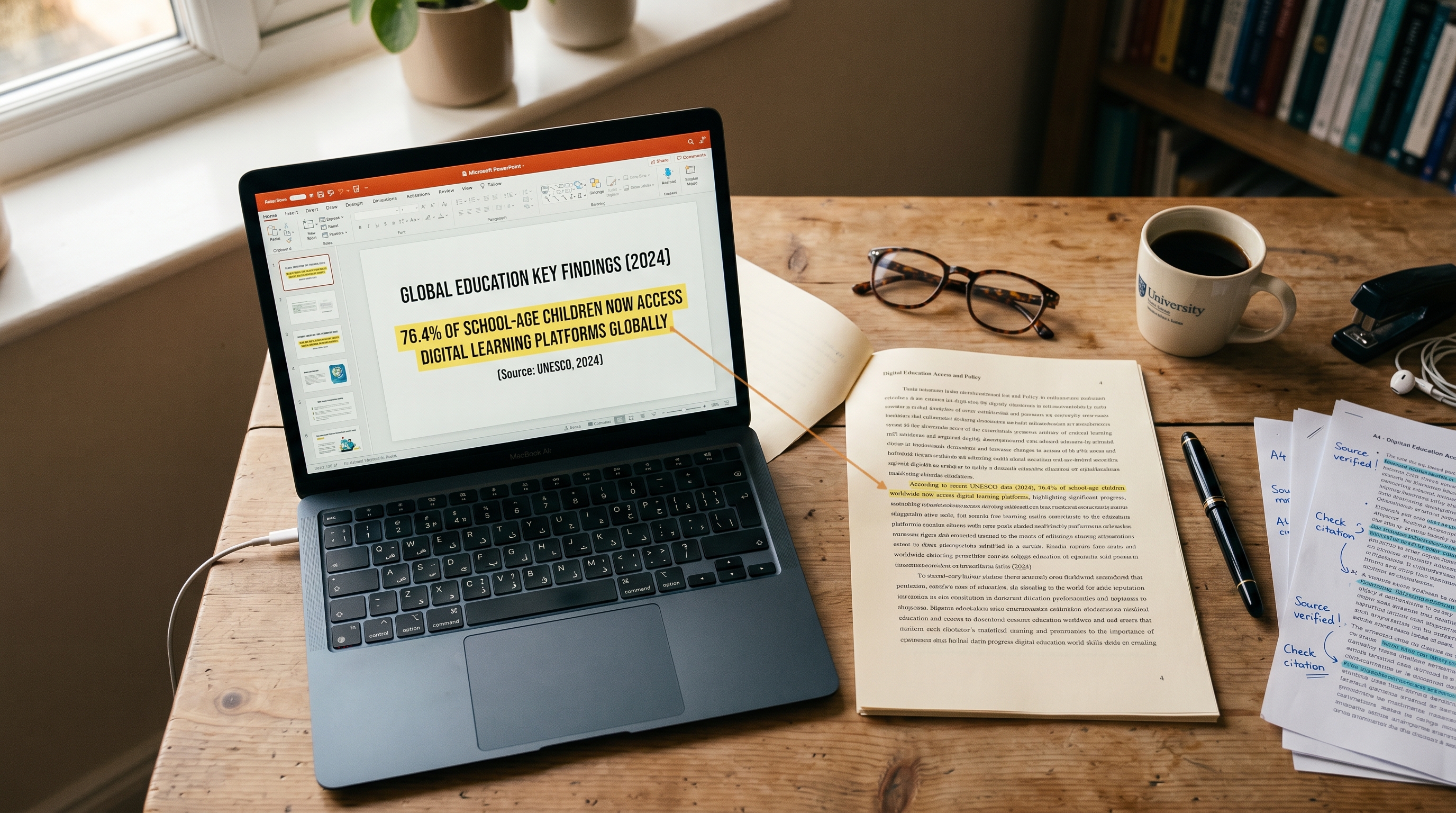
A fabricated statistic in a chatbot reply is easy to question. The same statistic placed in a professionally formatted slide, with a clean chart, a consistent color scheme, and a confident action title, looks like verified research. The presentation layer launders the error. This is a pattern we also unpacked in our earlier piece on hallucination-free document-to-PPT conversion.
A 2026 independent test of six AI presentation tools — including Gamma, Beautiful.ai, Canva, Tome, Kimi, and LayerProof — found that the best-performing tool had a claim accuracy rate of just 44%. Every factual assertion in a ten-slide deck on a well-documented topic was verified against primary sources. Most tools fabricated statistics, invented citations, and presented speculative figures as established facts. Every tool except one presented its claims as bare assertions with no source attribution whatsoever.
The researchers identified a phenomenon they called zombie statistics: fabricated numbers that look credible because they circulate widely. AI tools trained on web data reproduce these figures because they appear frequently, not because they are accurate. The presentation format then adds further credibility to numbers that were never grounded in real research.
Why AI Models Cannot Stop Hallucinating — And Why Confident Design Makes It Worse
Understanding why hallucinations are structurally difficult to eliminate helps explain why the problem persists even in the most capable models.
Large language models generate text by predicting the most statistically probable next token based on patterns in training data. They are not databases. They do not retrieve facts. They predict what a plausible answer looks like based on the corpus they were trained on — which includes a significant volume of incorrect, outdated, and fabricated information from the open web.
MIT research published in 2025 identified a particularly troubling characteristic: models are 34% more likely to use confident language — phrases like definitely, certainly, and without doubt — when generating incorrect information than when generating correct information. The more wrong the AI is, the more certain it sounds. This is a systematic feature of how language models produce text, not a quirk of specific models.
According to Forrester Research, each enterprise employee costs companies approximately $14,200 per year in hallucination-related verification and mitigation efforts. A 2025 study from Stanford found that when LLMs were asked about legal precedents, they collectively invented over 120 non-existent court cases, complete with convincingly realistic names, detailed but entirely fabricated legal reasoning, and false outcomes.
A 2025 mathematical proof confirmed that hallucinations cannot be fully eliminated under current LLM architectures. They are not bugs. They are an inherent characteristic of how these systems generate language.
Across all models, the average hallucination rate for general-knowledge questions remains approximately 9.2%. For scientific research, rates reach up to 16.9%. For legal information, up to 18.7%. For financial data, up to 13.8%. Even the best-performing models show dramatically different hallucination rates depending on subject matter and task type.
How We Evaluated Hallucination Risk Across Tools
When comparing AI presentation tools, we apply a four-part framework that you can reuse in your own evaluation:
- Source grounding. Does the tool start from a prompt, a URL, or a user-supplied document? Prompt-only tools have no ground truth and must generate content from scratch — the highest hallucination risk category.
- Claim-level attribution. For every bullet, chart, and quoted statistic in the output, can you trace the claim to a specific passage, table, or figure? If the tool surfaces citations at the deck level but not the claim level, it cannot distinguish a faithful sentence from a fabricated one.
- Handling of quantitative content. Charts and tables are the fastest vector for hallucination because small numerical errors are easy to miss. Does the tool extract numbers from the source document verbatim, or does it regenerate them through the language model?
- Editability of the trace. A good system lets you click a claim on the slide and jump to the passage it came from. If you cannot inspect the trace, you cannot defend the deck under scrutiny.
This framework is the basis for the comparison below, and it's also how we approach broader tool reviews like our Best AI Presentation Makers 2026 roundup.
Source-First vs. Prompt-First: A Side-by-Side Comparison
| Dimension | Prompt-First Tools | RAG / URL-Grounded Tools | Source-First with Claim Traceability |
|---|---|---|---|
| Input | Topic prompt only | Prompt + retrieved web snippets | User's full source document |
| Content origin | Generated from training data | Synthesized from retrieved chunks | Extracted and structured from source |
| Citations | Usually none | Deck-level, often approximate | Per-claim, linked to passage / figure / table |
| Hallucination risk | High | Reduced but not eliminated | Architecturally minimized |
| Defensibility | Weak | Partial | Strong — every claim is auditable |
| Best use case | Brainstorming, mood boards | Generic explainers | Research, financial, legal, executive decks |
Prompt-first tools are useful when no ground truth exists yet — a brainstorming deck, a moodboard, a first draft of an idea. For any context where the deck will be scrutinized, only the right-hand column is appropriate. For a narrower head-to-head, see our Tosea.ai vs. Gamma and Tosea.ai vs. Beautiful.ai comparisons.
The Source-First Architecture: Why Most AI PPT Tools Cannot Solve This
The fundamental design decision that separates hallucination-prone tools from reliable ones is whether the tool generates information or organizes it.
Most AI presentation tools work from prompts. You describe a topic, the AI generates what it predicts a presentation about that topic should contain, and the output is formatted into slides. The AI is creating information — deciding what facts to include, what statistics to cite, what trends to describe. Every one of those decisions is a hallucination risk, because the AI is predicting plausible content rather than retrieving verified content.
The alternative architecture starts with a source document that the user provides. The AI does not create information. It reads, structures, and presents information that already exists in the document. This approach is conceptually related to Retrieval-Augmented Generation, or RAG — research shows that RAG reduces hallucination rates by up to 71% compared to standard generation. Even RAG, however, leaves room for error in the synthesis step.
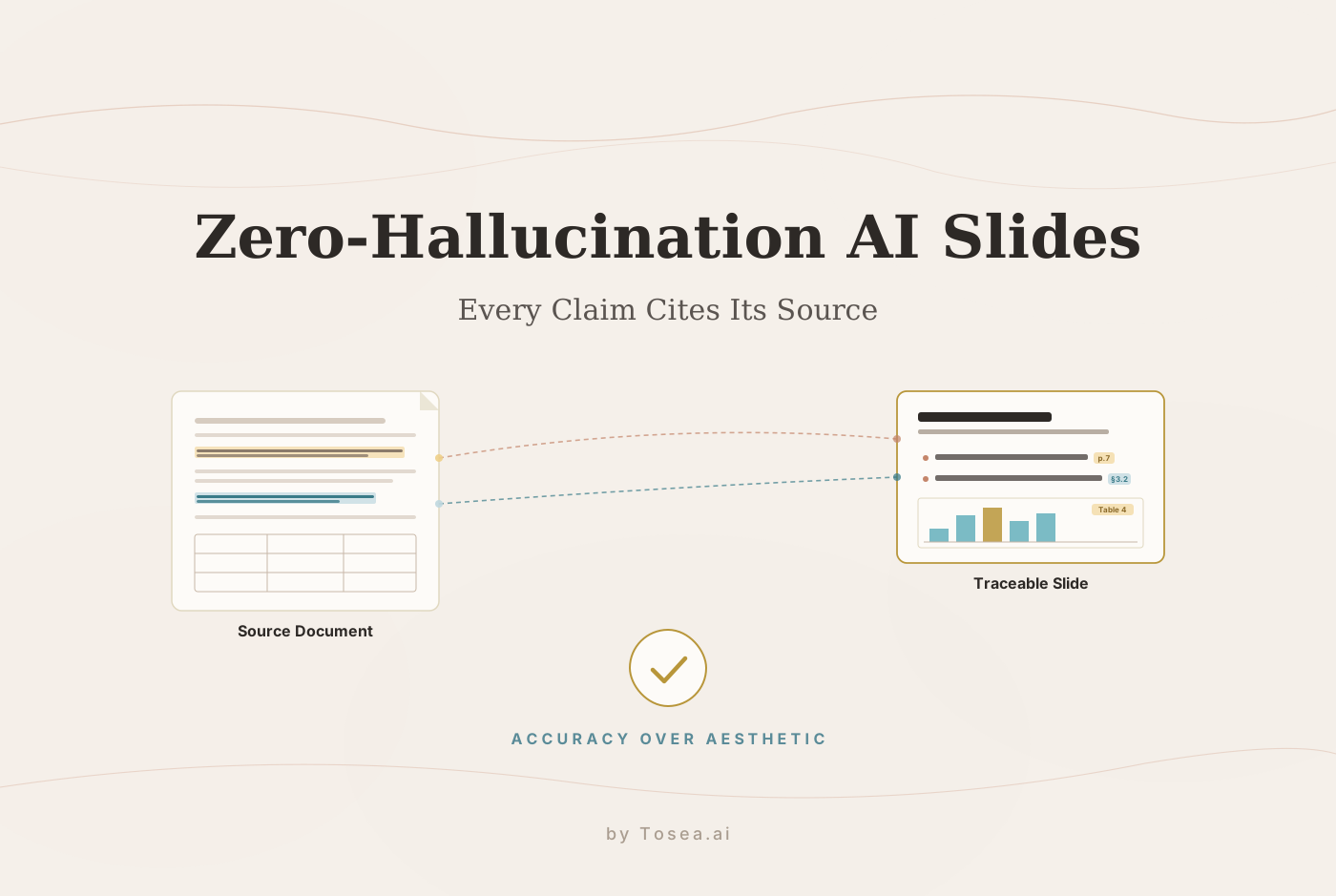
The more complete solution is what Tosea.ai calls Absolute Traceability: every claim, every data point, and every conclusion on a generated slide is linked directly back to the specific passage, figure, or table in the source document where it originated. There is no synthesis from memory. There is no interpolation from training data. There is only structured presentation of what the document contains.
How Tosea.ai Works: A Step-by-Step Guide
Tosea.ai is built for the use cases where hallucination is least acceptable: academic research, technical reports, financial analysis, legal documentation, and any professional context where every figure must be defensible. The workflow follows the source-first principle throughout — the same workflow we walk through in our 30-page research paper to slides tutorial and our PDF-to-PowerPoint quick guide.
Step 1: Upload your source document. Go to tosea.ai and upload your document. Tosea.ai accepts PDF, Word (.docx), plain text, and Markdown files. For academic use, this means your research paper, thesis chapter, conference submission, or literature review. For professional use, this means your financial report, audit document, strategy brief, or technical specification. The source document is the single source of truth for everything that follows — nothing enters the generated presentation that does not originate in it.
Step 2: AI analysis and outline generation. Tosea.ai's Spatial Semantic Perception engine reads the logical hierarchy of your document — distinguishing primary arguments from supporting evidence, identifying key figures and tables, understanding the relationship between sections. This is not keyword extraction; it is structural analysis that mirrors how a domain expert would read and organize the material. The AI then proposes an outline showing the narrative arc it has identified. You can review and adjust the outline before proceeding.
For academic papers, this step correctly identifies the standard structure — introduction, methods, results, discussion, conclusion — and maps each section to the appropriate slide type. For business reports, it identifies executive summary material, key findings, data exhibits, and recommendations.
Step 3: Slide generation with full traceability. When slides are generated, each content element — every bullet point, every chart, every table, every statistical claim — is linked to its origin in the source document. The traceability is not a summary or an approximation. It is a direct reference to the specific passage, figure number, or data table in the original file. If an investor asks where a revenue growth figure came from, you can point to the exact table on page 12 of your financial model. If a committee member challenges a methodology claim, you can reference the specific paragraph in your methods section. The presentation becomes a navigable interface to your source document, not a separate artifact that may or may not align with it.
Step 4: Export and present. The output is a native .pptx file — fully editable in PowerPoint or Google Slides, with clean layers, consistent formatting, and no locked elements. Paid plans export without watermarks. You can make final adjustments to layout, add your organization's branding, or customize individual slides before presenting.

Where Tosea.ai Delivers the Highest Value
Academic thesis and dissertation defenses. Committee members expect every claim to be defensible. Tosea.ai generates slides that are literally traceable to your paper. When a question arises about a specific finding, you know exactly where in your research it is supported. This is also why many academic teams treat it as the best Gamma alternative for research slides.
Conference presentations from research papers. Converting a 30-page paper into a 15-minute conference talk requires extracting the most important findings without introducing distortion. Tosea.ai's structural analysis identifies what the paper actually argues, rather than generating a generic summary of what papers on that topic typically argue.
Investment and fundraising decks from financial models. In due diligence, every figure in your deck will be verified. Tosea.ai ensures that the figures in your presentation are identical to the figures in your financial model, because they come directly from it.
Legal and compliance reporting. Law firms and compliance teams increasingly need to present complex analysis to non-technical audiences. A hallucinated precedent or a fabricated regulatory requirement in a compliance deck carries professional and legal consequences. Source-anchored generation eliminates that risk category.
Enterprise strategy and board reporting. When the CEO presents the annual strategy review to the board, every market figure and competitive analysis data point reflects the research that was actually conducted — not what an AI tool predicted should be in a strategy presentation. For a deeper treatment of this workflow, see our executive document transformation guide.
What Real Users Say
Reviews on There's An AI For That describe the zero-hallucination characteristic as the primary differentiator: the tool captures nuance and logical flow of the original document without the usual AI hallucinations, producing slides that are surprisingly deep and well-structured. Users who have tried multiple AI slide generators consistently identify accuracy and traceability as the features that make Tosea.ai distinct from tools that, as one reviewer put it, "just scrape the surface."
The tool is also described on AI Tools Space as extracting figures, tables, and mathematical formulas directly from uploaded documents with high-precision extraction technology — a feature that matters particularly for STEM research, where visual elements carry significant evidentiary weight.
Frequently Asked Questions
Does "zero hallucination" mean the tool never makes any mistakes? No. "Zero hallucination" is shorthand for no claim is introduced that does not trace back to the source document. Tosea.ai cannot prevent a source document itself from containing an error, and it will not rewrite faulty data. What it guarantees is that the deck reflects the document — not an imagined version of it.
How is this different from using ChatGPT with a PDF attachment? Chat assistants that read a PDF still synthesize answers token-by-token. They may quote from the document, but there is no architectural guarantee that every generated sentence corresponds to a specific passage. Without claim-level attribution, any error is indistinguishable from a faithful quote. Tosea.ai is designed around that attribution being the primary output, not a side effect.
Does source-first generation sacrifice creativity or visual polish? The layout, typography, and design logic of the slide is still AI-generated — only the content is constrained to the source. Users generally find the output more cohesive, because the narrative is structured around the document's own argument rather than a generic template.
What document types work best? Well-structured long-form PDFs, Word documents, and Markdown files produce the strongest results: research papers, whitepapers, financial reports, audit documents, strategy memos, and technical specifications. Poorly scanned PDFs with no OCR layer, or documents that are mostly unstructured notes, will produce weaker structural analysis — regardless of tool.
Can I still edit the generated slides? Yes. The output is a native .pptx file with no locked layers. Claim-level citation markers stay attached through edits so you can keep a full audit trail even after manual revisions.
What Hallucination-Free Presentations Actually Enable
Eliminating hallucination from presentations is not just about avoiding embarrassment. It is a qualitative shift in what presentations can be used for.
When every figure is traceable and verifiable, a presentation becomes a defensible artifact — something you can stand behind under scrutiny, something you can submit with a filing, something you can use in a context where errors have consequences.
When every claim links back to its source, presentations become navigable interfaces to research rather than summaries that inevitably simplify and sometimes distort. The audience can trust what they see because the author can verify it on demand.
This is what makes Tosea.ai a strong fit not just for researchers and academics, but for any professional whose work will be scrutinized — by investors, by regulators, by clients, by committees, by courts. The AI presentation tool market has produced plenty of beautiful output. For high-stakes professional contexts, the distinction that matters is whether the deck can be defended line by line.
If you want to try the approach on a real document, upload a PDF to Tosea.ai and walk through the citation trace on the first generated slide. That single click — from a claim on the slide to the passage it came from — is the clearest way to see why source-first generation is a different product category from what most AI presentation tools are currently shipping.