Beyond the Hallucination: How Tosea.ai Ensures Reliable Document-to-PPT Conversion
How Tosea.ai's multi-layered parsing pipeline and source-to-slide traceability eliminate AI hallucinations in professional presentations.
The Cost of AI Hallucinations in Professional Settings
In 2026, businesses rely heavily on large language models (LLMs) to accelerate decision-making and communication. But alongside the speed gains comes a persistent and well-documented problem: AI hallucinations. A hallucination occurs when an AI model generates information that sounds plausible but has no basis in the source material. In professional presentations, where accuracy directly affects credibility, this is not a minor inconvenience. It is a material risk.
How Often Do AI Models Hallucinate?
Research from the Vectara Hallucination Evaluation Model (published in late 2024 and updated through 2025) found that leading LLMs hallucinate at rates ranging from approximately 3% to 27% depending on the task, model, and prompt structure. Summarization tasks, which are central to document-to-slide conversion, tend to sit in the 5%--15% range for most commercial models. A 2025 Stanford study on retrieval-augmented generation (RAG) pipelines showed that even with grounding techniques, hallucination rates for complex multi-table documents still hovered around 4%--8% when using generic extraction methods.
These are not theoretical numbers. For a 40-slide presentation drawn from a 100-page document, a 5% hallucination rate could mean two or three slides containing fabricated or distorted information.
Real-World Business Damage
Consider what happened at a mid-sized consulting firm in early 2025. A team used a general-purpose AI assistant to convert a client's market analysis report into a pitch deck. The AI introduced a fabricated statistic: a "14.3% year-over-year revenue growth" figure that did not appear anywhere in the source report. The client noticed the discrepancy during the presentation, questioned the firm's due diligence, and ultimately moved the engagement to a competitor. The direct revenue loss was approximately $400,000. The reputational damage was harder to quantify but arguably worse.
Similar incidents have surfaced across legal, financial, and healthcare contexts. A law firm in New York faced sanctions after submitting a brief containing AI-generated case citations that did not exist. A pharmaceutical company's internal review board flagged an AI-generated safety summary that misrepresented clinical trial endpoints. These are not edge cases. They are the predictable consequence of feeding unstructured documents into models that optimize for fluency over fidelity.
For a tool like Tosea.ai, which converts dense documents into professional presentations, there is no acceptable margin for error. Every number, every claim, and every conclusion in the final slides must trace back to something in the original file.
The Multi-Layered Parsing Pipeline: Beyond Basic OCR
The primary entry point for AI hallucinations in presentation generation is poor document parsing. Most conversion tools rely on basic Optical Character Recognition (OCR) or standard text extraction libraries. These approaches work reasonably well for simple, text-heavy documents. But they fall apart when confronted with the kinds of files professionals actually work with: documents containing tables nested inside tables, footnotes that modify the meaning of body text, charts with legends that must be read in conjunction with axis labels, and multi-column layouts where reading order is ambiguous.
When the AI system does not understand the structure of the data it is reading, it fills the gaps with inference. And inference, in the context of LLMs, frequently means fabrication.
How Tosea.ai's Parsing Works
Tosea.ai uses a specialized parsing pipeline that treats documents as complex visual and logical structures rather than flat sequences of text. The pipeline consists of several integrated processing stages:
Advanced Layout Models. Before any text extraction begins, layout analysis models identify the spatial organization of each page. This includes headers, footers, sidebars, nested tables, figure captions, and margin notes. The system builds a structural map of the document that preserves the visual hierarchy of the original. This matters because a number appearing in a footnote has a different significance than the same number appearing in a headline, and the parsing system needs to know the difference.
Fine-Tuned Vision-Language Models (VLMs). Standard OCR and text extraction tools often misread charts, graphs, and diagrams. A bar chart showing quarterly revenue might be transcribed as a series of disconnected numbers without any indication of what the axes represent. Tosea.ai uses vision-language models that have been specifically fine-tuned to interpret the relationship between visual data and textual descriptions. These models process charts, tables, and infographics as integrated visual-textual units rather than extracting text and images separately.
Paragraph Sequencing Models. Documents often present information in a non-linear visual layout (sidebars, callout boxes, multi-column formats) while maintaining a linear logical argument. Paragraph sequencing models reconstruct the intended reading order, ensuring that the logical flow of information---how one idea leads to the next---remains intact throughout the extraction process.
Formula and Symbol Recognition. Technical and scientific documents frequently contain mathematical formulas, chemical notations, and specialized symbols. The pipeline includes dedicated models for recognizing and preserving these elements in their correct form, rather than approximating them as garbled text.
By running documents through this multi-stage pipeline, Tosea.ai ensures that the raw material fed into the presentation engine is both accurate and contextually rich. The data gaps that cause hallucinations are addressed at the extraction layer, before any content generation begins.
Solving the Long-Context Dilemma: Processing Large Documents
A second major source of hallucination in AI workflows occurs when processing very large files. A 200-page IPO prospectus, a comprehensive market research report, or a detailed technical specification can easily exceed the practical attention span of current LLMs, even those with 128k or 1M token context windows.
The problem is not just context length. It is attention distribution. Research published by Liu et al. (2024) demonstrated that LLMs tend to over-attend to information near the beginning and end of their context window while losing track of content in the middle. For a long document, this means the AI might accurately represent the executive summary and the appendix while fabricating or distorting information from the core analysis sections.
The Split-Process-Merge Approach
Tosea.ai addresses this with an agentic engineering approach that avoids processing massive files in a single pass. Instead of relying on a monolithic model call, the system employs a structured "Split-Process-Merge" methodology:
Intelligent Chunking. The document is deconstructed based on its logical chapters and sections, not arbitrary token counts. The parsing pipeline (described above) identifies natural boundaries in the document---chapter breaks, section headings, topic transitions---and uses these as division points. This ensures that each chunk is a semantically coherent unit rather than a fragment that cuts off mid-argument.
Segmented Analysis. Specialized processing agents handle each segment independently, maintaining focus and precision within a bounded context. Each agent operates with full awareness of the segment's content and its position within the broader document structure, but without the noise of the entire file competing for attention.
Cross-Segment Context Passing. As segments are processed, the system maintains a running summary of key themes, definitions, and data points. When a later segment references a concept introduced in an earlier one, the context-passing mechanism ensures the reference is resolved correctly rather than hallucinated.
Global Re-Synthesis. After all segments are processed, the system merges their outputs into a cohesive narrative. A final consistency pass checks for contradictions between sections, duplicate content, and logical gaps. The result is a presentation that maintains a clear, consistent argument from the first slide to the last, even when the source document spans hundreds of pages.
Source-to-Slide Traceability: The Verification Chain
In professional environments, an unverified conclusion is a liability. The most insidious aspect of AI hallucinations is not their frequency but their confidence. A hallucinated statistic looks exactly like a real one in the final output. Without a verification mechanism, the presenter has no way to distinguish between grounded claims and fabricated ones without manually cross-referencing every slide against the source document.
Tosea.ai addresses this with a strict traceability protocol that operates throughout the generation process.
How the Closed-Loop Verification Works
Every piece of content in a Tosea.ai presentation follows a transparent chain of custody:
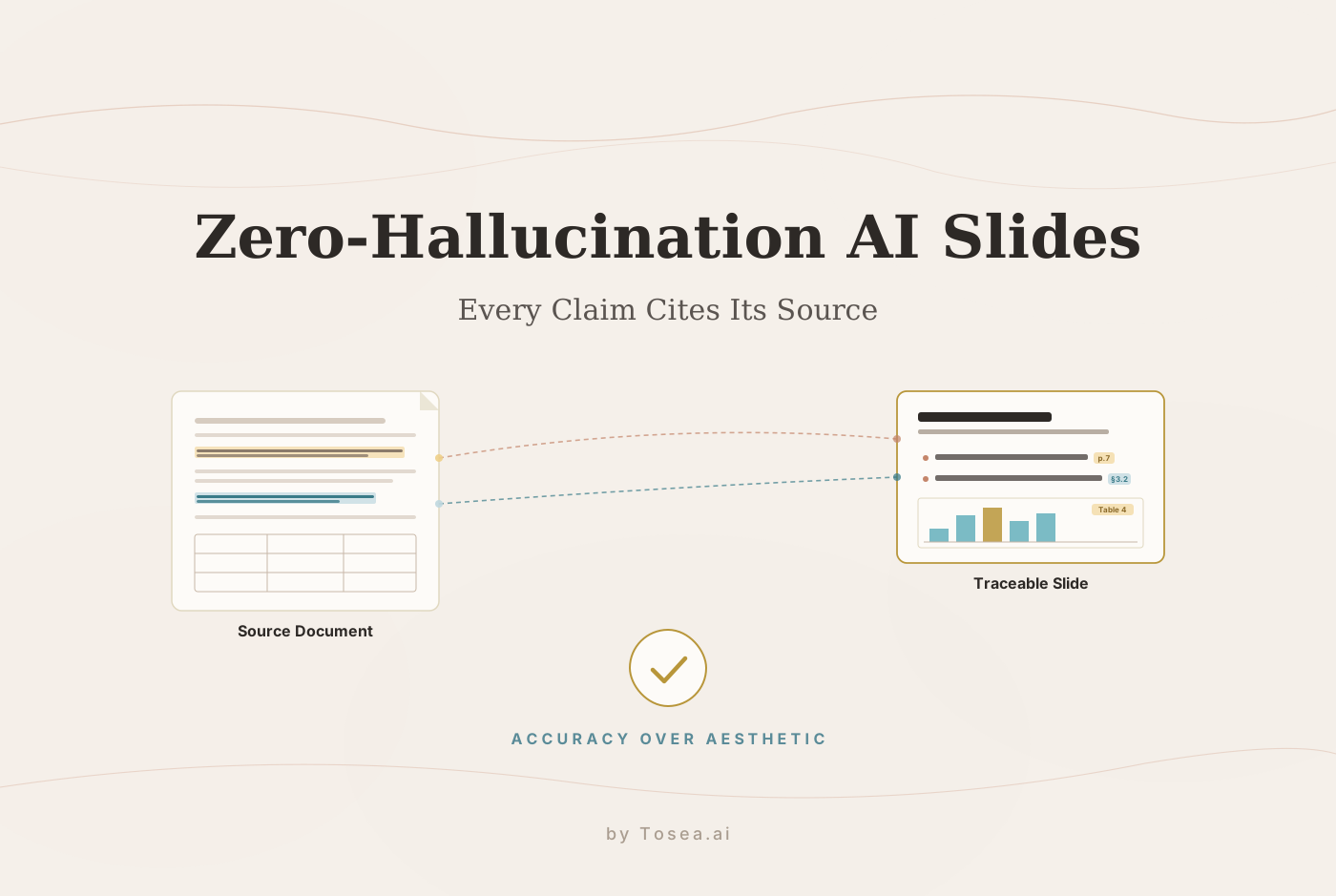
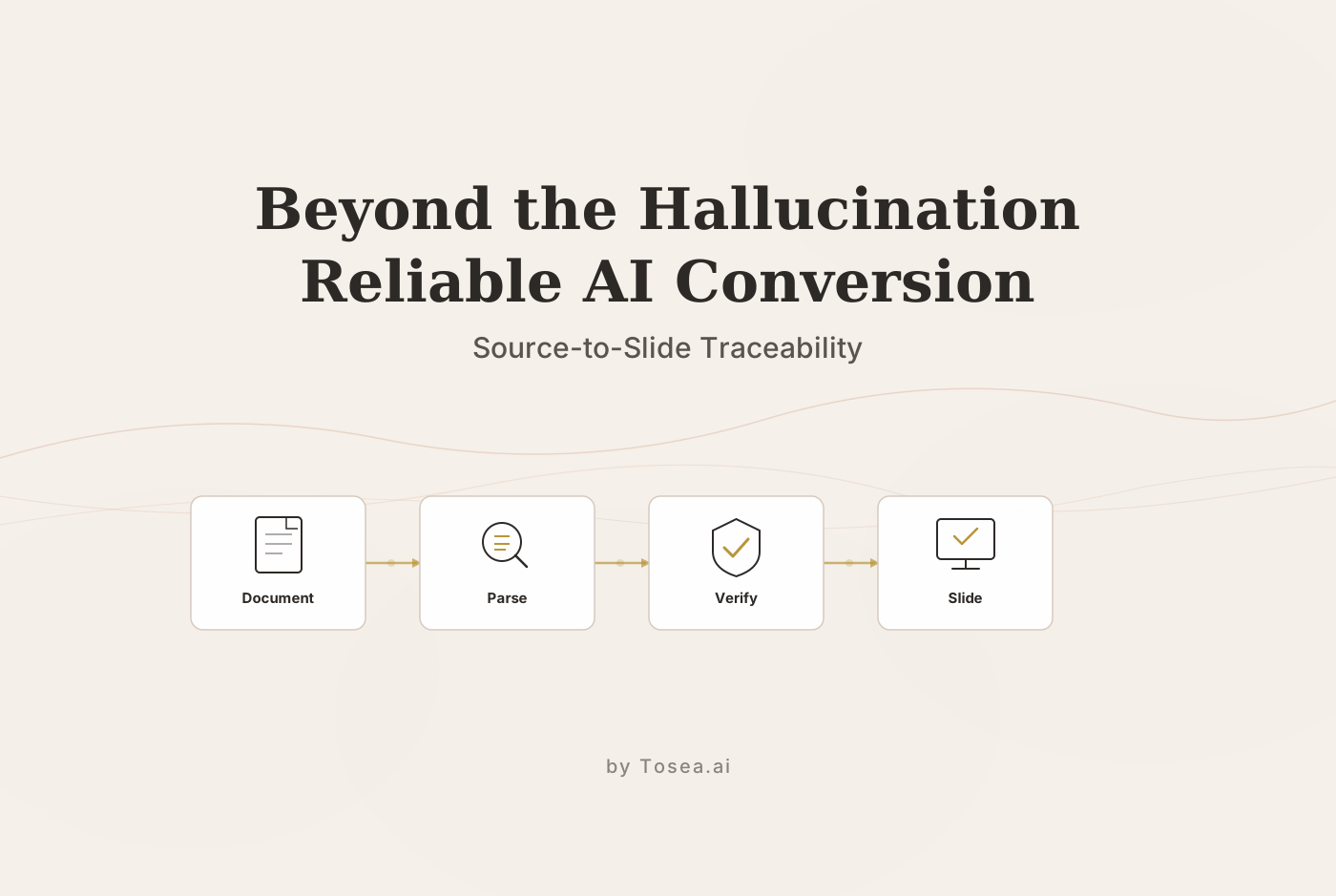
Step 1: Direct Extraction. Information is extracted from the source document using the multi-layered parsing pipeline. Each extracted element (a number, a quote, a table, a chart description) is tagged with its location in the original file: page number, section, and position.
Step 2: Outline Anchoring. When the system generates the presentation outline, every sentence is directly mapped back to specific segments in the original file. The outline is not a creative reinterpretation of the document. It is a structured reorganization of verified content. If a claim cannot be traced to a source segment, it is flagged and excluded.
Step 3: Slide Generation. Every bullet point, headline, and data visualization in the final presentation is derived from the verified outline. The generation step does not introduce new information. It transforms the outline into visual slide content while preserving the source mapping.
Step 4: Post-Generation Audit. After slides are generated, an automated verification pass confirms that every claim in the presentation corresponds to content in the source document. Any content that cannot be traced back to the original is flagged for review.
This means that every word in a Tosea.ai presentation has a clear origin. If a slide states that operational efficiency increased by 12%, that figure came from a specific line on a specific page of the uploaded document. The speculative gap that leads to hallucinated data is structurally eliminated.
How to Verify Your AI-Generated Presentations: A Checklist
Even with robust anti-hallucination measures, professionals should maintain verification habits when using any AI-powered tool. Here is a practical checklist for reviewing AI-generated presentations:
- Check key statistics. For every numerical claim in the presentation, locate the corresponding figure in the source document. Pay special attention to percentages, growth rates, and financial figures.
- Verify proper nouns. AI models sometimes substitute similar-sounding names, company names, or product names. Confirm that all proper nouns match the source exactly.
- Review causal claims. If a slide states that X caused Y, verify that the source document makes the same causal claim rather than merely noting a correlation or temporal relationship.
- Examine chart descriptions. When source charts are described in text form on slides, confirm that the descriptions accurately reflect the visual data. Check axis labels, time periods, and units of measurement.
- Look for unsupported superlatives. Phrases like "the largest," "the first," or "unprecedented" should have explicit support in the source material. These are common hallucination patterns.
- Cross-reference dates and timelines. AI models occasionally shift dates or compress timelines. Verify that all temporal references match the source.
- Test the "where did this come from?" question. For any claim that surprises you, ask whether you can point to a specific passage in the source document. If you cannot, investigate further.
Tosea.ai's traceability protocol automates much of this verification. But developing these review habits ensures an additional layer of quality assurance regardless of the tool you use.
Enterprise Trust: Security and Data Isolation
For organizations handling sensitive intellectual property, unreleased financial data, or private project plans, the risk of a data breach is as concerning as the risk of hallucination. Trust in an AI conversion tool requires confidence not only in its accuracy but also in its handling of confidential material.
Tosea.ai's Privacy Commitments
Tosea.ai operates under a strict data isolation policy:
No Training on User Data. Files you upload and presentations you generate are never used to train base models or any public LLMs. Your strategic insights and proprietary information remain your exclusive property. This is a firm architectural commitment, not a policy that can be overridden by a settings toggle.
Isolated Processing Environments. Documents are processed in isolated environments that prevent cross-contamination between users. Your data does not share memory space, storage, or processing queues with other users' files.
Temporary Asset Treatment. Uploaded documents are treated as temporary assets for the generation process. They are not retained beyond the period necessary to complete your conversion and deliver the results.
Ongoing Certification Work. Tosea.ai is actively working toward SOC2 and ISO 27001 certifications. The current architecture is built on principles of zero data contamination and minimal data retention, forming the foundation for these formal certifications.
The Road Ahead: From Workflow to Multi-Agent Collaboration
Currently, Tosea.ai operates as a high-performance pipeline: a series of carefully orchestrated processing steps that prioritize reliability and accuracy. This approach is deliberately conservative. In professional contexts, predictability and correctness matter more than creative flourish.
What Comes Next
The product roadmap includes an evolution from a linear pipeline toward a multi-agent system where specialized components collaborate in real time:
The Strategic Architect. An agent focused on narrative structure, ensuring that the presentation tells a coherent story rather than simply listing facts in sequence.
The Visual Designer. An agent that applies brand-specific colors, typography, and layout patterns based on uploaded brand guidelines or learned organizational preferences.
The Auditor. A dedicated fact-checking agent that performs continuous verification against the source file throughout the generation process, catching potential hallucinations before they reach the final output.
The Accessibility Checker. An agent that ensures generated presentations meet accessibility standards, including appropriate contrast ratios, alt text for images, and logical reading order for screen readers.
As these capabilities are introduced, the core commitment remains unchanged: every element in a Tosea.ai presentation must be grounded in the source document. Speed and sophistication are valuable only when they do not compromise accuracy.
Accuracy as a Professional Standard
AI hallucinations are not an inevitable cost of using language models. They are a technical problem with technical solutions. By replacing generic prompting with a specialized parsing pipeline, a structured split-process-merge methodology, and a source-locked traceability chain, Tosea.ai has built a conversion platform where speed and accuracy coexist.
In a boardroom, a courtroom, or a client meeting, your credibility depends on the reliability of your materials. Every fabricated statistic, every misattributed quote, and every invented trend line erodes the trust you have built with your audience. Tosea.ai is designed to ensure that your presentations are built on verified facts drawn directly from your source documents.
The goal is straightforward: when you present with Tosea.ai, you present with confidence, because every slide can be traced back to its origin.
FAQ: Reliability, Technology, and Trust
Q: How does Tosea.ai handle tables embedded in PDFs?
A: The parsing pipeline uses layout models to detect table boundaries and vision-language models to interpret cell contents, including merged cells, nested headers, and footnoted values. Tables are extracted as structured data with their relationships preserved, rather than being flattened into plain text. This structured extraction prevents the misinterpretation of tabular data that commonly leads to hallucinated statistics in presentations.
Q: Can Tosea.ai accurately summarize a 100-page or 200-page document?
A: Yes. The system uses an agentic split-process-merge approach that divides long documents at logical boundaries and processes each section with focused attention. Cross-segment context passing ensures that references between sections are resolved correctly. This avoids the "lost in the middle" problem documented in research on long-context LLM performance.
Q: What happens if the source document itself contains errors?
A: Tosea.ai's traceability system faithfully reproduces what is in the source document. The system does not attempt to fact-check external claims in the source material, nor does it introduce corrections. If the source states an incorrect figure, that figure will appear in the presentation. The traceability chain ensures you can always identify where each piece of information came from, making it easier to catch source-level errors during review.
Q: Does Tosea.ai support custom brand fonts and color schemes?
A: Custom branding support is on the product roadmap. The current output uses a clean, professional design language that serves as a high-quality foundation. Users can apply their organization's brand guidelines after export. The upcoming Visual Designer agent will automate brand application directly within the generation pipeline.
Q: Is my data used to improve Tosea.ai's AI models?
A: No. Tosea.ai maintains a strict data isolation policy. Your uploaded files and generated presentations are never used to train or fine-tune any AI models, whether internal or external. This policy is enforced at the architectural level through isolated processing environments.
Q: How does Tosea.ai handle documents with mixed languages?
A: The parsing pipeline supports multilingual content within a single document. Layout models and text extraction operate independently of language, and the vision-language models are trained on multilingual datasets. Documents containing, for example, English body text with Chinese tables or Japanese figure captions are processed without requiring language-specific configuration.
Q: What file formats does Tosea.ai accept beyond PDF?
A: The primary input format is PDF, which covers the vast majority of professional document workflows. Support for additional formats, including Word documents (.docx) and scanned image collections, is under active development. The parsing pipeline's modular architecture allows new input formats to be added without modifying the downstream generation and verification stages.
Q: How does the system handle charts and graphs in the source document?
A: Charts and graphs are processed by vision-language models that interpret both the visual representation and any associated labels, legends, and captions. The system extracts the data relationships depicted in the chart (trends, comparisons, distributions) and represents them accurately in the presentation. It does not attempt to regenerate or reinterpret the underlying data beyond what is visually presented in the source.