Ruflo Complete Guide: Enterprise AI Multi-Agent Development (2026)
Complete guide to Ruflo (formerly Claude Flow): the open-source multi-agent orchestration platform for Claude, with hive-mind swarms, SPARC, RAG, and federation.
A single Claude Code session is powerful. But a single agent working sequentially through a complex software-engineering task — a large codebase refactor, an architectural review across fifty files, a multi-phase feature implementation — is fundamentally limited by its single-threaded nature. One agent, one context window, one task at a time.
Ruflo is the open-source multi-agent orchestration platform built specifically to break that constraint. This guide walks through the project's history (it was previously known as Claude Flow), the hive-mind architecture that distinguishes it from generic agent runners, the SPARC methodology that gives the swarm a workflow to follow, the two installation paths, and how the engineering output flows into a presentation pipeline when stakeholders need a deck rather than a markdown report.
What Is Ruflo? The Evolution From Claude Flow
Ruflo is an open-source agent-orchestration platform built specifically for Claude. It was created by Reuven Cohen (GitHub handle ruvnet) and has accumulated over 40,800 GitHub stars with more than 6,000 commits — making it the most adopted open-source multi-agent platform of 2026.
The project has a notable history. Claude Flow was Cohen's first version, released in May 2025 as a personal experiment. The pitch was straightforward: take Anthropic's Claude, strap a multi-agent orchestration layer on top of it, and let coordinated swarms of AI agents tackle software-development tasks. Not one agent fumbling through your codebase on its own — dozens of them, working in parallel, with a queen agent calling the shots.
The rename from Claude Flow to Ruflo happened in January 2026 to address trademark considerations, but the npm package and CLI commands retain the historical name claude-flow for backward compatibility. The architectural evolution was equally significant: the v3.6 release represents a complete rewrite of more than 250,000 lines of code, in TypeScript with WASM kernels, with a Rust foundation underneath.
The adoption numbers validate the engineering investment: the project is closing in on 500,000 downloads, with nearly 100,000 monthly active users across more than 80 countries. For context on where Ruflo sits in the broader Claude tooling ecosystem, our Claude Code complete guide and our Claude Opus 4.7 complete guide cover the model layer that Ruflo orchestrates.
The Hive-Mind Architecture: How Ruflo's Swarm Intelligence Works
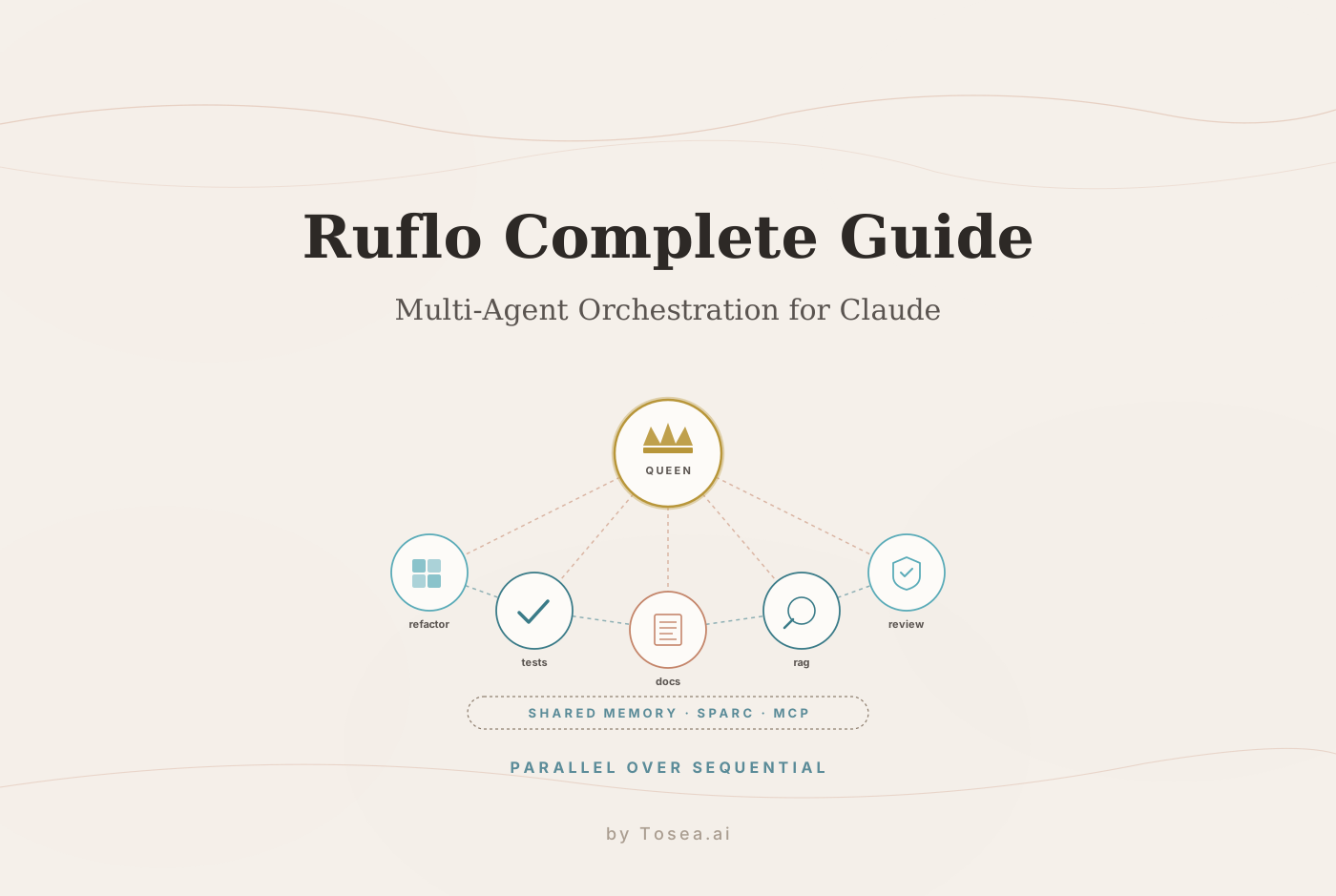
The conceptual frame that makes Ruflo distinct from other multi-agent tools is its hive-mind architecture. Rather than running multiple independent agents that happen to be working on the same project, Ruflo coordinates agents through a structured hierarchy with shared memory and continuous cross-agent learning.
Queen and Worker Architecture
The swarm operates through a hierarchical model: a queen agent coordinates the overall task, decomposes it into parallelizable workstreams, assigns worker agents to each workstream, monitors progress, resolves conflicts, and synthesizes results. Worker agents specialize — different agents handle different aspects of the work simultaneously rather than sequentially. The platform deploys 54+ specialized agents in coordinated swarms, backed by shared memory, consensus, and continuous learning.
Parallel Execution and Tool Coordination
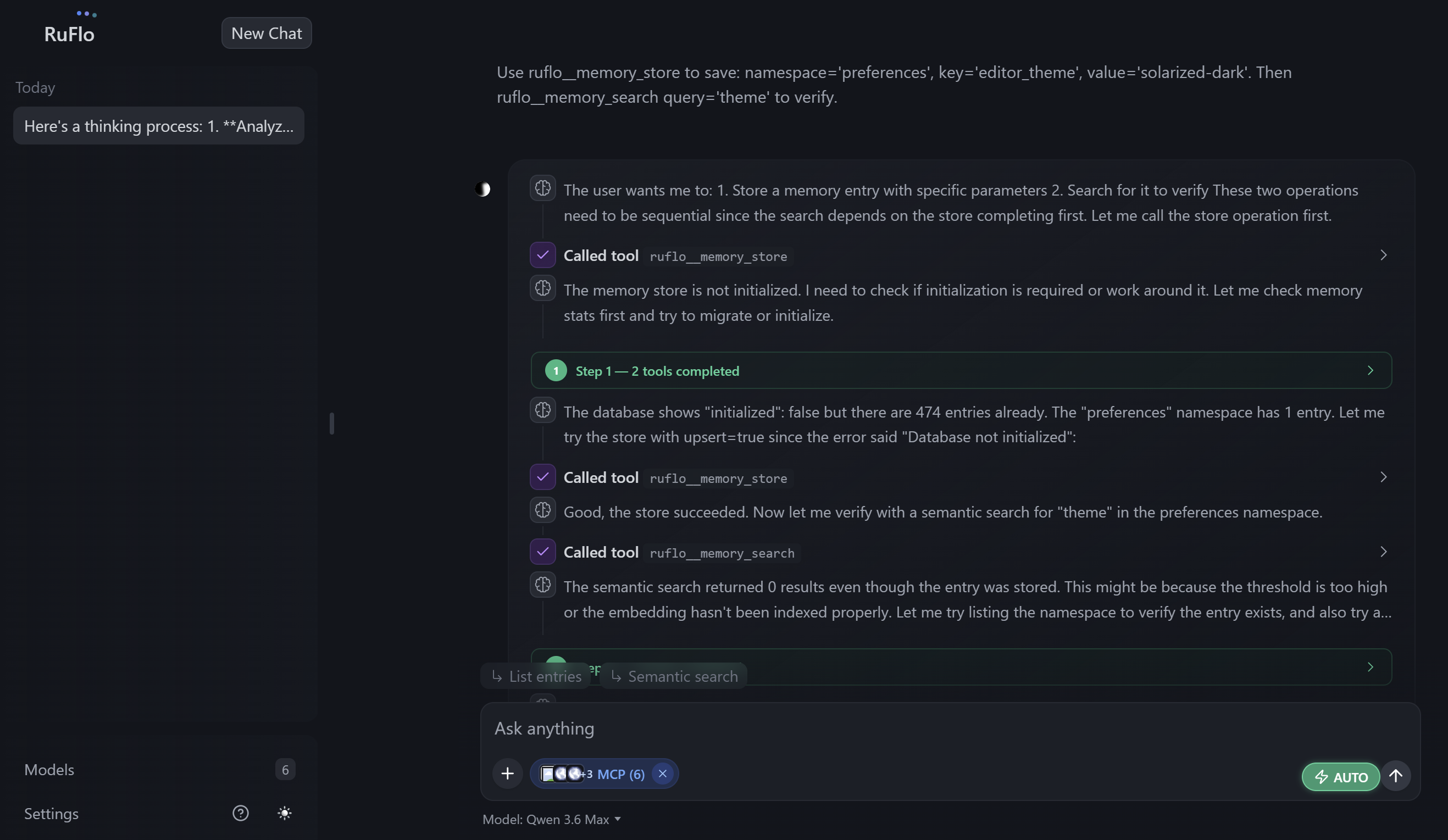
One of the most practically significant features is parallel tool execution. A single model response can fire 4–6+ tools at the same time. The UI shows them as cards with a "Step 1 — 2 tools completed" badge so you can see exactly what ran.
This parallel execution is what produces the cost and time savings that make Ruflo compelling for production use. The project reports an 84.8% solve rate on SWE-bench and roughly 75% API cost savings compared to using Claude Code directly — driven primarily by routing low-stakes calls to cheaper models and avoiding redundant work through shared memory. We covered the broader pattern of self-improving agent layers in our Hermes Agent self-improving AI guide.
Persistent Memory Across Sessions
Say "remember my favorite color is indigo" and ask — the memory system persists this kind of contextual information across sessions, building a cumulative model of your project, your preferences, and your team's conventions. This is the feature that makes Ruflo feel increasingly like a senior team member rather than a stateless tool.
The memory system uses SQLite for local persistence and supports distributed memory synchronization across multiple Ruflo instances through the federation feature released in v3.6.
Core Features: What Ruflo Includes
SPARC Methodology
SPARC stands for Specification, Pseudocode, Architecture, Refinement, Completion. It is a structured, test-driven approach to AI development packaged directly into Ruflo so that you don't have to invent a workflow or figure out how to prompt your agents.
The SPARC methodology enforces a disciplined approach to AI-assisted development: define the specification before writing code, validate the pseudocode before implementation, confirm the architecture before building, refine through testing, and complete with full coverage. This structure is what separates Ruflo from tools that simply parallelize unstructured agent activity.
RAG Integration
Ruflo includes native Retrieval-Augmented Generation support, allowing agents to query internal knowledge bases, documentation repositories, and codebases before generating responses. This is particularly valuable for enterprise teams where agents need to draw on proprietary context — internal APIs, domain-specific conventions, organizational architecture decisions — rather than relying on model training data alone.
As aitoolly's analysis of the platform describes: the platform features deep integration with Retrieval-Augmented Generation and native support for Claude Code and Codex, enabling developers to incorporate code-centric capabilities directly into their multi-agent workflows.
MCP Server and Tool Ecosystem
Five server groups (Core, Intelligence, Agents, Memory, DevTools) plus an 18-tool gallery that runs entirely in your browser — works offline. The platform supports 314 MCP tools accessible through Claude, and the architecture allows any external MCP server to be added: click the MCP (n) pill in the chat input, "Add Server," and paste any MCP endpoint (HTTP, SSE, or stdio). Your tools join Ruflo's native ones in the same parallel-execution flow. Run a local MCP server on localhost:3000 and it just works.
Agent Federation
The v3.6 stable release introduced agent federation: two or more Ruflo instances on different machines can talk to each other without exposing data. This enables enterprise deployments where different teams or environments run separate Ruflo instances that coordinate on shared tasks without compromising data-isolation requirements.
Installation: Two Paths With Different Capabilities
After init, just use Claude Code normally — the hooks system automatically routes tasks, learns from successful patterns, and coordinates agents in the background. You don't need to memorize 314 MCP tools or 26 CLI commands to get started.
There are two installation paths with meaningfully different feature availability.
Path A: Claude Code Plugin (Recommended for Getting Started)
# Add the marketplace
/plugin marketplace add ruvnet/ruflo

# Install core + plugins you need
/plugin install ruflo-core@ruflo
/plugin install ruflo-swarm@ruflo
/plugin install ruflo-autopilot@ruflo
/plugin install ruflo-federation@ruflo
This adds slash commands and agent definitions only. The Ruflo MCP server is NOT registered, so memory_store, swarm_init, agent_spawn, etc. won't be callable from Claude. For the full loop, use Path B.
This path is appropriate for teams that want Ruflo's workflow structuring and agent coordination without the full MCP infrastructure. It is the lowest-friction entry point.
Path B: Full MCP Installation (Recommended for Production)
npx claude-flow@latest init --sparc
The init command with the --sparc flag sets up the complete Ruflo infrastructure including the MCP server, memory system, swarm coordination layer, and SPARC methodology framework. After initialization, run:
claude
And use Claude Code normally. The hooks system operates in the background, routing tasks to appropriate agents and coordinating the swarm without requiring explicit commands for each operation.
For teams migrating from a previous Claude Flow installation, the migration command handles the transition:
hermes claw migrate          # if coming from Hermes Agent
npx claude-flow migrate       # standard migration path
Five High-Value Use Cases
Large codebase refactoring. Ruflo's parallel agent architecture makes it practical to refactor a 200,000-line codebase in a single coordinated session. The queen agent decomposes the refactor into file-level workstreams, assigns worker agents to each, and synthesizes the results into a coherent diff that maintains consistency across the entire change set. Tasks that would require days of sequential AI-assisted work complete in hours.
Parallel feature implementation. For features that span multiple services or components — a new authentication system that touches the frontend, API layer, database schema, and tests simultaneously — Ruflo can assign specialized agents to each layer working in parallel, with the coordinator ensuring that interfaces between components remain consistent as each layer evolves.
Enterprise workflow automation. By focusing on the Claude ecosystem, Ruflo provides a specialized environment for managing multiple autonomous entities working in tandem within a distributed framework. Enterprise teams use Ruflo to automate multi-step processes — code review pipelines, documentation generation, security scanning — that previously required manual coordination across multiple tools.
RAG knowledge-base construction. Organizations with large internal documentation repositories use Ruflo to build and maintain retrieval systems that give their Claude agents access to proprietary context. The RAG integration allows agents to query documentation, past decisions, and internal APIs as part of their reasoning process rather than relying solely on training data.
Technical documentation at scale. Ruflo can generate comprehensive technical documentation across a large codebase in a single coordinated pass — architecture decision records, API documentation, onboarding guides, and runbooks produced simultaneously by specialized agents drawing on the complete codebase context.
The Self-Learning Layer: ruvLLM and SONA
Ruflo includes native support for ruvLLM (lives in ruvnet/RuVector/examples/ruvLLM) — Ruflo's self-improving local model layer. It routes to MicroLoRA adapters, learns from your trajectories via SONA, and stays on your machine. Pair with cloud models or run fully offline.
SONA (Swarm Optimization via Neural Adaptation) enables Ruflo to learn from the trajectories of successful agent runs and apply that learning to future tasks without manual fine-tuning. This is the feature that gives Ruflo its self-improving characteristic — the platform gets more effective at your specific codebase and workflow conventions the more you use it.
For organizations with privacy requirements that prevent sending code to cloud APIs, the ruvLLM layer enables fully local operation with locally hosted models, with Ruflo's orchestration infrastructure applied to local inference rather than cloud APIs.
From Ruflo Output to Investor-Ready Slides
Ruflo's swarms produce significant technical artifacts: architectural analyses, codebase documentation, project status summaries, security audit reports, technical decision records. These outputs are the substance of engineering work — the analysis that supports decisions, the documentation that enables maintenance, the reports that track progress.
But engineering output rarely reaches the people who need to act on it in the format it was produced. Technical leadership needs executive summaries. Product teams need feature-level presentations. Investors and clients need professional briefings with a narrative arc. The orchestration layer ends at "the report is written"; the presentation layer is a different problem.
This is the document-to-deck handoff we have written about throughout the Tosea.ai blog. The analysis is finished; the deliverable is a deck; and most AI presentation tools try to re-write the analysis from a prompt instead of re-presenting it from the source. The result is fabricated statistics, generic milestones, and executive summaries that look polished but cannot be defended in a review.
Tosea.ai is the document-to-PPT orchestration layer for the artifacts that come out of Ruflo. Drop in the markdown architecture report or the security audit PDF, and Tosea reads its logical structure — sections, claims, data tables, citations — then renders a consulting-grade slide deck whose every element traces back to the source. We unpack the structural reasoning behind this in our piece on hallucination-free document-to-PPT conversion, and our zero-hallucination AI slides guide covers the full source-first AI slide generation architecture. For teams routinely shipping engineering work to the boardroom, our massive slide deck workflow covers the operational pattern at scale.
The output is a native .pptx file, fully editable in PowerPoint or Google Slides. Ruflo handles the engineering intelligence layer; Tosea handles the AI presentation tool layer. Together they cover the cycle from complex technical task to professional stakeholder delivery without losing fidelity at the handoff.
Get Started With Ruflo
The full repository and documentation are available at github.com/ruvnet/ruflo under the MIT license. The official user guide covers the complete installation process, MCP configuration, and agent coordination commands. The project wiki provides architecture documentation and enterprise deployment guidance.
If you want context on adjacent agent platforms, our Hermes Agent guide, DeerFlow super agent guide, and Best Manus AI alternatives cover where Ruflo sits in the wider multi-agent landscape.
Sources
- Ruflo on GitHub — Reuven Cohen (ruvnet), MIT-licensed repository
- Ruflo: A Leading Claude-Powered Multi-Agent Orchestration Platform for Enterprise-Grade Autonomous Workflows — aitoolly
- Ruflo official user guide — Installation, MCP, and SPARC reference
- Ruflo project wiki — Architecture documentation and enterprise deployment notes