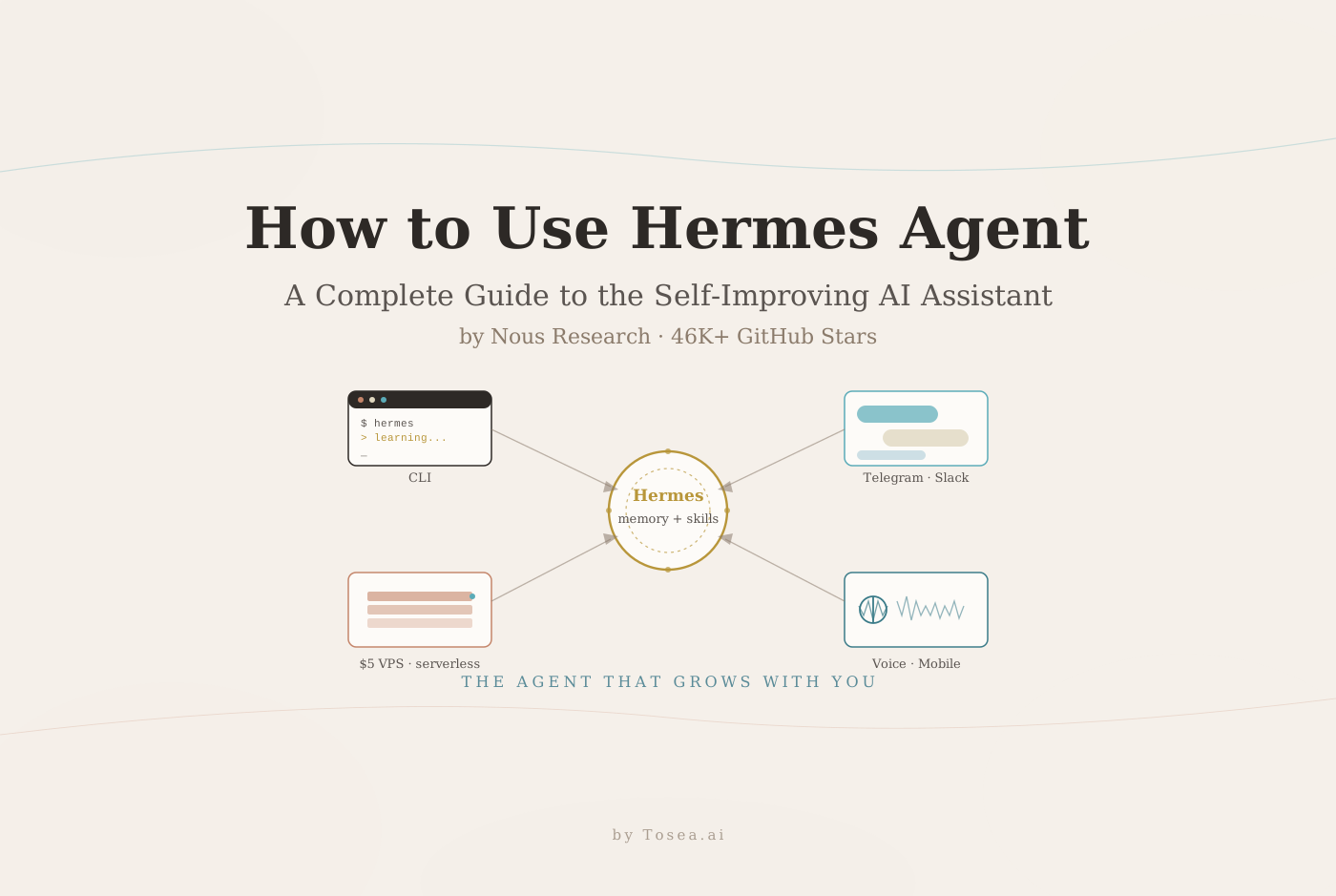
How to Use Hermes Agent: Complete Guide to the Self-Improving AI Assistant by Nous Research
A complete guide to Hermes Agent, the open-source self-improving AI by Nous Research. Covers architecture, install, messaging integrations, and how it fits into a document-to-presentation workflow.
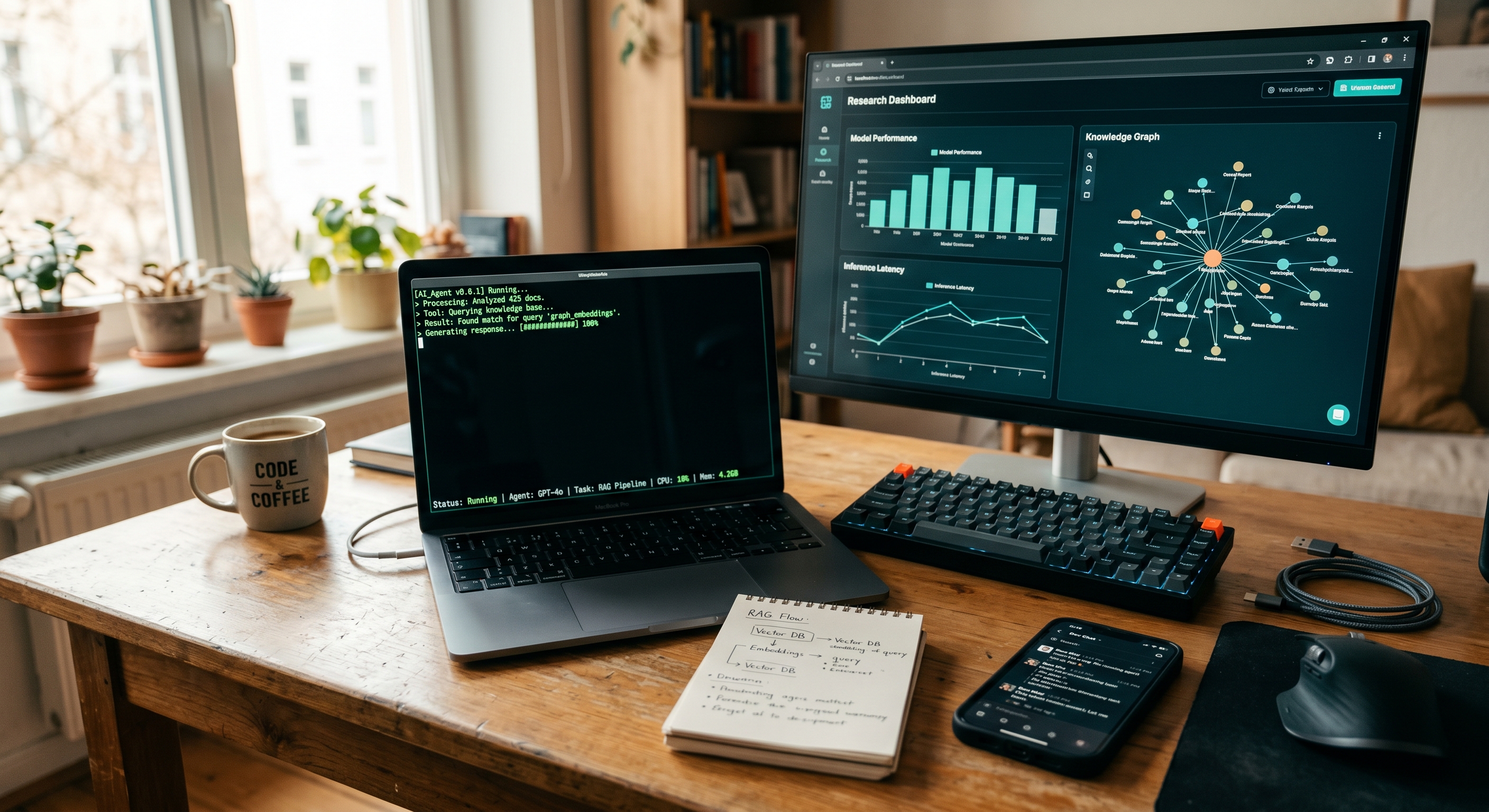
How many times have you spent the first ten minutes of a session re-explaining yourself to an AI tool? Your project context, your preferred output format, the specific terminology your industry uses, the stakeholder names that matter, the constraints you are working within. You type it all out, the session is productive, you close the chat, and tomorrow you do it again from scratch.
This is the amnesia problem of modern AI tools. The capability is there. The memory is not.
Before we get into the solution: once an AI agent like Hermes has completed your research, drafted your report, or synthesized your findings into a structured document, the next step is professional delivery. Tosea.ai transforms those documents into consulting-style presentations in under a minute. Register now — by the end of this guide you will see exactly where the two tools fit together.
What Is Hermes Agent?

Hermes Agent is an open-source, self-improving autonomous AI agent built by Nous Research — the lab behind the Hermes series of open-source language models. Released in February 2026 under an MIT license, it has accumulated over 46,000 GitHub stars and contributions from 346 developers, making it one of the faster-growing agent frameworks in the open-source AI ecosystem.
The project's tagline is precise: the agent that grows with you. That is not marketing copy — it describes a specific architectural decision that separates Hermes Agent from most other AI agent frameworks available in 2026. For a broader survey of the agent landscape this year, see our top 10 ChatGPT alternatives and DeerFlow super agent guide.
Most AI agents are stateless. They execute tasks within a session and retain nothing. Some agents implement memory as an add-on — a separate system you configure manually, a note file you maintain yourself. Hermes Agent makes the learning loop a first-class feature of the architecture itself. When the agent completes a task, it automatically creates a reusable skill file. When you come back the next day, the skills are there. When you run similar tasks, the agent draws on what it learned before and executes faster.
As Bitcoin News summarized in their technical overview, Nous Research's CEO Jeffrey Quesnelle has demonstrated the agent completing a 79,000-word novel autonomously across iterative sessions — a task that would be structurally impossible for any stateless agent, because it requires coherent continuity across dozens of separate working sessions.
The Closed Learning Loop: What Makes Hermes Different
The term that the Hermes documentation uses is a closed learning loop. Understanding what that means concretely is the key to understanding why the project has attracted so much attention.
When a conventional AI agent completes a task, it produces output and stops. The knowledge of how it solved the problem, what worked, what failed, what shortcuts exist — none of that persists. The next time a similar task arrives, the agent starts from zero.
When Hermes Agent completes a complex task, four things happen automatically:
The agent writes a reusable Markdown skill file documenting the approach it used. This skill is stored in the agent's skill library and loaded contextually when relevant future tasks arise — without bloating every prompt with irrelevant tools.
The outcome is stored in persistent memory. The memory system uses SQLite full-text search with LLM summarization, meaning you can ask the agent to recall a conversation from three months ago and it will retrieve the relevant context accurately.
The agent nudges itself to persist knowledge. Rather than requiring the user to decide what is worth remembering, Hermes periodically prompts itself to consolidate and store insights from recent sessions.
The user model deepens. Hermes uses Honcho dialectic user modeling to build an increasingly accurate picture of who you are — your projects, your preferences, your working style — across sessions. The agent becomes more useful the longer you work with it, not because the underlying model has been fine-tuned, but because the agent's accumulated context about you and your work grows.
This is the architecture that AI.cc's technical review describes as "backpropagation for prompts rather than weights": the agent reviews its own performance, identifies what worked, and updates its internal knowledge without requiring any manual intervention. For comparison with a different open-source skill-based agent architecture, see our OpenClaw skills autonomous productivity guide.
Where Hermes Agent Lives: Every Surface That Matters
One of Hermes Agent's practical advantages is that it does not require you to change how you work. It integrates into the platforms and devices you already use.
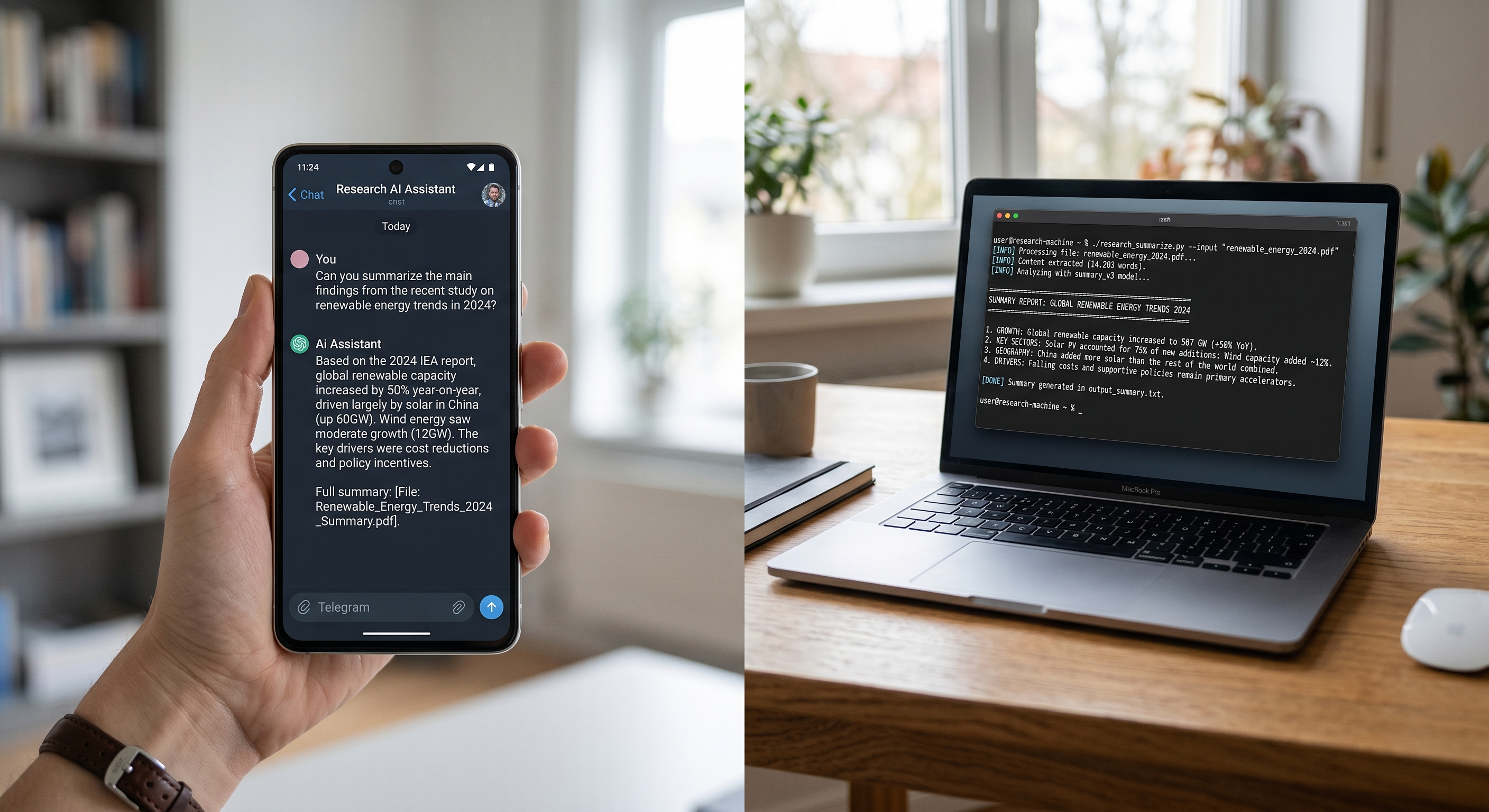
The gateway process connects to Telegram, Discord, Slack, WhatsApp, Signal, and the command line — all from a single running process. Start a research task on Telegram while you are away from your desk. Switch to the CLI when you are back at your computer. The conversation continues with full context across both interfaces.
Voice memo transcription is built in. Send a voice message with a task description, and Hermes processes it alongside text inputs.
The agent is not tied to your laptop. You can run it on a $5 VPS, a GPU cluster, or serverless infrastructure through Daytona or Modal — both of which offer persistent containerized environments that hibernate when idle and wake on demand, costing nearly nothing between sessions. This means you can fire off a long-running research task from your phone, put the phone down, and come back hours later to find the work completed — without keeping any local machine running.
Installation and Getting Started
Installation requires a single command and works on Linux, macOS, WSL2, and Android via Termux:
curl -fsSL https://raw.githubusercontent.com/NousResearch/hermes-agent/main/scripts/install.sh | bash
The installer handles Python, Node.js, dependencies, and the hermes command automatically. No prerequisites beyond git.
After installation:
source ~/.bashrc       # or ~/.zshrc
hermes                 # start the interactive CLI
hermes setup           # run the full setup wizard
hermes model           # choose your LLM provider and model
hermes gateway         # start the messaging gateway
If you are coming from OpenClaw, migration is built in:
hermes claw migrate              # interactive migration
hermes claw migrate --dry-run    # preview what would be migrated
The migration imports your SOUL.md persona file, memories, user-created skills, messaging settings, and API keys. Most users complete the migration in under five minutes. For background on the tool you may be migrating from, see our OpenClaw Clawdbot agentic shift article.
Model Flexibility: Use Any LLM, Switch Instantly
One design decision that matters significantly for long-term use is that Hermes Agent is completely model-agnostic. It connects to over 200 models through OpenRouter, Nous Portal, OpenAI, Anthropic, Kimi/Moonshot, MiniMax, z.ai/GLM, and any OpenAI-compatible endpoint — including local models through Ollama or vLLM.
Switching models requires one command:
hermes model
No code changes. No configuration rewrites. The agent's skills, memory, and user model carry over regardless of which model you switch to. This means you can use a fast, affordable model for routine tasks and switch to a more capable model for complex reasoning — without rebuilding your workflow around each model's specific API. For practitioners who want to compare developer-focused coding assistants, our Claude Code complete guide covers one of the most capable options that Hermes can wrap.
Five Professional Use Cases Where Hermes Delivers Outsized Value
Longitudinal research projects. Research that spans weeks or months — competitive intelligence tracking, technology landscape analysis, ongoing literature review — benefits directly from Hermes's cross-session memory. The agent builds a cumulative understanding of the topic area, recalls previous findings without being re-briefed, and can synthesize across sessions in ways that stateless tools cannot. For a related workflow focused on evergreen research, see our Last30Days AI research skill guide.
Automated recurring workflows. The built-in cron scheduler runs tasks in natural language on any schedule, with delivery to any connected platform. Daily news briefings, weekly competitive summaries, monthly performance audits — these run unattended and deliver results to your Telegram or Slack without any manual triggering.
Complex multi-step development tasks. For developers, the ability to spawn isolated subagents for parallel workstreams means that a task like reviewing a large pull request, running tests, and drafting a summary can be decomposed and run in parallel rather than sequentially. Python RPC scripts can call tools directly, collapsing multi-step pipelines into zero-context-cost turns.
Knowledge management across a team. Teams that run Hermes on shared infrastructure can configure project-specific context files that shape every conversation — ensuring the agent understands the codebase, the client context, or the strategic priorities before any team member starts a session.
RL training data generation. Nous Research built research tooling directly into Hermes — batch trajectory generation, Atropos RL environments, and trajectory compression for training the next generation of tool-calling models. For ML practitioners, this makes Hermes a production environment and a research platform simultaneously.
How Hermes Compares to Other 2026 Agent Frameworks
| Dimension | Hermes Agent | Conventional LLM Chat | OpenClaw-style Skill Agents |
|---|---|---|---|
| Cross-session memory | First-class (SQLite + LLM summary) | None | Optional, user-managed |
| Skill persistence | Auto-generated Markdown skills | None | Manual skill authoring |
| Messaging integration | Telegram, Discord, Slack, WhatsApp, Signal, CLI | Web/app only | Limited |
| Model flexibility | 200+ models via OpenRouter + direct APIs | Single provider | Provider-dependent |
| Self-improvement loop | Yes (Honcho user model + skill accumulation) | No | Partial |
| License | MIT | Proprietary | Varies |
The table isolates the differences that tend to matter for long-term professional use. Hermes is the option that front-loads configuration effort in exchange for compounding returns across months of work. For teams not yet comfortable operating self-hosted infrastructure, a managed alternative may be preferable in the short term.
What Hermes Agent Cannot Do on Its Own
Understanding the boundaries of any tool is essential for using it well.
Hermes Agent excels at extended autonomous tasks — research, analysis, code execution, scheduling, information synthesis. What it does not do is produce professionally formatted visual output. When the agent completes a multi-session research project and produces a structured report or a data synthesis document, that output is typically a Markdown file or a plain text summary. It is intellectually complete but not visually deliverable.
In most professional contexts — presenting findings to a client, briefing leadership on a strategic analysis, sharing research outcomes with stakeholders — the output needs to be a presentation, not a Markdown file.
From Agent Output to Professional Presentation: Closing the Loop With Tosea.ai
This is where Tosea.ai completes the workflow that Hermes Agent starts.
Take the structured document that Hermes produces — a research synthesis, a competitive analysis, a project summary, a technical specification — and upload it to Tosea.ai. The platform's Spatial Semantic Perception engine analyzes the logical structure of the document, identifies the primary arguments and supporting evidence, and generates a consulting-style slide deck that follows the narrative logic of the original content.
Every claim in the output links back to the source document through Absolute Traceability. If a stakeholder challenges a specific figure or finding, you can locate the exact passage in the Hermes-generated research document where it originated. For a closer look at why traceability matters, see our hallucination-free document-to-PPT conversion engineering note.
The output is a native .pptx file, editable in PowerPoint or Google Slides, ready for client review or boardroom delivery.
Hermes Agent handles the intelligence work — the research, the synthesis, the automation, the memory. Tosea.ai handles the delivery — the presentation that communicates that work to the people who need to act on it. The two tools together cover the cycle from task to deliverable.
Frequently Asked Questions
Is Hermes Agent free to use? The framework itself is MIT-licensed and free. You pay only for the LLM calls you make through your chosen provider (OpenAI, Anthropic, OpenRouter, or self-hosted). A $5/month VPS is enough to run the agent continuously.
Does Hermes store my data on Nous Research's servers? No. Hermes runs on infrastructure you control. Memory, skills, and user models are stored locally in a SQLite database on your machine or server. Nous Research does not receive any of your conversation data.
Can I use Hermes without writing any code? Yes, for day-to-day use. The CLI and messaging gateways are interactive. You only need to write code if you want to build custom skills or integrate Hermes into a larger pipeline via Python RPC.
How is Hermes different from Claude Desktop or ChatGPT with custom GPTs? Hosted assistants keep memory within a single product surface. Hermes keeps memory across your entire device fleet (CLI, Telegram, Slack, WhatsApp) and across any LLM you point it at.
What happens to my skills if I switch LLM providers? Skills are stored as Markdown files independent of the underlying model. Switching from GPT-4 to Claude or to a local Llama deployment does not erase them — the new model loads the same skill library.
Get Started With Hermes Agent Today
The full repository and documentation are available at github.com/NousResearch/hermes-agent under the MIT license. The official documentation lives at hermes-agent.nousresearch.com/docs. The community Discord is active, and the agentskills.io skills hub is growing with community-built extensions.
When your agent has done the work and the results need to become a professional presentation, Tosea.ai is ready.