How to Prepare a Thesis Defense Presentation: Complete Guide (2026)
Complete 2026 guide to preparing a thesis defense presentation — structure, slide-by-slide content, Q&A tactics, a rehearsal plan, and a Tosea workflow for the dissertation-to-deck handoff.
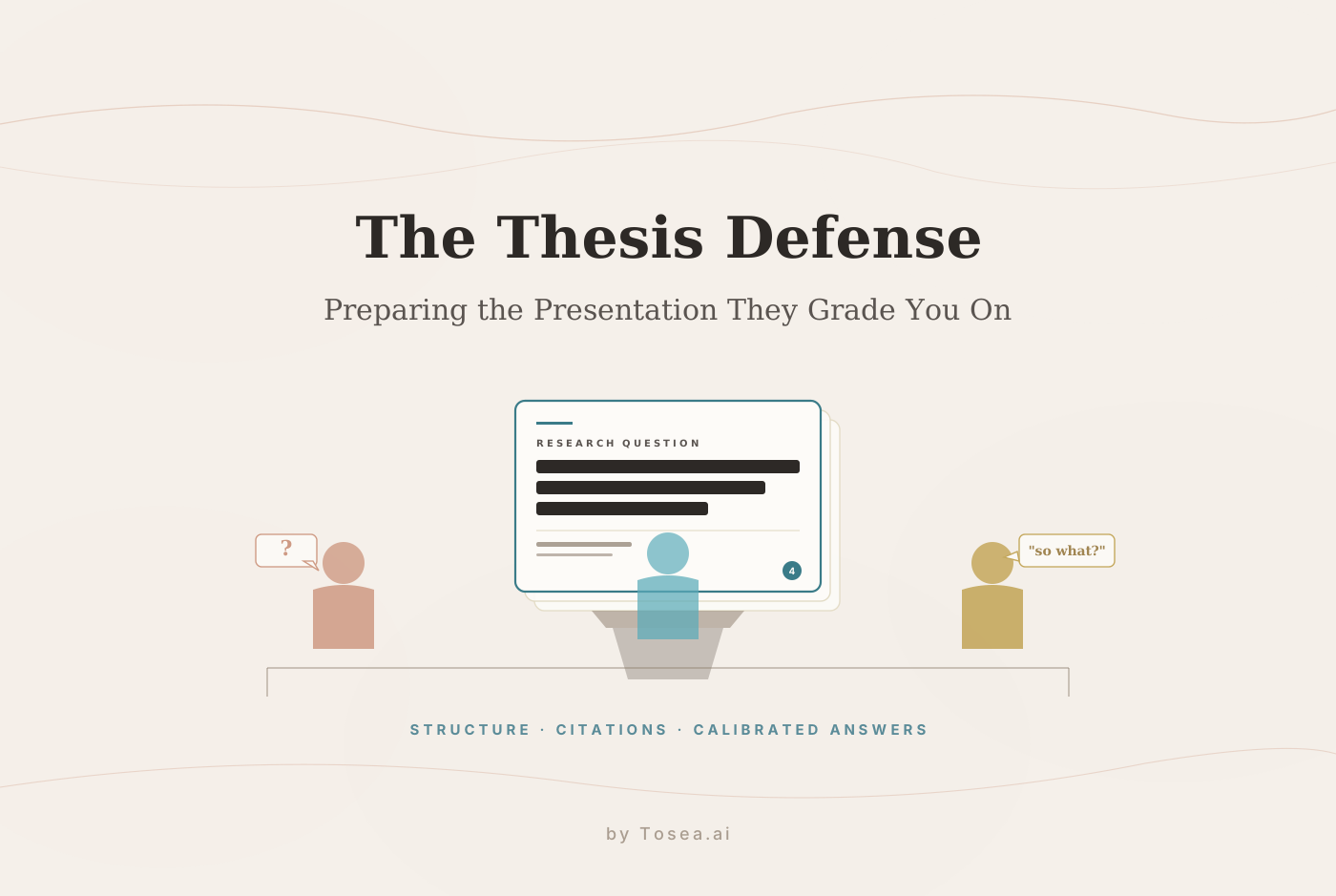
A thesis defense is the only presentation you give where the audience has already read everything you wrote, has the right to ask anything they want, and is empowered to grade you on the spot. Three to five experts who have been thinking about your work for weeks sit across a table and decide whether the last several years of your life pass.
Most graduate programs train you to write a dissertation. Almost none of them train you to present one. This guide walks through what a thesis defense actually requires — the structure that works, what goes on each slide, how to rehearse, how to handle the question that's designed to test whether you actually understand your own paper, and how to convert your dissertation PDF into a defense deck without hand-rebuilding every figure.
The advice draws on practical notes from PhD candidates across business schools, social sciences, and STEM, plus a popular r/HKUniversity Reddit post by an HKU Business School PhD candidate that captures the unwritten conventions especially well. We'll quote it directly later in this guide.
Why Thesis Defense Is Unlike Any Other Presentation You'll Give
A typical academic talk is 12–20 minutes for an audience that has read your abstract at most. A thesis defense is fundamentally different on four axes:
- Length. 30–60 minutes of structured presentation, followed by 30–120 minutes of Q&A. There is no "save it for the bar afterwards." The bar is the Q&A.
- Audience expertise. Your committee has read the dissertation. They will catch the slide that smooths over the inconvenient result. They will notice when you skip the robustness check.
- Format asymmetry. You speak for the first hour. They control the second hour. The deck has to set up the discussion you want, not just survive the talk.
- Outcome. Pass, conditional pass with revisions, or — rarely but really — fail. The presentation is part of the official record.
The implication: a defense deck is not a summary of your dissertation. It is a structured argument that anticipates the questions your committee will ask, told visually, with citations, in the language of your field.
If you are still in the writing phase, our research-paper-to-slides workflow covers the upstream step. If you also have a poster session, see our free academic poster template guide. This article covers the defense itself.
The Three-Act Structure That Works for Most Dissertations
After looking at hundreds of defense decks across disciplines, the same skeleton keeps reappearing. Treat it as a starting point, not a rule:
Act 1 — Why this matters (≈25% of your time). Motivation, real-world stakes, the specific gap in the literature, your research question. This is where committees decide whether to give you the benefit of the doubt for the next hour. Spend on it.
Act 2 — What you did and what you found (≈50% of your time). Methods condensed enough to be defensible, then your findings. One slide per major finding, headlined with the claim (not the variable name). Robustness checks live here too, but skim them — full tables go in the appendix.
Act 3 — What it changes (≈25% of your time). Contribution, limitations, future work. Most students spend too little time here and the committee leaves the room without a clean answer to "what does this paper actually contribute." Don't do that.
The single best test for whether your structure is working: if a committee member only read the slide titles, could they reconstruct your argument? This is the famous "title-as-claim" convention that consulting decks use, and it transfers cleanly to thesis defense. Our McKinsey research findings guide goes deeper on the technique.

What Goes On Each Slide
A 40-minute defense in social sciences typically lands around 22–28 slides. STEM defenses run shorter and denser; humanities defenses run longer with more text. Below is a generic slide-by-slide skeleton — adapt the counts to your discipline.
| # | Slide | Purpose | Time |
|---|---|---|---|
| 1 | Title | Title, author, committee, date | 30s |
| 2 | Roadmap | The 4–5 sections you'll cover | 30s |
| 3 | Motivation | Why this question matters in the world | 1–2 min |
| 4 | Research question | One slide. Big text. The question. | 1 min |
| 5 | Literature gap | What is unknown and why your work fills it | 2–3 min |
| 6 | Conceptual framework | The model / theory you operate inside | 2 min |
| 7–8 | Methods | Data, sample, identification strategy | 3–5 min |
| 9 | Sample / descriptive stats | One slide. The headline numbers | 1–2 min |
| 10–14 | Findings | One slide per major finding, claim-as-title | 8–12 min |
| 15–16 | Robustness / mechanisms | Skim. Refer to appendix. | 2–3 min |
| 17 | Contribution | Three bullets, no more | 2 min |
| 18 | Limitations | What you'd do with another year | 1–2 min |
| 19 | Future work | Two or three concrete extensions | 1 min |
| 20 | Acknowledgements | Advisor, committee, funding, lab | 30s |
| 21 | Q&A | Just the title, optionally a thank-you image | — |
| 22+ | Appendix / backup | Full regression tables, robustness, theory derivations, ethics review, replication notes | — |
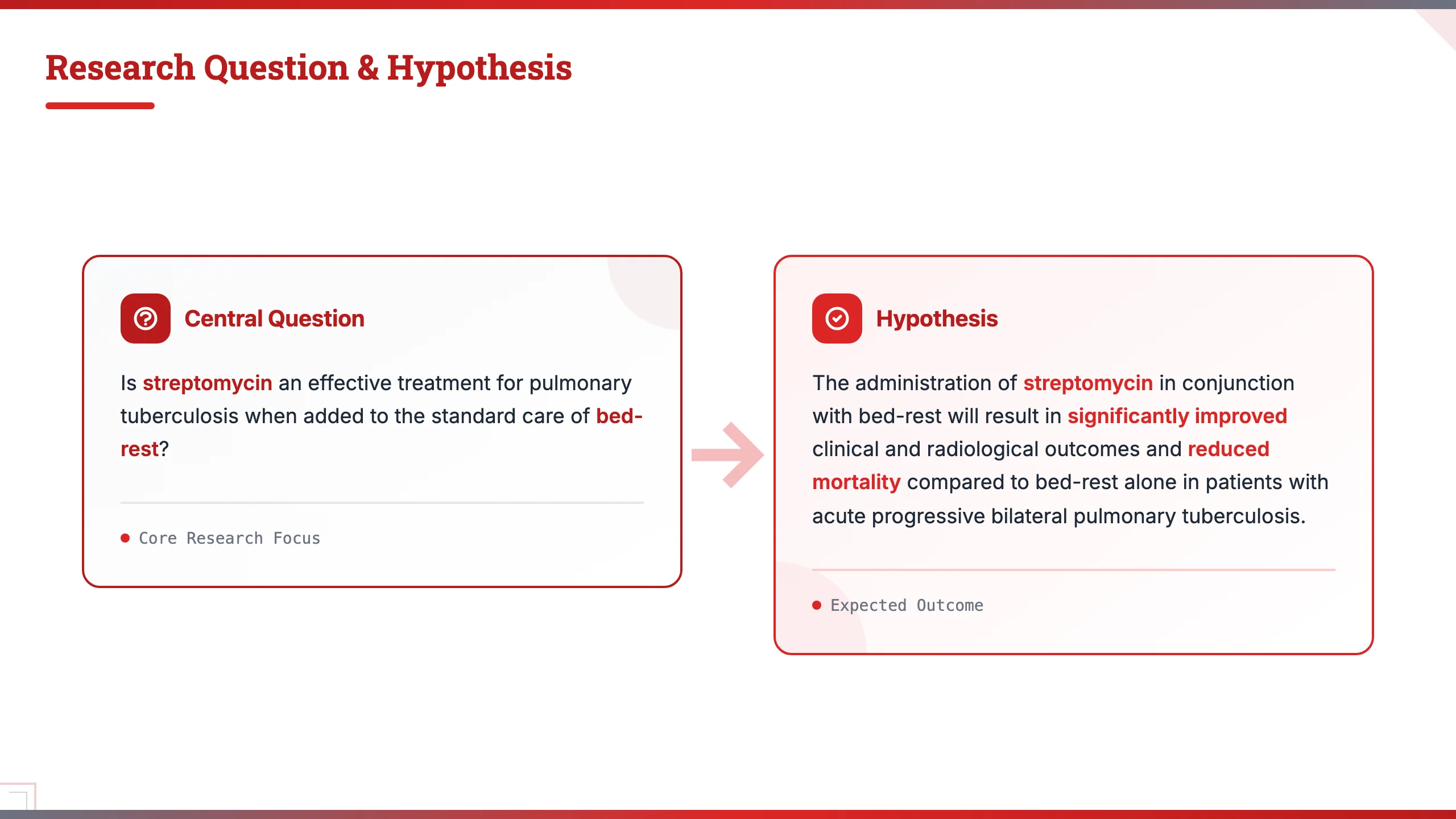
The research question slide is the slide your committee will return to during Q&A. It should be one sentence, large enough to read from the back of the room, and phrased exactly the way you would defend it under pressure. If you are unsure whether your research question is clearly stated, you are not yet ready to defend.
The findings slides are where most defenses live or die. The convention that translates best from consulting decks: the title is the claim, not the variable. "Streptomycin reduces mortality by 28% in acute pulmonary tuberculosis" — not "Mortality outcomes by treatment group." The reader should be able to read titles only and follow your argument.
Lessons from a HKU Business School PhD: Five Tactics That Translate Directly
The single best non-academic write-up of academic-presentation craft I've come across is a popular post on r/HKUniversity by a third-year HKU Business School PhD candidate, titled "the presentation skill nobody teaches you but everyone judges you on." The post ranks on the first page of Google for "hku presentation skill" and is the kind of unwritten-rules guide that PhD students in any business school recognize immediately. The five tactics map directly onto thesis defense; here they are with notes on how to apply each one to a defense specifically.
1. The "so what" test. The OP writes: "Every slide needs to answer 'so what does this mean for the argument I'm making.' In business school especially, professors will interrupt you mid-slide if the slide doesn't earn its place." On a defense deck this is even sharper — your committee has already read the dissertation, so any slide that just restates without advancing the argument feels like padding. Run every slide through the so-what test before the rehearsal.
2. The transition slides matter more than the title slide. The OP again: "Your title slide is not the important one. Your transition slides are. The moments where you're moving from literature review → hypothesis, or from method → results — those are where audiences get lost." For a defense, the high-risk transitions are usually motivation → research question, methods → findings, and findings → contribution. Build a real bridge slide at each one — a single sentence that names what you just established and what you're about to argue.
3. Data density is a trap. "Pick the 2–3 numbers that matter and make them impossible to miss. Put the full table in the appendix. Nobody has ever said 'I wish your slide had more standard errors on it.'" This is the single most common defense-deck failure mode in business and economics: a slide with 14 columns of regression coefficients, the committee reads the table and asks about a coefficient you didn't plan to discuss, you lose four minutes. Pull the 2–3 numbers you actually want to argue from. Park everything else in the appendix.
4. Rehearse out loud, alone, three times minimum. "Reading through your slides in your head is not rehearsing. The sentences you'll actually say are different from the ones you think in, and you find this out only by saying them. Record on your phone — it's painful but it's the single highest-ROI thing you can do." This is so universally true and so universally ignored that it bears repeating. The voice memo on your phone is enough. You will hear "um, basically, kind of" and you'll hear yourself burn 90 seconds on slide 6.
5. Handle "that question." "In every HKU business seminar there's at least one senior faculty member who asks a question specifically designed to test whether you actually understand your own paper. The right answer is rarely to defend — it's to acknowledge the real version of the critique, then say what you'd do differently / what you've already done to address it. Panicking or over-defending is the #1 way PhD students tank their own talks." Take this one to heart. The next section is dedicated to it.
How to Handle the Q&A — The Section Most Students Underprepare
If you have prepared the deck well, the talk itself is largely solved. The defense passes or fails in the Q&A. The four most common question shapes:
The "so what" question. A committee member asks why the contribution matters. The wrong answer is to repeat your contribution slide louder. The right answer names the specific downstream consequence: "If this finding holds, then the standard model in [X area] needs to be revised because it assumes [Y]." Concrete, specific, points outward.
The "what about [X paper]" question. A senior member of the field cites a paper you didn't engage with. Three responses, in order of preference: (a) "Yes, I read it — here's how my approach differs"; (b) "I'm aware of it but didn't include it because [reason]"; (c) "I haven't read that one — could you point me to which result you have in mind?" Honesty is fine. Bluffing is not.
The methodology challenge. "Your identification strategy doesn't address [endogeneity / selection / bias]." This is where the OP's tactic 5 really lives: acknowledge the real version of the critique, do not retreat to the version you already addressed in chapter 3. "You're right that the strategy doesn't fully address [Y]; what I did was [Z], and a fuller treatment would require [data / experiment we don't have]." Done.
The "this isn't your contribution" trap. "Doesn't this just replicate [paper X]?" Stay calm. The right move is to name the exact margin of difference: a different sample, a different identification, a different mechanism, a different prediction. "Paper X established [Y]. My contribution is [Z], which is distinct because [the specific thing]." Practice this answer for every paper that's close to yours.
When you genuinely don't know an answer, say so and offer to follow up. Committees respect calibrated uncertainty far more than they respect confident bluffing. "I haven't run that specification — I'd like to think about it; my intuition is [X] but I'd want to check before I commit" is a perfectly acceptable answer in a defense.
Visual Design: What Actually Matters in a Defense Deck
Most academic defense decks are visually under-designed. You don't need to over-correct the other way — your committee is not impressed by motion graphics — but a few things matter a lot:
- Title-as-claim, every time. "Effect of treatment on outcome" is not a slide title. "Treatment reduces outcome by 28% in the high-risk subgroup" is.
- One chart, one claim. A figure that's shared between three different arguments is a figure that fails all three. Either duplicate the figure on three slides with three different titles, or pick the one argument that figure is best at and write the others as text.
- Reading distance. If you can't read a slide from 5 meters away in a printed handout, your committee can't read it on the projector. Body text 24pt minimum, chart axis labels 18pt minimum, citations 14pt.
- Citation discipline. Every empirical claim from the literature gets a parenthetical citation on the slide. Every claim of your own gets a footnote pointing to the chapter and page in the dissertation. This is the same architecture we wrote about in our zero-hallucination AI slides guide: the slide and the source must be linked.
- Color sparingly, accent purposefully. One accent color for the headline number on each findings slide. Everything else neutral. The eye should be told exactly where to land.
- Consistent slide template. Pick one. Stick with it. A defense deck that switches typography between sections looks rushed. The Tosea HTML template gallery includes purpose-built academic systems —
cambridge_blue,stanford_cardinal,oxford_classic,mit_tech,nature_science,academic_blue_amber,paper_editorial— any of which carry a defense without distracting.
If you want to go deeper on the "code-renders-each-slide" vs "image-model-paints-each-slide" decision, see our HTML vs image AI slide generation guide. For a defense, HTML mode is almost always the right answer: text remains text, citations stay clickable, and the deck stays editable up to the morning of the defense.

How Tosea.ai Handles the Dissertation → Defense Deck Workflow
The deck-building step is where most defending students lose a week they don't have. The dissertation already exists; rebuilding the same figures and tables inside PowerPoint or Google Slides by hand is a poor use of the last fortnight. Tosea.ai's research paper presentation maker is built for this exact handoff.
Step 1 — Drop the dissertation. Upload your dissertation PDF (or markdown / Word source). Tosea's Spatial Semantic Perception engine reads the logical hierarchy of the document — chapters, sections, claims, tables, figures, citations — and constructs an outline that mirrors the structure of your argument, not just the chapter numbers.
Step 2 — Pick an academic template. Choose an HTML template from the academic category (cambridge_blue, stanford_cardinal, oxford_classic, mit_tech). HTML mode is the right choice here for the reasons above — every text element is editable, every citation is a real link, and the export to .pptx keeps text as text.
Step 3 — Generate the first draft. Tosea drafts a 22–28 slide deck following the structure outlined earlier in this guide, with one slide per major finding, your charts and tables imported from the source, and citation footnotes auto-attached to claims that came from the literature review. This is a first draft, not a finished deck — the human editing pass is what turns it into a defense.
Step 4 — Refine in plain language. Edit any slide directly. Change a chart, swap a number, rephrase a claim, add a transition slide between sections. Because every claim is linked to its source via Absolute Traceability — the same architecture we cover in our hallucination-free document-to-PPT framework — when your advisor asks "where did you get this number?" you can locate the exact passage in the dissertation in one click.
Step 5 — Export and finalize. Export to native .pptx, edit final layout details in PowerPoint or Google Slides, save the appendix backup slides separately, and you're done. For longer dissertations that need 60+ slide builds, our massive slide deck workflow covers the operational pattern.
For graduate students specifically, our academic researchers cutting presentation time with AI piece and the free trial guide for academics walk through the day-to-day workflow at the lab/cohort level.
Pre-Defense Rehearsal Plan: Two Weeks Out
Spread your preparation across two weeks. Cramming the day before makes the deck better and the talk worse.
Two weeks out — Deck v1 with advisor. Generate the first draft, hand-edit the structural slides (research question, contribution, limitations), share with your advisor for a structural review. Goal: agree on the spine of the argument before polishing.
One week out — Full rehearsal with lab or cohort. Run the full talk start to finish for two or three peers — ideally including someone outside your sub-field who can flag where you lose them. Take questions afterward. Note every question that catches you off-guard; those are the ones that will reappear in Q&A.
Three days out — Solo rehearsal, recorded. Voice memo on your phone. Two full passes. Listen back at 1.5x. Cut the slides where you ramble. Rewrite the transitions where you stutter. The OP's tactic 4, applied seriously.
Day before — Stop editing. Read the deck through once silently. Print the appendix. Check the projector adapter, the file format, the room booking. Do not change content. Last-minute edits are the #1 cause of defense-deck typos and broken transitions.
Morning of — Light routine. Eat something. Drink water. Don't change your caffeine pattern. Get to the room early, plug in the laptop, advance through every slide once to confirm fonts, animations, and embedded videos render. Then sit down. Breathe.
Discipline-Specific Notes
STEM defenses are typically shorter (20–30 minutes presentation, equation-heavy) and the appendix is enormous. Use mit_tech or nature_science templates, prioritize equation legibility, and lean hard on the appendix for derivations. The zero-hallucination architecture matters most here because numerical precision is the standard your committee will hold you to.
Social sciences and business defenses sit in the middle: 30–45 minutes presentation, regression-table heavy, identification strategy is usually the most contested point. The HKU Business School Reddit post above is calibrated for this audience. Templates: stanford_cardinal, boardroom_amber, executive_platinum for a business-school crossover, cambridge_blue for a more humanities-leaning department.
Humanities defenses are longer (often 60 minutes presentation), text-heavier, and the citation discipline is the highest of any discipline. oxford_classic, paper_editorial, and cambridge_blue are the natural templates. Read your slides as written prose, not as bullet points.
Final Checklist
The morning before you walk in, run through this:
- Research question slide is one sentence and readable from the back row
- Every findings slide title is a claim, not a variable name
- Every literature claim has a parenthetical citation on the slide
- Every chart has its source labelled
- Appendix contains full regression tables, robustness checks, ethics review, replication notes
- Transition slides exist at motivation → question, methods → findings, findings → contribution
- You have rehearsed out loud, recorded, at least three times
- You have sat with at least three "that question" rehearsal questions and your answers
- Your laptop has the file and a backup is on a USB drive and in your email
- Adapter, clicker, and water bottle packed
- You know the room number, the start time, and the door you walk in
- You have eaten
You've earned this. The committee already knows the work is good — that's why they let you defend. The defense is about confirming you can talk about it.
Sources
- PhD at HKU Business School — the presentation skill nobody teaches you but everyone judges you on — r/HKUniversity, anonymous third-year HKU Business School PhD candidate. The five tactics quoted in this guide.
- Mastering High-Quality Presentations with AI 2026 — Tosea companion guide on broader presentation craft
- Zero-Hallucination AI Slides Complete Guide (2026) — the source-first architecture behind defense-grade citation discipline
- McKinsey Way to Present Research Findings — title-as-claim convention adapted from consulting