How Academic Researchers Are Cutting Presentation Time from 3 Hours to 30 Minutes with AI
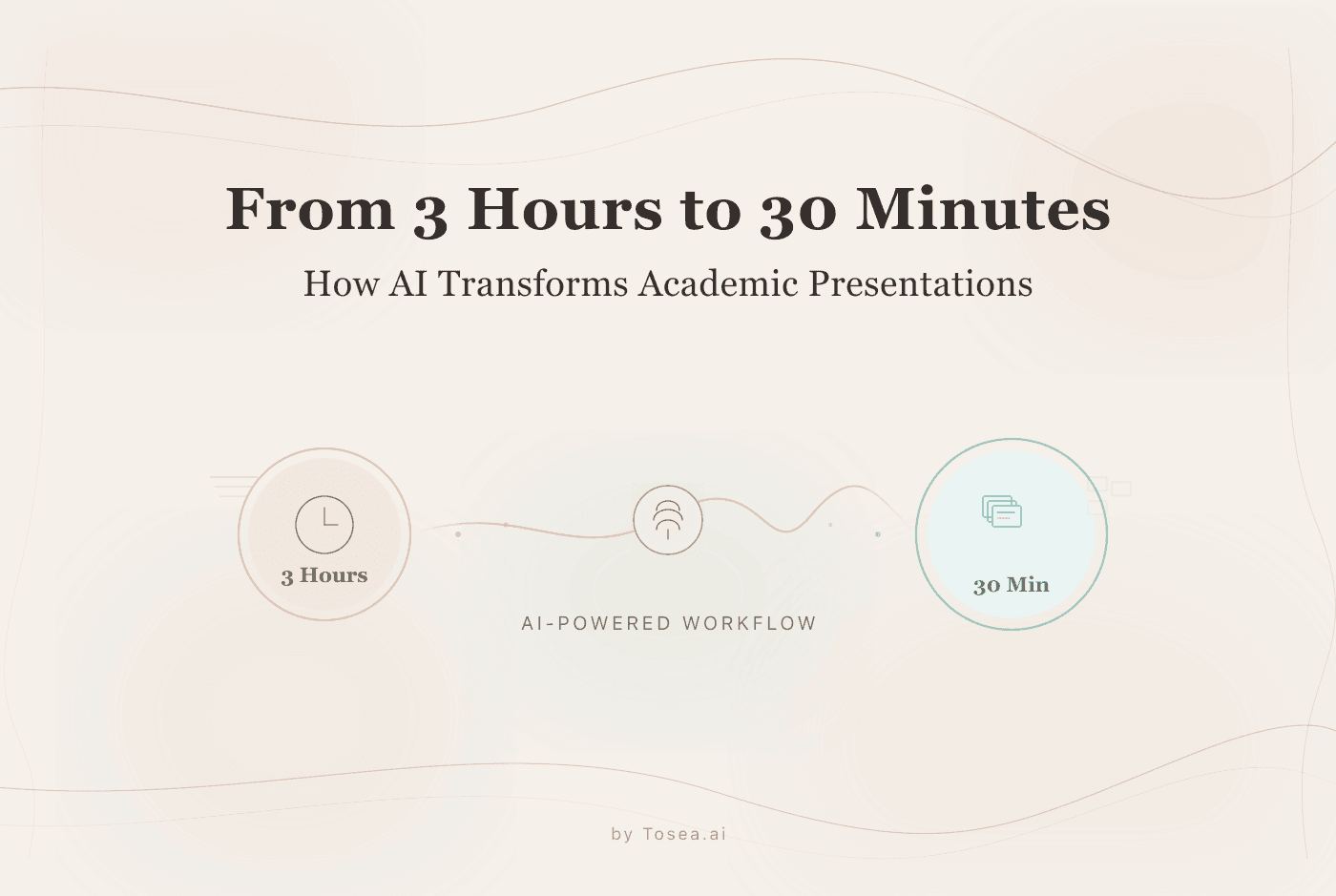
How a research team at HKU used AI agents to reduce presentation prep from 3 hours to 30 minutes while improving quality.
It was 2 AM in the economics department at the University of Hong Kong, and Dr. Sarah Chen was still wrestling with PowerPoint. Her regression tables looked fine in Stata, but transferring them to slides meant endless copying, pasting, and reformatting. The conference presentation was in eight hours, and she hadn't even started on the visualizations yet. This scene plays out in research institutions worldwide, night after night—brilliant minds spending precious hours on mechanical tasks that have nothing to do with actual research.
What if this entire bottleneck could simply disappear?
That's exactly what happened when Dr. Chen's team started using Tosea.ai three months ago. The same presentation that would have consumed her entire evening now takes less time than her morning coffee break. She's not cutting corners or sacrificing quality. In fact, her presentations have gotten noticeably better. She's just stopped doing work that an AI agent can handle more efficiently than any human ever could.
The Hidden Tax on Academic Productivity
Academic researchers face a peculiar form of professional frustration. Their job is to discover new knowledge, yet they spend an outsized amount of time on presentation logistics that contribute nothing to intellectual advancement. The typical workflow for preparing an academic presentation reveals the dysfunction clearly.
First, you run your econometric models in Stata or R, carefully constructing difference-in-difference estimations or instrumental variable regressions. Then comes the tedious part. You export regression tables, manually adjust decimal places, and format them to match academic standards. You create visualizations, save them as image files, and import them into PowerPoint one by one. You build slide templates, adjust font sizes, align text boxes, and wrestle with inconsistent spacing. By the time you're done, hours have vanished into purely mechanical work.
A recent survey of economics PhD students found they spend an average of 15 to 20 hours per month just on presentation preparation, not including the actual research or writing. For senior faculty juggling multiple projects, the number climbs even higher. This represents an extraordinary waste of human capital—trained researchers performing tasks that require no specialized knowledge whatsoever.
The problem intensifies as academic output accelerates globally. Researchers present more frequently at conferences, departmental seminars, and workshops. Each presentation demands the same laborious process of translating analytical results into visual communication.
When AI Meets Econometric Workflows
The research team at Hong Kong University saw a dramatic improvement when they integrated Tosea.ai into their workflow. A task that previously consumed three to four hours of focused work now required only about 30 minutes from start to finish—a significant efficiency gain that changed how they approached presentation preparation.
The transformation began with a simple test. The team had a panel dataset examining provincial-level policy interventions in China. Their analysis required a difference-in-difference model with individual and time fixed effects, standard errors clustered at the provincial level, and several robustness checks including placebo tests. Traditionally, this would mean running the models in Stata, exporting multiple regression tables, creating coefficient plots, designing event study graphs, and manually assembling everything in PowerPoint while maintaining consistent formatting throughout.
Instead, they uploaded their raw dataset to Tosea.ai and described their research design in plain language. No code writing, no manual data manipulation, no export-import cycles. The system understood the analytical requirements, identified the appropriate econometric specifications, cleaned and structured the data automatically, ran the models, generated publication-quality tables and figures, and assembled everything into a coherent presentation with proper academic formatting.
What struck the team most wasn't just the speed but the quality. The generated slides followed academic presentation conventions they hadn't even explicitly specified. Regression tables used standard formats from top economics journals. Visualization color schemes were colorblind-friendly. Slide layouts maintained visual hierarchy that guided audience attention appropriately. The system wasn't just automating grunt work—it was applying professional design judgment they would normally develop through years of trial and error.
The Architecture of an Academic AI Agent
Understanding why Tosea.ai performs so differently from generic AI tools requires looking at how it's actually built. Most people's experience with AI for academic work involves general-purpose language models that can write text or generate images but lack specialized knowledge of econometric methods, academic conventions, or research workflows. These tools force users to become prompt engineers, carefully crafting detailed instructions to coax out acceptable results.
Tosea.ai takes a different approach by embedding domain expertise directly into its architecture. Instead of relying on a general language model to improvise econometric analysis, the system integrates a library of validated statistical methods. When you request a difference-in-difference analysis, the agent isn't generating code from scratch based on pattern matching—it's invoking tested implementations of the DID estimator with appropriate standard error corrections, sensitivity checks, and diagnostic tests built in.
This matters enormously for research credibility. Econometric methods have subtle requirements that generic code generation frequently misses. Instrumental variable estimation requires testing instrument strength and checking for weak instrument problems. Regression discontinuity designs need bandwidth selection and multiple specification checks. Propensity score matching demands common support verification and balance tests. The agent handles these technical requirements automatically because they're encoded into its methodological library, not left to probabilistic code generation.
The system also includes autonomous error correction capabilities. When code encounters problems during execution—missing variables, data type mismatches, convergence failures—the agent doesn't simply return an error message and wait for human intervention. It analyzes the error, diagnoses the underlying issue, modifies its approach, and attempts execution again. This self-correction loop continues until it either succeeds or determines the problem requires human judgment about research design choices.
During testing, the HKU team deliberately fed the system messy, real-world data with all the problems that normally derail automated analysis. Province names had inconsistent spellings. Time periods had gaps. Some variables contained outliers that would distort regression results. The agent navigated these issues autonomously, standardizing naming conventions, interpolating missing time periods appropriately, and flagging outliers for researcher review rather than blindly including them.
Conversational Research Design
Perhaps the most transformative aspect of working with Tosea.ai is how it changes the relationship between researchers and their analytical tools. Traditional statistical software requires you to translate research questions into precise technical commands. You think in concepts like "treatment effect heterogeneity across subgroups," but you must express that thought as specific variable interactions, sample splits, and post-estimation commands. This translation process creates friction and cognitive load.
Tosea.ai inverts this dynamic through natural language interaction. You describe your research design the way you'd explain it to a colleague, and the agent handles the technical implementation. Want to check if your main results hold when you exclude the largest cities? Just say so. Curious whether using logged GDP instead of levels changes your coefficients? Ask for that variation. Need to split your sample by coastal versus inland provinces? Describe the split you want.
This conversational approach enables rapid iteration that's nearly impossible with traditional workflows. In conventional research, testing a new specification means writing additional code, debugging it, running the analysis, exporting new results, and updating your presentation. Each cycle takes time, so researchers naturally limit how many variations they explore. With Tosea.ai, iteration happens at the speed of conversation. You can test alternative specifications, compare different econometric approaches, and generate multiple presentation versions in the time it would traditionally take to prepare a single slide deck.
After generating an initial slide deck, you might notice that coefficient magnitudes would be clearer if expressed as percentage changes rather than raw coefficients. In the traditional workflow, this would require recalculating everything manually. With Tosea.ai, you simply request the modification and the system regenerates affected slides while maintaining formatting consistency throughout. The same applies to switching between regression table formats, adjusting visualization styles, or reorganizing slide sequences.
One researcher described the experience as finally having a research assistant who never gets tired, never makes transcription errors, and understands econometric nuances without requiring detailed supervision. The comparison isn't quite accurate—the system doesn't replace human judgment about research design—but it captures the feeling of having tedious execution work reliably handled so you can focus on intellectual questions.
Transparency Through Visualization
Academic research demands reproducibility and transparency. When you present regression results, skeptical colleagues should be able to trace exactly how you arrived at those numbers. This requirement creates tension with AI automation because "black box" systems that produce outputs without showing their work undermine research credibility.
Tosea.ai addresses this challenge through comprehensive workflow visualization. Rather than hiding its analytical process, the platform makes every step observable. When the agent processes your data and runs analysis, you can see exactly what it's doing in real time through an interactive interface that displays the analytical workflow, the actual code being executed, the output from each analytical step, the agent's reasoning when it encounters problems, and the modifications it makes during self-correction.
This transparency serves multiple purposes. For experienced researchers, visibility into the agent's workflow enables quality verification. You can spot if the agent misinterpreted your research design, catch if it's using an inappropriate specification, and intervene if it makes assumptions you disagree with. The system becomes a collaborative partner whose work you can review and refine rather than a black box whose output you must accept on faith.
For junior researchers and students, the observable workflow creates powerful learning opportunities. Watching the agent handle data cleaning, construct proper fixed effects specifications, and generate academic-quality visualizations demonstrates best practices in action. Students see how experienced researchers structure econometric analysis, what diagnostic tests they run, and how they present results professionally.
The research team at HKU is leveraging this transparency for an ambitious project. They're designing a randomized controlled trial to study how AI agents affect learning outcomes in econometrics education. The experiment will compare students learning traditional methods through conventional instruction versus students who learn by working alongside Tosea.ai while observing its analytical workflow.
Building on Established Research
The academic value of AI agents like Tosea.ai isn't just a matter of internal experience or anecdotal reports. Broader research on AI integration in educational and professional settings provides empirical grounding for these efficiency claims.
The Brookings Institution recently published analysis examining how AI systems are reshaping higher education and research institutions. Their findings emphasize that well-designed AI tools don't simply speed up existing processes—they alter what's possible by removing bottlenecks that previously constrained what individuals and teams could accomplish. When researchers spend less time on mechanical tasks, they tackle more ambitious projects and engage more deeply with the intellectual substance of their work.
Similar patterns appear in professional services research. PwC's 2025 survey of organizations implementing agentic AI found that 66% reported substantial productivity improvements, with the largest gains occurring in tasks involving data analysis and routine coordination work.
Research on econometric methodology provides additional context for why embedded domain expertise matters. Work by economists like Joshua Angrist and Jörn-Steffen Pischke has emphasized that credible causal inference requires rigorous attention to specification details, diagnostic testing, and robustness checks. Generic AI systems that generate code without understanding these methodological requirements often produce analyses that look superficially reasonable but violate important assumptions. Tosea.ai's integration of validated econometric methods directly addresses this quality concern.
Rethinking Academic Workflows
The deeper implication of tools like Tosea.ai extends beyond individual productivity gains. The traditional research workflow evolved during an era when human time and computer time had very different economics. Computers were expensive, so researchers invested substantial effort in careful manual preparation to minimize computational costs. Today that relationship has inverted—computational resources are abundant and cheap, while human attention from trained researchers is scarce and valuable.
AI agents create opportunities to redesign academic workflows around the actual bottleneck of human intellectual contribution. Instead of researchers spending hours translating analytical results into presentation format, they could spend that time on deeper engagement with theoretical implications, more thorough literature integration, or more creative research design.
Early adopters are already experiencing these shifts. Researchers report that liberating time from presentation preparation changes not just their productivity but their thinking. When you know you can rapidly generate presentations for alternative specifications or different audiences, you think more expansively about testing hypotheses and communicating to diverse constituencies.
Looking Forward
The transformation is still in its early stages. Current capabilities focus primarily on presentation generation from completed analysis, but the trajectory points toward deeper integration throughout the research lifecycle—real-time research design consultation, automated literature synthesis, and collaborative multi-researcher workflows.
For individual researchers, the choice increasingly isn't between traditional methods and AI assistance but rather between different forms of AI assistance with vastly different quality levels. Generic tools that lack domain expertise will continue producing superficially plausible but methodologically questionable output. Specialized agents built around validated domain knowledge offer something qualitatively different—genuine augmentation of researcher capabilities.
The HKU team stumbled onto these possibilities almost by accident when they tested Tosea.ai on a routine presentation task. What they discovered was that eliminating the tedious mechanics of presentation preparation didn't just save time. It changed how they approached research communication, enabling them to explore ideas more thoroughly and present results more effectively.
That question applies far beyond any single tool. It asks us to reconsider how we organize intellectual work in an era when AI can competently handle an expanding range of routine cognitive tasks. The researchers who thrive in this environment will be those who thoughtfully integrate AI assistance in ways that amplify their distinctly human capacities—creativity, judgment, and the ability to ask questions that no algorithm would think to pose.
If you spend hours each week on presentation preparation that adds nothing to your intellectual contribution, it may be worth exploring whether AI agents like Tosea.ai can recover that time for more valuable work.