Why the Fear of AI Obsolescence is Redefining Professional Stakes
Elite students are dropping out over AI fears. What this trend means for professionals navigating career strategy in the age of agentic AI.
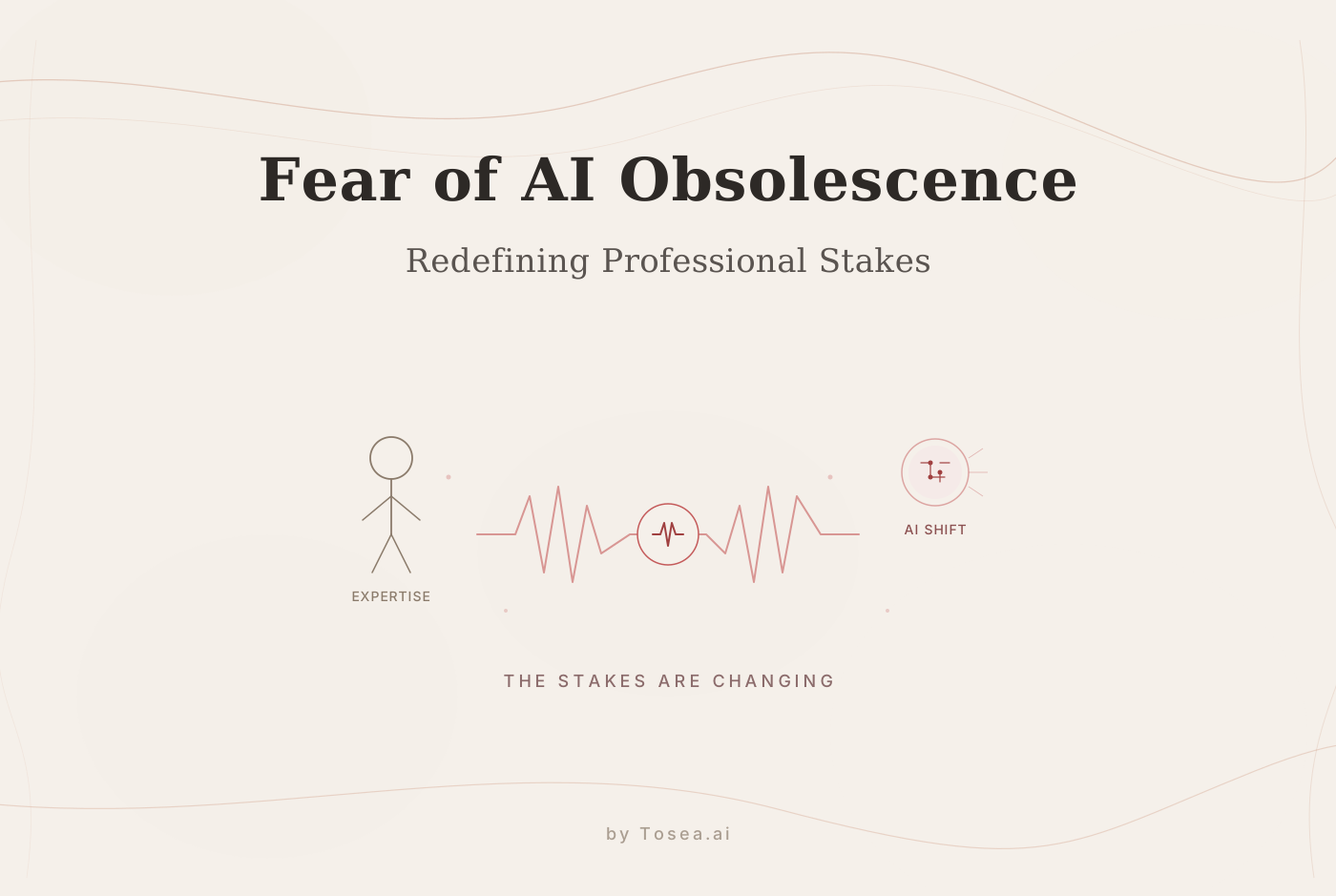
The halls of Harvard and MIT have historically been launchpads for ambitious founders. In the past, students like Bill Gates or Mark Zuckerberg left their programs because they had built something so profitable that the university schedule became a constraint. But as we move through 2026, a different trend is emerging. A growing number of elite students are leaving their programs not because of a specific startup opportunity, but because of a broader anxiety about the pace of AI advancement.
Reports from the current academic year suggest that some students are reconsidering the value of a four-year degree in the face of rapid AI progress. Their reasoning is straightforward: if the skills they're learning today might be automated by graduation, the opportunity cost of staying in school looks different than it did five years ago.
This shift highlights two anxieties that extend well beyond the ivory tower: the fear of economic obsolescence and the fear of missing a critical window. For working professionals, the underlying question is the same — how do you stay relevant when the tools and skills you rely on are evolving faster than any curriculum can keep up?
The Credential Question: Is the Degree Losing Its Edge?
The traditional four-year curriculum was designed for a world where professional knowledge shifted slowly. A computer science student at Harvard in 2010 could reasonably expect that the frameworks and languages they learned would remain relevant for a decade. That assumption no longer holds.
Recent surveys by the Harvard Undergraduate Association suggest that nearly half of the student body is concerned about AI's impact on their career prospects before they even graduate. When a freshman spends months mastering a specific coding framework or statistical methodology, only to see an AI model commoditize that skill within weeks, the value proposition of classroom learning changes.
When Knowledge Decays Faster Than Curricula Adapt
This isn't a new phenomenon — technology has always moved faster than universities. But the current pace is qualitatively different. In previous technology cycles, new tools made existing skills more productive. A spreadsheet didn't replace the accountant; it made them faster. The concern with AI agents is that they don't just augment existing skills — in some cases, they perform the entire task.
For practical, execution-focused skills — data cleaning, basic statistical analysis, report formatting, slide deck creation — AI agents are already performing at or above the level of a junior professional. This puts pressure on anyone whose primary value comes from executing routine knowledge work.
That said, the "degree is dead" narrative is almost certainly overblown. Credentials still serve as strong signals of persistence, critical thinking ability, and social capital. What's changing is the relative importance of different skills within a degree program. The ability to frame problems, exercise judgment, and communicate complex ideas is becoming more valuable, while pure execution skills are becoming less so.
The Strategic Dropout: Proximity Over Credentials
One of the more interesting aspects of the current dropout trend is where these students are going. They aren't all starting the next unicorn. Some are taking roles at AI safety organizations, research labs, or infrastructure companies — positions that prioritize proximity to frontier AI development over prestige or salary.
The Logic of Influence
This isn't a lack of ambition; it's a strategic calculation. In a world where AI development is moving rapidly, being inside the organizations shaping these systems — understanding their capabilities and limitations firsthand — may provide more career optionality than a degree that's still two years from completion.
The highly publicized cases are compelling: students leaving MIT to do technical writing at Anthropic, or dropping out of Stanford to join early-stage AI infrastructure companies. They're betting that hands-on experience with frontier AI systems provides a better foundation for the next decade than coursework designed in the last one.
What This Means for Working Professionals
You don't need to drop out of anything to apply this insight. The key takeaway is that direct engagement with AI tools — understanding their capabilities, limitations, and failure modes — is rapidly becoming a professional necessity.
For researchers, this means using AI agents to handle the mechanical portions of their work (data processing, visualization, slide creation) while focusing their own time on the intellectual tasks that AI can't do: formulating research questions, exercising methodological judgment, and interpreting results in context.
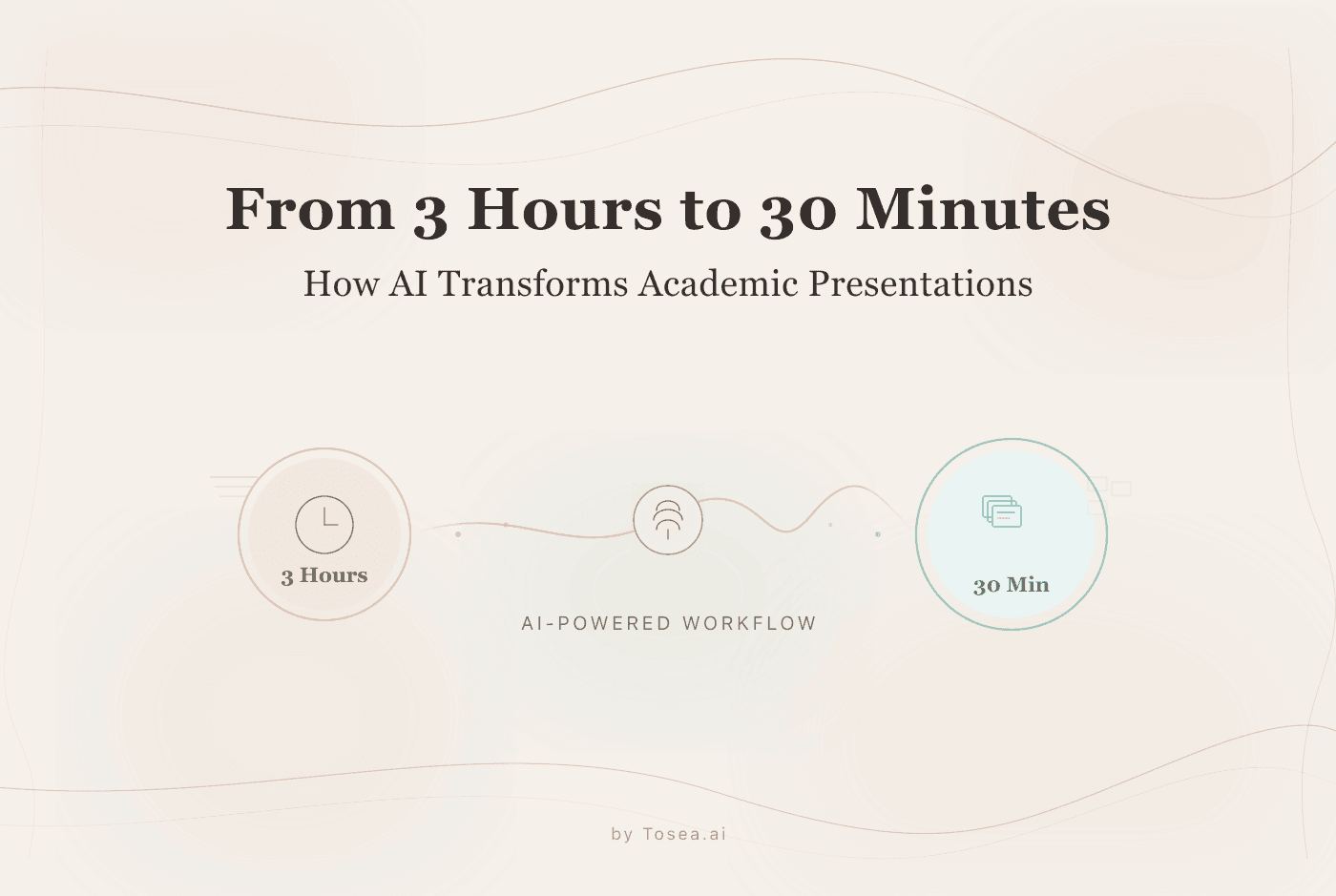
For corporate professionals, it means moving from manually executing workflows to designing and supervising agentic processes — spending less time inside the tools and more time deciding what the tools should produce. Tosea.ai, for instance, lets you feed raw data into a multi-agent pipeline and get a finished presentation back — skipping the hours of manual spreadsheet-to-slide transfer so your time goes toward the strategic decisions that the data informs.
The Two Camps: Doomers and Builders
The motivations behind the dropout trend split into two distinct worldviews:
The Safety Camp
A significant cohort believes that the development of increasingly capable AI systems poses real risks that need to be managed now, not after the systems are deployed. For them, contributing to AI alignment and safety research during this critical period is more urgent than completing a degree. The reasoning is emotional but not irrational — if you genuinely believe the next few years will determine how AI development unfolds, sitting in a lecture hall feels like misplaced priorities.
The Builder Camp
The second group is motivated by market opportunity. They see the current AI wave as a gold rush where early movers will build the infrastructure that everyone else eventually relies on. Companies like Mercor and Anysphere were founded by students who left prestigious programs to secure their position before the window closed. For this group, the calculus is simply that the best learning happens by building, and the best time to build is when the market is still forming.
The Middle Path: Accelerating Without Abandoning
For the vast majority of professionals — who can't simply walk away from their careers or educational commitments — the real question is how to gain the speed and AI fluency of the "dropout" mindset while maintaining the stability of their current trajectory.
The answer isn't dramatic. It starts with integrating AI agents into your daily workflow in concrete ways:
-
For researchers: Use AI presentation tools to eliminate the hours spent on slide formatting. Spend that time on deeper analysis instead. When your conference presentation is due in 48 hours, having an AI agent handle the data-to-slides pipeline means you can focus on refining your arguments rather than wrestling with PowerPoint.
-
For consultants: Adopt multi-agent workflows that handle data cleaning, visualization, and initial narrative drafting. Your value is in the strategic framing and client relationship, not in the mechanical assembly of a slide deck.
-
For students still in school: Treat AI tools as accelerators for your coursework, not replacements. Use them to explore more hypotheses, test more specifications, and produce higher-quality presentations — then spend the saved time going deeper on the intellectual substance.
The Trust Paradox: Credentials vs. Competence
There's a compelling counter-argument to the dropout narrative: if AI makes technical skills abundant, then signals of trustworthiness — degrees, track records, institutional affiliations — become more valuable, not less. A Harvard degree has never been purely about the knowledge acquired; it's a signal of grit, ability, and social capital.
But even with strong credentials, you still need to deliver results. A polished degree gets you into the room; your work keeps you there. The intersection of human judgment and AI capability is exactly where professional credibility is built or lost.
Building Trust Through Transparency
In professional settings, one of the biggest concerns about AI-assisted work is accountability. If an AI agent generates your analysis and slides, can you defend the methodology? Observable AI workflows address this concern directly. Platforms that show you the agent's reasoning process — the code it executes, the models it selects, the errors it corrects — enable you to maintain ownership of the work even when the mechanical execution is automated.
The goal isn't to hide AI involvement; it's to use it so well that you can explain and defend every aspect of the output. A researcher who uses Tosea.ai to generate their presentation slides can trace exactly how the agent processed their data, verify the statistical specifications, and walk through the visualization choices. The AI did the heavy lifting; the human maintained the judgment and the accountability.
Adapting Without Panic
The fear driving students away from elite institutions is understandable — the pace of change is faster than anything in recent professional memory. But for most professionals, the right response isn't to quit; it's to adapt deliberately.
The skills that remain most resilient to AI displacement are the ones that have always been hardest to automate: asking the right questions, exercising judgment under uncertainty, communicating complex ideas to diverse audiences, and building trust through consistent, high-quality work.
The Practical Integration Path
AI agents are tools that amplify these skills. They handle the data cleaning, the chart formatting, the slide assembly — so that you can focus on the thinking that makes those slides worth presenting. But knowing this in the abstract and implementing it in practice are different things.
Here's what the integration path actually looks like for most professionals:
Week 1-2: Use an AI presentation tool for a low-stakes task — a team update, an internal review, a practice run. The goal isn't to produce your best work; it's to develop an intuition for what the AI handles well and where you need to intervene.
Week 3-4: Apply the tool to a real deliverable. Compare the time investment and output quality against your manual process. Pay attention to where the AI surprises you positively (it often handles data visualization better than expected) and where it falls short (narrative framing and audience adaptation usually need significant human input).
Month 2 onwards: Integrate AI tools into your regular workflow for recurring deliverables — monthly reports, quarterly reviews, conference presentations. The cumulative time savings compound as you develop proficiency in directing the AI effectively.
The professionals who will thrive in this environment aren't the ones who fear AI or ignore it. They're the ones who learn to direct it effectively, treating AI agents as capable junior colleagues rather than magical oracles or existential threats.
The cost of being slow is real. But the solution isn't panic — it's deliberate integration of AI into workflows where it genuinely adds value, freeing human attention for the work that still requires human judgment.
FAQ
Is it really better to drop out than to finish a degree in 2026?
For the vast majority of people, no. The dropout stories that make headlines represent a tiny, self-selected group with exceptional opportunities. For most students and professionals, the smarter strategy is to complete your education while actively building AI fluency through hands-on use of agentic tools.
How can working professionals keep up with the speed of AI change?
Start by incorporating AI agents into specific, high-friction parts of your workflow — particularly the mechanical tasks like data formatting, visualization, and presentation assembly. Tosea.ai handles the data-to-slides pipeline end-to-end, which is a practical starting point for most researchers and analysts.
Won't AI eventually automate the "judgment" tasks too?
Perhaps eventually, but the timeline for automating genuine judgment, contextual reasoning, and stakeholder communication is much longer than for automating routine execution. The professionals who combine strong judgment with AI fluency will be the most valuable for the foreseeable future.
What's the most important skill to develop right now?
The ability to critically evaluate AI-generated output. As AI handles more production work, the professional who can quickly assess whether the output is accurate, appropriate for the audience, and logically sound becomes the essential quality gate. This skill requires domain expertise — you can't evaluate what you don't understand — which is why deepening your subject-matter knowledge remains the best long-term investment.