The SaaS-pocalypse: What the $300B Market Crash Means for Professional Workflows
The February 2026 SaaS market crash signaled a shift from seat-based software to AI agent-driven workflows. What this means for professionals.
The warnings were visible throughout 2025 in marketing subreddits and consulting forums. Early adopters argued that generative AI wasn't merely a productivity tool — it was a replacement for entire professional workflows. At the time, these predictions were largely dismissed as hype.
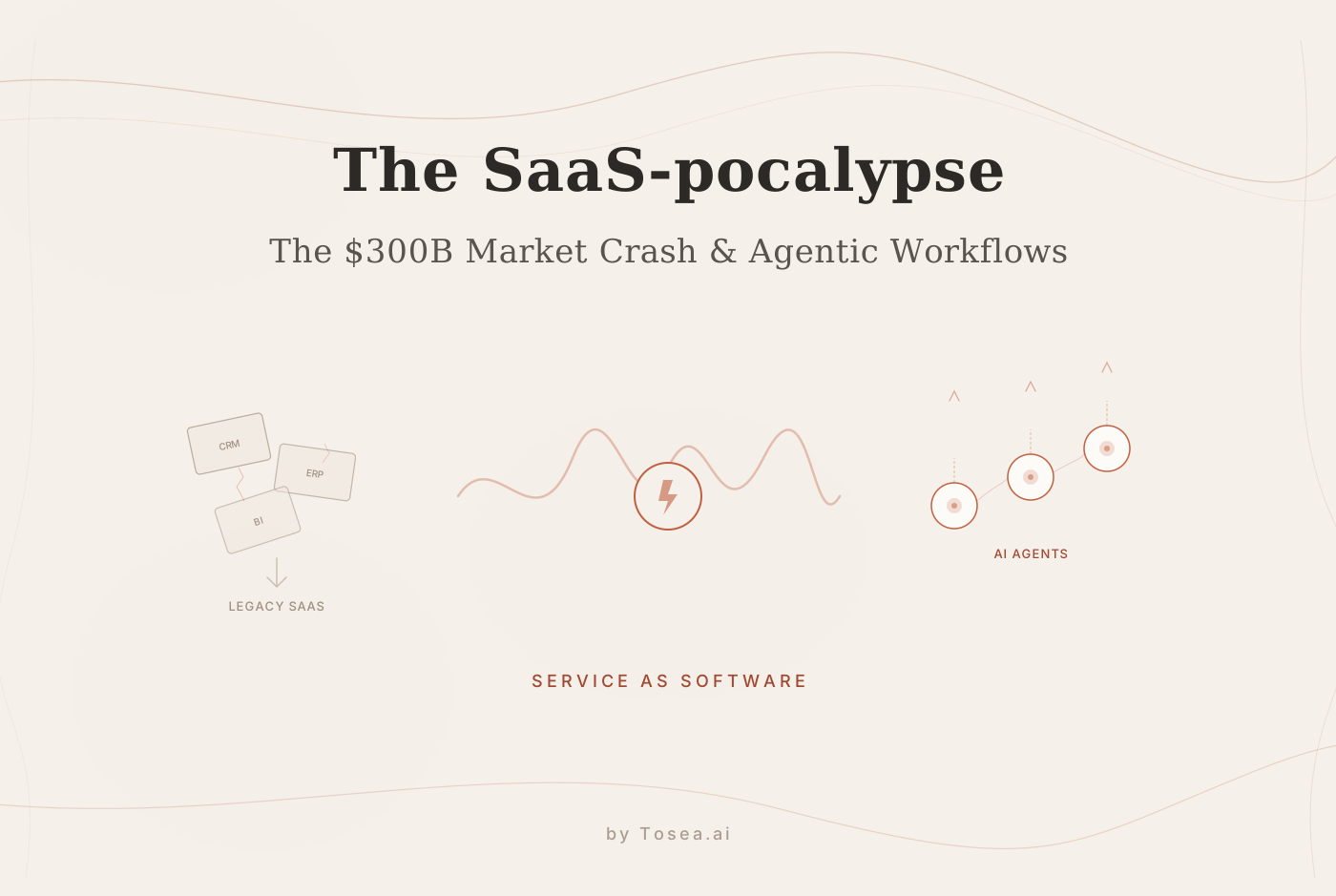
Then came February 2026, and the laughter stopped. A sharp selloff in SaaS stocks erased hundreds of billions in market value as investors recalculated the future revenue of companies whose business models depend on selling software licenses to human operators. The fundamental assumption governing two decades of enterprise technology — that software requires human users to create value — had been called into serious question.
What Actually Happened
The Inversion of the Software Model
For twenty years, the standard operating procedure was straightforward: companies bought software suites and hired teams to operate them. You purchased a CRM and hired sales administrators. You bought creative tools and hired designers. You subscribed to analytics platforms and hired analysts. In this model, the software was the tool, and humans provided the cognitive labor.
The shift that spooked investors is the inversion of this dynamic. AI agents can now perform much of the cognitive labor that previously required human operators. A marketing team that once needed ten people navigating a complex stack of SaaS tools can potentially achieve comparable output with two strategists directing a set of AI agents.
The Seat-Based Revenue Problem
Traditional SaaS companies price their products by the number of user seats. More employees means more licenses means more revenue. This model worked beautifully when software productivity was proportional to the number of humans using it.
AI agents break this relationship. When a single agent can perform the data analysis, report generation, and presentation drafting that previously required multiple people, the company doesn't need to purchase seats for employees who no longer exist. This creates a volume compression that seat-based pricing models weren't designed to withstand.
The Interface Moat Erosion
Legacy SaaS companies spent years building competitive moats around high switching costs and steep learning curves. If your team spent five years mastering a complex enterprise tool, you were unlikely to switch, even if a competitor offered better features.
AI agents erode these moats because they don't experience learning curves the way humans do. An AI agent can navigate a legacy API, interact with a clunky interface, or process data through an outdated workflow just as easily as a modern one. The stickiness that kept customers locked into familiar software decreases when the "user" is an agent that doesn't care about user experience.
What This Means for Individual Professionals
The SaaS-pocalypse is primarily a story about enterprise software companies and their investors. But it carries significant implications for individual professionals across every field.
The Shift From Tool Operator to Workflow Director
For the past two decades, professional value was partly defined by software proficiency. Being an "Excel expert" or a "PowerPoint guru" or a "Tableau specialist" was a marketable skill because operating these tools efficiently required training and practice.
As AI agents take over the mechanical operation of these tools, the valuable skill shifts from operating software to directing outcomes. You don't need to know the keyboard shortcuts for chart formatting; you need to know what chart type best communicates your analysis to your audience. You don't need to master pivot table construction; you need to understand what questions the data should answer.
This transition is uncomfortable for professionals who've invested years in developing software proficiency. But it's also liberating for those whose strengths lie in strategic thinking, domain expertise, and communication — skills that were always more valuable than tool operation, but were often undervalued because the mechanical work consumed so much time.
The Depreciation of Execution Skills
Skill sets based on operating complex software are becoming less scarce and therefore less valuable. This doesn't mean they're worthless — someone still needs to understand what the tools are doing — but the premium that companies pay for pure operational proficiency is declining.
The skills appreciating in value are:
Problem framing: Defining what question to ask is more valuable than knowing how to execute the query.
Quality judgment: Evaluating whether an AI-generated analysis is correct requires domain expertise that the AI itself doesn't have.
Communication: Translating data-driven insights into narratives that stakeholders can act on remains a distinctly human skill.
Contextual reasoning: Understanding organizational politics, competitive dynamics, and market context — the factors that determine how analysis should be interpreted and presented.
Building a Resilient Professional Toolkit
The practical response to the SaaS-pocalypse isn't to panic about job security. It's to deliberately shift your time allocation toward the skills that are appreciating in value:
Spend less time on production work. Use AI tools to handle data cleaning, chart creation, slide formatting, and report assembly. Tosea.ai, for example, takes raw data and produces presentation-ready output — freeing your time for analysis and strategy rather than production.
Spend more time on judgment and interpretation. The AI generates the charts; you decide what they mean. The AI structures the presentation; you determine the strategic narrative. The AI handles the formatting; you handle the persuasion.
Develop your ability to evaluate AI output. As AI handles more of the production work, the ability to critically assess AI-generated output becomes a core professional skill. Can you spot a misleading visualization? Can you identify when a statistical model is inappropriate for your data? Can you recognize when an AI-generated narrative oversimplifies a complex situation?
From Software-as-a-Service to Service-as-Software
The SaaS-pocalypse doesn't mean the end of software — it means the end of a specific business model. The industry is transitioning from Software-as-a-Service (paying for access to a tool) to what some analysts call Service-as-Software (paying for an agent that performs the service).
In the old model, you bought accounting software and hired accountants to use it. In the new model, you buy an accounting agent that performs accounting. The distinction is subtle but the economic implications are enormous.
What This Looks Like in Practice
For a marketing team building monthly performance reports, the old model looked like this:
- Export data from 5 platforms into spreadsheets
- Clean and normalize the data manually
- Build charts and analysis in Excel or Tableau
- Transfer everything into PowerPoint
- Format and brand the deck
- Review and iterate
Each step required a human operator using specialized software. The new model compresses this:
- Point the AI agent at your data sources
- Describe the analysis and narrative you need
- Review the generated presentation
- Refine through dialogue
The human effort shifts from steps 1-5 (mechanical execution) to steps 3-4 (judgment and refinement). The total time drops from hours to minutes. The total software licenses drop from multiple platforms to one.
The Observable Workflow as Professional Insurance
As AI agents take over more production work, the ability to verify and defend that work becomes essential. Observable workflows serve as a form of professional insurance here.
When your AI-generated presentation is questioned in a board meeting or a thesis defense, you need to be able to explain exactly how the analysis was conducted, what data was used, and why specific visualizations were chosen. Tools that hide their reasoning behind a black box leave you unable to answer these questions.
Observable workflows — where you can see the agent's code execution, model selection, and reasoning process — allow you to maintain professional accountability even when the production was automated. This isn't just nice to have; in the post-SaaS world, it's the difference between AI as a professional asset and AI as a professional liability.
Navigating the Transition
The SaaS-pocalypse isn't a one-time event — it's an ongoing structural shift. The companies and professionals who navigate it successfully will share a common trait: they'll have decoupled their productivity from the number of hours they spend inside any particular software interface.
For individual professionals, the action items are concrete:
Audit your current tool stack. Where are you paying for software that AI agents could partially or fully replace? Where are you spending time on mechanical tasks that could be automated? Most professionals find that the data-to-presentation pipeline — the process of taking raw data, analyzing it, building visualizations, and assembling a polished deck — is the single highest-friction workflow in their regular rotation.
Invest in AI fluency. Start using agentic tools for real work, not just experiments. The learning curve exists, but it's measured in days, not years. The key is to begin with a specific, recurring task rather than trying to overhaul your entire workflow at once. Your next monthly report or quarterly review is a good starting point.
Redirect saved time deliberately. When AI saves you three hours on a monthly report, don't fill that time with more mechanical work. Invest it in the strategic thinking, relationship building, and professional development that create lasting career value.
Develop your evaluative skills. As AI handles more of the production work, the ability to critically assess AI-generated output becomes a professional differentiator. Practice reviewing AI output with the same rigor you'd apply to work from a junior colleague — checking data accuracy, evaluating visualization choices, and testing narrative logic.
The Pricing Model Shift and What It Means for You
The SaaS-pocalypse is also reshaping how professional tools are priced. Seat-based licensing — paying per user per month — is the model under pressure. The emerging alternatives include usage-based pricing (paying for what the AI actually does), outcome-based pricing (paying for deliverables produced), and hybrid models that combine a base subscription with usage-based components.
For professionals evaluating new AI tools, this pricing evolution matters. A tool that charges per seat incentivizes the vendor to maximize the number of human users. A tool that charges per task or per output incentivizes the vendor to make each interaction as efficient as possible. The alignment between vendor incentive and user benefit is stronger in the latter model.
What This Means for Your Budget
The practical budget implication is counterintuitive. In the seat-based world, software costs scaled with team size — more people meant more licenses. In the agentic world, software costs scale with output volume — more presentations, more reports, more analyses. For teams that produce a high volume of analytical work, the agentic pricing model can actually be more cost-effective than maintaining licenses for an entire team of tool operators.
The flip side is that teams which used to justify their headcount by the number of software seats they occupied will need to justify it differently. The value proposition shifts from "I can operate this tool" to "I can interpret, evaluate, and act on what this tool produces." This isn't a subtle distinction — it changes who gets hired, who gets promoted, and what career development looks like across the organization.
For individual contributors, the implication is clear: the ROI of your time is best measured not by how many tools you can operate, but by how effectively you can evaluate and improve what automated workflows produce. That evaluative capacity — the ability to look at AI-generated output and know whether it's right, whether it's misleading, and whether it serves your audience — is what justifies your seat at the table when the tools no longer need someone sitting in theirs.
Clinging to software expertise as a career anchor is increasingly risky when the software itself is being consumed by agents. The durable advantage belongs to people who can think clearly about problems, communicate findings persuasively, and exercise the kind of contextual judgment that no model can replicate. Tosea.ai is built for this shift — handling the data-to-presentation pipeline so that your energy goes toward the work that actually moves decisions forward.