What Goldman Sachs' Deployment of Claude Means for Professional AI Workflows
Goldman Sachs deployed Claude for back-office operations managing trillions in assets. What this signals about the future of AI-driven professional workflows.
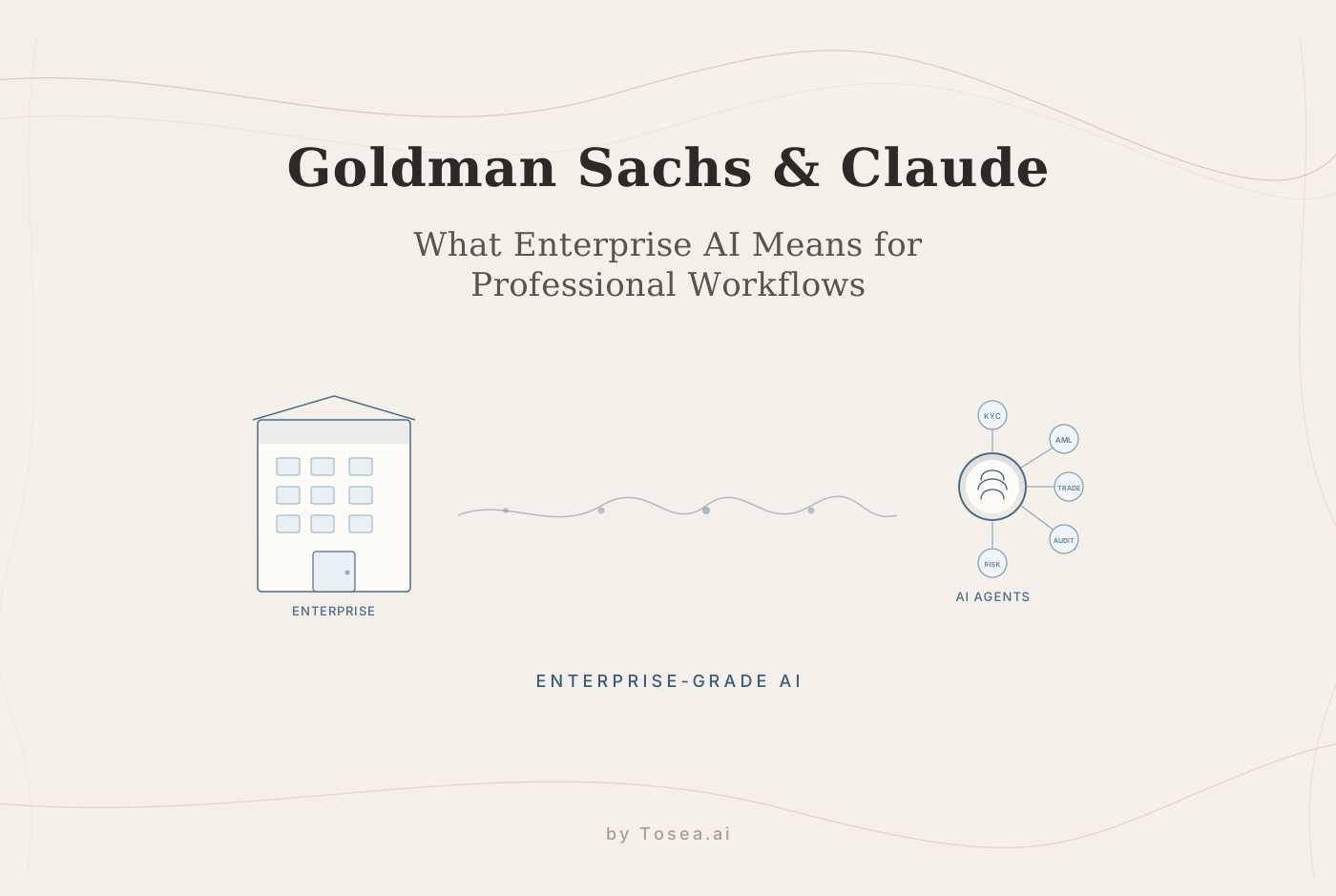
Goldman Sachs has officially deployed Anthropic's Claude to handle core back-office operations. This isn't a small-scale pilot or an internal experiment. The bank is using autonomous AI agents for trade accounting, compliance processing, and client onboarding — processes governing approximately $2.5 trillion in assets under management.
For the broader professional world, this deployment is worth paying attention to. When one of the most risk-averse institutions on the planet trusts AI agents with operations at this scale, it signals something about where professional workflows are heading across industries.
What Goldman Actually Did
The details of the deployment reveal a more nuanced picture than the headlines suggest.
The Shift From Coding to Reasoning
Goldman's CIO, Marco Argenti, emphasized that the bank's AI priorities have moved from "simple coding assistance" to "complex financial tasks that require logic and reasoning." This distinction matters. The first wave of enterprise AI adoption focused on developer productivity — autocomplete for code, documentation generation, bug detection. Goldman is now in the second wave: using AI agents for tasks that require understanding context, applying rules, and making judgment calls within defined parameters.
Why Context Window Size Matters
Financial data is fragmented, dense, and governed by regulatory frameworks that span thousands of pages. Traditional language models struggled with this because of context decay — they would lose track of earlier information as conversations or documents grew longer.
Claude's million-token context window addresses this directly. Goldman's agents can process thousands of pages of regulatory documentation alongside transaction data in a single session, maintaining coherent reasoning across the full corpus. This is fundamentally different from the summarization or retrieval-based approaches that characterized earlier AI deployments.
The Trust Framework
How does a bank trust an AI with trillion-dollar operations? The answer isn't blind trust — it's structured oversight. Anthropic's "Constitutional AI" framework provides guardrails that constrain agent behavior within defined parameters. The AI can reason and act autonomously within those bounds, but the bounds themselves are set by humans who understand regulatory requirements (KYC/AML compliance, Federal Reserve oversight, etc.).
Goldman's engineers monitor agent behavior, reviewing decision chains and flagging edge cases for human review. The system is autonomous but auditable — every action can be traced back through the agent's reasoning process.
What This Means for Non-Financial Professionals
You might not be managing trillion-dollar portfolios, but if you work with data in any professional capacity, the Goldman deployment carries relevant lessons.
The Requirements Are Universal
Whether you're a researcher preparing a conference presentation, a consultant delivering a quarterly review, or a marketing manager building a performance report, your core requirements mirror those of a Wall Street analyst:
Accuracy: A misinterpreted coefficient or a mislabeled chart undermines your credibility. In research, it can invalidate your findings. In business, it can lead to poor decisions.
Efficiency: The time spent on mechanical tasks — data cleaning, formatting, slide assembly — is time not spent on analysis and strategic thinking.
Communication: Raw data has no value until it's synthesized into a narrative that your audience can understand and act on. The "data-to-presentation" pipeline is where most professionals lose the most time.
The Convergence of Enterprise and Professional AI
The Goldman deployment demonstrates that enterprise-grade AI capabilities are moving downstream. The multi-agent architecture that Goldman uses — with specialized agents handling different aspects of a complex workflow — is the same architectural pattern used by professional AI tools designed for individual researchers and analysts.
Tosea.ai applies this same approach to the data-to-presentation pipeline. Instead of a single chatbot trying to handle everything, specialized agents handle distinct aspects of the workflow:
| Component | Goldman's Implementation | Professional Workflow (Tosea.ai) |
|---|---|---|
| Data Ingestion | Cross-referencing global financial databases | Importing CSV, Excel, or statistical software outputs |
| Analysis | Applying regulatory rules and compliance checks | Running statistical models (DID, RDD, regression analysis) |
| Quality Control | Auditing agent decisions against regulatory standards | Observable workflow showing code execution and reasoning |
| Output | Processed transactions and compliance reports | Presentation-ready slide decks with verified data |
The scale is different, but the architecture and principles are the same: specialized agents, transparent reasoning, and human oversight.
The Observable Workflow Standard
Goldman's approach to AI trust has broader implications for how professionals should evaluate any AI tool they use for high-stakes work.
Why "Show Your Work" Matters
The Goldman deployment includes what they call "internal trials" — a process where engineers monitor Claude as it interprets policy language, applies rules, and makes decisions. Every step is observable and auditable.
This is the same principle behind observable workflows in professional AI tools. When an AI agent generates your presentation slides, you need to be able to answer questions like:
- What statistical model did the AI use, and was it appropriate for your data?
- How did the AI handle missing values or outliers?
- Why did the AI choose a particular visualization type?
- Are the numbers in the charts consistent with the raw data?
If you can't answer these questions, you can't defend the work in front of a committee, a client, or a board of directors. Observable workflows solve this by making every step of the agent's reasoning visible and auditable.
The End of the "Black Box" Era
Goldman's willingness to deploy AI at this scale — but only with full auditability — signals that the "black box" approach to AI is losing ground in professional settings. The pattern emerging across industries is clear: AI agents can handle complex, high-stakes tasks, but only when the human user can verify and take responsibility for the output.
This has practical implications for how you choose AI tools:
Prefer tools that show their reasoning. If an AI generates a chart from your data, you should be able to see how it processed the data to produce that chart.
Demand auditability. Can you trace any claim in your AI-generated presentation back to a specific data point? If not, the tool isn't meeting the standard that Goldman has set for AI in professional contexts.
Maintain human oversight for judgment calls. Goldman doesn't let AI make unsupervised decisions about regulatory interpretation. Similarly, you shouldn't let AI make unsupervised decisions about how to frame your research findings or present your analysis to stakeholders.
The Multi-Agent Pattern in Practice
Goldman's deployment uses what the industry calls a multi-agent architecture — multiple specialized AI agents, each handling a specific aspect of a complex workflow. This is worth understanding because it explains why the deployment works at the scale it does.
Why Not a Single Model?
The intuitive approach to enterprise AI is to deploy one large, capable model and have it handle everything. Goldman tried this in earlier iterations and found the limitations quickly. A single model handling trade accounting, compliance checks, and client onboarding simultaneously tends to lose focus on the specific rules governing each domain.
The multi-agent approach mirrors how Goldman's human teams actually work. The trade accounting team doesn't do compliance — the compliance team does. The client onboarding team doesn't process trades. Each team has specialized knowledge and follows specific procedures. The multi-agent architecture replicates this specialization in software.
What This Looks Like for Presentation Workflows
The same principle applies at a smaller scale. When you're building a data-driven presentation, the tasks involved are genuinely different: statistical analysis requires mathematical precision, narrative construction requires logical reasoning, and visual design requires aesthetic judgment. A single AI model trying to handle all three simultaneously tends to compromise on at least one.
Multi-agent presentation tools separate these concerns. One agent focuses on getting the data analysis right. Another structures the narrative for logical flow. A third handles the visual design. Each agent can be evaluated independently, and the integration between them is managed by the system architecture rather than by the user manually stitching together outputs from different prompts.
The Overhead Trade-Off
Multi-agent systems are more complex to build and more expensive to run than single-model approaches. This is why consumer AI tools generally don't use them — the cost per interaction needs to stay low for mass-market products. For professional use cases, where the cost of an error is measured in lost credibility or poor decisions rather than in cents per query, the trade-off favors accuracy over efficiency.
Getting Started With Professional AI Workflows
If the Goldman deployment has you thinking about how to integrate AI agents into your own work, here's a practical starting point:
The Professional AI Checklist
1. Identify your highest-friction workflows. Where do you spend the most time on mechanical tasks that don't require your expertise? For most professionals, the data-to-presentation pipeline is the obvious candidate.
2. Choose tools with observable workflows. Look for AI platforms that show you the agent's reasoning process — the code it runs, the models it applies, the decisions it makes. This ensures you can verify and defend the output.
3. Start with a single, well-defined task. Don't try to automate your entire workflow at once. Start with one recurring task — your monthly report, your quarterly analysis, your next conference presentation — and iterate from there.
4. Maintain your domain expertise. AI handles the mechanical execution; you provide the strategic judgment. Don't outsource the thinking — outsource the formatting, the data cleaning, and the slide assembly.
5. Build your evaluative skills. The Goldman model works because engineers actively monitor and evaluate the AI's decisions. Apply the same principle to your own work: review every chart, verify every statistic, and assess whether the AI's narrative choices serve your communication goals. This evaluative layer is what distinguishes professional AI usage from uncritical reliance on automation.
What Comes Next
The Goldman deployment is an inflection point, but it's early in the adoption curve. As more institutions follow Goldman's lead, the expectations for AI integration in professional workflows will rise.
Waiting for AI to become perfect before adopting it is like waiting for the stock market to become predictable before investing. The advantage goes to those who start now, developing an intuition for what AI handles well and where human oversight remains essential.
For researchers, analysts, and consultants, the practical implication is straightforward: the tools that Goldman uses to process trillions in financial data are architecturally similar to the tools available for your presentation and analysis work. The gap between enterprise AI and professional AI is closing rapidly.
Goldman has effectively answered the adoption question for the industry. What remains is the practical work of learning to direct these tools — understanding their strengths, recognizing their limitations, and building the evaluative habits that turn AI from a novelty into a reliable professional asset. Tosea.ai makes that transition practical by bringing enterprise-grade multi-agent architecture to the individual researcher or analyst without requiring a Goldman-sized IT department.
FAQ
Is Tosea.ai's technology comparable to what Goldman uses?
The underlying architectural pattern — multi-agent systems with specialized agents handling different workflow components — is the same. The application domain is different: Goldman processes financial transactions; Tosea.ai processes data-to-presentation workflows. But the principles of observable reasoning, specialized agents, and human oversight apply equally.
Can I use professional AI tools for PhD-level research?
Yes. Tosea.ai is built for high-stakes academic work, including thesis defense presentations, conference talks, and publications that require rigorous statistical methodology and professional formatting.
How do I explain AI-assisted work to my colleagues or committee?
Be transparent about which parts were AI-assisted and which reflect your own analysis. Observable workflows make this straightforward — you can walk through the agent's reasoning process and explain your own decisions at each point where you reviewed or modified the output.