What Seedance 2.0 Teaches Us About the Director Era for Professional Slides
ByteDance's Seedance 2.0 shifted AI video from single shots to directed storytelling. The same shift is happening in professional presentations.
ByteDance's Seedance 2.0 launched this week to widespread attention across tech forums and social media. The system can generate two-minute, 1080p cinematic sequences from a single prompt — complete with consistent characters, realistic physics, and phoneme-level lip-syncing. It represents a notable advance in generative AI video, and the reactions from early users reveal something worth examining beyond the viral clips.
Users consistently describe the experience not as "generating a clip" but as "acting like a director." That framing matters. It signals a broader shift in how people interact with AI tools — from issuing atomic commands to orchestrating complex, multi-step workflows where the AI maintains coherence across the entire output.
This shift from prompter to director is playing out across professional domains, not just video production. And the implications for how researchers, analysts, and consultants build presentations are worth unpacking in detail.
Multi-Shot Coherence: The Problem That Matters Most
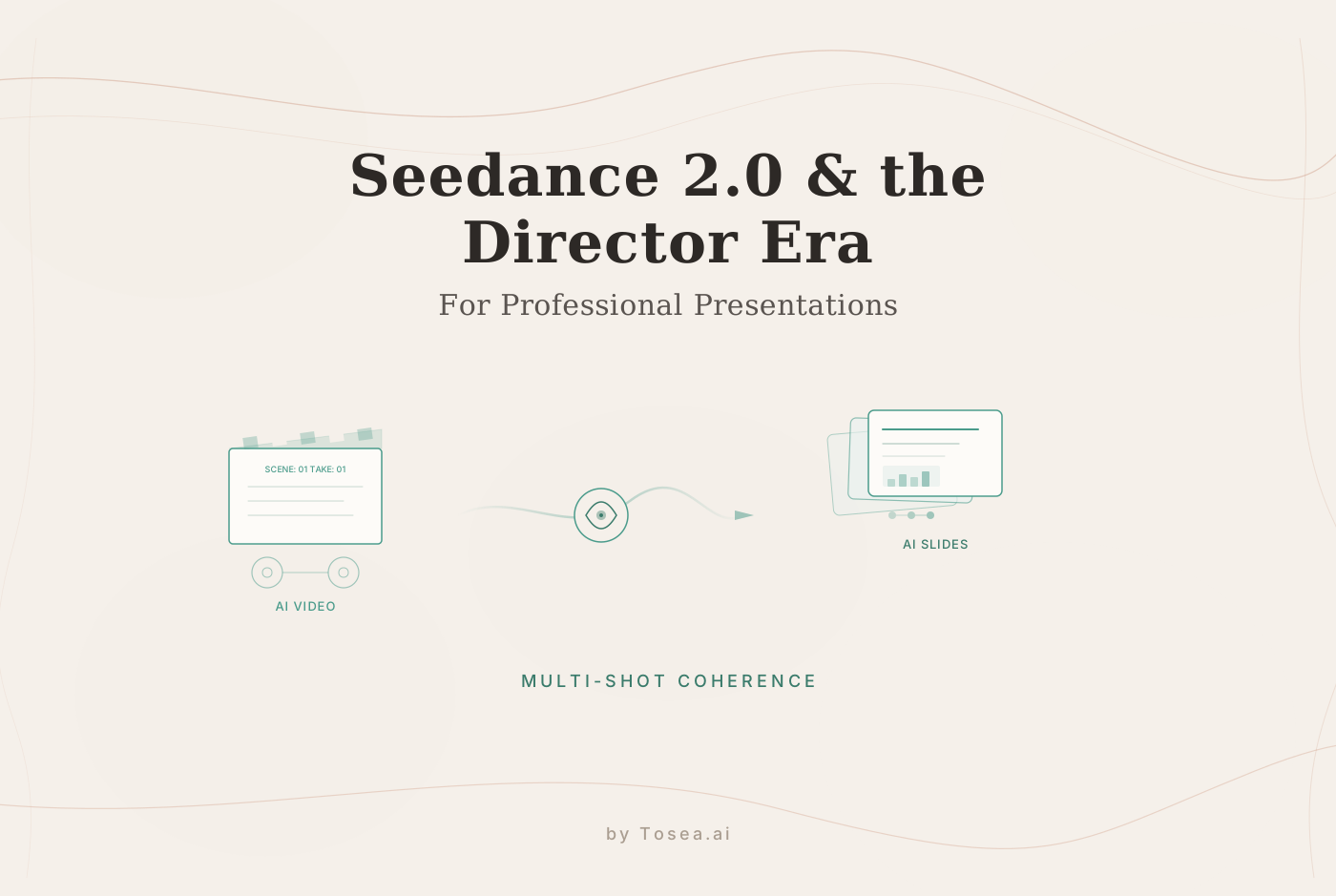
The headline feature of Seedance 2.0 isn't raw image quality — several competitors produce comparable individual frames. The differentiator is multi-shot coherence. In previous generations of AI video tools, characters would change appearance between cuts. Clothing would shift. Facial features would drift. The individual shots looked impressive; the sequence felt broken.
Seedance 2.0 maintains a consistent narrative identity across a full two-minute span. The same character wears the same clothes, has the same face, and moves through a coherent physical space. This sounds obvious — human filmmakers do it automatically — but it's technically difficult for generative models, which treat each frame or segment semi-independently.
The Presentation Parallel
The same coherence problem exists in professional presentations, and it's more common than most people realize.
Consider a typical data-driven presentation built with general-purpose AI tools. You ask the AI to analyze a dataset and produce slide one — an executive summary. Then slide two — a trend analysis. By slide five, the AI has subtly drifted from the constraints established in the first slide. The summary claims revenue grew 12%, but the detailed chart on slide seven shows 11.3%. The terminology shifts — "customer churn" on slide three becomes "attrition rate" on slide eight. The color coding that represented product lines on the overview slide doesn't match the colors in the drill-down charts.
These inconsistencies are the presentation equivalent of a character changing clothes between cuts. Each individual slide might look fine in isolation. The sequence feels unreliable.
The solution that Seedance 2.0 applies to video — maintaining a coherent state representation across the full output — is the same architectural principle that makes multi-agent presentation tools effective. When specialized agents handle different aspects of a presentation (data analysis, narrative structure, visual design) while sharing a common understanding of the source data, the output maintains logical consistency from the first slide to the last.
From Prompter to Director: What the Role Shift Actually Means
One viral review of Seedance 2.0 noted: "It acts like a director... creating entire full-length videos with lots of cuts... but with you just giving it one prompt."
This observation captures a genuine transition in how users interact with capable AI systems. The old interaction model was transactional — you gave the AI a specific instruction, it returned a specific output, and you manually assembled the pieces. The new model is directorial — you define the vision, and the AI orchestrates the execution across multiple components.
What Directors Actually Do
In filmmaking, the director doesn't operate the camera, design the costumes, or edit the footage. The director makes decisions about what the film should communicate and how it should feel. The execution is handled by specialists who understand their craft.
This is a useful mental model for how professional AI tools are changing presentation workflows. The researcher's role isn't to format charts, align text boxes, or choose color palettes. Those are execution tasks that specialized agents can handle. The researcher's role is to decide what story the data should tell, what evidence best supports that story, and how the audience should feel about the conclusions.
The difference between "making a presentation" and "directing a presentation" might sound semantic, but in practice it changes where you invest your time:
The old allocation: 20% thinking about what to communicate, 80% executing the production (data cleaning, chart building, slide formatting, design tweaks).
The director allocation: 60% thinking about what to communicate, 20% reviewing and refining the AI's execution, 20% rehearsing delivery.
The total hours might be similar — or fewer — but the quality of the output improves because the human effort is concentrated on the decisions that actually matter.
Practical Workflow Planning
When Seedance 2.0 processes a prompt, it doesn't jump directly to rendering frames. It first plans the sequence — deciding on shot composition, camera angles, scene transitions, and pacing. This workflow planning step is what enables the coherent multi-shot output.
The same principle applies to professional presentations. Effective AI presentation tools don't jump from raw data to finished slides. They first plan the analytical approach — identifying the key findings in the data, determining the logical order of the argument, and selecting appropriate visualization types for each data point. Tosea.ai applies this planning-first approach through multi-agent architecture, where a planning agent structures the narrative before specialized agents handle data visualization and slide design.
This planning step is also where human direction has the most leverage. Before the AI starts rendering charts, you can review its proposed structure and redirect it. "The quarterly comparison is less important than the year-over-year trend — restructure around that." This kind of high-level guidance is exactly the "director" role that both Seedance and professional AI tools are enabling.
The Quality Standard: Why 1080p Is a Metaphor
Industry analysts have noted that Seedance 2.0's quality threshold — full 1080p resolution with consistent physics — represents a new baseline for AI-generated video. Content that falls below this standard now looks conspicuously AI-generated, which undermines its purpose.
What "1080p" Means for Presentations
Professional presentations have their own quality threshold, and it's not primarily about aesthetics. The equivalent of "1080p" in a business or academic presentation is:
Data accuracy: Every number in every chart traces back to a verifiable source. No rounding errors, no misaligned axes, no aggregation artifacts.
Visual consistency: Fonts, margins, color palettes, and spacing are synchronized across the entire deck. A slide from the middle of the presentation should be visually indistinguishable in style from a slide at the beginning.
Logical flow: Each slide follows from the previous one with clear transitions. The argument builds progressively, and the conclusion feels inevitable rather than arbitrary.
Professional formatting: Charts follow recognized best practices — labeled axes, appropriate chart types for the data being displayed, clear legends, sufficient contrast for readability.
When presentations fall below this threshold, the audience notices. A chart with unlabeled axes doesn't just look unprofessional — it signals that the presenter didn't scrutinize the output. An inconsistent color scheme across slides suggests the presentation was assembled hastily from disconnected pieces.
The parallel to Seedance's quality standard is direct: AI-generated output that falls below professional expectations does more harm than manual work that meets them. The bar for "good enough" has risen, and AI tools that can't meet it create more problems than they solve.
Addressing the Displacement Concern
The Seedance 2.0 launch predictably sparked discussion about job displacement in video production and editing. Similar concerns surface whenever AI tools demonstrate new capabilities in professional domains.
The more nuanced reality, observed across multiple fields, is that these tools tend to change the composition of work rather than eliminate it entirely. Video editors who previously spent hours on frame-by-frame color correction now focus on narrative pacing and emotional arc. Graphic designers who once spent days on layout mechanics now concentrate on brand strategy and communication design.
What This Means for Analysts and Researchers
The pattern holds for data-driven professional work. AI presentation tools don't eliminate the need for domain expertise — they amplify it. A researcher who deeply understands their subject matter can direct an AI agent to produce output that reflects that understanding. A researcher who doesn't understand their data can't effectively evaluate whether the AI's output is correct, regardless of how polished the slides look.
This creates a new premium on what might be called "evaluative expertise" — the ability to look at AI-generated output and quickly identify whether it accurately represents the underlying data and supports the intended argument. It's a skill that requires deep domain knowledge, but it's a different application of that knowledge than manually building charts.
For professionals thinking about how to position themselves in this transition, the practical advice is straightforward:
Invest in your domain expertise, not your tool proficiency. Understanding statistical methods, research methodology, and the substantive content of your field becomes more valuable when the mechanical execution is handled by AI.
Develop your editorial judgment. Practice evaluating AI-generated output critically. Can you spot when a visualization misrepresents a trend? Can you identify when a narrative oversimplifies a complex finding?
Focus on communication strategy. The "director" skill isn't just about giving good prompts — it's about understanding your audience, defining your key message, and making structural decisions about how to present information for maximum impact.
The Convergence of Creative and Analytical AI
What makes the Seedance 2.0 launch relevant beyond the video production industry is the convergence it represents. The same architectural patterns — multi-step planning, specialized sub-processes, coherence maintenance across outputs — are appearing simultaneously in creative AI (video, music, design) and analytical AI (data analysis, report generation, presentations).
This convergence suggests that the "director" interaction model isn't specific to any one domain. It's a general pattern for how humans work with AI systems that are capable enough to handle complex, multi-component workflows.
What This Means for Professional Tooling
The convergence also has a practical implication for how professional AI tools will evolve. As the same architectural patterns prove effective across video, music, and analytical work, the tools built on these patterns will benefit from cross-domain improvements. Advances in coherence maintenance developed for video generation, for example, will improve consistency in presentation generation. Better planning algorithms developed for music composition will improve narrative structuring for analytical reports.
For individual professionals, this means the quality ceiling for AI-assisted work will continue rising. The presentations generated by multi-agent systems in 2027 will likely be noticeably better than those generated today — more coherent, more accurate, more professionally polished. Developing comfort with these tools now, while the learning curve is manageable, positions you well for the next generation of capabilities.
The analogy to Seedance is apt here too. Early AI video tools produced interesting novelties. Seedance 2.0 produces content that's professionally usable. The same trajectory is playing out in analytical presentation tools — and the professionals who develop their evaluative and strategic skills during this transition period will be the ones who extract the most value from each successive generation of tools.
For professionals who work with data, the practical takeaway is that the tools are arriving now. Multi-agent presentation platforms like Tosea.ai implement the same architectural principles that Seedance 2.0 uses for video — planning before execution, specialized agents for different aspects of the output, and coherence verification across the full deliverable.
Seedance 2.0 demonstrates that this model of human-AI collaboration has already become standard in video production. Presentations, reports, and analytical deliverables are next. Whether that timeline is six months or two years matters less than whether you're building the relevant skills — evaluating AI output critically, directing multi-step workflows, and focusing your own effort on the strategic decisions that shape how your work lands with its audience.