Beyond the Vibe: Why Professional Workflows Demand More Than Code That Runs
Vibe coding's hidden costs — from Tailwind's layoffs to QGIS infrastructure collapse — reveal why professional work needs rigor over intuition.
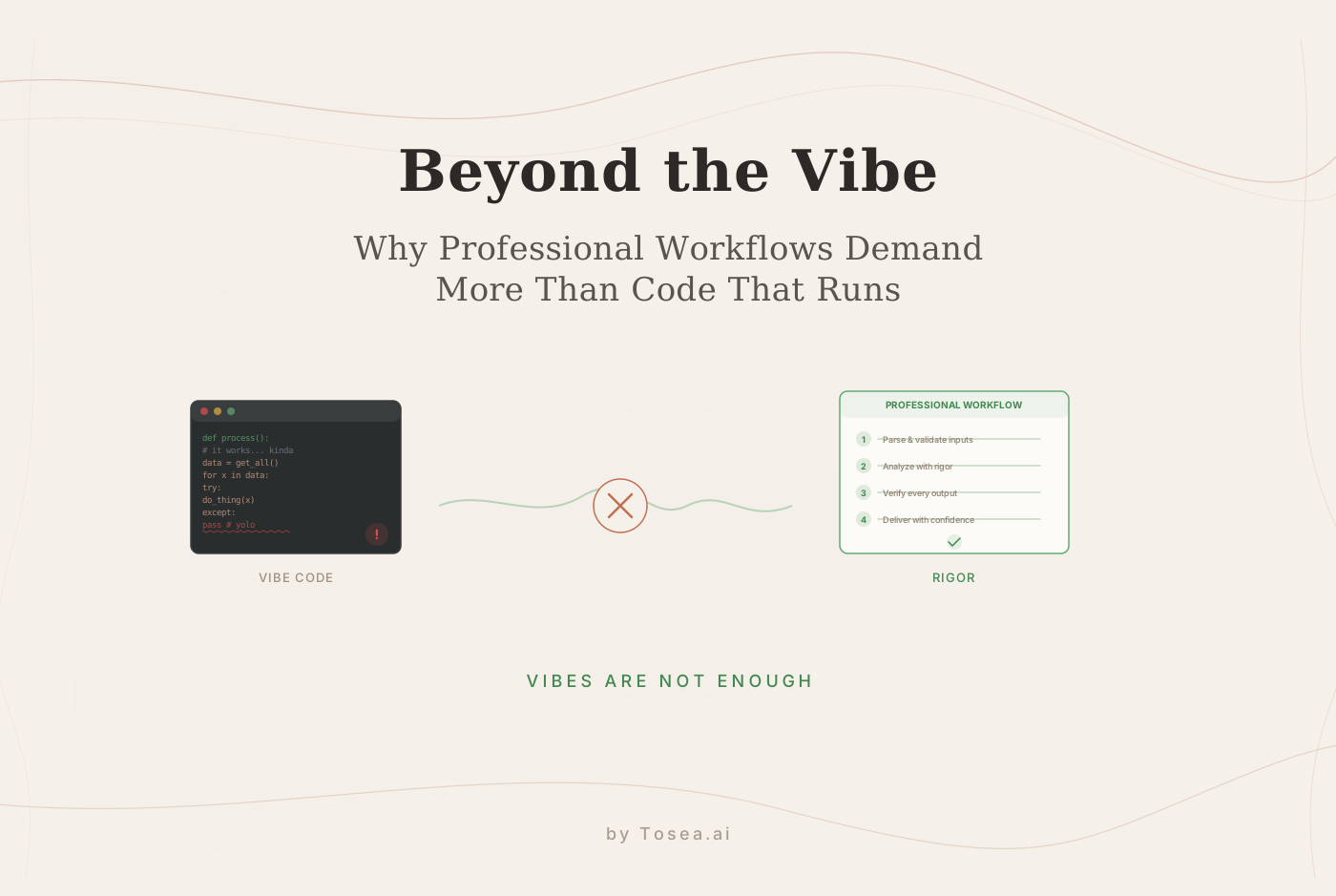
In early 2025, Andrej Karpathy coined the term "vibe coding." It described a new way of building software: prompt an LLM, accept whatever output compiles, and move on. If it runs, it ships. If it looks right, it's finished. The approach was built on intuition and speed — a "vibe check" applied to software development.
For hobbyist projects, weekend prototypes, and learning exercises, vibe coding works well enough. Karpathy himself framed it that way. But as we move through 2026, the downstream consequences of the vibe coding ethos are becoming visible — and they're more severe than most people anticipated.
From the near-collapse of critical open-source infrastructure to significant staff reductions at well-known development companies, the costs of "if it works, ship it" are now being paid. For professionals whose careers depend on accuracy — data scientists, researchers, analysts, consultants — the lessons extend well beyond software development.
The Economic Parasite: Tailwind's Cautionary Tale
The most visible casualty of the vibe coding movement has been the economic sustainability of the tools that AI systems depend on. The recent crisis at Tailwind CSS illustrates the mechanism clearly.
The Paradox of Popularity
Tailwind CSS is more widely used in 2026 than at any point in its history. Developer surveys consistently rank it among the most popular CSS frameworks. GitHub stars continue to climb. Usage metrics are at record highs.
Yet Tailwind Labs was forced to reduce its engineering team by 75%.
The explanation lies in a pattern that's emerged across the open-source ecosystem: "mediated usage." In the pre-AI workflow, a developer learning Tailwind would visit the official documentation, browse examples, read guides, and engage with the community. That traffic — direct human engagement with the project's resources — funded the operation through premium templates, advertising, sponsorships, and enterprise support contracts.
Today, a vibe coder prompts an AI assistant: "Build me a landing page with Tailwind." The AI, trained on Tailwind's documentation, generates the code correctly. The developer never visits the Tailwind website, never engages with the community, and never encounters the premium offerings that fund development. The AI extracted the value of thousands of hours of human-written documentation while severing the financial connection between user and creator.
The Ouroboros Effect
This creates a self-consuming cycle. When documentation funding dries up, documentation stops being updated. When documentation stops being updated, the AI models eventually begin generating outdated patterns — using deprecated classes, recommending removed features, or applying approaches that no longer represent best practices.
The AI doesn't know its training data has become stale. It continues generating with confidence, and the vibe coder continues accepting output that compiles. The errors are subtle at first — a slightly wrong utility class, a deprecated responsive breakpoint — and by the time they become visible, the damage has cascaded through thousands of projects.
This isn't a hypothetical. It's happening now across multiple open-source projects that serve as the foundation for AI-generated code. The economic model that sustained the tools is being undermined by the AI systems that depend on them.
What This Means Beyond Software
The Tailwind story has a direct parallel for any professional who relies on AI tools for analytical work. When an AI tool generates a visualization, selects a statistical test, or structures a narrative, the quality of that output depends on the quality of the knowledge the AI draws from. If the sources that knowledge is built on stop being maintained — because the economic model that supported them has been disrupted — the AI's output quietly degrades.
For professionals, this reinforces the importance of evaluating AI output against your own domain expertise rather than accepting it on the basis that it "looks right." The vibe check is insufficient when the underlying knowledge base may itself be deteriorating.
Infrastructure Under Siege: The QGIS Incident
The financial consequences of vibe coding are concerning. The infrastructure consequences are alarming.
QGIS is an open-source geographic information system used globally for humanitarian mapping, disaster relief coordination, and environmental monitoring. Organizations including the WHO and UNICEF rely on QGIS infrastructure for critical operations.
Recently, QGIS experienced a 100,000% spike in API requests. This wasn't a distributed denial-of-service attack. It was the cumulative result of thousands of users building "simple" mapping scripts with AI assistance.
How Vibes Became a DDoS
The users weren't malicious. They wanted basic functionality — display a map, overlay some data points, generate a report. They prompted their AI assistants, received code that worked on their screens, and deployed it.
The problem was what "worked" actually meant. The AI-generated scripts were downloading entire terabyte-scale geographic databases on every execution — not caching data locally, not using incremental updates, not respecting rate limits. Each individual script ran correctly from the user's perspective: the map appeared, the data displayed. But the collective impact of thousands of these scripts was effectively a sustained denial-of-service attack against QGIS infrastructure.
What the user saw: "My script works. The map loads."
What was actually happening: The script was re-downloading a multi-gigabyte dataset every 15 seconds, alongside thousands of other scripts doing the same thing.
Why Vibe Coding Missed It
A developer with a basic understanding of API design would have immediately recognized the inefficiency — no caching, no pagination, no rate limiting. These are foundational principles of responsible API usage. But vibe coders don't evaluate the code they receive. They evaluate the output. The output looked correct, so the code was deemed acceptable.
This pattern — correct output masking catastrophically inefficient or harmful implementation — is the core risk of the vibe coding approach. And it extends directly to professional data work.
The Professional Parallel
Consider a data scientist who uses an AI tool to build an analysis pipeline. The tool generates code that produces the correct final numbers. But the implementation loads the entire dataset into memory six times during processing, runs redundant calculations, and doesn't release temporary variables. On a small test dataset, this runs fine. On the production dataset with millions of rows, it crashes — or worse, produces subtly wrong results due to memory pressure.
The vibe coder says: "It worked on my test data." The professional says: "Let me understand how it's processing the data."
This distinction — between evaluating output and evaluating process — is what separates professional-grade AI usage from vibe-level AI usage. Observable workflows, where you can see how the AI processes your data at each step, exist specifically to enable this deeper evaluation.
From Vibes to Verification: What Professional Workflows Require
If vibe coding represents one end of the spectrum — maximum speed, minimum oversight — what does the professional end look like? The answer involves three principles that the Tailwind and QGIS incidents make concrete.
Principle 1: Source Verification
Professional AI workflows must maintain a verifiable connection between output and source data. When a chart appears in your presentation, you should be able to trace every data point back to the raw dataset. When a statistical claim is made, you should be able to identify which test was applied and verify that it was appropriate for the data.
This is the opposite of the vibe approach, where the output is accepted if it looks plausible. In professional contexts, plausibility isn't enough — verifiability is the standard.
Tools designed for professional use, like Tosea.ai, implement this through observable workflows that expose the agent's analytical reasoning. You can see which data was used, how it was processed, and why specific visualizations or statistical approaches were selected. This transparency isn't just a quality-assurance feature — it's what enables you to defend your work when questioned.
Principle 2: Process Awareness
The QGIS incident demonstrated that correct output can mask destructive process. In professional data work, the equivalent risk is that a correct-looking analysis might be built on inappropriate methodology — using a parametric test on non-normal data, for instance, or applying a trend line to a dataset with insufficient observations.
Professional AI workflows should make the process visible, not just the result. When an AI agent selects a visualization type, applies a statistical test, or structures a narrative argument, you should be able to see why and evaluate whether the choice was appropriate for your specific context.
Principle 3: Domain-Grounded Evaluation
Vibe coding works for tasks where the user doesn't need to understand the implementation — throwaway scripts, quick prototypes, personal tools. Professional work operates under a different constraint: you are responsible for the output, which means you need to understand it well enough to explain and defend it.
This doesn't mean you need to build everything manually. It means you need enough domain expertise to evaluate what the AI produces. Can you identify when a regression model is inappropriate for your data? Can you spot when a visualization misrepresents a trend? Can you recognize when a narrative oversimplifies a complex finding?
These evaluative skills — the ability to look at AI-generated output and assess its correctness against your domain knowledge — are the professional skills that appreciate in value as AI handles more production work.
Multi-Agent Architecture as a Quality Framework
One architectural response to the vibe coding problem is the multi-agent approach, where different specialized agents handle different aspects of a workflow rather than a single model attempting to do everything.
The reasoning is practical: a single model handling data analysis, narrative construction, and visual design in one conversation thread tends to lose focus. It's the AI equivalent of a person trying to simultaneously check the math, write the story, and design the slides. Errors in one domain leak into others.
Multi-agent systems address this by assigning specialized agents to specific tasks:
Data validation agents audit the raw data before any analysis begins — checking for missing values, outliers, format inconsistencies, and sample size adequacy.
Analysis agents apply appropriate statistical methods based on the data characteristics rather than defaulting to the most common approach regardless of fit.
Narrative agents structure the presentation's argument for logical coherence — ensuring that claims follow from evidence and that the conclusion is supported by the analysis.
Design agents handle the visual execution — chart rendering, slide layout, typography, color consistency — according to professional standards rather than arbitrary defaults.
This separation of concerns means that each agent can be evaluated independently. You can check whether the data validation was thorough, whether the statistical method was appropriate, whether the narrative is coherent, and whether the design meets your standards — without trying to evaluate all of these simultaneously.
The Evaluative Skill Premium
The vibe coding era has inadvertently highlighted which professional skills are becoming more valuable. As AI handles more of the production work — writing code, generating visualizations, drafting narratives — the ability to evaluate AI output critically has become a differentiating skill.
What Evaluative Expertise Looks Like
It's the ability to look at an AI-generated chart and notice that the y-axis doesn't start at zero, potentially exaggerating a trend. It's recognizing that a correlation coefficient was computed on a dataset where the relationship is clearly nonlinear. It's identifying that a presentation narrative makes a causal claim when the data only supports a correlational one.
These are skills that require deep domain knowledge — the same knowledge that was always valuable — applied to a new context. The difference is that in the pre-AI workflow, that knowledge was often consumed by production tasks (formatting, calculation, design). In the AI-augmented workflow, it's freed up for the evaluative and strategic work that actually leverages expertise.
Building Evaluative Habits
For professionals looking to develop this skill set, the approach is practical:
Review AI output with the same rigor you'd apply to a junior colleague's work. Don't assume it's correct because it looks professional. Check the methodology, verify the numbers, and evaluate the narrative logic.
Use tools that show their work. Black-box tools that produce polished output without explaining their reasoning make evaluation difficult. Observable workflows — where you can see the AI's decision chain — make it possible to identify where errors entered the process. Tosea.ai is designed around this principle, exposing the agent's analytical process so you can verify it at each step.
Maintain your own technical foundation. Understanding statistical methods, data structures, and domain-specific conventions isn't less important because AI handles the execution — it's more important because you need that knowledge to evaluate what the AI produces.
Moving Beyond the Vibe
The vibe coding era taught the technology world a valuable lesson about the gap between "it works" and "it's correct." For software developers, that gap manifested in broken economic models and overwhelmed infrastructure. For professionals who work with data, the equivalent gap is between a presentation that looks polished and one that's analytically sound.
The transition from vibes to verification isn't about rejecting AI tools — it's about using them with the same professional standards you'd apply to any other aspect of your work. AI handles the production; you handle the judgment. The combination is more powerful than either alone, but only when the human contribution is genuine expertise rather than uncritical acceptance.
FAQ
Is vibe coding always inappropriate?
No. For personal projects, learning exercises, and throwaway scripts, it's a reasonable approach. Karpathy's original framing was clear about this — vibe coding is for contexts where the cost of errors is low. The problems emerge when the same approach is applied to professional work where accuracy, efficiency, and accountability matter.
How does the Tailwind situation affect AI presentation tools?
It's a broader ecosystem risk. AI tools that generate presentations, code, or analysis depend on the quality of the knowledge they were trained on. As the economic models that sustain that knowledge (documentation, research, professional communities) are disrupted by AI-mediated usage, the quality of AI output may degrade over time. This reinforces the importance of human evaluation of AI-generated work.
What's the difference between "observable workflow" and just showing the code?
Showing code is a start, but observable workflows go further — they show the reasoning behind decisions. Why was this chart type selected? Why was this statistical test applied instead of an alternative? How was missing data handled? This level of transparency enables professionals to evaluate not just what the AI did, but whether its choices were appropriate for the specific context.