Agentic AI in Global Banking: How Autonomous Agents Are Reshaping Document Workflows
How Deutsche Bank, Goldman Sachs, and Nomura are deploying agentic AI for trading surveillance and what it means for professional document transformation.
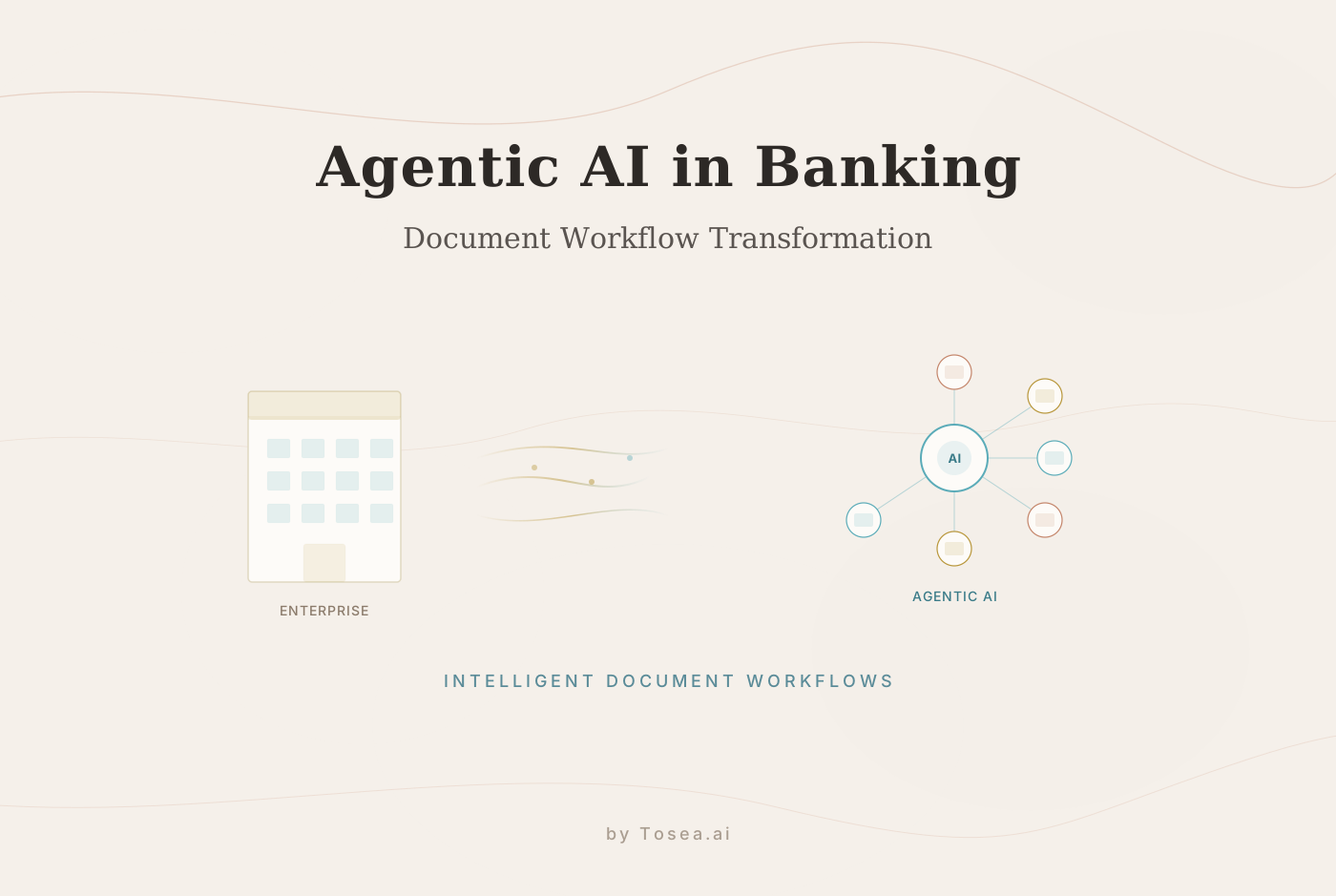
The financial services industry is undergoing one of its most significant technological overhauls in decades. According to reports from February 2026, global banking institutions including Deutsche Bank, Goldman Sachs, and Nomura are pivoting aggressively toward agentic AI. These firms are deploying autonomous agents to manage the growing complexity of trading surveillance, compliance, and risk mitigation.
This shift marks a departure from static AI models. Banks now favor autonomous agents capable of independent reasoning, anomaly detection, and the reconstruction of complex logical narratives. For modern professionals far removed from Wall Street trading desks, the implications of this banking revolution still matter. It signals a broader shift in which the ability to process, analyze, and visually communicate dense information has become a primary driver of professional value.
As Bernd Leukert, Deutsche Bank's head of technology, innovation, and data, recently indicated, the bank is retiring legacy systems and, more importantly, legacy thinking. The institution now favors language models that can monitor vast streams of communication and market movements in real time.
In this environment, tools that connect deep data intelligence with executive-level communication become increasingly important. Tosea.ai occupies this space, helping professionals transform complex documents into authoritative presentations.
The Strategic Shift: Why Global Giants Are Betting on Agentic AI
The transition to agentic AI represents a fundamental change in how institutions handle information. Traditionally, AI was used to answer specific prompts or summarize short texts. The new systems being developed by major banks operate differently. They perform multi-step tasks with limited human intervention, chaining together reasoning steps to arrive at conclusions.
Deutsche Bank, in collaboration with Google Cloud, is building advanced models for surveillance and compliance. Goldman Sachs is running internal projects with similar ambitions. Banco Santander and Nomura have each invested in autonomous AI agents designed for regulatory monitoring and cross-departmental communication analysis.
Decoding the Banking Blueprint
Banks are using these advanced models to accomplish several key objectives:
Identify Market Anomalies: Spotting subtle patterns in orders and trades that traditional rule-based algorithms might miss. Agentic systems can correlate order flows across multiple desks and time zones, surfacing irregularities that would take human analysts days to detect.
Monitor Multi-Channel Communications: Analyzing the dialogue between sales staff, traders, and clients across email, chat, and voice channels to ensure compliance with regulatory standards. The agents can flag potential conflicts of interest or information barriers in near real time.
Streamline Regulatory Reporting: Rebuilding compliance workflows from the ground up to eliminate the friction caused by legacy internal servers. Rather than relying on periodic manual reviews, agentic systems generate continuous compliance reports that adapt to changing regulatory frameworks.
Reconstruct Trading Narratives: Perhaps the most sophisticated application involves agents that can piece together the story behind a series of trades, identifying intent, timing, and context without requiring a human to manually trace each transaction.
This level of sophistication is required because financial data is rarely simple. It is high-context, non-linear, and deeply interconnected.
The same philosophy drives Tosea.ai's approach to document transformation. Just as a bank needs an AI that understands the intent behind a trade, a professional needs an AI that understands the strategic intent behind a 200-page report.
How We Evaluated the Parallels Between Banking AI and Document Transformation
To draw meaningful connections between banking agentic AI and professional document workflows, we examined several dimensions:
Reasoning Depth: How many logical steps does the AI take before producing output? Banking agents perform multi-hop reasoning across data sources. Similarly, document transformation requires understanding how a chart on page 47 relates to a conclusion on page 3.
Structural Preservation: Banking agents must maintain the chain of custody for compliance evidence. In document transformation, the equivalent challenge is preserving the hierarchical structure of the source material throughout the conversion process.
Accuracy Under Pressure: In trading surveillance, a false positive wastes resources while a false negative can result in regulatory penalties. For presentation generation, an inaccurate summary or a misplaced data point can undermine the credibility of an entire briefing.
Latency Requirements: Banks need near-real-time analysis. Professionals preparing for board meetings need rapid turnaround without sacrificing quality.
These parallels are not superficial. The technical challenges are genuinely similar, which is why solutions designed for one domain can inform approaches in the other.
From Surveillance to Strategy: The Presentation Gap
While banks focus on monitoring for misconduct, the broader professional world faces a different but equally demanding challenge: the presentation of complex findings.
Consider these scenarios. A legal expert must present an audit to a regulatory body. A consultant is delivering a market analysis to the C-suite. A strategy lead is outlining the terms of a merger for the board. In each case, the bottleneck is the same: the time-consuming and cognitively exhausting process of manual slide creation.
The standard has been raised. Stakeholders now expect presentations that reflect the same level of logical rigor found in the underlying analysis. A simple bullet-point summary no longer demonstrates the depth of work performed. Professionals need tools that can translate the full complexity of a document into a structured visual narrative.
This is where specialized document-to-presentation tools provide tangible value. By applying agentic principles to layout and narrative flow, these tools enable professionals to move from a raw document to a polished deck in minutes rather than hours.
Tosea.ai: A Professional Engine for Document Transformation
Tosea.ai is a platform for document intelligence. Its technology is designed to replicate the analytical process of a senior analyst, ensuring that every file-to-PPT conversion maintains the professional standard required in high-stakes environments.
1. Advanced Spatial Semantic Perception
Tosea.ai utilizes a method of interpreting files that goes beyond simple text extraction. Instead of treating a document as a flat stream of text, the system perceives the spatial semantics of the page.
It recognizes how a header relates to a data table. It understands how a sidebar supports a primary thesis. It sees how the overall visual layout indicates the document's hierarchy.
This approach allows Tosea.ai to:
Preserve Complex Logic: Understanding the relationship between different sections of a lengthy report ensures the narrative thread remains unbroken across the generated slides.
Perform Intelligent Content Mapping: Automatically determining which points are high-level takeaways and which are supporting details, then assigning each to the appropriate slide element.
Maintain Structural Consistency: Generating transition slides and modular chapters that reflect the original document's architecture, giving the audience a clear sense of progression.
2. The Nano Banana Pro Model
To match the reasoning capabilities currently being deployed by firms like Banco Santander and Nomura, Tosea.ai has integrated the Nano Banana Pro model.
This model offers several capabilities tuned for professional output:
Executive Aesthetic Judgment: Ensuring that every slide adheres to high design standards, utilizing professional typography, high-contrast visual hierarchies, and a refined consulting aesthetic.
Multimodal Accuracy: The ability to accurately interpret complex tables, graphs, and multi-layered diagrams commonly found in technical and financial documents.
Deep Contextual Awareness: Maintaining an understanding of industry-specific nuances, from financial terminology to legal jargon, so that generated slides use the correct register and emphasis.
3. Traceability as a Professional Standard
Following the lead of the banking sector, Tosea.ai prioritizes transparency. In a professional setting, an AI hallucination is a liability.
The system ensures traceability throughout the conversion process. Every claim, figure, and bullet point on the generated slides can be traced back to its specific origin in the source file. This allows professionals to defend their presentations with confidence, knowing that every element has a documented provenance.
Feature Comparison: Banking-Grade AI vs. Professional Document AI
| Capability | Banking Agentic AI | Professional Document AI (Tosea.ai) |
|---|---|---|
| Multi-step reasoning | Reconstructs trade narratives across data silos | Reconstructs document logic across sections and chapters |
| Anomaly detection | Flags irregular trading patterns | Identifies missing context or structural gaps in source documents |
| Compliance traceability | Full audit trail from alert to evidence | Full traceability from slide content to source page |
| Multi-modal processing | Analyzes text, voice, and transaction data | Processes text, tables, charts, images, and formulas |
| Latency | Near real-time monitoring | Minutes for a full document conversion |
| Output format | Compliance reports and alerts | Editable .pptx presentations |
Real-World Applications: Powering Professional Workflows
The adoption of agentic AI by leading banks confirms that the future of productivity lies in autonomous, high-reasoning tools. Tosea.ai applies this capability to one of the most universal professional tasks: the presentation.
For Audit and Compliance Teams
Internal auditors deal with massive volumes of data, much like the surveillance teams at Deutsche Bank. Tosea.ai allows these teams to transform exhaustive investigative reports into clear, concise presentations designed for the board of directors. The generated decks highlight anomalies and corrective actions without requiring manual slide design.
For Investment Banking and Research
Analysts at firms like Nomura need to collaborate and share information across departments and with external regulators. Tosea.ai enables the rapid creation of high-fidelity pitch decks and sectoral updates, allowing professionals to focus on the substance of their analysis rather than the mechanics of formatting.
For Legal and Professional Services
Consultants and lawyers regularly handle sensitive, long-form contracts or policy documents. Using Tosea.ai, they can create executive summaries that are both visually clear and logically sound, ensuring that all stakeholders are aligned on the most critical takeaways without wading through hundreds of pages.
For Academic and Research Institutions
Researchers preparing conference presentations or grant reviews benefit from a tool that can parse dense academic papers and produce slides that faithfully represent the methodology, findings, and conclusions of their work.
Who Is This For?
Tosea.ai is designed for professionals whose work depends on accurately communicating complex information. This includes:
- Financial analysts preparing quarterly reviews or investor updates
- Management consultants converting strategy documents into client-facing decks
- Legal teams summarizing case files or regulatory filings for partners
- Academic researchers transforming papers into conference presentations
- Corporate strategists distilling market research into board-level briefings
If your work involves turning a long, detailed document into a presentation that must withstand scrutiny, Tosea.ai is built for that workflow.
The Professional AI Shift
The news that global banks are retiring legacy systems to make room for agentic AI should resonate with knowledge workers across industries. The tools we use shape the speed and quality of our output.
In 2026, relying on manual PowerPoint design for complex document conversion is the professional equivalent of a bank relying on the legacy internal servers that Deutsche Bank has just decommissioned. The technology exists to automate the structural and analytical work, freeing professionals to focus on the strategic decisions that require human judgment.
Tosea.ai is built for professionals who recognize this shift. The platform treats AI not as a novelty but as a specialized agent that handles the burden of document reconstruction, delivering output that meets the standards expected in boardrooms, courtrooms, and conference halls.
FAQ: AI, Banking, and Professional Presentations
Q: How does Tosea.ai handle highly technical or industry-specific data?
A: Tosea.ai is built on the Nano Banana Pro engine, which is trained to understand professional document structures across finance, law, medicine, and engineering. It recognizes technical terminology and maintains the logical hierarchy of the data during the conversion process.
Q: Is my sensitive corporate data secure?
A: Tosea.ai implements enterprise-grade security protocols and strict data isolation. Your files are processed in a secure environment and are never used to train public AI models. This ensures your proprietary information remains confidential.
Q: Can I customize the design to match my company's branding?
A: Yes. While Tosea.ai generates a professional layout by default, the final output is a standard .pptx file. You can apply your own templates, adjust colors, and modify fonts within Microsoft PowerPoint or Google Slides to match your brand identity.
Q: How many pages can Tosea.ai parse at once?
A: Tosea.ai can comfortably parse documents up to 200 pages, extracting the most relevant strategic insights and organizing them into a cohesive, structurally sound presentation.
Q: How does agentic AI differ from traditional AI assistants?
A: Traditional AI assistants respond to individual prompts in isolation. Agentic AI systems perform multi-step reasoning, maintain context across a chain of actions, and can independently decide which steps to take to complete a complex task. In document transformation, this means the AI can analyze the full structure of a document before deciding how to organize the presentation, rather than processing each page in isolation.
Q: Does Tosea.ai work with non-English documents?
A: Tosea.ai supports multiple languages and can process documents that contain mixed-language content, which is common in international banking and legal contexts. The system preserves the original language while maintaining structural accuracy in the generated presentation.