How to Use Gemini 3.6 Flash: Complete Guide to Google's New Flash, Flash-Lite & Cyber Models
Gemini 3.6 Flash launched July 21, 2026 with 17% fewer output tokens and lower pricing than 3.5 Flash. Full official benchmarks, Flash-Lite speed data, the restricted Cyber model, and API notes.
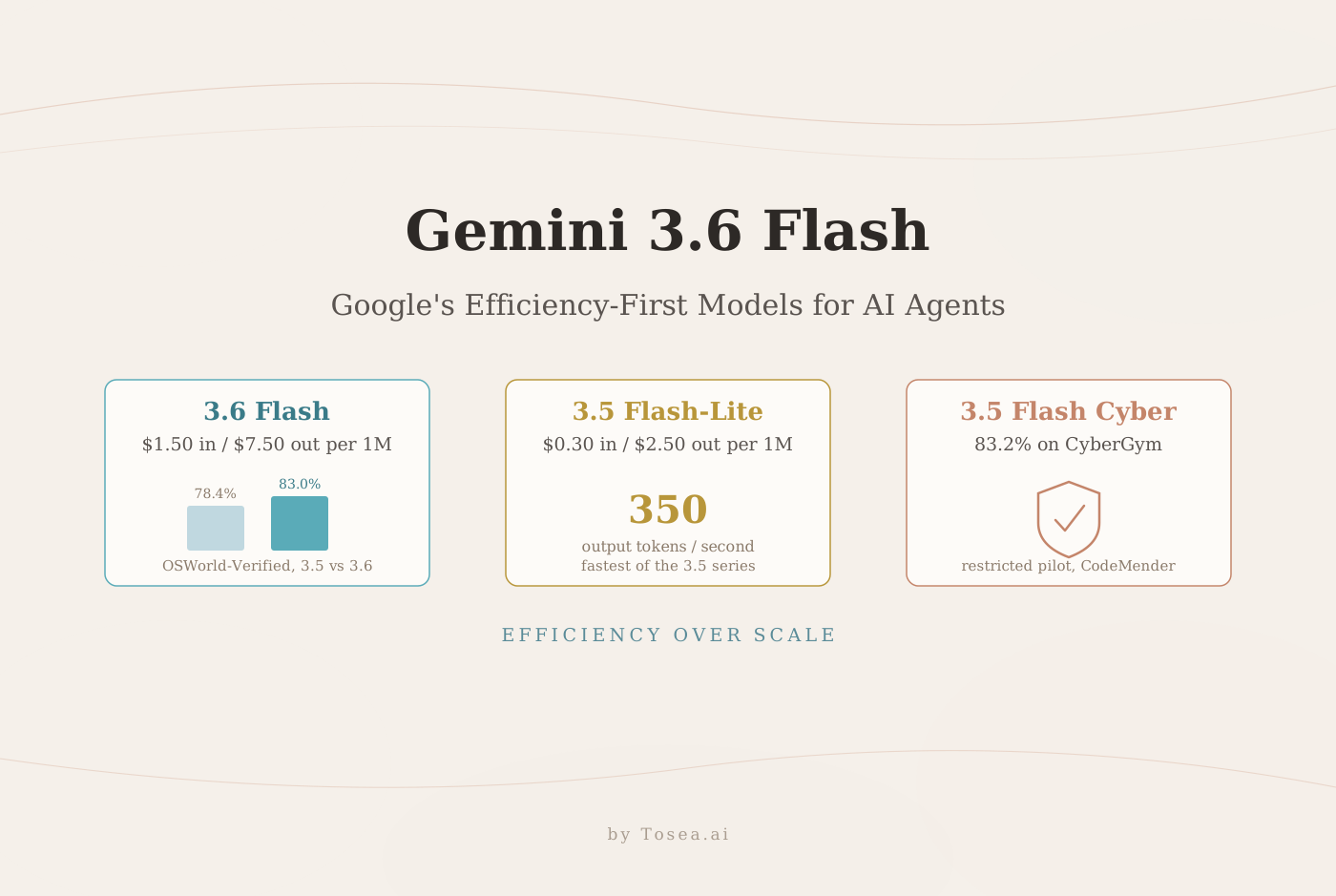
On July 21, 2026, Google quietly shipped three new Gemini models in a single announcement: Gemini 3.6 Flash, Gemini 3.5 Flash-Lite, and a restricted security specialist called Gemini 3.5 Flash Cyber. There was no Pro model, no keynote, and no claim of a new intelligence frontier. Instead, the entire release is built around one argument: if you are running AI agents in production, what you actually need is fewer tokens, lower latency, and more predictable behavior per dollar — not a bigger model.
That framing matters because it tells you exactly who this launch is for. Gemini 3.6 Flash is priced below its predecessor while beating it on every benchmark Google published. Flash-Lite pushes throughput to 350 output tokens per second for high-volume pipelines. And Flash Cyber — arguably the most interesting model of the three — is not publicly available at all: Google is restricting it to governments and vetted partners because it is genuinely good at finding exploitable vulnerabilities.
This guide walks through the full official benchmark data (transcribed from Google's own charts and the model card), where 3.6 Flash honestly wins and loses against GPT-5.6, Claude Sonnet 5, and Grok 4.5, what changed at the API level, and how to decide which of the new models fits your workload.
TL;DR: The July 2026 Gemini Flash Lineup
| Model | Price (per 1M tokens) | Positioning | Availability |
|---|---|---|---|
| Gemini 3.6 Flash | $1.50 input / $7.50 output | Workhorse for coding, agents, knowledge work; 17% fewer output tokens than 3.5 Flash | Gemini API, AI Studio, Android Studio, Antigravity, Gemini Enterprise, Gemini app |
| Gemini 3.5 Flash-Lite | $0.30 input / $2.50 output | Fastest 3.5-series model at 350 tokens/s; high-volume agentic pipelines | Gemini API, AI Studio, Gemini Enterprise; rolling out in Google Search |
| Gemini 3.5 Flash Cyber | Not publicly priced | Fine-tuned vulnerability finder/fixer inside the CodeMender agent | Limited pilot for governments and trusted partners only |
Two roadmap notes hide in the same post: Gemini 3.5 Pro is still in partner testing with no public date, and Google confirmed it has started its "most ambitious pre-training run yet" for Gemini 4.
What Google Announced on July 21
The announcement, published by Tulsee Doshi, Senior Director of Product Management for Gemini, positions the Flash series as the "sweet spot of efficiency and quality" for scaling agentic workflows. Google's own words are telling: "Developers and customers building production AI agents need higher token efficiency, lower latency, and more reliable performance."
That is a different pitch from the one Google made at I/O this spring, when Gemini 3.5 and Antigravity 2 took the main stage. The I/O story was capability; this one is unit economics. It is also a tacit admission of where the market has moved in 2026: most production LLM spend now goes to agent loops — multi-step tool-calling workflows where verbosity compounds. A model that takes fewer reasoning steps and emits fewer tokens per task is cheaper even at the same per-token price, and 3.6 Flash cuts the per-token price too.
The release slots into the existing lineup like this: 3.6 Flash replaces Gemini 3.5 Flash as the default mid-tier model, Flash-Lite replaces 3.1 Flash-Lite at the bottom, and the long-promised 3.5 Pro remains the missing top tier.
Gemini 3.6 Flash: The Efficiency Play
A Price Cut and a Quality Bump at the Same Time
Gemini 3.6 Flash costs $1.50 per million input tokens and $7.50 per million output tokens, with cached input at $0.15 per million — a 90% discount on cache hits. Its predecessor charged $9 per million output tokens, so Google cut the output price by roughly 17% while improving benchmark scores across the board. Price cuts on better models are how vendors signal they are optimizing for volume, and Google says so directly: the goal is to "reduce the overall cost per agentic task."
The efficiency story goes beyond the sticker price. According to the Artificial Analysis Intelligence Index, 3.6 Flash consumes 17% fewer output tokens than 3.5 Flash on identical workloads, and on Datacurve's DeepSWE benchmark Google observed token reductions of up to 65%. The model also takes fewer reasoning steps and fewer tool calls to finish multi-step workflows. For an agent that loops dozens of times per task, these three effects multiply: cheaper tokens × fewer tokens × fewer loops.
Official Benchmarks: 3.6 Flash vs 3.5 Flash vs 3.1 Pro
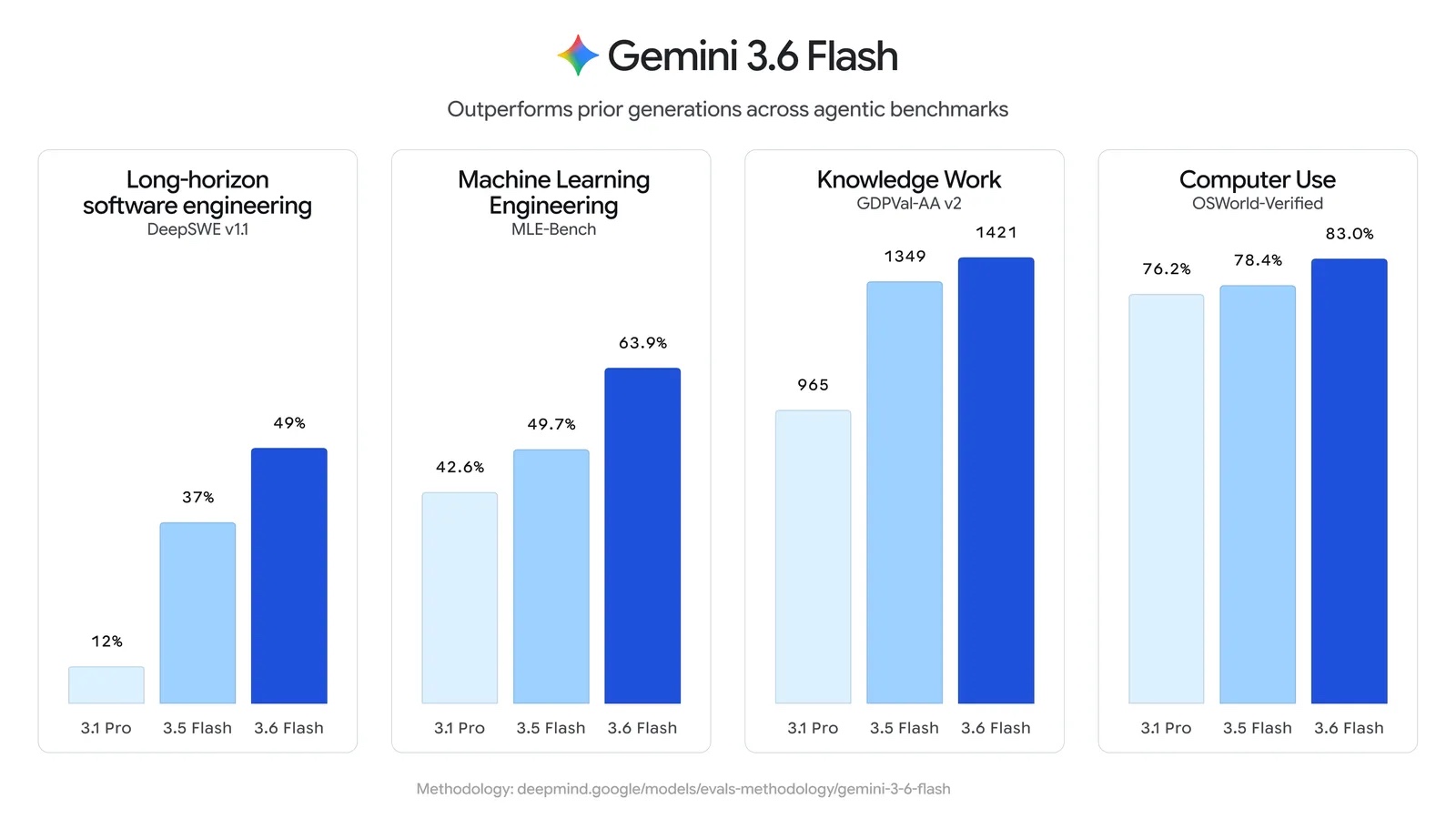
Google's launch chart compares 3.6 Flash against 3.5 Flash and the older 3.1 Pro on four agentic benchmarks. The numbers below are transcribed directly from the official figure:
| Benchmark | Gemini 3.1 Pro | Gemini 3.5 Flash | Gemini 3.6 Flash |
|---|---|---|---|
| DeepSWE v1.1 (long-horizon software engineering) | 12% | 37% | 49% |
| MLE-Bench (machine learning engineering) | 42.6% | 49.7% | 63.9% |
| GDPVal-AA v2 (knowledge work, Elo) | 965 | 1349 | 1421 |
| OSWorld-Verified (computer use) | 76.2% | 78.4% | 83.0% |
Reporting by OfficeChai, which compiled the fuller table from Google's evaluation methodology page, adds three more wins over the prior generation: SWE-Bench Pro (58.7% vs 55.1% for 3.5 Flash), Terminal-Bench 2.1 (78.0% vs 76.2%), and the GDM-MRCR v2 long-context retrieval test at the full 1M-token depth, where 3.6 Flash roughly doubles both predecessors (54.0% vs under 27%).
A few contextual details from the official model card round out the picture: the knowledge cutoff moved forward to March 2026 (from January 2025 on 3.5 Flash), the context window stays at 1M input tokens with 64K output, and the model accepts text, images, audio, and video natively. Computer use — the ability to operate a GUI — is now a built-in client-side tool in the Gemini API and Gemini Enterprise rather than a separate integration.
Early customer signals are consistent with the benchmark deltas. Harvey, the legal AI company, reported 12% faster task completion, per SiliconANGLE's coverage; Hebbia and Harvey both highlighted multimodal document parsing, chart analysis, and report drafting as the standout improvements; Figma and JetBrains appear as launch testimonials on the coding side.
Where 3.6 Flash Wins — and Where It Loses
Google's chart only compares Gemini against Gemini, so here is the honest cross-vendor picture, using the mid-2026 scores compiled by OfficeChai from each vendor's published results:
| Benchmark | Gemini 3.6 Flash | GPT-5.6 Luna | Grok 4.5 | Claude Sonnet 5 |
|---|---|---|---|---|
| DeepSWE v1.1 | 49% | 67% | — | — |
| Terminal-Bench 2.1 | 78.0% | 84.7% | — | — |
| SWE-Bench Pro | 58.7% | — | 64.7% | — |
| MLE-Bench | 63.9% | — | — | 66.9% |
| GDPVal-AA v2 (Elo) | 1421 | — | — | 1607 |
| OSWorld-Verified | 83.0% | — | — | — |
No model sweeps the board. 3.6 Flash leads on OSWorld-Verified computer use, both CharXiv chart-reasoning variants, and both GDM-MRCR long-context tests — the multimodal and long-context lanes Google has consistently owned. It clearly trails GPT-5.6 Luna on agentic coding (DeepSWE and Terminal-Bench) and trails Claude Sonnet 5 on ML engineering and knowledge work (MLE-Bench and GDPVal-AA, where Sonnet 5's 1607 Elo is a different weight class than 3.6 Flash's 1421).
The independent data tells the same story from another angle. Artificial Analysis scores 3.6 Flash at 50 on its Intelligence Index — rank #21 of 187 models tracked. That is not frontier intelligence, and Google is not claiming it is. What the same evaluation found is that the model ranks #1 on output speed at 303.6 tokens per second in its class and is "fairly concise" in token usage, though time-to-first-token (11.54 seconds at high thinking effort) sits at the slow end for its tier. One methodology caveat worth noting: vendor benchmark scores in the table above are generally reported at each model's maximum thinking configuration, and cross-vendor agent harnesses differ, so treat small gaps as noise and only the large ones as signal.
The practical read: if your workload is raw coding-agent horsepower, GPT-5.6 Luna and Sonnet 5 still hold the top of the board — at several times the price. If your workload is computer use, document-heavy multimodal work, or long-context retrieval at scale, 3.6 Flash now offers the best score-per-dollar in its bracket.
Gemini 3.5 Flash-Lite: 350 Tokens per Second for High-Volume Pipelines
The second release targets the opposite end of the cost curve. Gemini 3.5 Flash-Lite is the fastest model in the 3.5 series at 350 output tokens per second (as measured by Artificial Analysis), priced at $0.30 per million input and $2.50 per million output tokens — one-fifth and one-third of 3.6 Flash's rates respectively.
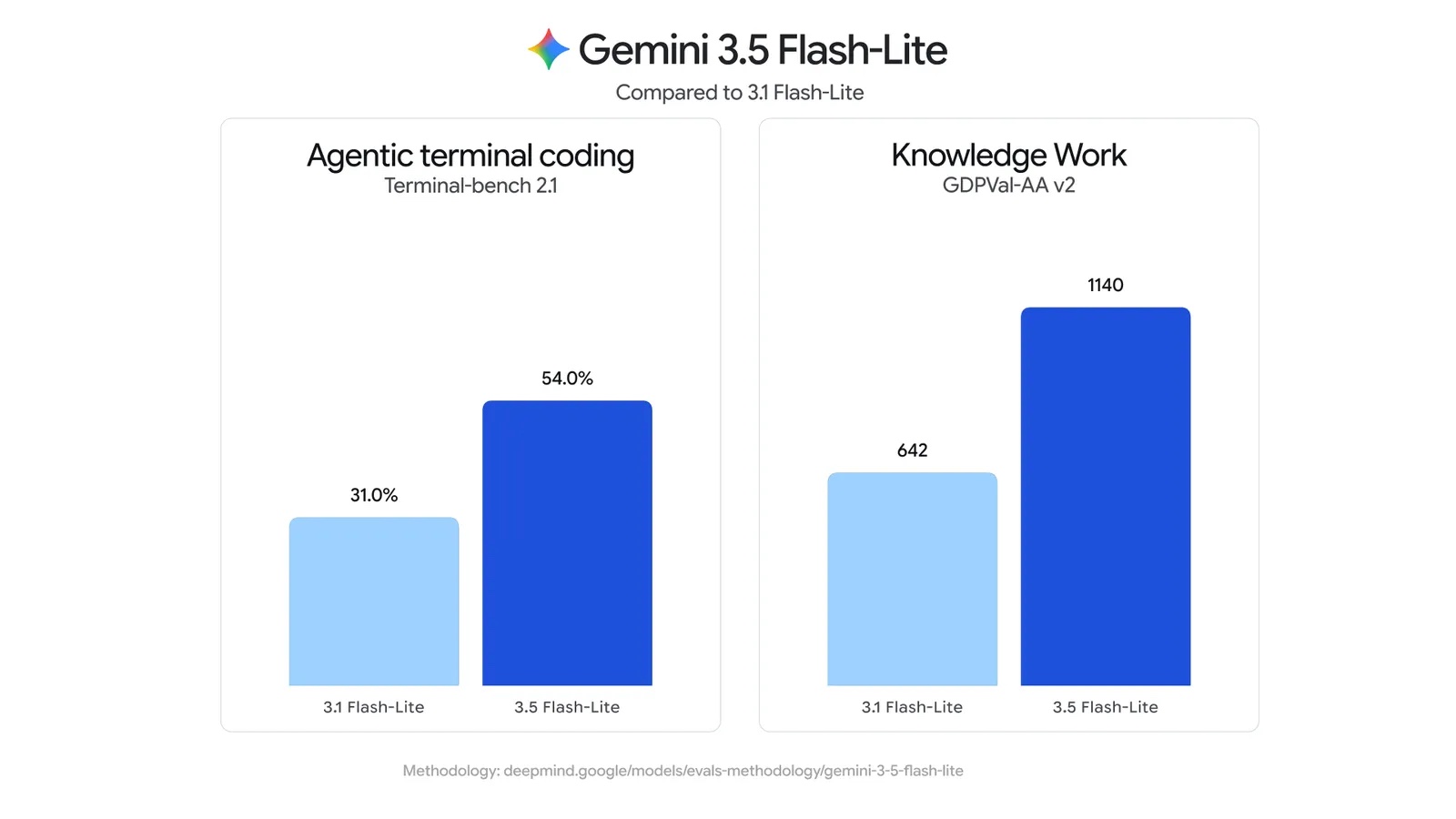
The generational jump is larger here than anywhere else in the release:
- Terminal-Bench 2.1: 54.0% vs 31.0% for 3.1 Flash-Lite — a 23-point jump in agentic terminal coding
- GDPVal-AA v2: 1140 Elo vs 642 — nearly double on real-world knowledge work
- GDM-MRCR v2 long context: 72.2% vs 60.1%
- Versus the bigger, older 3 Flash: Flash-Lite now wins on SWE-Bench Pro (54.2% vs 49.6%) and OSWorld-Verified (74.0% vs 65.1%)
That last comparison is the notable one: the cheapest current model outperforms the previous generation's mid-tier on coding and computer-use benchmarks. Google's positioning for it is explicitly high-throughput work — agentic search, bulk document processing, classification, subagent fan-out — with configurable thinking levels from minimal (the default, tuned for latency) up to high for multi-step subagent workloads. Computer use is built in here too, and Google says Flash-Lite is rolling out inside Google Search, which is about as strong a scale endorsement as the company can give one of its own models.
For teams currently routing bulk workloads to budget models like GLM-5.2 or open-weight alternatives, Flash-Lite's pitch is that the quality floor for sub-dollar models just moved up.
Gemini 3.5 Flash Cyber: A Bug-Hunter on a Leash
The third model is the one Google will not sell you. Gemini 3.5 Flash Cyber is a version of 3.5 Flash fine-tuned specifically for finding, validating, and patching security vulnerabilities, and it ships exclusively inside CodeMender, DeepMind's code-security agent — available only to governments and trusted partners in a limited-access pilot.
According to DeepMind's companion technical post, the fine-tuning leans on assets few other labs have: the OSV.dev database of 700,000+ open-source vulnerabilities, more than a decade of OSS-Fuzz results, and real security-workflow data from Google-scale codebases like Chromium. Inside CodeMender, multiple 3.5 Flash Cyber sub-agents analyze different code paths and merge findings into a single vulnerability report — a deliberate architecture choice that lets a cheap model, called up to five times, compete with single calls to far larger models.
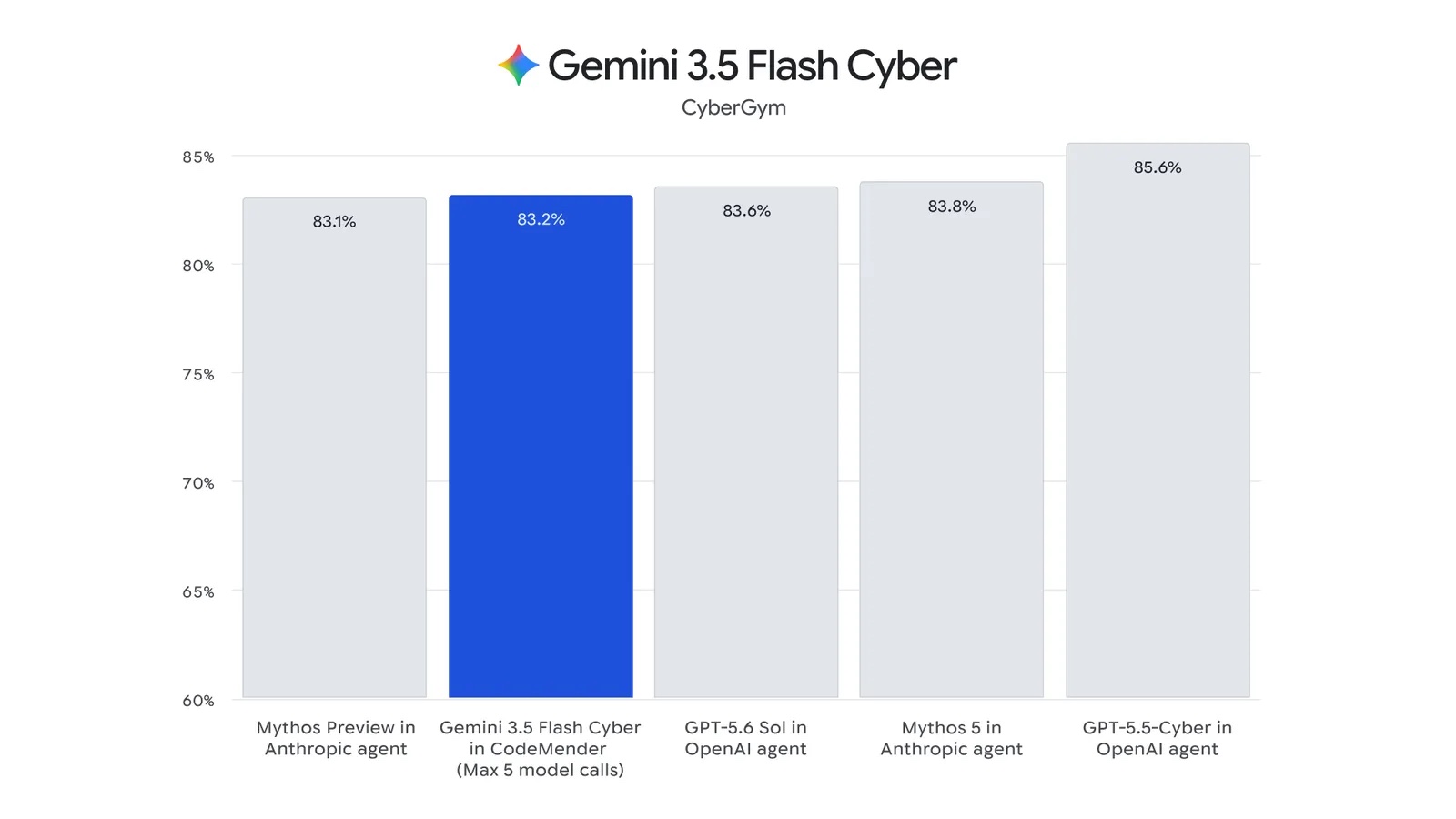
The official CyberGym chart shows exactly that trade working:
| System | CyberGym score |
|---|---|
| GPT-5.5-Cyber in OpenAI agent | 85.6% |
| Claude Mythos 5 in Anthropic agent | 83.8% |
| GPT-5.6 Sol in OpenAI agent | 83.6% |
| Gemini 3.5 Flash Cyber in CodeMender (max 5 model calls) | 83.2% |
| Claude Mythos Preview in Anthropic agent | 83.1% |
Read honestly: Flash Cyber does not top this chart. OpenAI's dedicated GPT-5.5-Cyber leads by 2.4 points, and Anthropic's Mythos 5 edges it by 0.6. Google's claim is "competitive performance at the frontier" from a Flash-sized model — a cost claim, not a crown. Where the model does clearly win is in Google's own deeper evaluations: on a V8 JavaScript engine test it confirmed 55 unique real issues versus 47 for stock 3.5 Flash and 36 for Claude Opus 4.6, including 10 issues no other model found, and it significantly outperformed both 3.5 Flash and 3.6 Flash at discovering Chrome and Safari vulnerabilities in Big Sleep-style evaluations. Google's Cloud Vulnerability Research team reports using it to find a memory-corruption vulnerability in a production service and build a working exploit chain — bypassing ASLR and W^X — within two hours.
Which explains the leash. Google states plainly that the capability is dual-use, and its Frontier Safety work has previously flagged the Gemini 3 series at the cyber alert threshold. The mitigations stack: access limited to vetted defenders, deployment only inside CodeMender's reporting workflow, and human approval required before patches ship (though SiliconANGLE notes CI/CD integration can automate this if the customer configures it). Early enterprise testers reportedly include Salesforce, Robinhood, and Palo Alto Networks. Whether this access model holds as competitors ship less restricted security models is one of the more interesting policy questions of the second half of 2026.
Architecture and API Notes
Under the hood, the model card describes 3.6 Flash as based directly on Gemini 3.5 Flash — same natively multimodal, sparse reasoning-model foundation, same 1M/64K context envelope — with the gains coming from post-training rather than a new base model. The safety data in the card shows the same pattern: multilingual safety violations down 5.45 percentage points versus 3.5 Flash, content safety down 1.35 points, unjustified refusals essentially flat, with a small regression in refusal tone that Google flags transparently. Jailbreak resistance was specifically hardened in the CBRN and cyber-offense domains while training the model to refuse less on benign requests.
For developers, the migration checklist is short but breaking:
- Model IDs are
gemini-3.6-flashandgemini-3.5-flash-lite thinking_budgetis replaced by athinking_levelstring enum; 3.6 Flash defaults tomedium, Flash-Lite tominimal- The classic sampling knobs —
temperature,top_p,top_k— are removed and should be deleted from request payloads candidate_countis unsupported, and prefilled model turns (conversations ending on a non-emptymodelrole) are rejected
Both public models expose the full built-in tool suite, including computer use, search grounding, and code execution. If you are on 3.5 Flash today, the switch is a model-string change plus deleting deprecated parameters — there is no new SDK surface to learn.
Which Model Should You Pick?
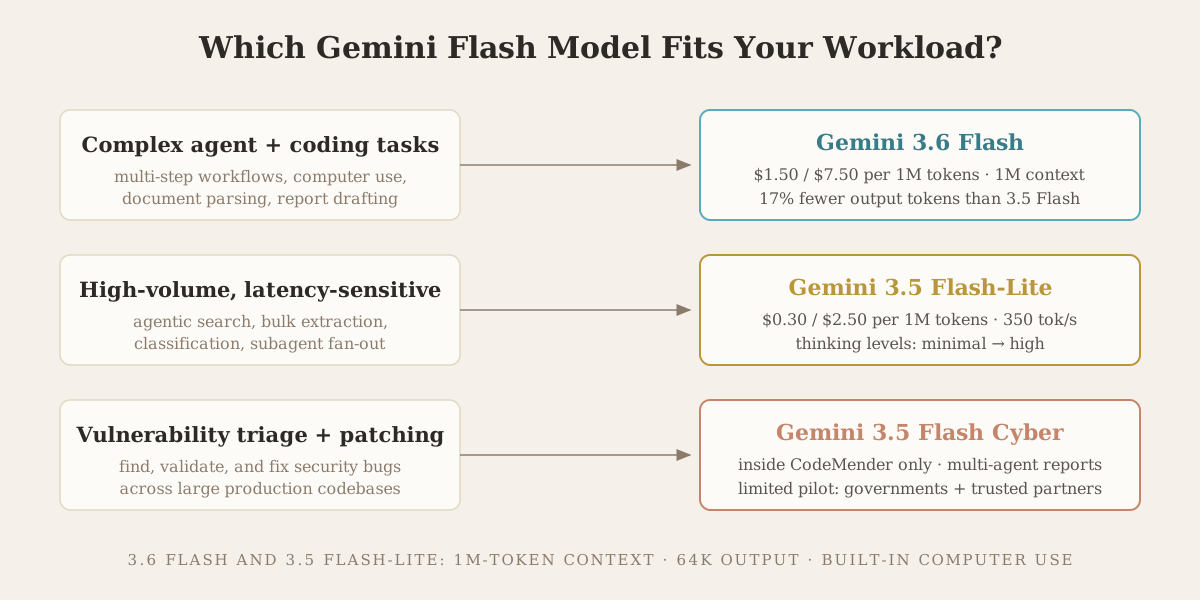
A simple routing heuristic based on the published numbers:
- Default to 3.6 Flash for agent loops that involve coding, computer use, document parsing, or anything multi-step. The token-efficiency gains compound precisely where agent costs explode.
- Route bulk, latency-sensitive work to Flash-Lite — extraction, classification, search summarization, subagent fan-out — and only raise
thinking_levelwhere sampled quality checks say you must. - Keep frontier coding on frontier models. If DeepSWE-class autonomy is the job, the honest numbers say GPT-5.6 Luna or Claude Sonnet 5 still finish tasks 3.6 Flash cannot, and the premium may be worth it for low-volume, high-stakes runs.
- Flash Cyber is not a choice you get to make unless you are a government or an invited partner; for everyone else, CodeMender's foundational capabilities surface through Gemini Enterprise with standard models.
What This Launch Signals
Three reads between the lines. First, the Pro-tier delay is real: Gemini 3.5 Pro was expected around I/O season, and Google now says only that it is "testing with partners." Shipping two Flash models and a security specialist while the flagship slips suggests the top of the lineup is harder to land than the middle. Second, Gemini 4 pre-training has started — Google volunteering that it has begun its "most ambitious pre-training run yet" is the kind of statement that usually precedes a 6-12 month runway. Third, the restricted release of Flash Cyber is a template: it is the first time Google has gated a Gemini model behind a government-and-partners allowlist rather than an API safety filter, and it will not be the last if capability trends continue.
FAQ
Is Gemini 3.6 Flash actually cheaper than 3.5 Flash? Yes, on output: $7.50 versus $9 per million tokens, a ~17% cut — and because the model also emits about 17% fewer tokens for the same work, the effective cost per completed task drops more than the sticker price suggests. Cached input costs $0.15 per million.
Can I access Gemini 3.5 Flash Cyber? Not unless you are a government agency or an invited partner in the CodeMender pilot. Google has committed to expanding access over time, and CodeMender's general capabilities are reachable through the Gemini Enterprise Agent Platform with standard models.
What happened to Gemini 3.5 Pro? It remains in partner testing with no announced date. Google says it will ship "as soon as it's ready," while confirming Gemini 4 pre-training is already underway.
Do I need to change code to upgrade from 3.5 Flash?
Minimally: swap the model string to gemini-3.6-flash, replace thinking_budget with thinking_level, and remove temperature, top_p, top_k, and candidate_count from requests.
What is the context window? Both 3.6 Flash and 3.5 Flash-Lite accept up to 1M input tokens and produce up to 64K output tokens, with text, image, audio, and video inputs.
What Gemini 3.6 Flash Means for AI Slide Generation
The capabilities Google chose to highlight — multimodal document parsing, chart analysis, report drafting, long-context retrieval — are precisely the workload profile of document-to-PPT pipelines, which is why this release matters beyond chatbots. An AI presentation tool spends most of its tokens in two places: reading source material (a 60-page PDF, a spreadsheet, a transcript) and structuring it into a slide outline. A model that handles 1M tokens of context, doubles its predecessor's long-context retrieval score, and emits 17% fewer output tokens changes the economics of both steps — especially for massive multi-document decks where outline generation used to be the cost bottleneck.
The 83% OSWorld-Verified computer-use score points at a second-order effect: agents that can operate real slide software, not just emit markup. But for the core PDF-to-PowerPoint workflow, the near-term win is quality-per-dollar on the reading-and-structuring stage. GDPVal-AA — where 3.6 Flash posted 1421 Elo — specifically measures knowledge-work deliverables of the kind a slide deck ultimately is: synthesized, structured, decision-ready output from messy source documents.
At Tosea.ai, we run exactly this kind of multi-model orchestration for document-to-deck conversion: parsing, outline generation, and slide rendering are separate stages, each routed to whichever model wins that stage's quality-per-dollar trade — the same routing logic sketched in the decision diagram above. Cheap, fast models like Flash-Lite are natural fits for bulk parsing and per-slide fan-out, while the outline stage — where hallucinated numbers are most damaging — justifies stronger reasoning models. A release that raises the quality floor at $0.30 input pricing while cutting the mid-tier's effective cost per task is good news for anyone whose product turns documents into slide decks at scale — and a reminder that in presentation workflows, model choice is a per-stage decision, not a one-time allegiance.
Sources
- Introducing Gemini 3.6 Flash, 3.5 Flash-Lite, and 3.5 Flash Cyber — Google, July 21, 2026
- Gemini 3.6 Flash Model Card — Google DeepMind, July 2026
- Introducing Gemini 3.5 Cyber Flash — Google DeepMind, July 21, 2026
- Gemini API: Latest model documentation — Google AI for Developers
- Google launches Gemini 3.6 Flash and 3.5 Flash-Lite, teases Gemini 4 — 9to5Google
- Google expands Gemini with cheaper models and a bug-hunter it keeps on a leash — SiliconANGLE
- Gemini 3.6 Flash Beats Gemini 3.5 Flash, Gemini 3.1 Pro On Most Benchmarks — OfficeChai
- Gemini 3.6 Flash — Intelligence, Performance & Price Analysis — Artificial Analysis