How to Use GLM-5.3-Flash: Complete Guide to the Ox Alpha Model Zhipu Just Revealed
Zhipu's Ox Alpha stealth model is GLM-5.3-Flash: 320B-A18B, natively multimodal, 1M context, MIT license. Full official benchmarks vs Claude Opus 4.8 and GPT-5.6 Terra, plus pricing and API setup.
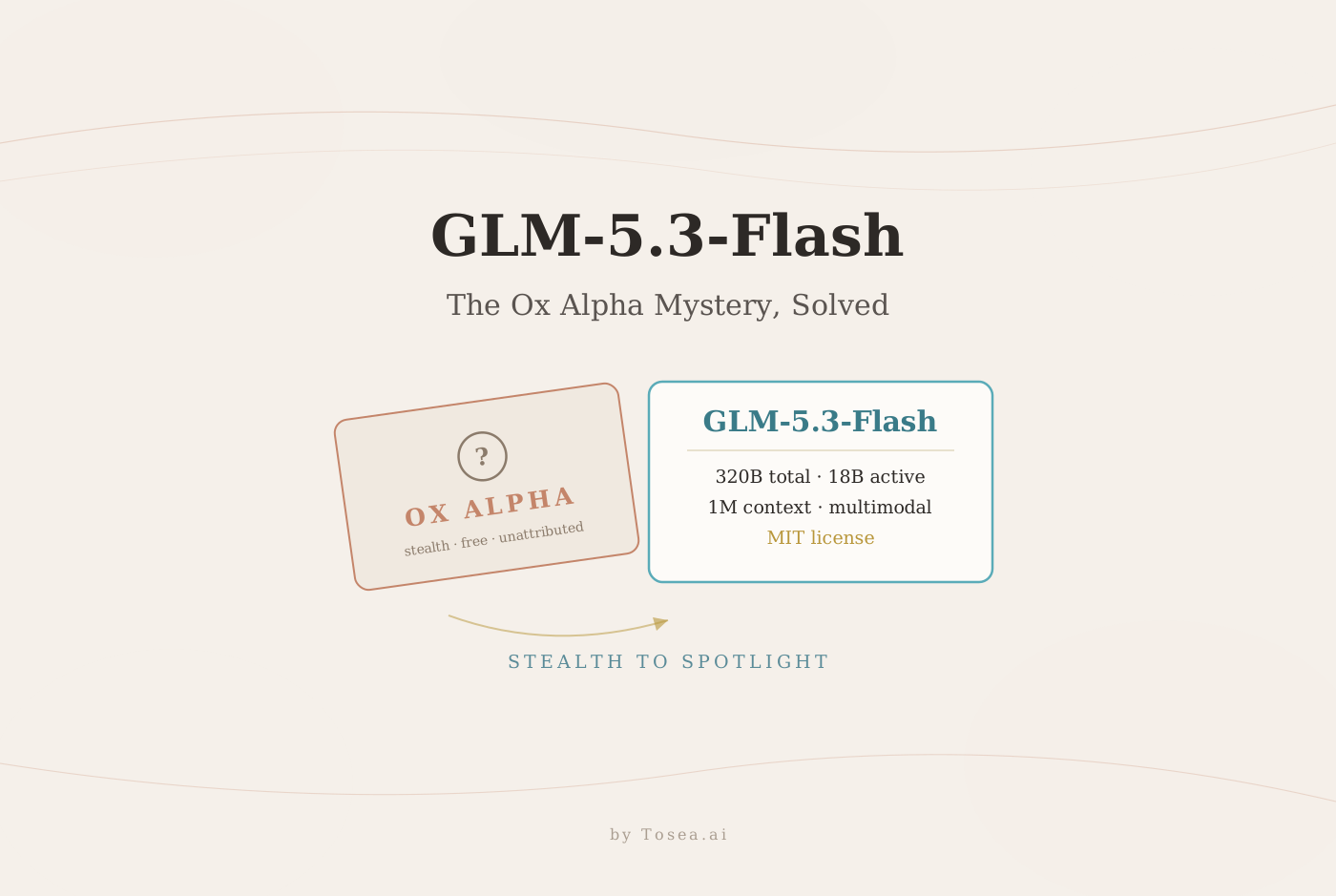
For six days, the most talked-about model in AI had no name, no vendor, and no price tag. On August 20, 2026, a listing called Ox Alpha quietly appeared on OpenRouter, OpenCode, Cline, and Nous Research's portal — free to use, with a 1-million-token context window and support for text, image, and video input. Stripe CEO Patrick Collison, whose company had acquired OpenRouter just one day earlier, called it "very impressive" in a post that sent half the developer internet to go test it. Community benchmarkers reported eye-catching coding scores. Fingerprint hunters ran tokenizer probes and declared themselves "99% certain" it came from Zhipu's GLM family.
On August 26, Z.ai (Zhipu AI's international brand) ended the guessing game: Ox Alpha is GLM-5.3-Flash, the first natively multimodal model in the GLM-5 series — a 320B-parameter Mixture-of-Experts model with just 18B active parameters, released under the MIT License, priced at $0.15 per million input tokens, and, according to the company, running entirely on Chinese AI chips.
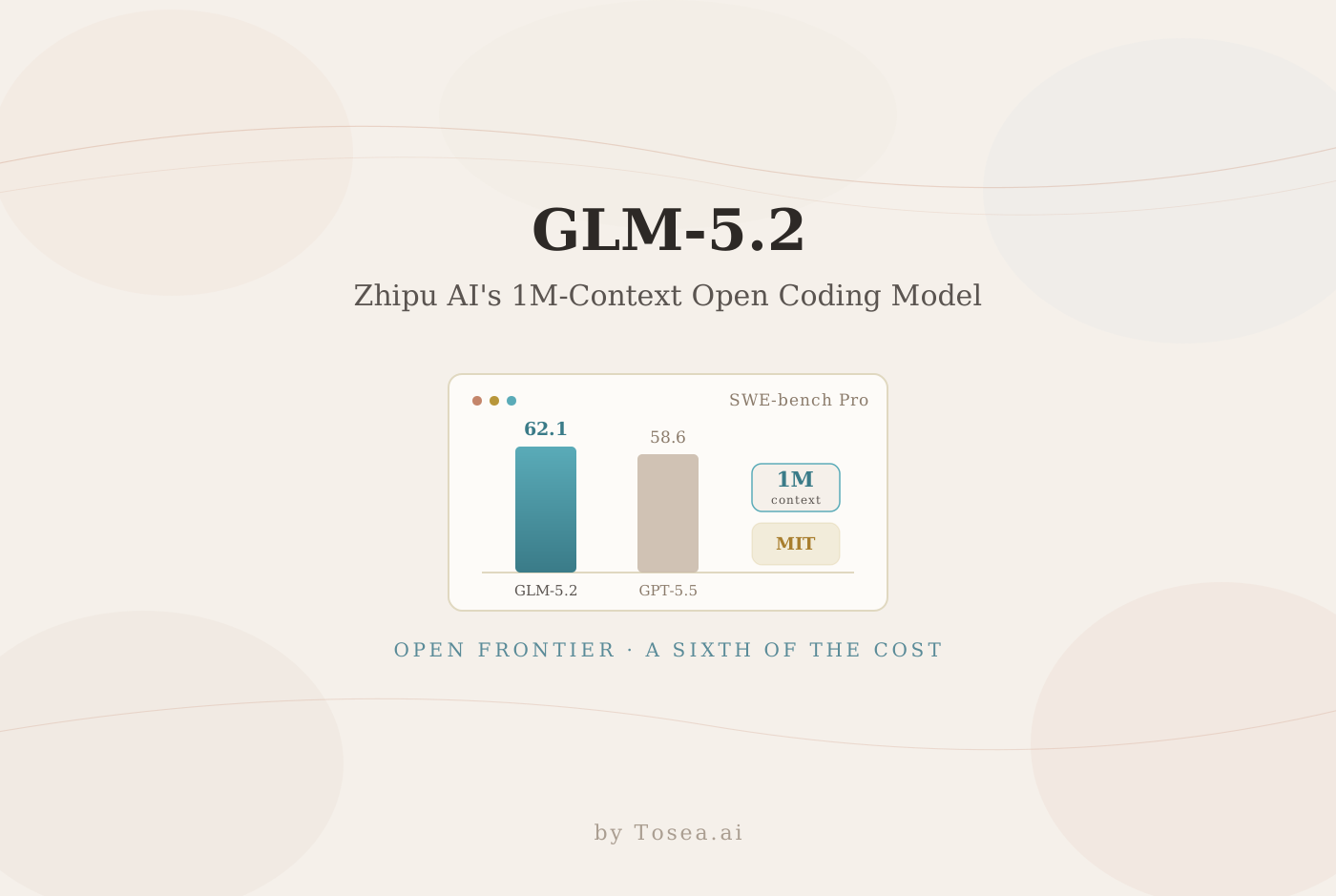
This guide covers the full story: how the community unmasked the model before Zhipu confirmed it, what the hybrid sparse-linear attention architecture actually changes, the complete official benchmark table (transcribed from Zhipu's own chart, including the benchmarks it loses), pricing economics, and how to start using it through the API today. If you followed our earlier GLM-5.2 guide, this is the next chapter in the same lineage — and arguably a more interesting one.
The Ox Alpha Week: How the Community Unmasked a Stealth Model
A stealth model is a listing a routing platform runs under a codename, usually free, on behalf of a lab that wants real-world usage data before an official launch. OpenRouter has hosted more than a dozen of them: Quasar Alpha and Optimus Alpha turned out to be GPT-4.1 snapshots, Horizon Alpha was an early GPT-5 checkpoint, and Hunter Alpha came from Xiaomi's MiMo team.
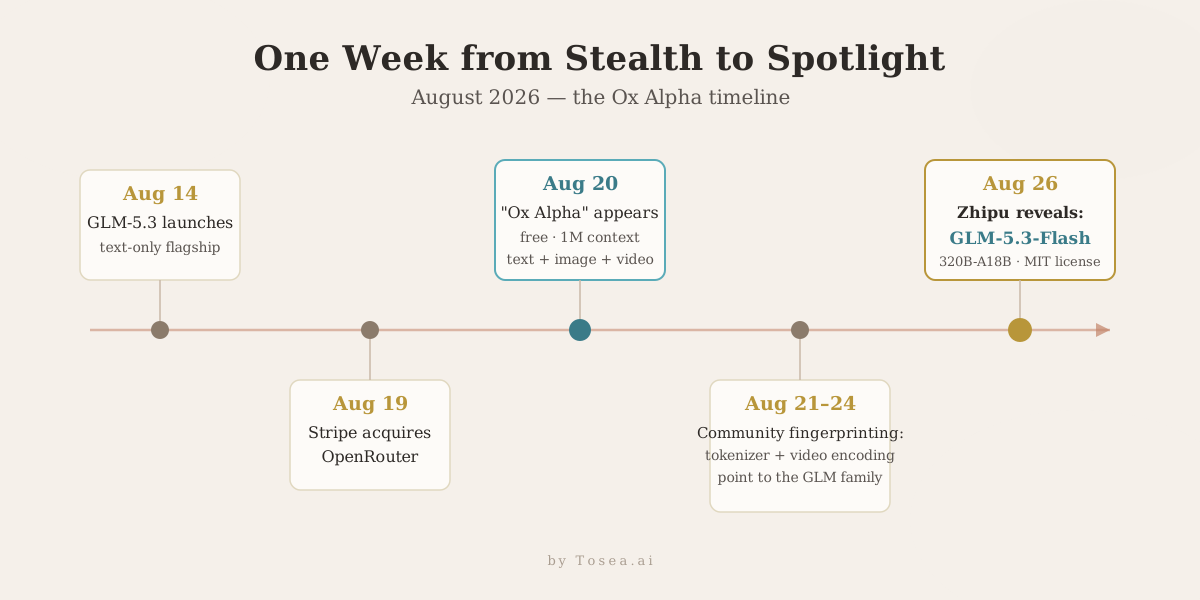
The Ox Alpha episode compressed that entire arc into one week:
- August 14: Zhipu launches GLM-5.3, a text-only flagship priced at $1.40 input / $4.40 output per million tokens.
- August 19: Stripe completes its acquisition of OpenRouter.
- August 20: Ox Alpha appears without attribution on OpenRouter, OpenCode, Cline, and Nous Research's portal — free for roughly one week, 1M-token context, text/image/video input, tool calling enabled. OpenCode claimed serving capacity of 100 trillion tokens per day.
- August 21–24: Patrick Collison publicly praises the model. Developer Ben Davis posts a viral claim: on a 10-task sample of the DeepSWE coding benchmark, Ox Alpha resolved 80% of GitHub issues, ahead of the frontier closed models he tested against. Two full 113-task runs later, the number settled near 63% — a reminder that small benchmark samples have enormous variance, and a number that turned out to almost exactly match Zhipu's own official figure.
- August 26: Z.ai confirms Ox Alpha is GLM-5.3-Flash.
The fingerprinting work deserves credit, because it was genuinely rigorous. Davis and other researchers found that Ox Alpha's tokenizer matched GLM-5.3 exactly across normalized tests, that its video-token encoding matched GLM's scheme across four separate clips, and that both models shared distinctive errors and identical audio-rejection behavior. Early theories pointing to Microsoft, DeepSeek, Xiaomi, Google, and Alibaba were ruled out one by one on architectural grounds.
There was one complication: GLM-5.3, launched August 14, was text-only — yet Ox Alpha accepted images and video. The community's conclusion was that this had to be an unreleased multimodal sibling, and analysts started calling it "GLM-5.3 Flash" days before Zhipu said a word. They guessed the exact name.
Zhipu Has Run This Play Before
This is not Zhipu's first stealth release. In February 2026, a codename called Pony Alpha appeared on OpenRouter, processed over 40 billion tokens on its first day, and topped the platform's popularity rankings before Zhipu confirmed on February 11 that it was GLM-5, its 744B-parameter flagship. The playbook is now recognizable: ship anonymously, let usage and independent benchmarks accumulate without launch-day hype distorting them, then attach the brand once the numbers are in.
One detail worth noting from the stealth-model census: most cloaked listings default to terms that let the provider train on your conversations. Ox Alpha was the only stealth model to date with an explicit no-training carve-out — a small but meaningful signal about what Zhipu was optimizing for during the preview (deployment validation rather than data harvesting).
What GLM-5.3-Flash Actually Is
Strip away the mystery narrative and the model itself is a substantial release:
| Spec | GLM-5.3-Flash |
|---|---|
| Total parameters | 320B (Mixture-of-Experts) |
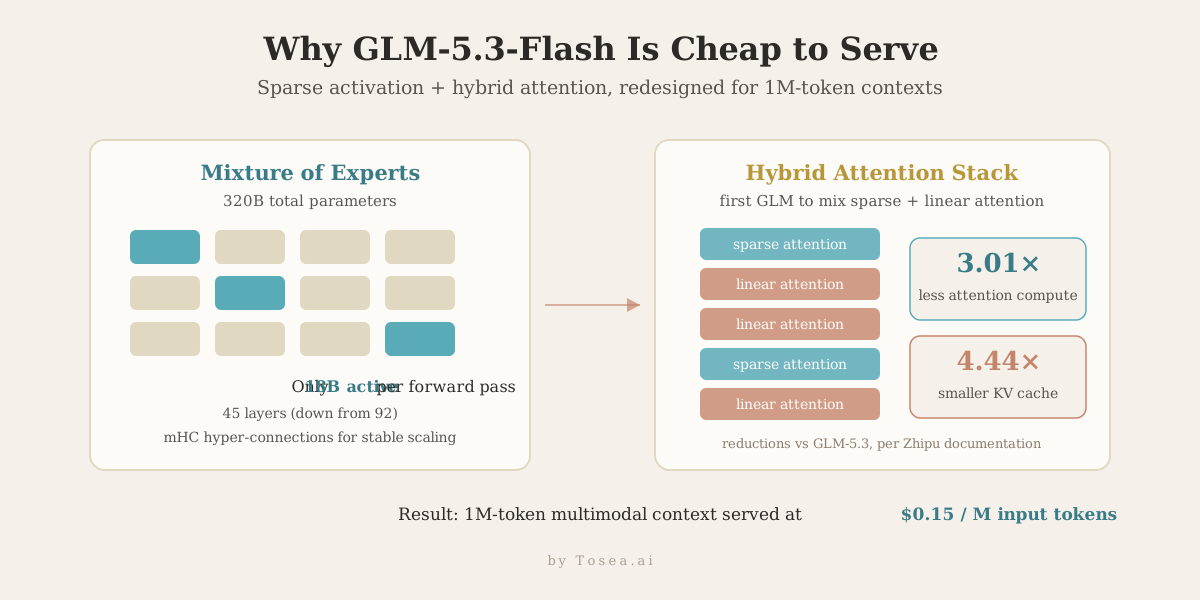
| Active parameters | 18B per forward pass |
| Modalities | Native multimodal: text, images, video, files |
| Context window | 1M tokens |
| Reasoning | Thinking mode, always on (cannot be disabled) |
| Pre-training corpus | 30T multimodal tokens |
| License | MIT (open weights on Hugging Face) |
| API price | $0.15 / M input, $0.50 / M output, $0.03 / M cached input |
| Hardware | Runs entirely on Chinese AI chips, per Z.ai |
Three things distinguish it from every previous GLM release.
First, it is natively multimodal. Previous GLM vision models were adaptations; GLM-5.3-Flash was pre-trained from scratch on a 30-trillion-token multimodal corpus. That is why the stealth version handled video input — and why the community's tokenizer forensics could match its video-token encoding against GLM's published scheme.
Second, it is aggressively small where it counts. 18B active parameters is tiny for a model that Zhipu positions against Claude Opus 4.8 and GPT-5.6 on agentic benchmarks. The model card's headline claim is that it outperforms GLM-5.2 across benchmarks at roughly one-tenth the price while approaching Claude Opus 4.8 on coding and agentic tasks. As we cover below, the official numbers mostly support the first half of that claim and partially support the second.
Third, the MIT license. Like DeepSeek's V4 line and Kimi K3, the weights are on Hugging Face with no usage restrictions. You can self-host, fine-tune, and deploy commercially. For teams that need on-premises inference with multimodal input, the field of frontier-adjacent options under a permissive license remains short, and this model joins it.
Architecture: Why an 18B-Active Model Can Serve 1M Tokens Cheaply
The most technically interesting part of this release is not the benchmark table — it is how the model was restructured to make long-context serving economical. GLM-5.3-Flash is built on a newly trained base model, not a distillation of GLM-5.3, and two architectural decisions carry most of the weight.
Hybrid Sparse + Linear Attention
For the first time in the GLM series, the model mixes sparse attention and linear attention layers instead of running full attention everywhere. Full attention scales quadratically with sequence length and forces the server to hold a key-value cache for every token — which is exactly what makes million-token contexts expensive to serve. Per Zhipu's documentation, the hybrid design cuts attention computation by 3.01× and KV cache size by 4.44× relative to GLM-5.3, and the company claims the lowest attention compute among the baselines it measured against (including DeepSeek-V4-Flash and Kimi-K3), while acknowledging its KV cache remains slightly larger than some competing designs.
The layer count tells the same story: 45 layers, down from 92 in prior GLM models. Fewer, wider layers with cheaper attention is a serving-cost decision as much as a modeling one.
Manifold-Constrained Hyper-Connections
The second novelty is what Zhipu calls Manifold-Constrained Hyper-Connections (mHC) — a modification to how layers connect that the company credits with improved training stability and scaling behavior. Zhipu's stated design goal for the release is to "deliver more intelligence with less compute," and mHC is presented as the training-side half of that equation, complementing the attention changes on the inference side.
The practical consequence shows up in the price sheet. A 1M-context multimodal model at $0.15 per million input tokens only works if the underlying serving math works, and the architecture is the reason a free week for the entire internet — at claimed capacity of 100 trillion tokens per day — was economically survivable at all.
Full Official Benchmarks: The Complete Table
Zhipu published a six-benchmark comparison against GLM-5.2, DeepSeek-V4-Vision-Exp, Claude Opus 4.8, GPT-5.6 Terra, and Gemini 3.7 Flash. The table below is transcribed from the official chart in the GLM-5 GitHub repository — every number, including the ones where GLM-5.3-Flash loses.
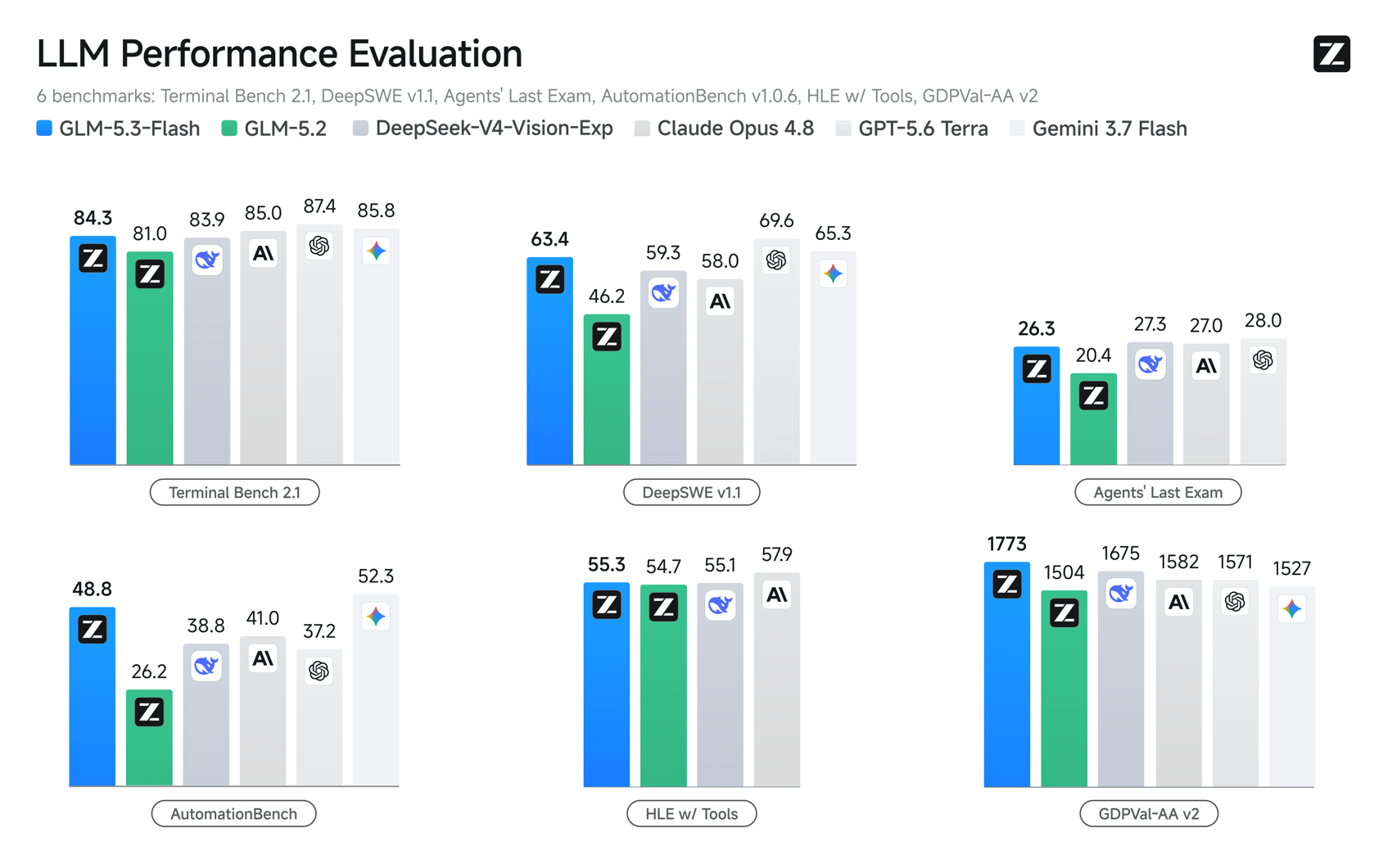
| Benchmark | GLM-5.3-Flash | GLM-5.2 | DeepSeek-V4-Vision-Exp | Claude Opus 4.8 | GPT-5.6 Terra | Gemini 3.7 Flash |
|---|---|---|---|---|---|---|
| Terminal Bench 2.1 | 84.3 | 81.0 | 83.9 | 85.0 | 87.4 | 85.8 |
| DeepSWE v1.1 | 63.4 | 46.2 | 59.3 | 58.0 | 69.6 | 65.3 |
| Agents' Last Exam | 26.3 | 20.4 | 27.3 | 27.0 | 28.0 | — |
| AutomationBench v1.0.6 | 48.8 | 26.2 | 38.8 | 41.0 | 37.2 | 52.3 |
| HLE (with tools) | 55.3 | 54.7 | 55.1 | 57.9 | — | — |
| GDPVal-AA v2 | 1773 | 1504 | 1675 | 1582 | 1571 | 1527 |
Methodology caveats, from the model card: evaluations run with a maximum context of 300K tokens using a context-management strategy; Terminal-Bench 2.1 was evaluated inside Claude Code 2.1.207; DeepSWE used the mini-swe-agent harness with temperature 0.95, a 400K context, and a 6-hour timeout; HLE answers were judged by GPT-5.6-luna. Harness and judge choices move agentic scores by real margins, so treat cross-vendor comparisons on these benchmarks as directional rather than exact.
Where It Wins, Where It Loses
Reading the table honestly, benchmark by benchmark:
- Terminal Bench 2.1 (84.3): Mid-pack. It edges GLM-5.2 (81.0) and DeepSeek-V4-Vision-Exp (83.9), but trails Claude Opus 4.8 (85.0), Gemini 3.7 Flash (85.8), and GPT-5.6 Terra (87.4). "Approaching Opus" is accurate here; "matching" is not.
- DeepSWE v1.1 (63.4): The strongest coding result. It beats Claude Opus 4.8 (58.0) and DeepSeek (59.3) outright, and the jump from GLM-5.2 (46.2) is 17 points — the largest generational gain in the table. It still trails Gemini 3.7 Flash (65.3) and especially GPT-5.6 Terra (69.6). Note that Ben Davis's independent full-run figure of ~63% during the stealth week landed within half a point of the official 63.4 — an unusually clean external validation.
- Agents' Last Exam (26.3): A clear loss. All three closed frontier models score higher (27.0–28.0). The gain over GLM-5.2 (20.4) is real, but on frontier agentic reasoning this model is a step behind.
- AutomationBench v1.0.6 (48.8): A strong win against most of the field — Claude Opus 4.8 sits at 41.0 and GPT-5.6 Terra at 37.2 — but Gemini 3.7 Flash leads at 52.3. Nearly doubling GLM-5.2 (26.2) suggests targeted training on computer-use workflows.
- HLE with tools (55.3): Effectively a three-way tie with GLM-5.2 (54.7) and DeepSeek (55.1); Claude Opus 4.8 leads at 57.9.
- GDPVal-AA v2 (1773): The headline win. On this Elo-style rating of economically valuable knowledge work, GLM-5.3-Flash tops every model in the chart, including Claude Opus 4.8 (1582) and GPT-5.6 Terra (1571), by a wide margin.
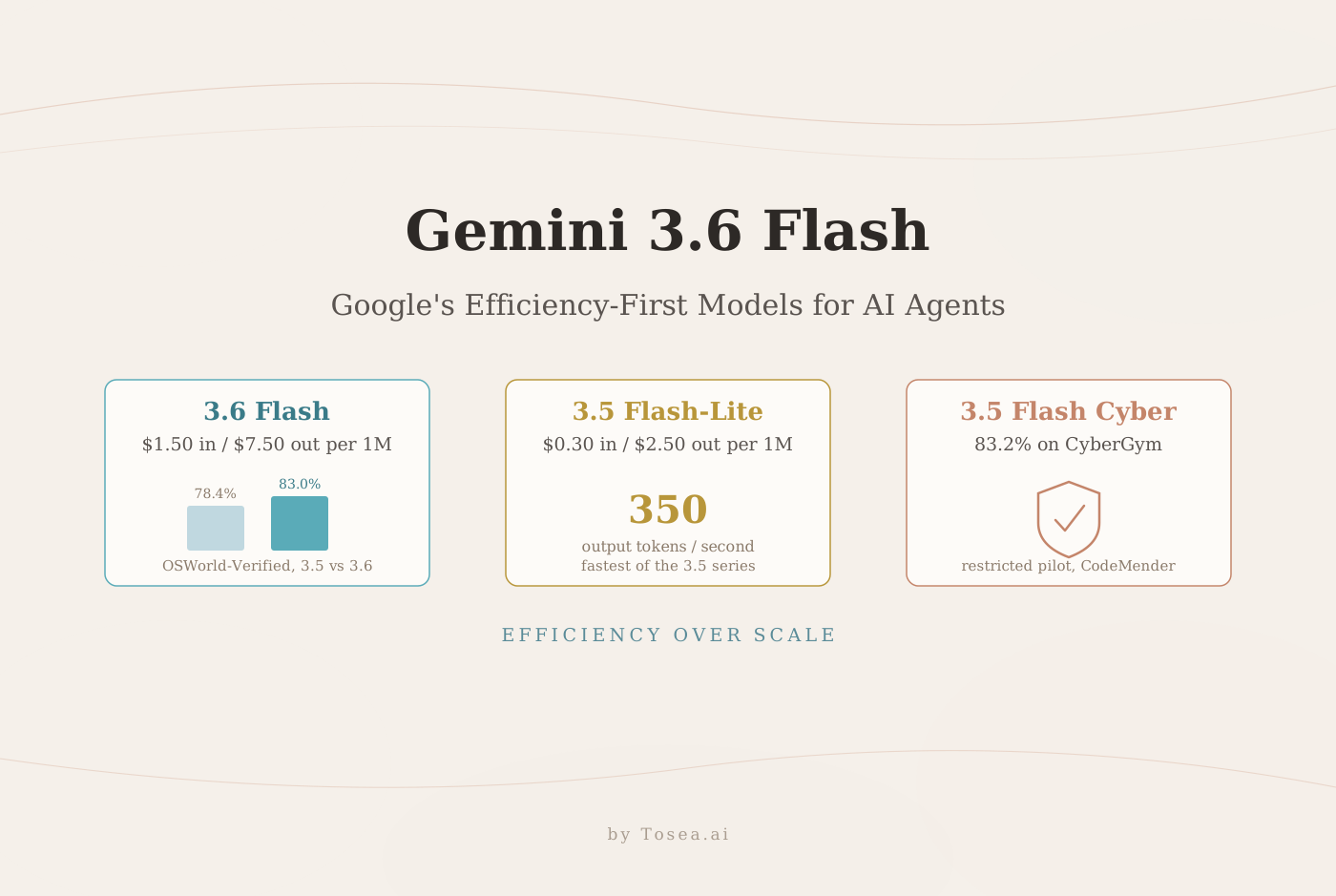
The pattern is consistent: GLM-5.3-Flash does not claim the frontier on raw agentic reasoning, and Zhipu's own chart shows GPT-5.6 Terra winning half the benchmarks outright. What the chart actually argues is that the gap to the frontier has shrunk to single digits on most tasks — from a model with 18B active parameters at a fraction of the price. Against its price-class peers, the comparison it most resembles is Gemini 3.6 Flash's efficiency-first pitch: both releases bet that production agent workloads care more about cost-per-solved-task than leaderboard crowns.
Pricing: The Actual Economics
The API pricing sits an order of magnitude below both its own flagship sibling and Western frontier models:
| Model | Input / M tokens | Output / M tokens | Notes |
|---|---|---|---|
| GLM-5.3-Flash | $0.15 | $0.50 | $0.03 cached input; 1M context, multimodal |
| GLM-5.3 (flagship) | $1.40 | $4.40 | Text-only, launched Aug 14 |
| Claude Opus 4.8 | ~$15 | ~$75 | Closed, frontier |
| GPT-5.6 class | ~$1.25–$10 | ~$10–$40 | Varies by tier |
Concretely: processing a 200-page annual report (~150K tokens) costs about $0.02 in input on GLM-5.3-Flash. Running the same document through a frontier closed model costs 10–100× more. For bulk agentic workloads — repository-wide code analysis, long-document extraction, video understanding pipelines — that multiplier is the entire decision.
The cached-input rate matters more than it looks. Agentic loops resend the same system prompt and context on every step, and at $0.03 per million cached tokens, a long-running agent's context becomes nearly free after the first pass. This is the same lesson we drew in our loop engineering guide: agent economics are dominated by repeated context, not by single calls.
Zhipu also folds the model into its GLM Coding Plan subscriptions with a 3× quota increase and 50% off during off-peak hours, and the open weights mean self-hosting is a real alternative for teams with GPU capacity — though a 320B-parameter MoE, even with 18B active, still needs serious memory to serve.
How to Use GLM-5.3-Flash Today
Via the API. The model code is glm-5.3-flash on Zhipu's open platform (docs.bigmodel.cn) and through Z.ai's international API. It follows the standard OpenAI-compatible chat format, accepts image URLs or Base64, and supports function calling, streaming, and JSON structured output. Zhipu's recommended settings are temperature 1.0, top_p 0.95, and maximum reasoning effort.
Via OpenRouter. With the reveal, the stealth/ox-alpha listing gives way to a first-party GLM-5.3-Flash listing; the free stealth window was scheduled to close around August 27, so expect standard pricing.
Self-hosted. Weights are at zai-org/GLM-5.3-Flash under MIT. The 4.44× smaller KV cache is the practical enabler here — long-context serving memory, not FLOPs, is usually what makes 1M-context self-hosting infeasible.
Three operational caveats before you commit a workload to it:
- Thinking mode cannot be disabled. Every response spends reasoning tokens. For high-volume, low-complexity calls (classification, short extraction), a non-reasoning model may be faster and cheaper despite the attractive per-token rate.
- No audio input. The audio-rejection behavior that helped fingerprint the model is a genuine limitation — multimodal here means text, images, video, and files.
- Benchmark harness sensitivity. The official agentic numbers were produced in specific harnesses (Claude Code 2.1.207, mini-swe-agent) with generous timeouts. Your agent stack will differ; run your own evals on your own tasks before migrating anything that matters.
FAQ
Is Ox Alpha still free? The stealth free window was projected to end around August 27, 2026. After that, standard GLM-5.3-Flash API pricing applies — though at $0.15/M input, "no longer free" is a mild demotion.
What is the difference between GLM-5.3 and GLM-5.3-Flash? GLM-5.3 (August 14) is the larger text-only flagship at roughly 9× the price. GLM-5.3-Flash is a newly trained, natively multimodal 320B-A18B model with the hybrid attention architecture. They are siblings, not a base model and its distillation.
Did the community's 80% DeepSWE claim hold up? No — and the correction is instructive. The 80% figure came from a 10-task sample; two full 113-task runs landed near 63%, matching the official 63.4. Always distrust small-sample benchmark claims in launch-week discourse.
Can I use it commercially? Yes. MIT license, no restrictions, weights on Hugging Face.
Why does "running entirely on Chinese AI chips" matter? It is the first time Zhipu has served a frontier-adjacent launch without NVIDIA hardware in the loop, per its own announcement. Whatever your read on the geopolitics, it removes one supply-chain dependency from the serving cost curve — and helps explain how a free week at claimed 100-trillion-token daily capacity was feasible.
What GLM-5.3-Flash Means for AI Slide Generation
Beyond the coding benchmarks, the specific combination this model ships — native multimodal input, a 1M-token context window, and near-free cached input — maps directly onto the hardest problems in document-to-PPT workflows.
The bottleneck in AI slide generation has never been writing bullet points; it is reading the source faithfully. A real conversion job means ingesting a 60-page PDF where the argument lives partly in text and partly in figures, tables, and chart images. A natively multimodal model with 1M tokens of context can hold the entire document — prose and visuals together — in a single pass, which is precisely the property that determines whether a generated slide deck reflects the source or hallucinates around it. We covered why grounding in the full source document is the core quality lever in our zero-hallucination AI slides guide, and GLM-5.3-Flash's spec sheet reads like it was written for that problem.
The economics compound the point. At $0.15 per million input tokens, feeding a full research paper into the outline stage of a presentation workflow costs fractions of a cent, and the $0.03 cached-input rate makes iterative slide refinement — where the same source document anchors every regeneration step — nearly free. For pipelines that convert documents at scale, per-deck model cost stops being a line item worth optimizing.
At Tosea.ai, we sit at the orchestration layer of exactly this stack: our PDF-to-PowerPoint pipeline parses the source document, grounds a multi-step outline in its actual text and figures, and renders editable slides — and we continuously benchmark models like GLM-5.3-Flash for the outline and analysis stages, where long-context comprehension quality decides everything downstream. If you want to see what that pipeline looks like in practice, our research paper to slides workflow walks through the full document-to-deck process, and our HTML vs image slide generation comparison explains the rendering trade-offs at the final stage.
The short version: cheap, open-weight, long-context multimodal models keep lowering the cost floor of the reading stage of presentation workflows. The differentiation moves to what happens after the reading — slide structure, visual consistency, and editability.
Sources
- Introducing GLM-5.3-Flash — Z.ai official announcement, August 26, 2026
- GLM-5.3-Flash model card — Hugging Face, zai-org
- GLM-5.3-Flash documentation — Zhipu AI Open Platform
- GLM-5 repository (official benchmark chart) — GitHub, zai-org
- AI Model Ox Alpha Is Free, Beats Frontier Models, and Nobody Knows Who Built It — Decrypt
- OpenRouter Stealth Models: Who They Turned Out to Be — Digital Applied
- GLM-5.3 hits the API at $1.4/$4.4 per million tokens — VentureBeat
- Zhipu Confirms "Pony Alpha" as GLM-5 — CN Wire, February 11, 2026
- Ox Alpha 是誰做的?Stripe 執行長大讚的匿名模型 — INSIDE