Google I/O 2026: A Complete Guide to Gemini 3.5, Antigravity 2.0 & Key Announcements
Google I/O 2026 recap: Gemini 3.5 Flash, Antigravity 2.0, Gemini Omni, AI Mode in Search, the new AI Ultra plan, and what every major announcement means for AI presentation workflows.
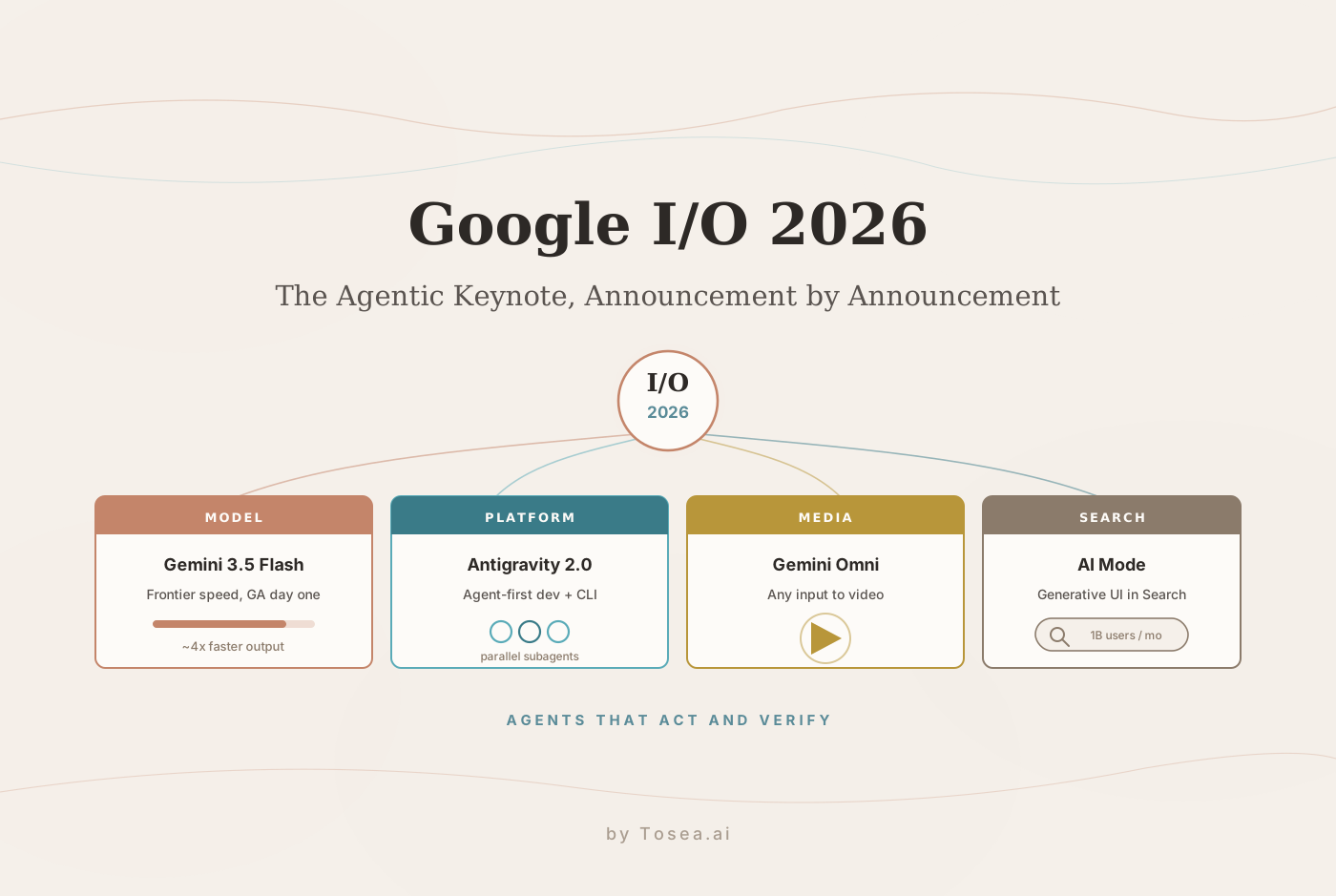
Google I/O has a rhythm. For the last few years the keynote has been a parade of model numbers and demo reels. This year the through-line was different, and Sundar Pichai said it in the first few minutes: the year is about agents — software that plans, acts, and verifies its own work, not just software that answers. Every major announcement at I/O 2026 bends back to that idea, from a Flash model fast enough to run agent fleets to a development platform built around them to a Search box that assembles interfaces on demand.
This is a structured recap of everything that mattered at Google I/O 2026, held May 19–20 at the Shoreline Amphitheatre in Mountain View. We will go announcement by announcement, flag what is shipping versus what is "coming this summer," and be explicit about which claims are official and which are press-reported. At the end we look at what the agentic shift means specifically for turning documents into presentations — because that is the workflow most of our readers care about.
The Keynote in One Paragraph
Pichai opened; Demis Hassabis covered world models and the new Gemini Omni media model; Liz Reid and Robby Stein handled Search; Josh Woodward demoed the Gemini app's new personal agent; and Varun Mohan presented the Antigravity platform. The headline releases: Gemini 3.5 Flash (generally available the same day), Antigravity 2.0 (Google's agent-first development platform, now a standalone desktop app plus a CLI), Gemini Omni (a generative video-first model), a rebuilt AI Mode in Search, and a repriced Google AI subscription lineup. Notably absent: there was no "Veo 4," no "Imagen 5," and no Gemini 3.5 "Deep Think." If you have seen those names circulating, they were not announced at I/O 2026.
Gemini 3.5 Flash: The Model Everything Else Runs On
The most consequential release was Gemini 3.5 Flash, the first model in the Gemini 3.5 series and generally available on May 19.
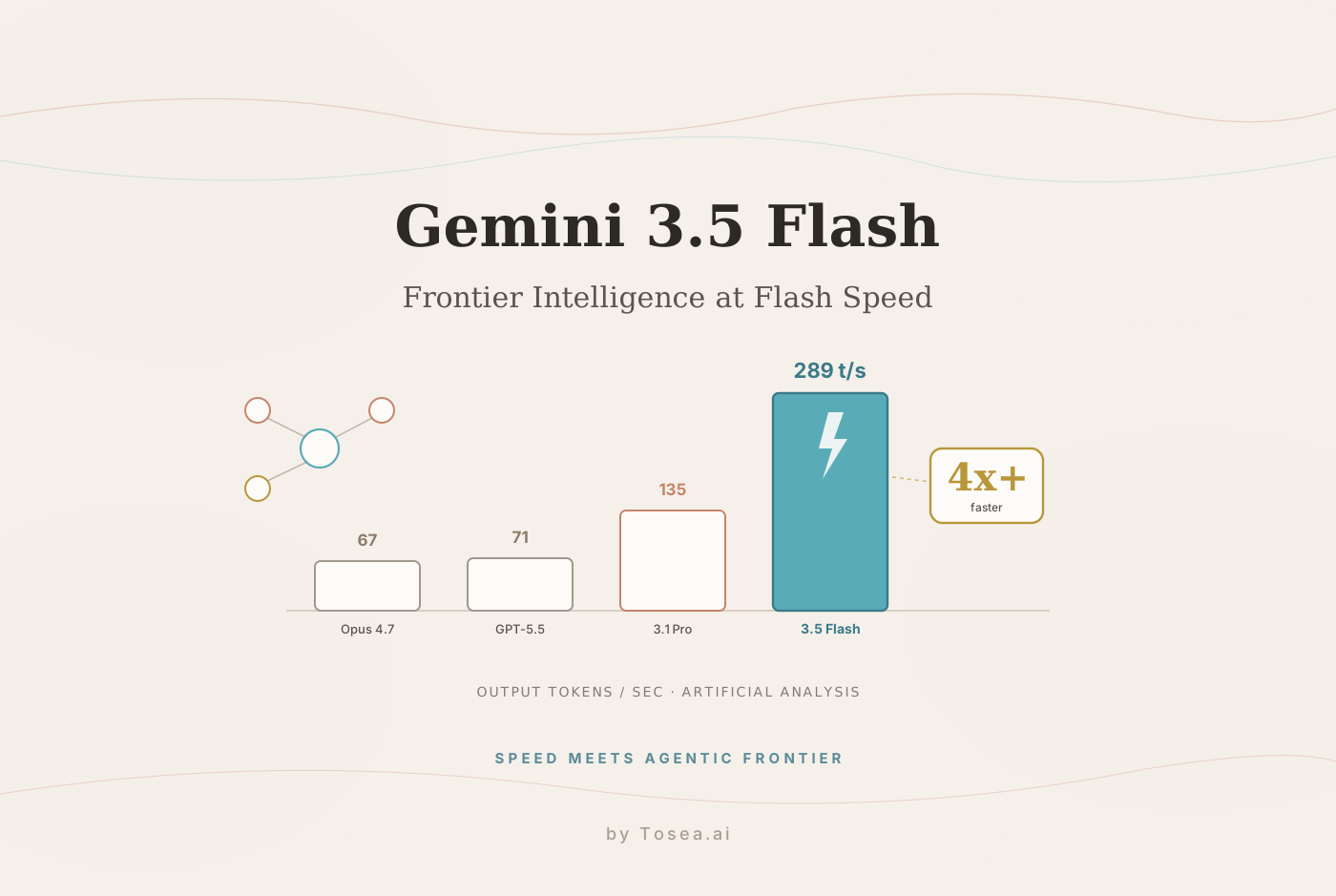
The short version: it is a Flash-tier model that outperforms Google's previous flagship, Gemini 3.1 Pro, on coding and agentic benchmarks — Terminal-Bench 2.1 at 76.2%, GDPval-AA at 1656 Elo, MCP Atlas at 83.6% — while running roughly 4x faster in output tokens per second (about 289 tokens/sec per Artificial Analysis data). Google describes it as costing "less than half" of competing frontier models. Gemini 3.5 Pro, the heavier-reasoning sibling, is in internal use with a public rollout planned for June 2026.
Why does a cheap fast model headline a keynote? Because it is the substrate for everything else Google announced. AI Mode in Search runs on it. Antigravity's parallel subagents run on it. The Gemini app's personal agent runs on it. Agentic products only become economical when the underlying model is both capable and cheap to call thousands of times, and Gemini 3.5 Flash is Google's answer to that constraint. We have a full breakdown in our dedicated Gemini 3.5 Flash guide, including the complete benchmark table and where it lands against GPT-5.5 and Claude Opus 4.7.
Antigravity 2.0: Google's Bet on Agent-First Development
The user-facing name confirmed on stage is Antigravity 2.0. (The original Antigravity launched in November 2025 on Gemini 3 Pro; I/O 2026 is the 2.0 generation.) Antigravity is Google's agent-first development platform — a VS Code–based environment where agents autonomously plan, execute, and verify work across the editor, terminal, and browser.
What is new in 2.0:
- A standalone desktop app designed to orchestrate multiple agents in parallel, with a Manager surface for coordinating them and an Artifacts system (task lists, plans, screenshots, recordings) for verifying what agents actually did.
- Dynamic subagents — custom subagent workflows you design for parallel work, each instance powered by Gemini 3.5 Flash. Google says the model itself was co-developed using Antigravity.
- Scheduled tasks — background automation that runs on a schedule rather than only on demand.
- New integrations with Google AI Studio, Android, and Firebase, plus native voice commands and a project-export tool for continuing work locally.
Alongside the desktop app, Google announced the Antigravity CLI, a Go-based terminal experience that shares the same server-side agent harness as the 2.0 app and supports asynchronous background orchestration, Agent Skills, Hooks, Subagents, and Extensions. There is a consolidation cost attached: Google stated that the Gemini CLI and Gemini Code Assist IDE extensions stop serving requests on June 18, 2026 for Pro, Ultra, and free-tier users, as those tools fold into Antigravity. There is also an Antigravity SDK for programmatic access and hosting custom agents on third-party infrastructure.
Antigravity 2.0 is available globally starting May 19 as a free public preview for individuals on macOS, Windows, and Linux at antigravity.google. Higher rate limits are tied to the new paid tiers (more on those below). If you write code or build automation, this is the single most important developer announcement of the event — comparable in ambition to what we covered in our Claude Code complete guide.
AI Mode in Search: The Biggest Search Box Change in 25 Years
Google's framing for Search was aggressive: AI Mode reached roughly 1 billion monthly users within about a year, with queries "more than doubling every quarter." It is now powered by Gemini 3.5 Flash as the default model, globally.
The concrete changes:
- A rebuilt Search box that dynamically expands, offers AI-powered suggestions, and accepts multimodal input — text, images, files, videos, even Chrome tabs — plus conversational follow-ups directly from AI Overviews. This is live worldwide on desktop and mobile.
- Information Agents — 24/7 monitoring of the web and real-time data, arriving summer 2026, AI Pro/Ultra first.
- Agentic booking — local services and business calling for things like home repair, beauty, and pet care, US summer 2026.
- Generative UI / mini apps — custom dashboards, tables, graphs, and simulations assembled in real time for a given query. Free for all users (US, summer 2026), with the Antigravity-powered features gated to Pro/Ultra first.
The generative-UI piece is the one to watch. A search engine that builds a small interactive interface in response to a question is the same underlying capability as an AI tool that builds a slide from a document — both are "generate a structured visual artifact from an intent," which we will come back to.
Gemini Omni: The Video-First Media Model
The video story this year was not a new Veo number. Veo stayed at 3.1 (with consistency and control updates landing in Flow), and Imagen remained at Imagen 4. The headline was Gemini Omni, a new model series presented by Demis Hassabis that "can create anything from any input, starting with video."
Omni accepts text, image, audio, and video, and outputs editable video grounded in real-world knowledge — combining Gemini's reasoning with generative media built on Veo technology. It is available in the Gemini app for AI Plus/Pro/Ultra subscribers and powers the new Remix feature in YouTube Shorts. A lighter "Gemini Omni Flash" was referenced for later in the summer (press-reported; treat the timing as tentative).
The Gemini App: A Personal Agent
The Gemini app got a visual overhaul Google calls Neural Expressive — fluid animations, brighter color, haptics — and, more substantively, a personal agent.
- Gemini Spark — a 24/7 remote agent that takes actions across Google products (Gmail, Docs, Sheets), powered by Gemini 3.5 Flash with the full Antigravity agent harness for long-horizon tasks. Rolling out the week of the keynote to AI Ultra subscribers, US only.
- Daily Brief — a personalized digest pulled from Gmail, Calendar, Tasks, and your Gemini chats. Rolling out May 19 to AI Plus/Pro/Ultra, US.
- Gemini Live now runs inline rather than forcing a fullscreen mode.
Workspace, YouTube, and the Long Tail
A lot shipped beyond the headline acts:
- Workspace: Docs Live (voice-create and edit documents; Pro/Ultra, summer 2026, global, English), Gmail Live (conversational email search; Pro/Ultra, summer 2026, US), an AI Inbox for AI Plus/Pro, AI organization in Google Keep, a new AI image app called Google Pics, and a cross-service Universal Cart for shopping across Search and the Gemini app.
- YouTube: Ask YouTube — AI search across video content, testing now for US Premium users — plus Gemini Omni in Shorts Remix.
- NotebookLM: a new Gemini "notebooks" system for thematic organization that syncs directly with NotebookLM. No major standalone NotebookLM version was announced; keep expectations modest here.
- World models: Hassabis demoed Project Genie integrated with Google Maps Street View — pick a US place, reimagine it with a prompt. It is still a prototype, rolling out gradually to AI Ultra subscribers (US). The exact "Genie" version number was not confirmed on an official page, so we are not assigning one.
Project Astra and Project Mariner: The Quiet Continuation
Two names that dominated previous I/O keynotes were treated very differently this year. Project Astra — Google's real-time multimodal assistant research (video understanding, screen sharing, memory, natural audio, computer control) — was not relaunched as a standalone "Astra 2." Instead, its capabilities continue folding into shipping products: Gemini Live, Search, the Live API, and the new glasses form factor. The research line is alive; the brand is being absorbed into products rather than headlined.
Project Mariner, the agentic computer-use research, appears to have been wound down as a standalone, with its computer-use capability folded into the Gemini API and Gemini products for AI Ultra users (US). This was reported in press coverage rather than confirmed on a clean official I/O 2026 page, so treat the specifics as tentative. The pattern across both is the same one that defined the keynote: Google is done shipping research demos as separate apps and is consolidating everything into a small number of agentic surfaces.
Android, Hardware, and What's Coming Later
The Android Show (I/O Edition) leaned on Gemini Intelligence — proactive, on-device AI across Android — and Gemini in Chrome with agentic, auto-browsing capabilities on Android. Google also teased Googlebook, a Gemini-centric laptop category that syncs with Android phones, and Android Halo, an at-a-glance agent-activity bar at the top of the phone screen arriving later in 2026. Android XR audio glasses — with partners Samsung, Qualcomm, Gentle Monster, and Warby Parker — were dated to fall 2026. (Some press referred to "Android 17"; Google's own framing emphasized "Gemini Intelligence" rather than a numbered OS headline, so treat the version label as unconfirmed.)
On the enterprise side, the Gemini Enterprise Agent Platform lets organizations build, govern, and scale agents end to end. A security agent called CodeMender, meant to catch vulnerabilities in agent-generated code, was reported in press coverage but not cleanly confirmed on an official I/O page — flagging it as tentative rather than definitive.
The New Google AI Subscriptions
Pricing changed, and it matters for anyone planning to actually use these agentic features at volume.
- A new $100/month AI Ultra tier aimed at developers, technical leads, and creators, with roughly 5x the usage limits of the Pro plan in the Gemini app and Antigravity.
- The previous $250 plan was repriced to $200, now offering about 20x Pro usage limits with the same capabilities.
- Google is shifting from daily prompt limits to a compute-used model that refreshes roughly every five hours.
The move from "number of prompts" to "compute consumed, refreshed every five hours" is the pricing structure of a company that expects you to run agents, not send chat messages. It is consistent with everything else at the event.
What's Real vs. What's Hype: A Quick Reference
| Announcement | Status | Availability |
|---|---|---|
| Gemini 3.5 Flash | Shipped | Globally, May 19 |
| Gemini 3.5 Pro | Internal | June 2026 |
| Antigravity 2.0 + CLI | Shipped (preview) | Globally, May 19 |
| Gemini Omni | Shipped | Gemini app, AI Plus/Pro/Ultra |
| AI Mode rebuilt Search box | Shipped | Worldwide |
| Information Agents / Agentic booking | Announced | Summer 2026, Pro/Ultra first |
| Gemini Spark | Rolling out | AI Ultra, US |
| Android XR glasses | Announced | Fall 2026 |
| Veo 4 / Imagen 5 / 3.5 Deep Think | Not announced | — |
What Google I/O 2026 Means for AI Slide Generation
Strip away the product names and I/O 2026 was about one capability: generating a structured, useful artifact from an intent, fast and cheaply enough to do it constantly. That is exactly the problem an AI presentation tool solves — the artifact is just a slide deck instead of a search interface.
Three threads from the keynote map directly onto document-to-PPT workflows. Generative UI in Search is the same primitive as slide generation: take a request, produce a laid-out visual the user can act on. Antigravity's parallel subagents are the orchestration pattern behind turning a long document into a deck — one agent segments the source, one drafts the outline, one writes layout markup, one verifies fidelity — and Gemini 3.5 Flash makes running that fleet affordable. The shift to compute-based pricing is a signal that the cost of generating long structured outputs (like a 60-slide deck from a research report) is about to fall, because the whole industry is optimizing for exactly that.
What the keynote did not deliver is a document-to-deck product. Google announced a faster model and a better agent platform; it did not announce a tool that turns your 80-page PDF into a source-faithful, presentation-ready slide structure. That orchestration layer — chunking, outlining, slide allocation, and hallucination checking against the original document — is what Tosea.ai is built to do, and the faster, cheaper agentic models from I/O 2026 make that pipeline run better underneath. If you want the architectural detail on how modern AI decks are actually rendered, our comparison of HTML vs image-based slide generation and our HTML slide skills library are the places to start.
The Bottom Line
Google I/O 2026 was coherent in a way recent keynotes have not been. One model (Gemini 3.5 Flash), one platform (Antigravity 2.0), and one organizing idea (agents that act and verify) ran through nearly every announcement. The honest caveats: a lot of the most interesting features are "summer 2026, Pro/Ultra first," several press-reported items could not be confirmed on official pages, and Gemini 3.5 Pro — the model for the genuinely hard reasoning — is still a month out. But the direction is unambiguous. The interesting question for the rest of 2026 is not whether models can act; it is which workflows get rebuilt around agents first. Turning documents into decks is a strong candidate.
Sources
- Gemini 3.5: frontier intelligence with action — Google, May 19, 2026
- Search at Google I/O 2026 — Google
- Build with Google Antigravity, our new agentic development platform — Google Developers Blog
- An important update: transitioning Gemini CLI to Antigravity CLI — Google Developers Blog
- More magic in one plan: Google AI subscriptions — Google
- Google launches Antigravity 2.0 with an updated desktop app and CLI tool — TechCrunch
- Everything Google announced at I/O 2026 — Engadget (live blog)