How to Use GPT-6 Sol and Luna: Complete Guide to Benchmarks, Pricing and Tiers
GPT-6 Sol and Luna launched September 22, 2026 at half the price of GPT-5.6. Official results, independent benchmarks, where each tier regresses, and how they compare with Claude Opus 5.5.
What Are GPT-6 Sol and GPT-6 Luna?
On September 22, 2026, OpenAI released GPT-6 Sol and GPT-6 Luna, the mid and low tiers of the GPT-6 family. They sit below GPT-6 Astra, which launched on September 3 and which OpenAI still calls its best model "across the board." The announcement came about 90 minutes after Anthropic shipped Claude Opus 5.5.
OpenAI's framing is cost efficiency. Sol and Luna were trained "with similar methods as GPT-6 Astra," and OpenAI cut their API prices by 50% compared with the promotional pricing of their predecessors, GPT-5.6 Sol and Luna. Sol is aimed at complex work such as coding and agent tasks. Luna is meant for what OpenAI calls "high-volume tasks with a clear goal, like summarizing documents, extracting information, or answering quick questions."
This guide covers the official specs and pricing, every benchmark OpenAI published, independent results from Artificial Analysis, the places where the new models score lower than GPT-5.6, and how both compare with Claude Opus 5.5.
Disclosure: Tosea.ai builds an AI presentation tool that routes work across several model vendors, including OpenAI and Anthropic. We pay both for API usage and have no other relationship with either.
GPT-6 Sol and Luna at a glance
| Spec | GPT-6 Sol | GPT-6 Luna |
|---|---|---|
| API model ID | gpt-6-sol | gpt-6-luna |
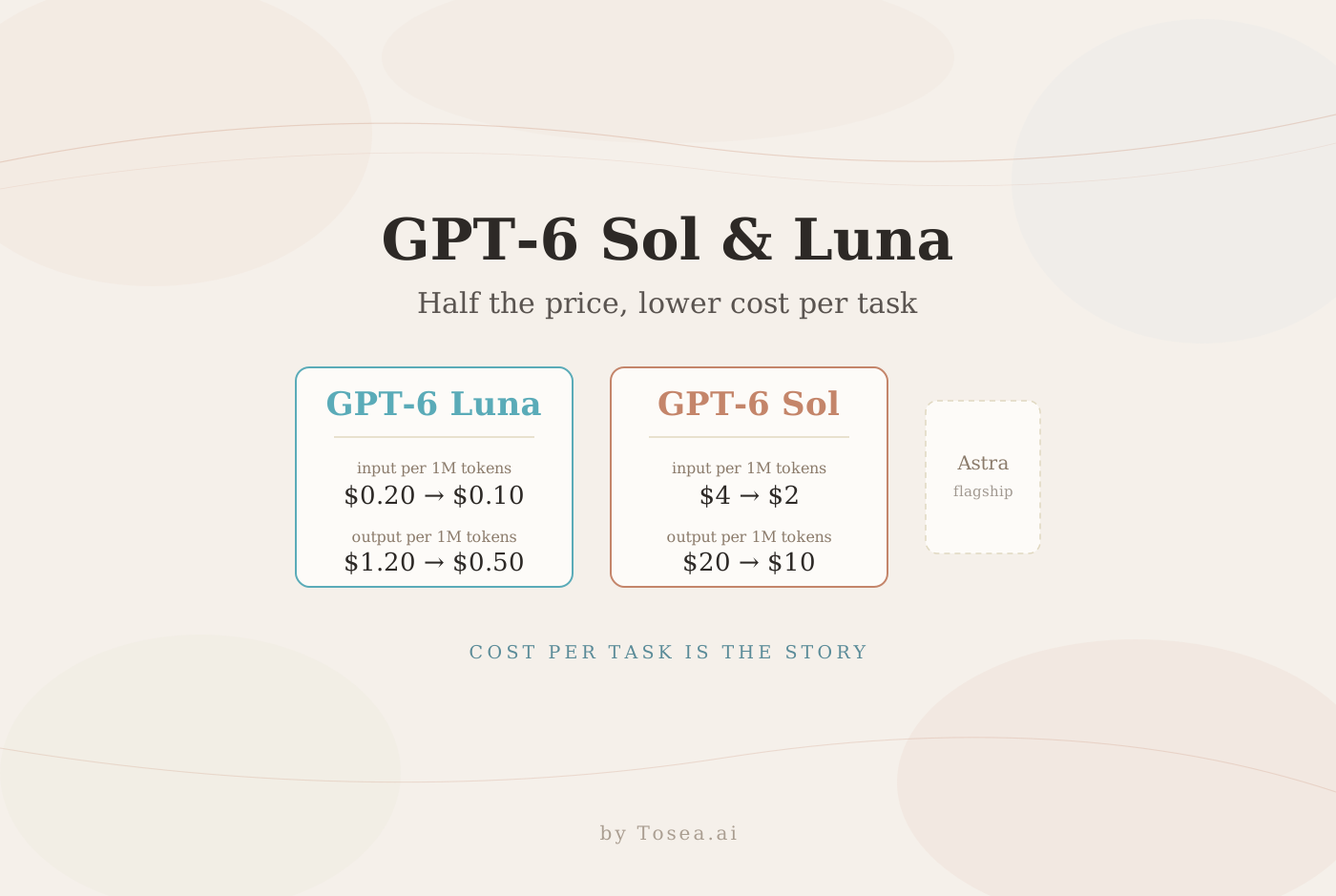
| Input / output price (per 1M tokens) | $2 / $10 | $0.10 / $0.50 |
| Cached input / cache writes | $0.20 / $2.50 | $0.01 / $0.125 |
| Previous tier price (GPT-5.6) | $4 / $20 | $0.20 / $1.20 |
| Context window | 1.05M tokens (922K max input) | 1.05M tokens (922K max input) |
| Max output | 128K tokens | 128K tokens |
| Knowledge cutoff | April 20, 2026 | May 18, 2026 |
| Reasoning effort | none, low, medium (default), high, xhigh, max | same |
| Input / output modalities | text, image / text | text, image / text |
| ChatGPT availability | ChatGPT Work and Codex (Plus, Pro, Business, Enterprise, Edu) | Same, plus Free and Go users in the desktop app |
Both models are available through the Chat Completions, Responses and Batch APIs, with the full hosted tool set: web search, file search, code interpreter, hosted shell, apply patch, skills, computer use, MCP, tool search and image generation.
Pricing: The Fine Print
The headline is a flat 50% cut. The developer documentation adds several modifiers that matter for real workloads:
- Long prompts cost more. Prompts over 272K tokens are billed at 2x the input and cache rates and 1.5x the output rate. For Sol, a 500K-token prompt costs $4 per million input tokens, the same as GPT-5.6 Sol's old standard rate.
- Batch and Flex are half price. Asynchronous jobs get 50% off standard rates.
- Fast mode is double. Priority latency costs 2x the applicable rate.
- Cache reads are 90% off. OpenAI also says caching itself improved: higher default hit rates, explicit cache breakpoints, and the ability to change reasoning effort or toggle tools mid-conversation without invalidating the cache. GitHub reports these changes cut the share of prompt tokens needing fresh processing by more than 50% across billions of Copilot requests.
The caching changes may matter as much as the price cut for agent builders. In an agent loop, most input is repeated context. Being able to raise reasoning effort for one hard step without losing the cached prefix removes a real trade-off.
Official Benchmarks: What OpenAI Published
OpenAI's launch post reports results on five external evaluations plus an internal factuality test. Unlike Anthropic, OpenAI presents most results as score-versus-cost charts across effort levels rather than one table. The numbers below are the ones OpenAI states in the text, with the best-effort chart values transcribed where the text does not give them.
Professional work
| AutomationBench 1.0.6 (business workflows, 47 tools) | Score | Cost per task |
|---|---|---|
| GPT-6 Astra (max) | 41.4% | $1.73 |
| GPT-6 Sol (xhigh) | 33.2% | $0.27 |
| Claude Fable 5.1 with Opus 5 fallback (max) | 31.4% | >8.9x Sol (fallback cost not reported) |
| GPT-6 Astra (low) | 30.3% | 3.9x Sol |
| GPT-5.6 Sol (max) | 28.8% | $0.67 |
| Claude Opus 5 (max) | 26.9% | 11.1x Sol |
| GPT-6 Luna (max) | 20.7% | $0.037 |
On Agents' Last Exam V1, which covers long-horizon professional tasks across 55 sub-industries, GPT-6 Sol at max effort scores 56.4%, above Claude Opus 5's best result (55.9% at high effort) at 60% lower cost per task. GPT-6 Luna (max) scores 50.9% at about $0.15 per task, and GPT-6 Astra (max) leads at 59.3%.
Coding
| DeepSWE v1.1 (long-horizon SWE tasks) | Score | Cost per task |
|---|---|---|
| GPT-6 Astra (xhigh) | 74.1% | $4.43 |
| Claude Opus 5 (max) | 73.7% | $11.84 |
| GPT-5.6 Sol (max) | 72.7% | $6.46 |
| Claude Fable 5 (xhigh) | 69.9% | $13.41 |
| GPT-6 Sol (max) | 68.8% | $2.74 |
| GPT-6 Luna (max) | 66.6% | $0.22 |
On FrontierCode 1.1 Main, which grades code on mergeability as well as correctness, GPT-6 Sol (max) scores 49.3% versus 47.5% for GPT-5.6 Sol, and OpenAI says it matches Claude Fable 5.1 at xhigh at much lower cost. GPT-6 Luna scores 42.4% at about $0.11 per task.
Computer use
On OSWorld 2.0 (offline set, partial reward), GPT-6 Sol at xhigh scores 60.5% versus 60.3% for Claude Opus 5 at medium, at about 80% lower cost per task. At max effort Sol reaches 64.4%. GPT-6 Luna (max) scores 52.7%, which OpenAI says exceeds GPT-5.6 Sol at medium effort at one-tenth the cost. Astra (max) leads the chart at 73.5%.
Factuality
On an internal evaluation built from de-identified ChatGPT conversations in which users flagged a factual error, OpenAI says GPT-6 Sol makes about half as many mistakes as GPT-5.6 Sol. Luna at higher effort levels matches GPT-5.6 Sol at about a hundredth of its cost. OpenAI notes these conversations were selected because an earlier model made a mistake, so they are harder than typical usage.
Where GPT-6 Sol and Luna Regress
A careful read of OpenAI's own charts shows several places where the new models score below the GPT-5.6 models they replace. The launch text does not highlight these.
- DeepSWE v1.1: GPT-6 Sol (max) scores 68.8%, below GPT-5.6 Sol (max) at 72.7%. It costs $2.74 per task instead of $6.46, so it is far better value, but it is not a better model on this benchmark.
- OSWorld 2.0: GPT-6 Sol (max) scores 64.4% against 66.2% for GPT-5.6 Sol (max).
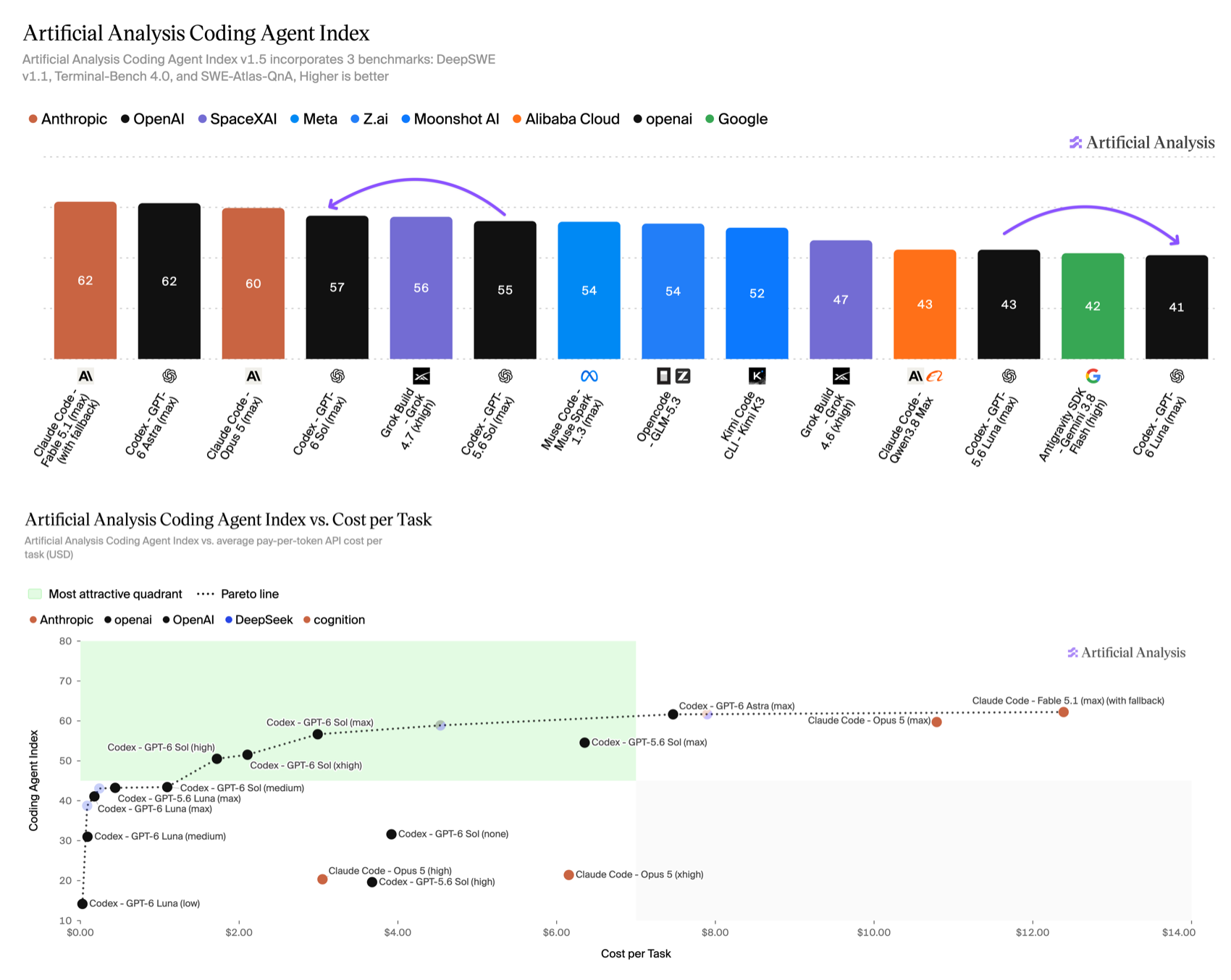
- Coding Agent Index (independent): Artificial Analysis measured GPT-6 Luna (max) at 41, down 2 points from GPT-5.6 Luna (max). Luna fell on SWE-Atlas-QnA (44% versus 49%) and DeepSWE v1.1 (64% versus 66%).
The pattern is consistent. At the top of each tier's effort range, GPT-6 Sol and Luna are roughly as capable as the GPT-5.6 models, sometimes a little less, at a much lower cost per task. At a matched cost, they are clearly better. That is exactly what OpenAI claims when it says the models "lead across the cost–intelligence curve," but it is not the same as "smarter than GPT-5.6." If you are already paying GPT-5.6 Sol max prices for a coding agent and quality is your only metric, test before switching.
Independent Results: Artificial Analysis
Artificial Analysis evaluated both models on launch day. Their view matches OpenAI's framing: the gains are mostly in cost, not raw intelligence.
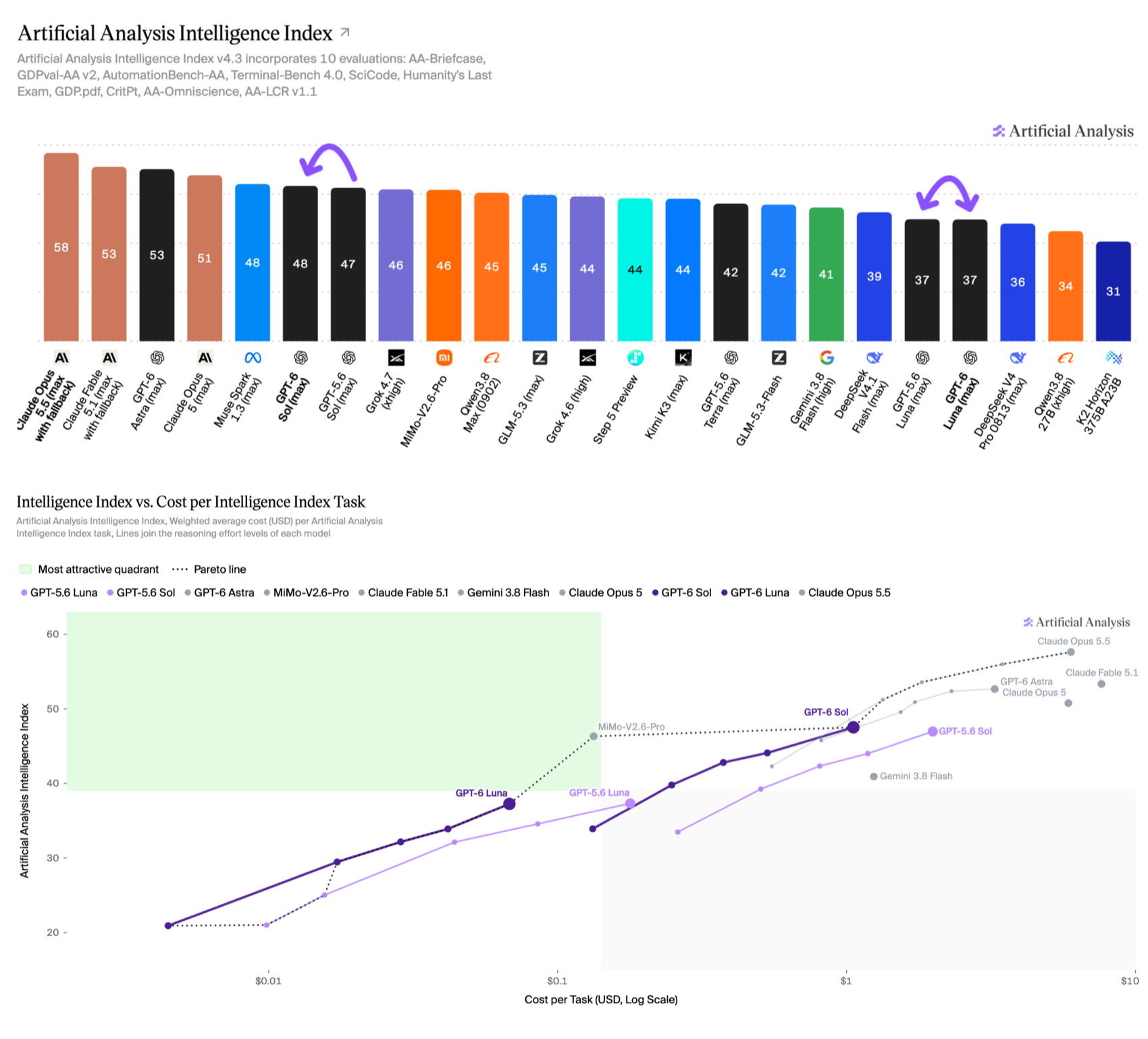
| Metric (Artificial Analysis) | GPT-6 Sol (max) | GPT-5.6 Sol (max) | GPT-6 Luna (max) | GPT-5.6 Luna (max) |
|---|---|---|---|---|
| Intelligence Index v4.3 | 48 | 47 | 37 | 37 |
| Cost per Intelligence Index task | $1.06 | $1.99 | $0.07 | $0.18 |
| Output tokens per task | 31K | 29K | 51K | 41K |
| Coding Agent Index v1.5 | 57 | 55 | 41 | 43 |
| Terminal-Bench 4.0 | 43% | 37% | 13% | 12% |
| SWE-Atlas-QnA | 58% | 54% | 44% | 49% |
| AutomationBench-AA | 62% | 60% | 53% | 50% |
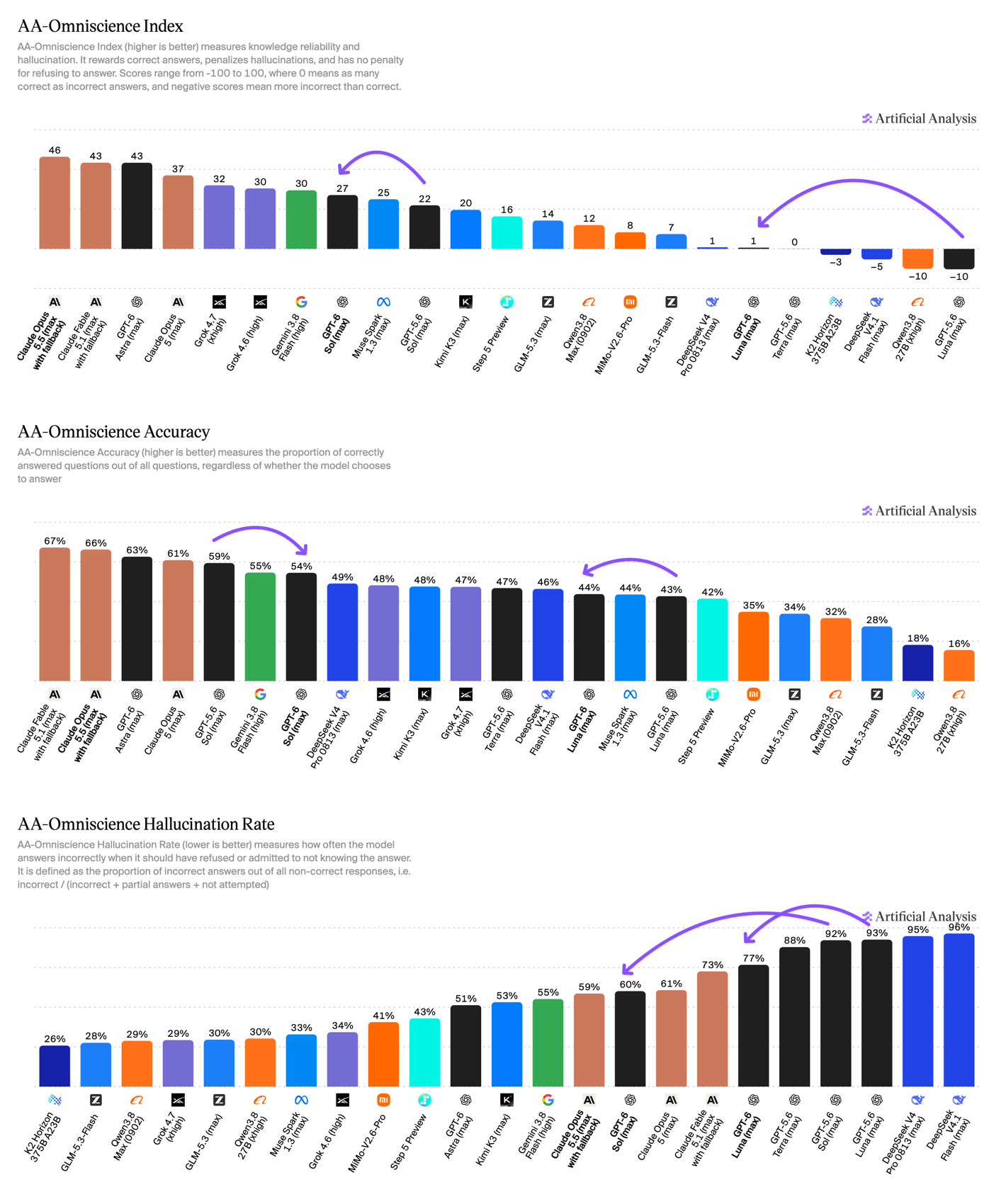
| AA-Omniscience hallucination rate (lower is better) | 60% | 92% | 77% | 93% |
Three things stand out.
Cost per task roughly halves for Sol and falls about 60% for Luna. Intelligence barely moves: Sol gains one point on the index and Luna is flat. Luna also uses about 25% more output tokens per task than its predecessor, which eats into its per-token discount.
Hallucination is the biggest real improvement. On AA-Omniscience, Sol's hallucination rate falls from 92% to 60%, and Luna's from 93% to 77%. That matches OpenAI's factuality claim and is the most important change for anyone using these models to summarize or extract facts. Even so, Luna still answers incorrectly on more than three-quarters of the questions it should decline, so it needs source grounding for factual work.
Sol is a strong coding-agent value. On the Coding Agent Index, GPT-6 Sol (max) scores 57, up from 55, and sits on the Pareto frontier at about $3 per task. The top of that chart (Fable 5.1 and GPT-6 Astra at 62, Opus 5 at 60) costs $7.50 to $12.50 per task.
GPT-6 Sol and Luna vs Claude Opus 5.5
The two launches landed on the same day, so the comparison is unavoidable. The honest answer is that they target different price points.
| GPT-6 Luna | GPT-6 Sol | Claude Opus 5.5 | GPT-6 Astra | |
|---|---|---|---|---|
| Price (input / output per 1M) | $0.10 / $0.50 | $2 / $10 | $4 / $20 | $10 / $50 |
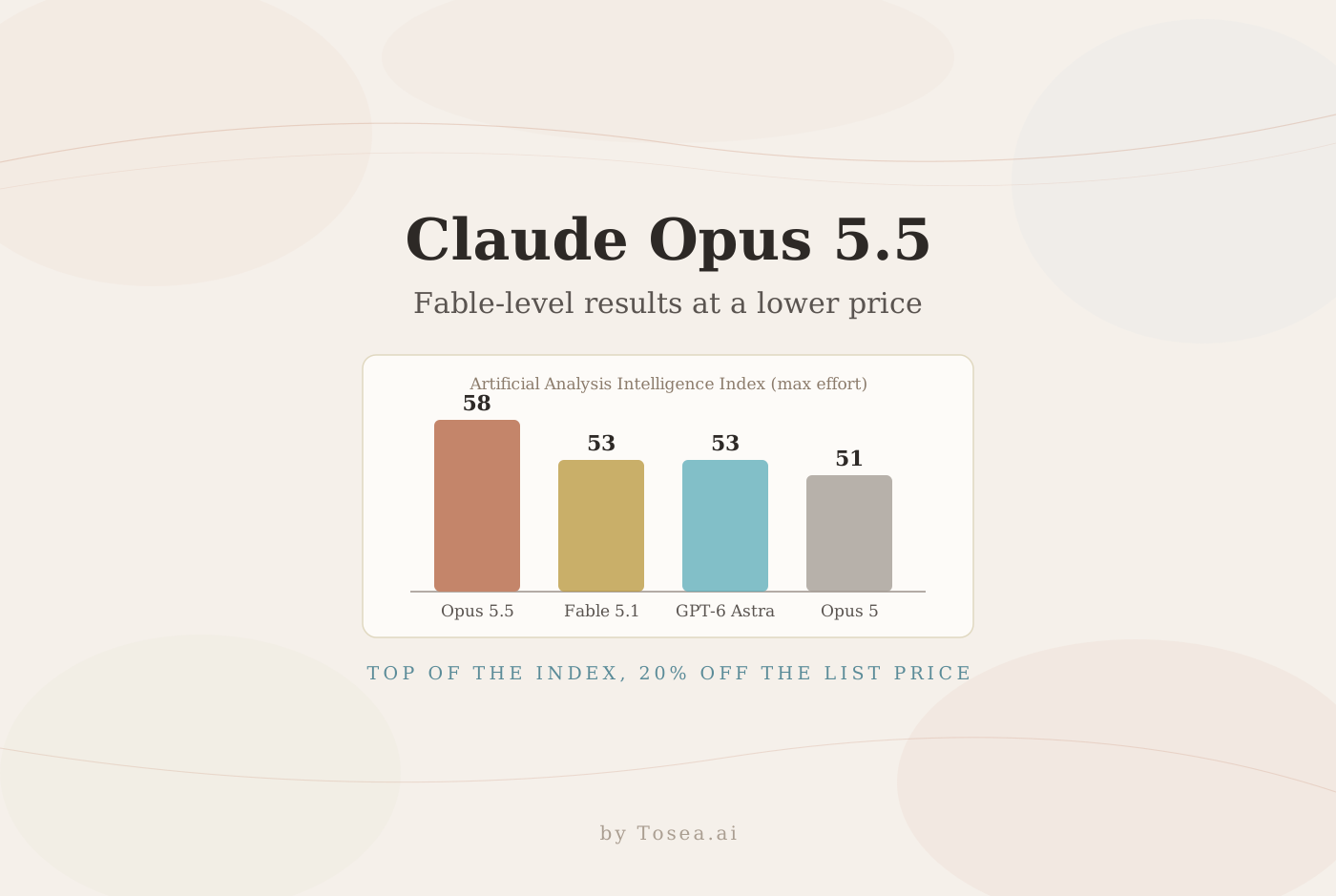
| AA Intelligence Index (max) | 37 | 48 | 58 | 53 |
| AA cost per Intelligence Index task (max) | $0.07 | $1.06 | ~$6 | ~$3.30 |
| AA-Omniscience hallucination rate | 77% | 60% | 59% | 51% |
| AutomationBench (vendor-reported, best effort) | 20.7% | 33.2% | 40.0% | 41.4% |
Intelligence Index and hallucination figures come from Artificial Analysis. Opus 5.5 and Astra cost-per-task figures are approximate readings from Artificial Analysis's chart. AutomationBench scores come from each vendor's own run and are not a controlled comparison.
Opus 5.5 is ten points ahead of Sol on the Intelligence Index, and it also leads Anthropic's table on agentic coding and knowledge work. It costs about five to six times as much per task at max effort. At its medium setting, Artificial Analysis places Opus 5.5 at an index score around 51 for about $1.50 per task, which is above Sol max (48 at $1.06) for somewhat more money. The two cost curves are close in the middle, and Opus 5.5 extends much further at the top.
A reasonable routing policy for most teams:
- GPT-6 Luna for high-volume extraction, classification, summarization with source grounding, and first-pass drafts that a stronger model reviews.
- GPT-6 Sol for everyday coding agents, tool-heavy workflows and business automation where you need a good result at a predictable cost.
- Claude Opus 5.5 or GPT-6 Astra for the hardest reasoning, knowledge-work deliverables, and anything where one wrong answer is expensive. Opus 5.5 leads on agentic coding and knowledge work in the published evidence. Astra leads on business automation and science tasks, and hallucinates least.
Collaboration Style and Alignment
OpenAI says Sol and Luna inherit GPT-6 Astra's communication style: "more clarity, less jargon, fewer odd turns of phrase, fewer low-value details, and slightly shorter answers overall." The launch post includes a side-by-side coding example in which GPT-5.6 Sol echoes obvious details and vague phrases, while GPT-6 Sol reports what it checked (desktop and mobile layouts, browser back navigation) and what it did not need to change.
On alignment, OpenAI reports improvements over GPT-5.6 on its stress-test evaluations, including fewer misleading claims about completed coding work. Per coverage of the system card by Decrypt, the coding-deception rate is 1.3% for GPT-6 Sol and 2.8% for Luna, down from 10.4% for GPT-5.6 Sol. OpenAI emphasizes that these evaluations deliberately test difficult situations and are not typical-use failure rates.
How to Use GPT-6 Sol and Luna
In ChatGPT. Both models are in ChatGPT Work and Codex for Plus, Pro, Business, Enterprise and Edu users. Free and Go users get Luna in the desktop app. Neither is in the regular Chat mode yet, and OpenAI is rolling them out gradually.
In the API. Use gpt-6-sol or gpt-6-luna. The default reasoning effort is medium. Effort now ranges from none to max, and changing it mid-conversation no longer breaks the prompt cache. A practical approach:
- Start Luna at medium for extraction and summarization. Measure accuracy against a labeled sample before raising effort.
- Start Sol at medium or high for coding and agent work. Reserve xhigh and max for steps that fail.
- Keep prompts under 272K tokens where you can, since long prompts cost 2x on input.
- Move nightly or bulk jobs to the Batch API for another 50% off.
- Use the new Prompt Caching Dashboard and explicit breakpoints to check your hit rate.
Who Should Switch?
- GPT-5.6 Luna users: Switch. Same intelligence, lower cost per task, much lower hallucination rate. Re-check any coding use, where Luna regressed slightly.
- GPT-5.6 Sol users: Switch for most workloads, since cost per task roughly halves. For coding agents where you ran GPT-5.6 Sol at max purely for quality, test first: DeepSWE and OSWorld both dipped at the top effort level.
- Claude Opus 5 users on a budget: GPT-6 Sol beats Opus 5 on AutomationBench and Agents' Last Exam at a fraction of the cost. Compare it with Claude Opus 5.5, which is also cheaper than Opus 5 now.
- Teams needing the best available answer: Sol and Luna are not that. Look at GPT-6 Astra or Opus 5.5.
What GPT-6 Sol and Luna Mean for AI Slide Generation
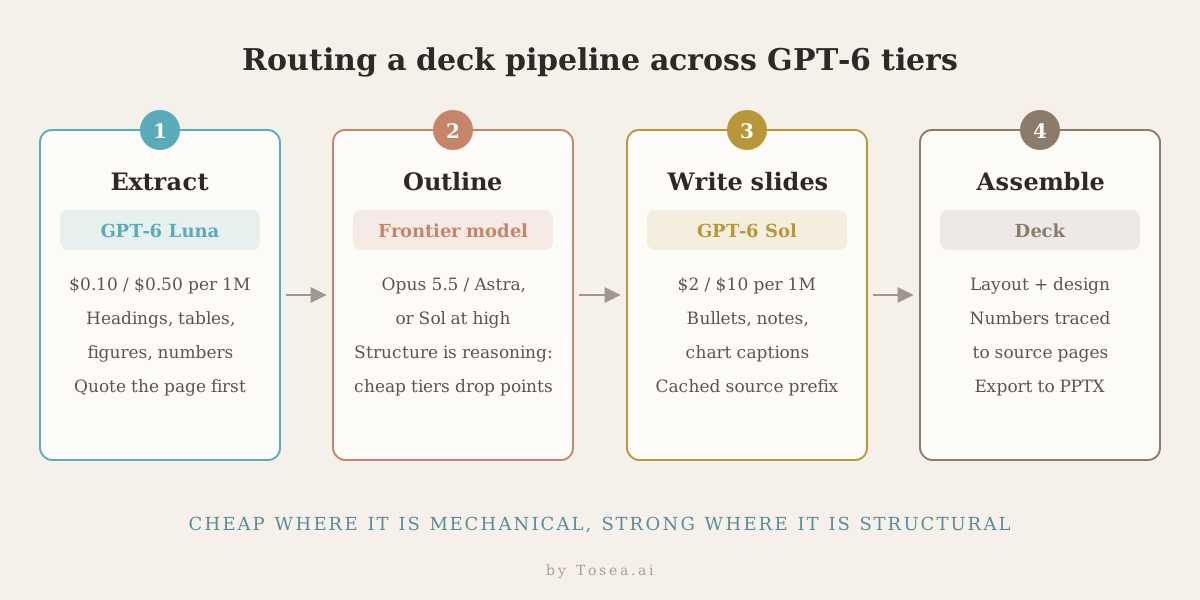
Turning a long document into a slide deck is a multi-step presentation workflow, and the model tiers map naturally onto those steps. Tiered models like Sol and Luna make it cheaper to split that work sensibly instead of sending everything to one expensive model.
Extraction is Luna's job, with guardrails. The first stage of document-to-PPT conversion is mechanical: pull section headings, figures, tables and key numbers out of the source. At $0.10/$0.50 per million tokens and about $0.07 per Intelligence Index task, Luna makes it affordable to process a 200-page report in full rather than sampling it. Its 77% hallucination rate on questions it should decline is the limiting factor, so extraction should be source-anchored (quote the page, then summarize) rather than open-ended. Our zero-hallucination slides guide explains why that traceability matters for any slide deck with numbers on it.
The outline is where cheap models fail quietly. We learned this directly. In July we benchmarked GPT-5.6 Luna for outline generation, and it was about 8x cheaper than our production model but kept only about half of the source document's framework items. The output looked like a reasonable outline, just with half the argument missing. GPT-6 Luna's Intelligence Index is unchanged from GPT-5.6 Luna, so we would not expect this to be fixed. Slide structure is a reasoning task, and it deserves Sol at high effort or a frontier model.
Per-slide content sits in the middle. Writing bullet text, speaker notes and chart captions for each slide is where GPT-6 Sol's price and shorter, clearer answers fit well. The improved caching also helps, because every slide call reuses the same source document and outline as a cached prefix.
This split between extraction, structure and writing is how Tosea.ai approaches AI slide generation: each stage gets the model and effort level that suits it. For the end-to-end presentation workflow, see our PDF to PowerPoint guide and our walkthrough of building a massive slide deck with AI.
Frequently Asked Questions
When were GPT-6 Sol and Luna released? September 22, 2026, about 90 minutes after Anthropic released Claude Opus 5.5.
How much do GPT-6 Sol and Luna cost? Sol costs $2/$10 per million input/output tokens and Luna $0.10/$0.50. Cached input is 90% off. Prompts over 272K tokens cost 2x on input and 1.5x on output.
Is GPT-6 Sol better than GPT-5.6 Sol? At matched cost, clearly yes. At max effort, it is similar: it scores higher on AutomationBench, FrontierCode and Terminal-Bench 4.0, but lower on DeepSWE v1.1 and OSWorld 2.0.
Is GPT-6 Sol better than Claude Opus 5.5? No. Opus 5.5 scores 58 versus 48 on the Artificial Analysis Intelligence Index. Sol is about half the price per token and much cheaper per task.
What is the context window? 1.05M tokens with a 922K maximum input and 128K maximum output for both models.
Can free ChatGPT users use GPT-6 Luna? Yes, in the ChatGPT desktop app. Neither model is in regular Chat mode yet.
The Bottom Line
GPT-6 Sol and Luna are a pricing and reliability release more than an intelligence release. Their independent intelligence scores barely move, and at max effort they sometimes score below the GPT-5.6 models they replace. What changes is cost per task, which roughly halves, and hallucination rates, which drop sharply. For most production workloads that is a better trade than a few benchmark points. Use Luna for high-volume grounded work, Sol for everyday agents and coding, and keep a frontier model like Claude Opus 5.5 or GPT-6 Astra for the steps where one wrong answer costs more than the tokens.
Sources
- Introducing GPT-6 Sol and Luna — OpenAI, September 22, 2026
- GPT-6 Sol model documentation — OpenAI API docs
- GPT-6 Luna model documentation — OpenAI API docs
- GPT-6 Sol and Luna push the cost efficiency frontier — Artificial Analysis
- Claude Opus 5.5 takes the top spot on the Artificial Analysis Intelligence Index — Artificial Analysis
- OpenAI launches GPT-6 Sol and Luna, boasting lower cost and fewer mistakes — TechCrunch
- OpenAI Launches GPT-6 Sol and Luna Minutes After Anthropic Drops Claude Opus 5.5 — Decrypt
- Anthropic releases Claude Opus 5.5 and OpenAI counters with two cheaper GPT-6 models — SiliconANGLE
- GPT-6 Sol and GPT-6 Luna: Specs, Benchmarks, Pricing and How They Compare — Kingy AI (chart value transcriptions)