How to Use maths-cs-ai-compendium: Become a Cracked AI/ML Research Engineer
A practical guide to maths-cs-ai-compendium, the open-source Maths, CS & AI textbook: a 6-stage learning path, 12-week plan, MCP study workflow, and project ideas for AI/ML research engineers.
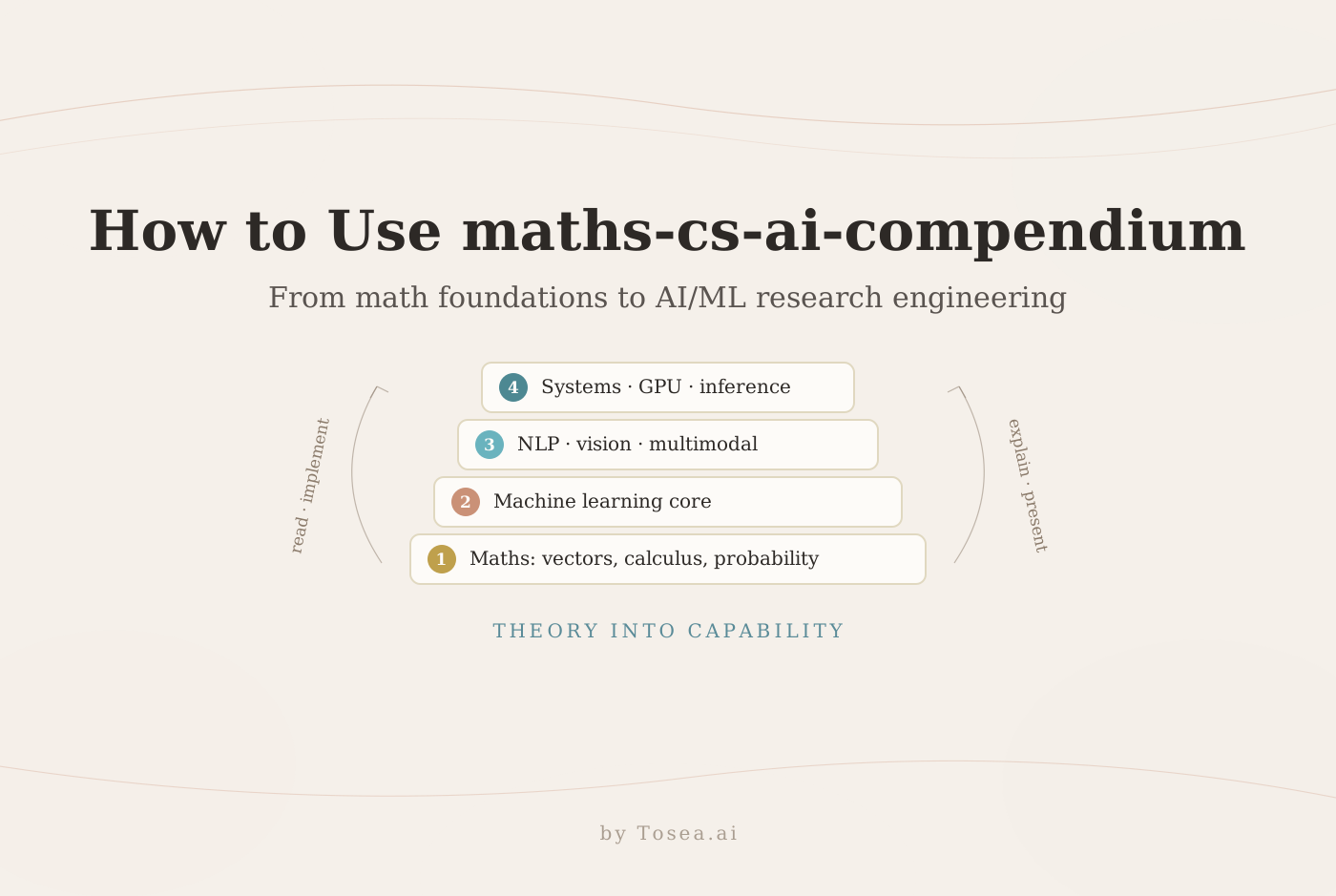
"Become a cracked AI/ML Research Engineer" — the mission statement of HenryNdubuaku/maths-cs-ai-compendium — is not about memorizing model names or collecting more tutorials. It is about building a connected mental model across mathematics, computer science, machine learning, AI systems, inference, GPU programming, and applied research. This open-source compendium is one of the few GitHub repositories that tries to teach that full stack from the ground up.
Quick Answer
maths-cs-ai-compendium is an open-source Maths, CS, and AI textbook for people who want to deeply understand AI/ML research engineering. It covers vectors, matrices, calculus, statistics, probability, machine learning, NLP, computer vision, multimodal learning, operating systems, algorithms, production software engineering, GPU programming, AI inference, and ML systems design. Use it as a long-term learning roadmap, not a quick cheat sheet.
What Is maths-cs-ai-compendium?
maths-cs-ai-compendium is an open-source learning project by Henry Ndubuaku. The GitHub repository describes its mission clearly: become a cracked AI/ML Research Engineer.
The project is available as both a GitHub repository and an online book at henryndubuaku.github.io/maths-cs-ai-compendium. The repository is under the Apache-2.0 license and, when checked on July 16, 2026, showed about 6.3k GitHub stars and nearly 800 forks.
The project is not just another list of machine learning links. It is a structured compendium that connects core mathematical ideas, computing fundamentals, AI concepts, engineering practice, and systems knowledge.
The online documentation says it is written for curious practitioners who want to understand the material deeply, not just survive exams or interviews. That framing matters because research engineering requires more than knowing which library function to call.
A strong AI/ML Research Engineer should understand:
- Why gradient descent works
- What matrices and vector spaces mean geometrically
- How probability and information theory shape learning systems
- How transformers, diffusion, and multimodal models are built
- How operating systems, memory, concurrency, and hardware affect performance
- How GPU kernels, inference batching, quantization, and serving systems work
- How to turn a paper idea into a reproducible, deployed, measurable system
That is the kind of bridge this repository is trying to build.
What the Compendium Covers
The compendium is organized as a broad roadmap across mathematics, computer science, and AI.
Major sections include:
- Vectors
- Matrices
- Calculus
- Statistics
- Probability
- Machine Learning
- Computational Linguistics
- Computer Vision
- Audio and Speech
- Multimodal Learning
- Autonomous Systems
- Graph Neural Networks
- Computing and Operating Systems
- Data Structures and Algorithms
- Production Software Engineering
- SIMD and GPU Programming
- AI Inference
- ML Systems Design
- Applied AI
- Bleeding Edge AI
This scope is ambitious, but it matches the reality of modern AI work. The boundary between research and engineering has become thinner. If you want to build useful systems, you need to understand both papers and production constraints.
Who Should Use This Repository?
maths-cs-ai-compendium is especially useful for:
- Students preparing for AI/ML research internships
- Software engineers moving into machine learning
- ML engineers who want stronger theory
- Researchers who want better systems intuition
- Technical founders building AI products
- Applied scientists who need a broader CS foundation
- AI infrastructure engineers learning model internals
- Self-taught learners who want a connected roadmap
It is less useful if your only goal is to call an LLM API and ship a simple wrapper. For that, shorter practical tutorials may be enough.
But if your goal is to understand modern AI deeply enough to research, implement, debug, optimize, and explain it, this compendium gives you a serious map.
How to Start: Do Not Read It Randomly
The biggest mistake is treating the repository like a content library.
Do not jump from transformers to CUDA to autonomous systems because the topics sound exciting. That gives you fragments, not capability.
Use the compendium as a layered curriculum.
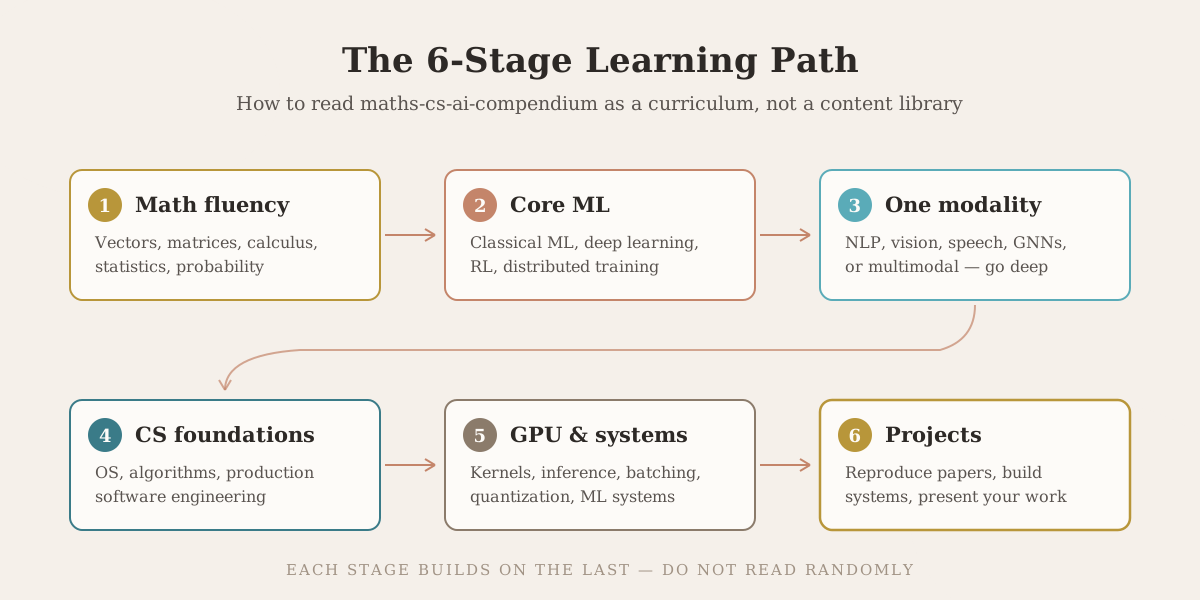
A practical learning path:
-
Build math fluency
Start with vectors, matrices, calculus, statistics, and probability. You do not need to become a pure mathematician, but you need enough comfort to read equations without panic. -
Learn core ML
Move into classical ML, gradient-based methods, deep learning, reinforcement learning, and distributed training. -
Pick one AI modality
Choose NLP, computer vision, audio and speech, multimodal learning, graph neural networks, or autonomous systems. Go deep enough to implement and explain a real method. -
Build CS foundations
Study computing, operating systems, data structures, algorithms, software engineering, and deployment. Research engineers who cannot build reliable systems hit a ceiling quickly. -
Learn performance and systems
Study GPU programming, AI inference, quantization, serving, batching, scaling, and ML systems design. -
Apply everything in projects
Build experiments, reproduce papers, write technical notes, and present your work.
That sequence converts reading into capability.
A 12-Week Study Plan
This repository is too large to finish casually. A 12-week plan can help you make visible progress.
| Week | Focus | Output |
|---|---|---|
| 1 | Vectors and matrices | Linear algebra notes plus NumPy implementations |
| 2 | Calculus and optimization | Gradient descent from scratch |
| 3 | Statistics and probability | Bayesian reasoning and distributions notebook |
| 4 | Classical ML | Implement regression, trees, clustering, and evaluation |
| 5 | Deep learning | Build a small neural network and training loop |
| 6 | NLP or CV track | Implement a mini transformer or vision model |
| 7 | Multimodal or speech track | Summarize one architecture and reproduce a toy version |
| 8 | Algorithms and OS | Write notes on complexity, memory, concurrency |
| 9 | Production software engineering | Package, test, and document a small ML project |
| 10 | GPU and inference | Study batching, quantization, serving costs |
| 11 | ML systems design | Design an end-to-end recommendation, search, or fraud system |
| 12 | Portfolio presentation | Write a technical report and turn it into slides |
The goal is not to finish every page. The goal is to build a repeatable study loop.
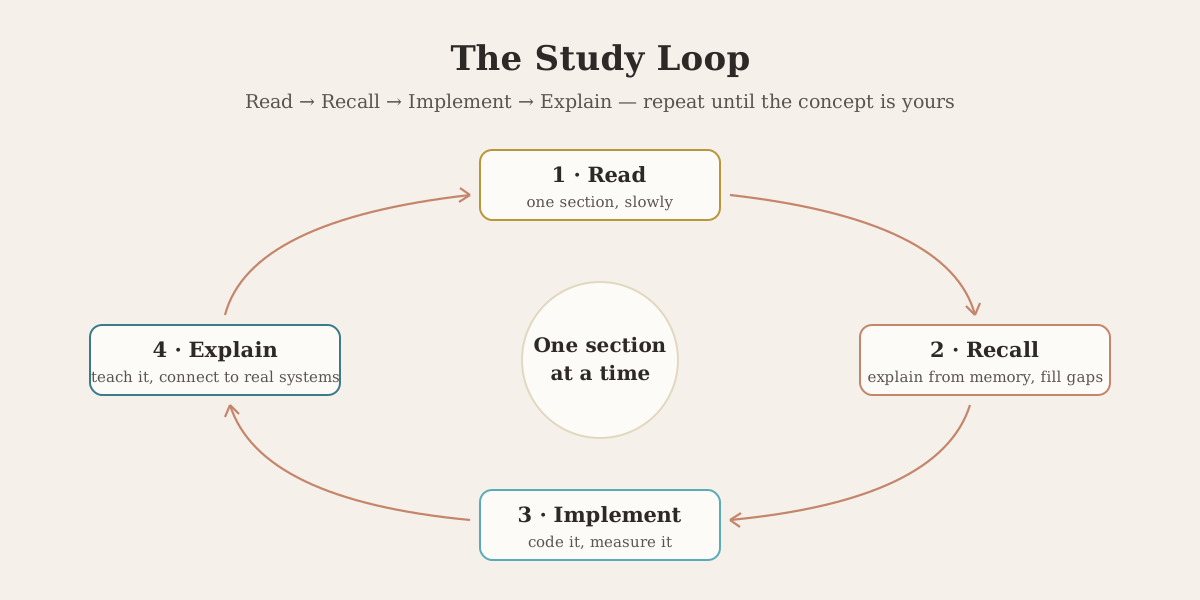
The Study Loop: Read, Recall, Implement, Explain
The compendium itself recommends active learning ideas such as cumulative reading and shadow reading. The practical version for AI/ML research engineering is:
- Read one section
- Close the page
- Explain the concept from memory
- Reopen the page and fill gaps
- Implement the concept in code
- Write a short note
- Teach it back in plain language
- Connect it to a real AI system
For example, do not just read about SVD. Implement it, visualize it, connect it to dimensionality reduction, then explain why low-rank approximations matter for compression and model efficiency.
Do not just read about quantization. Build a toy example, compare precision, measure error, then connect it to inference cost and model serving.
This is how knowledge becomes usable.
Common Pitfalls When Self-Studying the Compendium
A resource this large fails people in predictable ways. Watch for these patterns:
-
Collector mode. Starring the repo, cloning it, and bookmarking chapters feels like progress but is not studying. If a week passes without notes or code, you are collecting, not learning. Fix it by committing to one section and one implementation per week.
-
Restarting the math forever. Many self-taught learners loop through linear algebra basics repeatedly because the early chapters feel safe. If you can compute eigenvalues and explain what a projection does, move on. Depth comes from returning to math with a real model problem in hand, not from a fourth pass over the same chapter.
-
Confusing recognition with recall. Rereading a section and thinking "yes, I know this" is recognition. Closing the page and reconstructing the argument is recall. Only recall predicts whether you can use the concept in an interview, a code review, or a debugging session.
-
Skipping the systems half. The ML chapters are more comfortable than operating systems, SIMD, and inference serving, so most readers quietly drop the second half of the roadmap. That half is exactly what separates a research engineer from a model user. Schedule it explicitly — weeks 8 through 11 in the plan above exist for this reason.
-
Studying with no artifacts. Six months of reading with nothing to show is a real risk. Set a rule: every two weeks, produce one artifact — a notebook, a benchmark, a design document, a short writeup, or a small deck. Artifacts compound; unrecorded reading evaporates.
Use the MCP Server as a Learning Assistant
The repository includes an MCP server that lets AI assistants such as Claude Code, Cursor, and VS Code use the compendium as a local knowledge base. The GitHub README says it requires a local clone of the repo and includes tools for educational purposes and example implementations.
This is powerful if used correctly.
Good uses:
- Ask for explanations of one section
- Generate practice problems
- Compare related concepts
- Ask for implementation exercises
- Ask the assistant to quiz you
- Ask for a project idea based on the chapter
- Ask for a concept map across chapters
Bad uses:
- Ask AI to summarize everything so you do not read
- Ask it to produce interview answers without understanding
- Ask it to write a fake portfolio project
- Treat it as a replacement for implementation
A strong prompt:
Use the maths-cs-ai-compendium as the source. Quiz me on matrix decompositions. Ask one question at a time. After my answer, explain what I missed and give a small coding exercise in Python.
Another useful prompt:
Using the compendium, connect transformers, attention, matrix multiplication, GPU kernels, and inference batching. Explain the chain from math to production serving, then suggest one implementation project.
The MCP workflow is valuable because it lets you study with an assistant that references the same curriculum. If you already work inside coding-agent environments, our guide to the Claude Code academic research suite covers a similar pattern for paper search, literature review, and structured research workflows.
What Users Actually Care About
People who search for an AI/ML Research Engineer roadmap usually care about practical questions.
How much math do I need?
You need enough linear algebra, calculus, probability, statistics, and optimization to read papers and debug models. You do not need to know every theorem, but you do need working intuition. The compendium is useful because it tries to explain concepts intuition-first rather than hiding them behind notation.
For additional foundations, the Deep Learning Book remains a classic reference for mathematical and conceptual depth in deep learning.
Do I need systems knowledge?
Yes, if you want to become a research engineer rather than only a model user. Modern AI performance depends on memory, compute, kernels, batching, quantization, serving architecture, and deployment. The compendium's production software engineering, GPU programming, AI inference, and ML systems sections are important for this reason.
For production ML practice, the Google Machine Learning Crash Course is a useful complementary resource.
Do I need to read papers?
Yes, but not randomly. Read papers after you have enough foundations to understand the method and enough implementation skill to test it. Start with one subfield, such as language models, computer vision, speech, graph learning, or inference optimization.
Useful public paper sources include arXiv, Papers with Code, and Semantic Scholar. If you want AI-assisted paper search and literature review on top of that, see our roundup of the best AI skills for research workflows.
How do I prove I have learned this?
Create artifacts:
- GitHub implementations
- Reproduced experiments
- Technical notes
- Benchmarks
- System design documents
- Paper reviews
- Slide decks
- Demos
- Blog posts
- Open-source contributions
The best proof is not claiming you understand AI. It is showing a system, a writeup, and a clear explanation of tradeoffs. For the visual side of that portfolio — experiment plots, architecture diagrams, result figures — our guide to scientific figure skills for researchers covers how to make technical visuals presentation-ready.
Project Ideas Based on the Compendium
Use the compendium to build portfolio projects that connect theory and engineering.
-
Gradient descent visualizer
Implement gradient descent, momentum, Adam, and learning-rate schedules. Show convergence behavior. -
Transformer from scratch
Build a small transformer language model and explain attention using matrix operations. -
Vision model comparison
Compare CNNs and vision transformers on a small dataset. Explain where inductive bias matters. -
Quantization experiment
Quantize a small model, measure accuracy loss, memory savings, and inference speed. -
GPU kernel notebook
Write simple CUDA or Triton kernels and compare them to standard tensor operations. -
ML system design document
Design a recommendation, search, fraud detection, or ads ranking system with data flow, training, serving, monitoring, and A/B testing. -
Paper reproduction
Pick one manageable paper from Papers with Code, reproduce a simplified version, and document what did and did not match.
Each project should end with a short presentation. If you cannot explain it clearly, you probably have not learned it deeply enough.
How Tosea AI Fits Into the Research Engineer Workflow
Learning the material is only half of the work. AI/ML Research Engineers also need to communicate.
You will need to explain papers, present experiments, share system designs, defend technical choices, and summarize complex documents for teammates.
That is where Tosea AI fits.
Tosea AI is a source-grounded AI presentation tool that turns PDFs, research papers, financial reports, technical documents, and complex source materials into editable PowerPoint slides. It is built for researchers, analysts, consultants, engineers, and teams that need accurate slide decks with preserved tables, charts, figures, formulas, layout structure, and source context.
For an AI/ML Research Engineer, this document-to-PPT workflow is useful whenever technical material needs to become a deck:
- Research paper to slides
- Experiment report to presentation
- System design notes to PPT
- Model benchmark summary to deck
- Reading group presentation
- Thesis defense slides
- Lab meeting update
- Interview project walkthrough
- Technical roadmap presentation
If the deck in question is a paper walkthrough, our guide on turning a 30-page research paper into professional slides shows the full pipeline from dense PDF to clean slide structure. And if it is the highest-stakes version of the same task, the thesis defense presentation guide walks through structure, content, and rehearsal.
After using maths-cs-ai-compendium to learn the concepts, use Tosea AI to communicate what you learned.
Q&A
What is maths-cs-ai-compendium?
maths-cs-ai-compendium is an open-source Maths, CS, and AI compendium by Henry Ndubuaku. It teaches mathematics, computing, machine learning, AI modalities, GPU programming, AI inference, and ML systems design for people who want to become strong AI/ML Research Engineers.
Is maths-cs-ai-compendium good for beginners?
Yes, if the beginner is patient. The project says elementary math and basic Python are enough to start. However, the scope is large, so beginners should follow a staged plan instead of jumping randomly into advanced topics.
Can this repository help me become an AI/ML Research Engineer?
It can help build the foundation, but it is not enough by itself. You also need implementation projects, paper reading, experiments, system design practice, and communication skills. Use the compendium as the curriculum, then turn each major section into code and written outputs.
Should I read the compendium in order?
For most learners, yes. Start with math foundations, then machine learning, then one AI modality, then systems, inference, and GPU topics. If you already have a strong foundation, you can skip to weak areas, but do not ignore the connections between chapters.
Does the repository include an MCP server?
Yes. The GitHub README says the repository includes an MCP server that lets AI assistants use the compendium as a local knowledge base. This is useful for asking chapter-based questions, generating exercises, and building a guided study workflow.
How should I use Tosea AI with this repository?
Use maths-cs-ai-compendium to learn and implement concepts. Then use Tosea AI to turn your paper notes, experiment reports, system designs, and technical documents into editable PowerPoint slides for lab meetings, interviews, reading groups, or research presentations.
Final Takeaway
Becoming a cracked AI/ML Research Engineer is a long-term project. You cannot get there by reading model announcements, collecting GitHub repos, or memorizing interview answers.
You need connected understanding across math, machine learning, computer science, software engineering, GPU programming, inference, and ML systems. HenryNdubuaku/maths-cs-ai-compendium gives you a serious map for that journey.
Use it actively. Read slowly. Recall from memory. Implement concepts. Reproduce papers. Build systems. Write notes. Present what you learn.
And when you need to turn that work into a clear deck, use Tosea AI. Tosea AI helps researchers and technical teams convert PDFs, research papers, technical documents, experiments, figures, and reports into editable PowerPoint slides with source context. For AI/ML Research Engineers, that means your learning, experiments, and research outputs can become presentation-ready work faster, without losing the structure and evidence that make technical communication trustworthy.
Sources
- HenryNdubuaku/maths-cs-ai-compendium on GitHub — Henry Ndubuaku, checked July 16, 2026
- Maths, CS & AI Compendium online book
- Deep Learning Book — Goodfellow, Bengio, Courville
- Google Machine Learning Crash Course — Google Developers
- arXiv
- Papers with Code
- Semantic Scholar