


Ansoff Matrix prompts for PowerPoint
Four PwC-style prompts, one for each Ansoff growth route. Each builds a single decision slide: a driver tree for market penetration, a market comparison for market development, a needs heat map for product development and a gated option map for diversification.
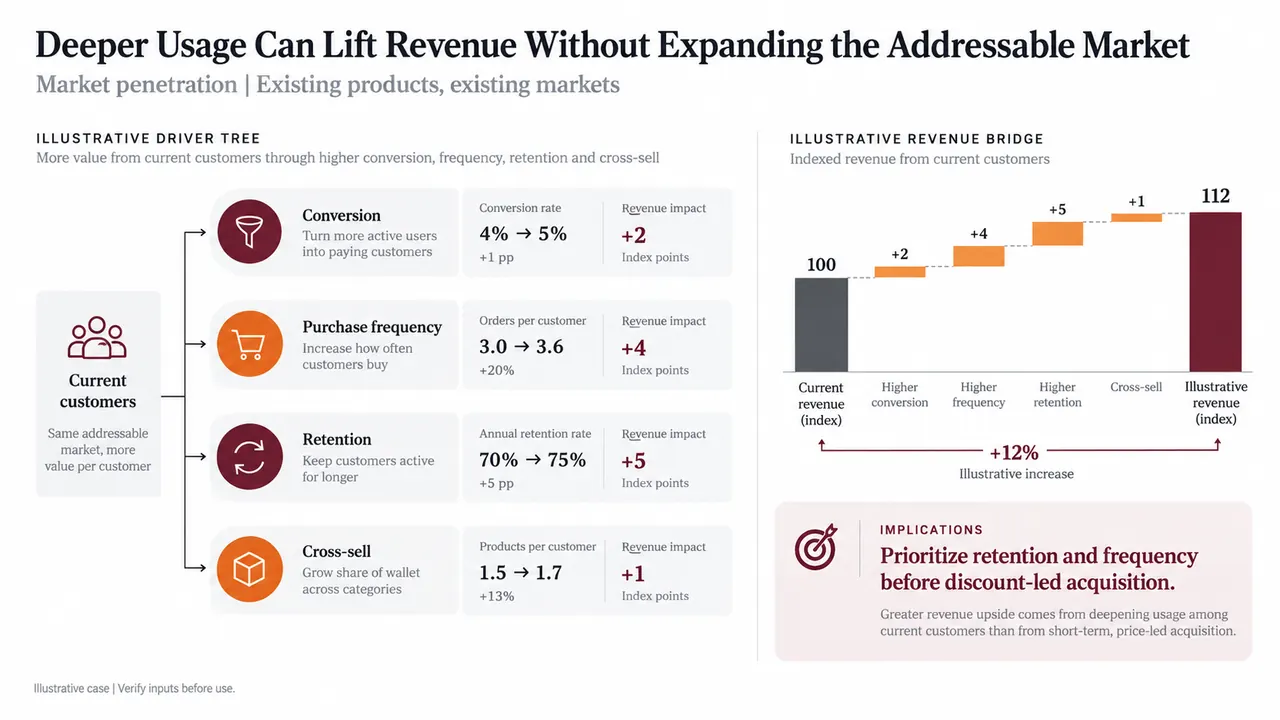
Ansoff matrix prompt
Pick a slide, fill in any highlighted fields, then copy or run it.
Create one 16:9 executive strategy slide for market penetration. Audience: [leadership team]. Business: [company and product]. Decision required: [decision]. Use only the verified data below: [paste data and sources]. Build a driver tree covering acquisition, conversion, purchase frequency, retention, pricing, and cross-sell. Add a revenue bridge from the current baseline to the target. Write an action title that states the main implication. Use a restrained consulting layout with white space, charcoal text, muted burgundy accents, and one warm highlight color. Label estimates and assumptions clearly. Do not invent numbers. Add source notes and a recommendation box.
Create one 16:9 market development slide for [company]. Compare these new markets or segments: [list]. Use only these verified inputs: [market size, growth, margin, competition, regulation, channel access, localization cost, sources]. Place a simple opportunity map on the left and a market attractiveness versus right-to-win matrix on the right. Highlight no more than two priority markets. Add a Partner, Pilot, Scale entry path and state the conditions required to move between stages. Use an action title with the recommendation, not a topic label. Mark any missing evidence as a gap. Do not fabricate data.
Create one 16:9 product development slide for existing customers. Customer segments: [segments]. Candidate products or modules: [options]. Verified evidence: [research findings, usage, willingness to pay, delivery cost, sources]. Build a customer-needs heat map and identify the strongest evidence-backed opportunity. Add a three-stage roadmap covering Validate, Build, and Launch. Define one measurable gate for each stage. Use an action title that links customer need to the investment decision. Keep all wording concise, label illustrative values, and do not invent evidence.
Create one 16:9 diversification decision slide. Current transferable assets: [brand, data, channels, technology, operations, customer insight]. New product and market options: [options]. Verified evidence and sources: [paste]. Map each option by capability adjacency, synergy potential, execution risk, capital required, and time to proof. Recommend an option only if the evidence supports it. Add three stage gates: Test thesis, Prove demand, Commit capital. State the stop conditions. Use an implication-led title, a restrained consulting palette, and clear source notes. Do not invent numbers or certainty.
Why these prompts work
Penetration is broken into drivers
The penetration prompt names six levers (acquisition, conversion, frequency, retention, pricing, cross-sell) and bridges baseline revenue to target. Growth claims become arithmetic.
Priorities are capped
The market development prompt allows no more than two priority markets and asks for the conditions that must hold to move from Partner to Pilot to Scale.
Every stage has a gate
Product development sets one measurable gate per Validate, Build and Launch stage. Diversification adds Test thesis, Prove demand, Commit capital and stop conditions.
No evidence, no recommendation
The diversification prompt recommends an option only if the evidence supports it, and all four prompts ban invented numbers and ask for estimates to be labeled.
Adapt it to your own deck
Run only the routes you need
Most growth reviews weigh two routes. Use the matching prompts and add "Open with a small Ansoff grid showing which quadrant each slide covers."
Plug in your market data
Paste market size, growth, margin and regulation facts into the bracketed fields, or attach the research pack, and add "Mark any market without channel access data as a gap."
Match the house style
The prompts ask for charcoal text and muted burgundy accents. Swap in your brand colors, or choose a template in Tosea and remove the color instructions.
Ansoff matrix FAQ
What is the Ansoff Matrix?
A growth-strategy grid that Igor Ansoff published in 1957. It crosses existing and new products with existing and new markets, giving four routes: market penetration, market development, product development and diversification, in roughly rising order of risk.
Can I paste these prompts into ChatGPT, Claude or Gemini?
Yes. You will get the driver logic, market scoring and slide text back as an outline. Tosea takes the same prompts plus your attached data and produces editable slides that export to PowerPoint.
Is this an official PwC template?
No. The Ansoff Matrix is a public framework, and "PwC-style" describes the restrained burgundy and charcoal look. Tosea is not affiliated with PwC.
PwC-style describes a common consulting framework. Tosea is not affiliated with PwC. Figures on the example slides are illustrative.
Prefer not to write a prompt?
Upload the document. Tosea drafts the deck, you edit and export.
Start for free