


Bain-style diagnostic prompts for PowerPoint
Four Bain-style prompts for management reviews that combine several standard frameworks on one slide each: a financial health scorecard, a cost and capital allocation view, a SCOR-based supply chain diagnosis and a project delivery control page.
Business diagnostic frameworks prompt
Pick a slide, fill in any highlighted fields, then copy or run it.
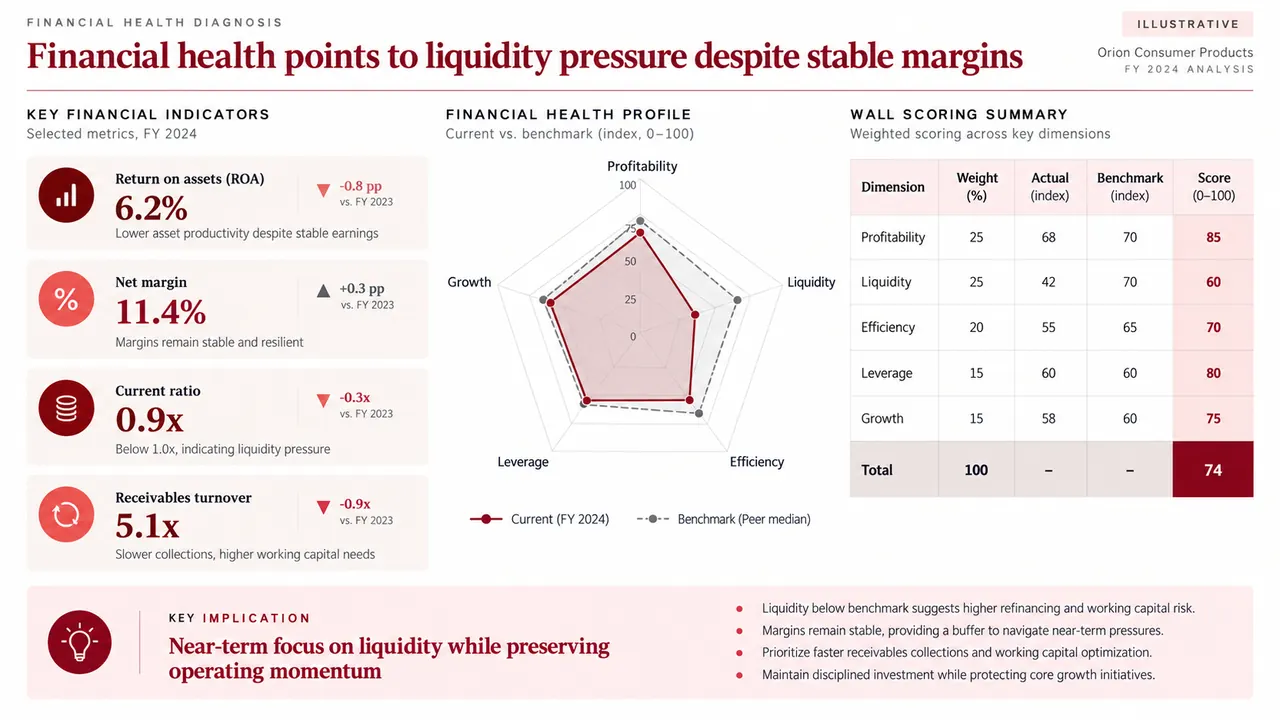
Create one executive financial health slide for a management review. Use the attached financial statements and peer benchmarks. Calculate profitability, liquidity, efficiency, leverage, and growth ratios. Build a weighted Wall scorecard with weights totaling 100 percent, a current-versus-benchmark radar chart, and four KPI cards. State the main implication in the title. Show formulas, period, units, benchmark source, the dimension scoring rule, and any score caps in a footnote. Do not invent missing values. Flag every assumption for review.
Build a four-panel investment decision slide from the attached cost model and project forecasts. Panel 1 allocates overhead through Activity-Based Costing. Panel 2 shows the Cost-Volume-Profit break-even point, the relevant range, and downside sensitivity. Panel 3 compares NPV, annual EVA impact, payback, and risk for each initiative using one discount rate and horizon. Panel 4 shows a zero-based budget reallocation with sources equal to uses. Use only supplied values, identify inconsistent assumptions, and write a conclusion-led title that recommends an action.
Create an end-to-end supply chain diagnosis using the attached service, inventory, lead-time, and emissions data. Map Plan, Source, Make, Deliver, Return, and Enable, and state the SCOR version used. Show every KPI against its target and highlight no more than three bottlenecks. Add a VMI replenishment loop with the reorder point calculated from demand, lead time, and safety stock. Connect ECR, Quick Response, and Green Supply Chain actions to measurable decisions, each with baseline, target, owner, and timing. Label missing evidence instead of estimating it.
Turn the attached project plan into a delivery-control slide. Build a deliverable-based Work Breakdown Structure, a RACI matrix with exactly one accountable owner per activity, and a network plan with the critical path and float highlighted. Where three-point estimates exist, calculate the PERT expected duration and standard deviation, and show the date at 50 and 90 percent confidence. Add an inputs-to-impact logical framework and list the three milestones most at risk. Preserve all source dates and flag dependency conflicts and RACI rows without an owner.
Why these prompts work
Weights and totals must reconcile
The financial prompt needs Wall scorecard weights totaling 100 percent, and the capital prompt needs zero-based budget sources equal to uses. Numbers that do not add up get flagged.
Formulas go in the footnote
The financial health prompt asks for formulas, period, units, benchmark source and the scoring rule in a footnote, so a CFO can trace every score back to its input.
One discount rate for all options
The capital prompt compares NPV, EVA, payback and risk using one discount rate and horizon, and asks the model to point out inconsistent assumptions.
Ownership gaps are surfaced
The project prompt requires exactly one accountable owner per RACI row and flags rows without one, plus dependency conflicts and the three milestones most at risk.
Adapt it to your own deck
Attach the real source files
Each prompt expects an attachment: statements and peer benchmarks, a cost model, supply chain KPIs or a project plan. Add "Label every number as actual, forecast or assumption."
Split dense panels into slides
The four-panel cost and capital slide is dense. For a workshop, ask for one slide per panel and a summary slide that carries the recommendation.
Swap frameworks you do not use
If your team does not use EVA or VMI, say so: "Replace EVA with ROIC" or "Drop the VMI loop and show reorder points by SKU group." Keep the reconciliation checks.
Business diagnostic frameworks FAQ
What is a diagnostic slide in consulting?
A page that measures current performance against a target or benchmark, isolates the few causes that matter and states what to do. These prompts apply that to finance, capital, supply chain and projects using standard tools such as Wall scoring, SCOR, RACI and PERT.
Why does the supply chain prompt ask for the SCOR version?
The SCOR model has been revised over time, and newer releases name the process stages differently. Stating the version tells reviewers which definitions the map and KPIs follow.
Is this an official Bain template?
No. Bain-style describes a common consulting convention: one conclusion per slide, dense but sourced evidence and a clear implication. Tosea is not affiliated with Bain & Company.
Can I use these prompts in ChatGPT, Claude or Gemini?
Yes. A chat assistant can run the calculations as text and suggest a layout. In Tosea you attach the statements or plan with the prompt and get slides you can edit and export to PowerPoint.
Bain-style describes a common consulting framework. Tosea is not affiliated with Bain & Company. Figures on the example slides are illustrative.
Prefer not to write a prompt?
Upload the document. Tosea drafts the deck, you edit and export.
Start for free