


Decision-making framework prompts for PowerPoint
Three Bain-style prompts that follow a decision from start to finish: framing a messy problem with 5W2H and the Garbage Can model, estimating under uncertainty with a Delphi panel, and choosing between options with Kepner-Tregoe analysis and a decision tree.
Decision-making frameworks prompt
Pick a slide, fill in any highlighted fields, then copy or run it.
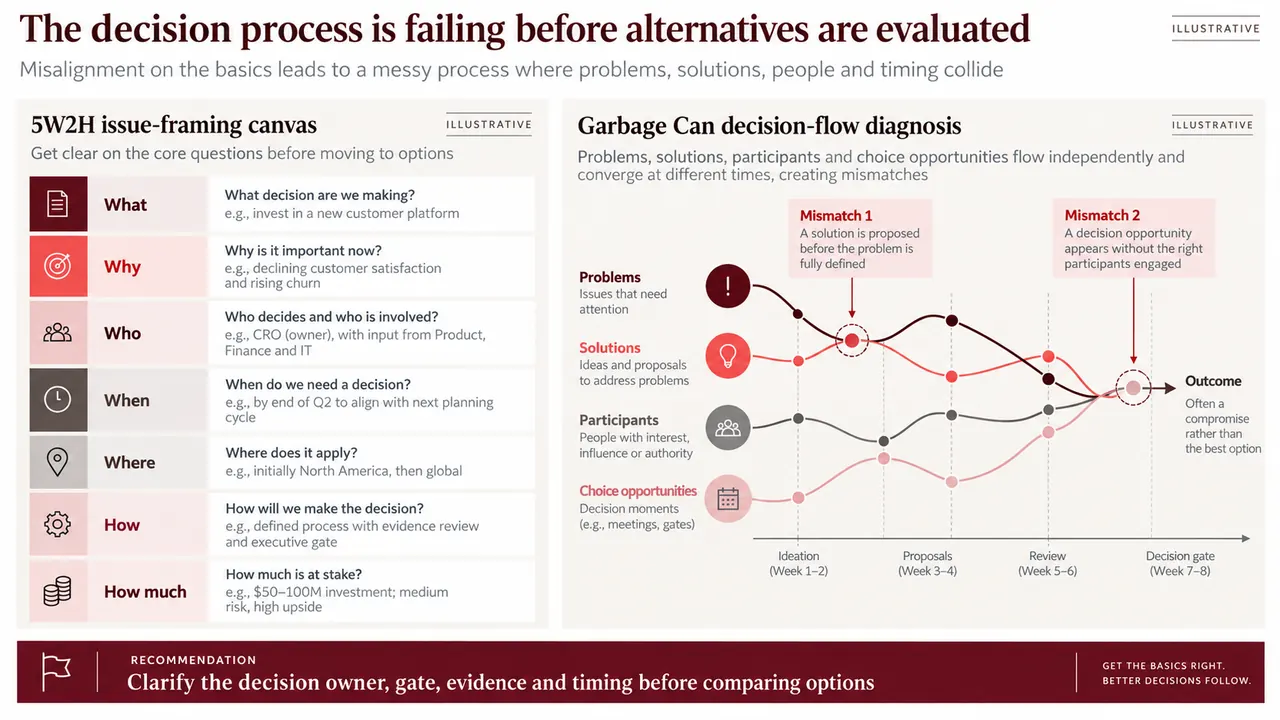
Create one executive decision-framing slide from the attached notes and meeting records. Build a 5W2H canvas covering What, Why, Who, When, Where, How, and How much. On the same page, map Problems, Solutions, Participants, and Choice opportunities across time. Identify where these streams fail to meet. Write a conclusion-led title and recommend one governance change. Use only source evidence and label unresolved questions instead of inventing answers.
Build a Delphi forecasting slide from the attached round-level responses. State the expert panel size and composition, anonymity protocol, feedback process, and stopping rule. Plot every response for each round, then show the median, interquartile range, and change between rounds. Separate consensus from unresolved disagreement. Do not remove outliers without a documented rule. End with the planning assumption and the trigger that would justify revising it.
Create one Kepner-Tregoe Decision Analysis slide for the attached alternatives. State the decision objective. Separate MUST objectives from WANT objectives. Eliminate any option that fails a MUST. Weight the WANT objectives, score each feasible option on one disclosed scale, and show the weighted totals. Add a decision tree only where source data provides probabilities and outcomes, and report the break-even probability if the ranking changes between branches. Review adverse consequences for the leading option and list mitigations. Recalculate every total and flag missing evidence.
Why these prompts work
Mismatches are shown, not assumed
The framing prompt maps problems, solutions, participants and choice opportunities across time and asks where the streams fail to meet. That explains a stalled decision better than opinions do.
Every Delphi response is plotted
The Delphi prompt plots every response per round with median, interquartile range and change between rounds, and bans dropping outliers without a documented rule.
MUSTs eliminate before WANTs score
The Kepner-Tregoe prompt removes any option that fails a MUST before weighted scoring, so a strong total cannot hide a failed requirement.
Trees only where data exists
The decision tree is added only when sources give probabilities and outcomes, and it reports the break-even probability if the ranking flips. Every total is recalculated.
Adapt it to your own deck
Attach records or expert rounds
The framing prompt reads notes and meeting records; the Delphi prompt needs round-level responses. Attach them and add "Quote the source line for each claim."
Use one stage or all three
Run them as a three-slide decision pack, or use only the stage you are in. The Kepner-Tregoe prompt alone works well for vendor or site selection.
Show the method to skeptics
For a governance committee, add "Include a backup slide listing MUST thresholds, WANT weights and who set them." It moves the debate from the answer to the criteria.
Decision-making frameworks FAQ
What is Kepner-Tregoe decision analysis?
A structured method for choosing between alternatives. You state the objective, screen options against MUST criteria, score the remaining options on weighted WANT criteria, then review the adverse consequences of the leading option before deciding.
What is the Delphi method?
A forecasting method in which a panel of experts gives anonymous estimates over several rounds, sees a summary of the group's answers after each round, and revises until the range stabilizes or a stopping rule is met.
Is this an official Bain template?
No. Bain-style describes the consulting convention of a conclusion-led title and a recommendation bar. Tosea is not affiliated with Bain & Company.
Can I use these prompts in ChatGPT, Claude or Gemini?
Yes. You will get scoring tables and text to lay out yourself. In Tosea you attach the meeting notes or expert responses with the prompt and get slides you can edit and export to PowerPoint.
Bain-style describes a common consulting framework. Tosea is not affiliated with Bain & Company. Figures on the example slides are illustrative.
Prefer not to write a prompt?
Upload the document. Tosea drafts the deck, you edit and export.
Start for free