


Competitive analysis prompt for PowerPoint
A prompt for an 8-slide competitive analysis that compares your product with two competitors for product and commercial leaders. It draws on product documents, win-loss notes and customer interviews, and ends with a positioning map, two gaps to close and one advantage to defend.
Competitive analysis prompt
Fill in any highlighted fields, then copy or run it.
Create an 8-slide competitive analysis for [product] versus [competitor A] and [competitor B].
Audience: product and commercial leadership.
Decision: choose two gaps to close and one advantage to defend.
Use the attached product documents, win-loss notes, and customer interviews.
Compare segments, use cases, implementation, integrations, security, pricing logic, and service.
End with a positioning map and three implications.
Label unsupported claims as unverified.
Why this prompt works
A narrow decision
"Choose two gaps to close and one advantage to defend" turns a feature inventory into a short list of choices leadership can act on.
Evidence from real deals
Win-loss notes and customer interviews sit next to product documents, so the comparison reflects why deals were won or lost, not only spec sheets.
Seven buying dimensions
Segments, use cases, implementation, integrations, security, pricing logic and service cover how a product is bought and run, not just what it does.
Unverified claims are labeled
"Label unsupported claims as unverified" matters for competitor data, where much of what a team believes comes from sales anecdotes.
Adapt it to your own deck
Name your competitors
Replace [product], [competitor A] and [competitor B]. You can add a third rival, but keep the positioning map to the two axes that split the field most clearly.
Choose the map axes
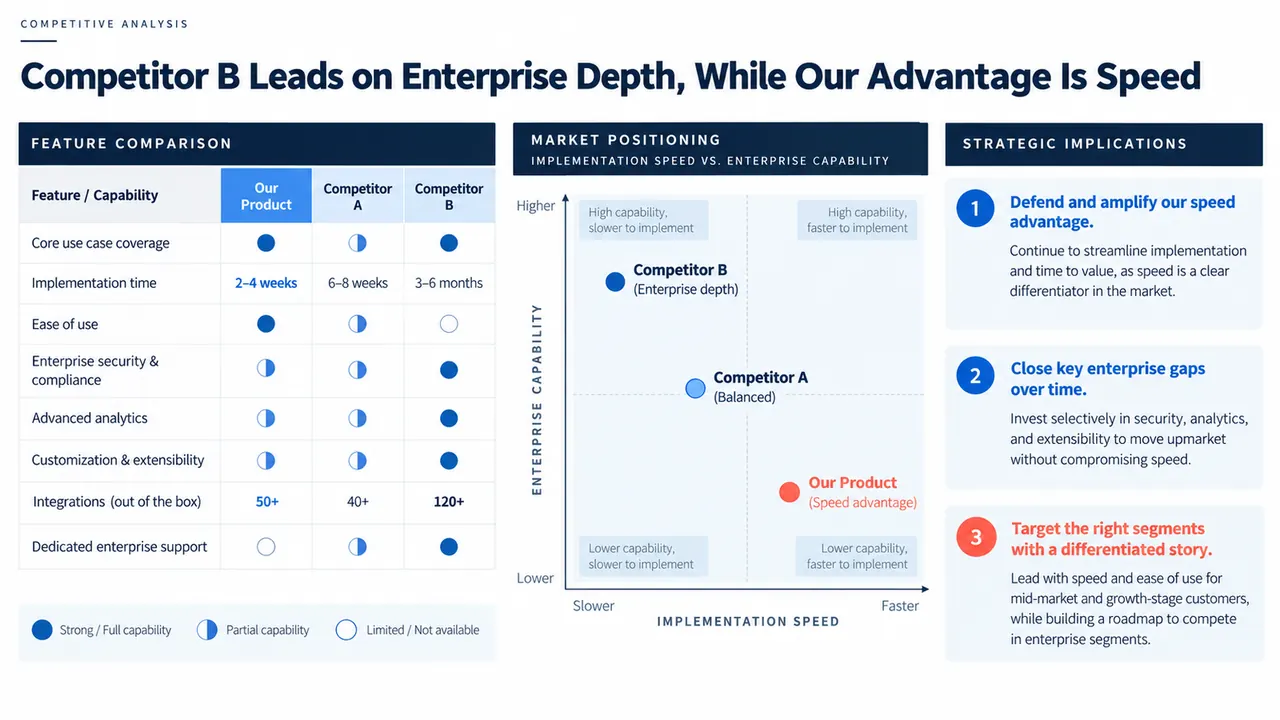
The example slide uses implementation speed against enterprise capability. Tell the model yours: "Positioning map: price per seat versus depth of analytics."
Retarget for sales enablement
For a sales team, change the audience and decision: "Audience: account executives. Decision: agree on three talk tracks to use against Competitor A."
Competitive analysis FAQ
What should a competitive analysis presentation include?
A comparison of your offer with named rivals on the dimensions buyers weigh, a view of where each sits in the market, and what that means for your strategy. A useful one ends with specific choices rather than a feature checklist.
Does this work in ChatGPT, Claude or Gemini?
Yes. Paste the prompt with your notes and you will get comparison tables and slide-by-slide text to lay out yourself. In Tosea you attach the same documents, pick a template, and get slides you can edit and export to PowerPoint (.pptx).
Where should competitor information come from?
Public material such as websites, pricing pages, documentation and filings, plus your own win-loss notes and customer interviews. Do not use confidential documents you are not entitled to. The prompt flags anything it cannot support as unverified.
Figures on the example slides are illustrative.
Prefer not to write a prompt?
Upload the document. Tosea drafts the deck, you edit and export.
Start for free