How To Use FinceptTerminal: The Free Bloomberg Alternative for Finance Professionals in 2026
A complete guide to FinceptTerminal, the open-source Bloomberg alternative: features, install steps, AI agents, and how to turn its output into investor-ready decks.
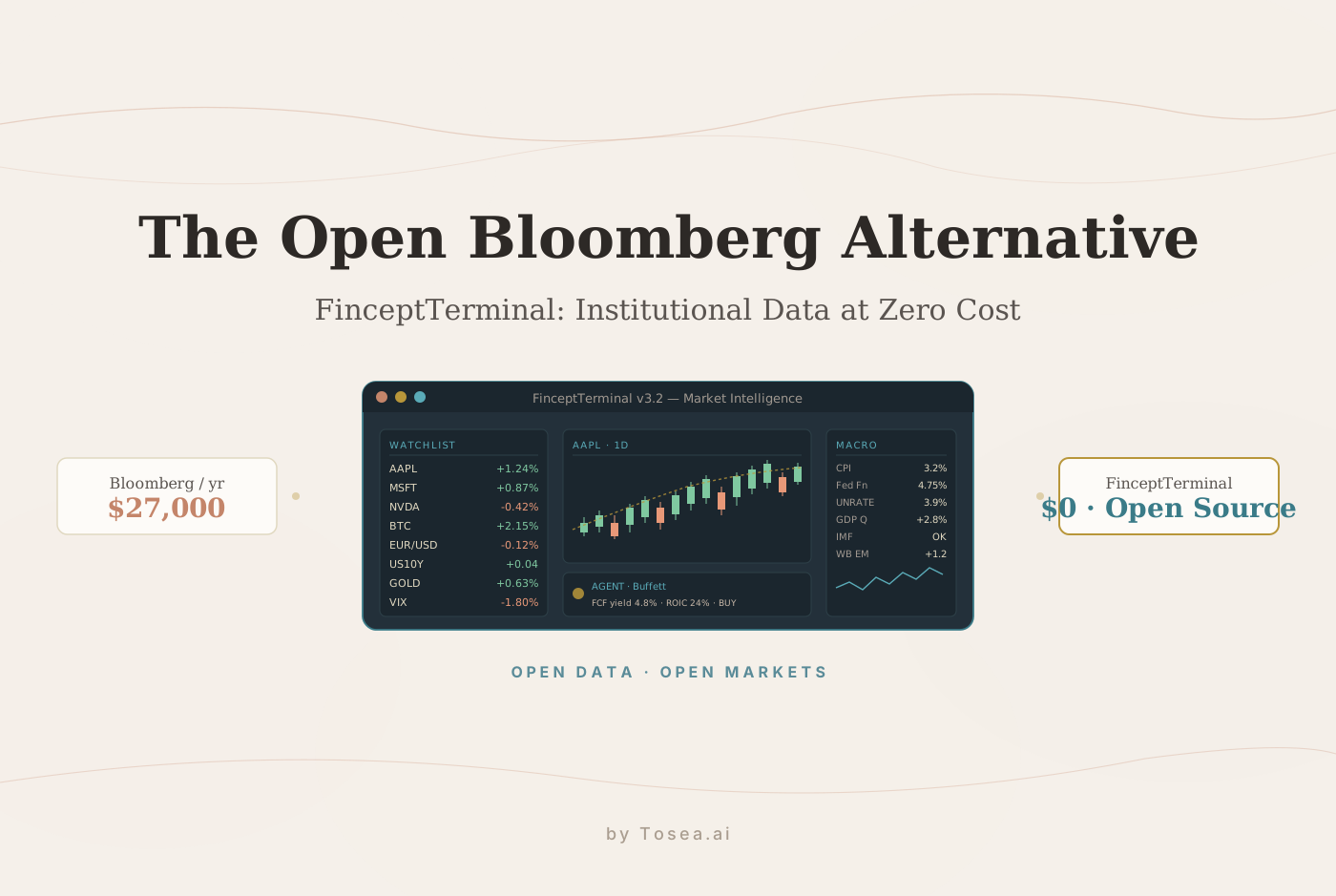
A Bloomberg Terminal costs around $27,000 per seat per year. Refinitiv Eikon, FactSet, and similar platforms follow comparable pricing. For decades this has meant that the most powerful financial data and analytics tools were effectively available only to banks, large hedge funds, and institutional asset managers with budgets to match. Independent portfolio managers, boutique family offices, emerging hedge funds, and academic researchers were priced out of the same infrastructure.
FinceptTerminal is the project that narrows that gap the most directly. In this guide we walk through what it is, how to install it, where it genuinely replaces a paid terminal, where it still does not — and how teams pair it with Tosea.ai when the raw analysis has to become an investor-ready presentation deck.
What Is FinceptTerminal?
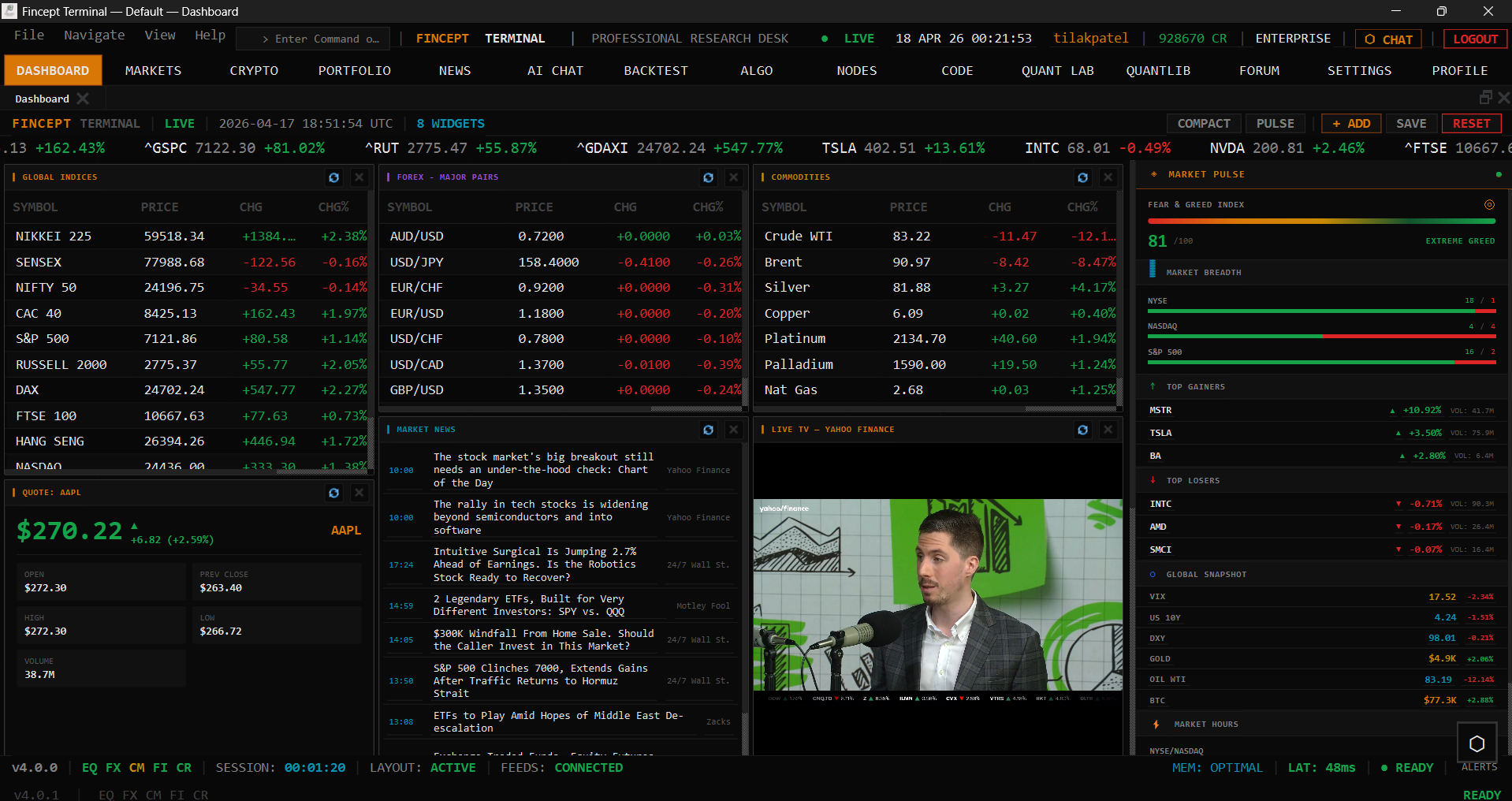
FinceptTerminal is an open-source financial intelligence platform built by Fincept Corporation and released under the AGPL-3.0 license. Its stated mission is direct: professional financial tools should not cost $27,000 per year. The platform delivers institutional-grade market data, equity research tooling, economic indicators, and AI-powered analysis at zero cost.
As SourceForge's project overview describes it, FinceptTerminal is an open-source financial intelligence platform aimed at bringing powerful market analysis and investment research tools to a broad audience without the cost of proprietary terminals. It provides both command-line and graphical interfaces that let users access real-time market data, economic indicators, and advanced analytics from a unified environment, supporting stocks, forex, commodities, and more.
The current stable release is version 3.2, a cross-platform desktop application with native packages for Windows, macOS Apple Silicon, macOS Intel, and Linux. Version 4 is in active development as a pure native C++20 desktop application built on Qt6 with embedded Python for analytics — described by the project as delivering Bloomberg-terminal-class performance in a single native binary.
The Problem FinceptTerminal Solves
The financial data industry has operated behind paywalls for decades. A single Bloomberg Terminal subscription costs approximately $27,000 annually, and Refinitiv Eikon and FactSet operate in a similar price range. This creates a structural asymmetry in financial markets: the quality of your analytical infrastructure depends directly on your institution's budget.
For a large investment bank with hundreds of terminal licenses, this is a line item. For an emerging hedge fund with five analysts, an independent family office, a university research department, or an individual portfolio manager, it is prohibitive. The analytical disadvantage is real — access to real-time feeds, advanced screening tools, economic databases, and quantitative modeling capabilities makes a measurable difference in investment decision quality. This same asymmetry is part of why large banks have moved quickly on in-house AI tooling, as we covered in our pieces on Goldman Sachs' Claude deployment and agentic AI in global banking document workflows.
The World Bank's research on financial market access consistently identifies information asymmetry as a structural barrier in global capital markets. FinceptTerminal addresses this barrier directly by making the data infrastructure layer available at no cost under an open-source license.
FinceptTerminal vs. Bloomberg Terminal: Side-by-Side
The table below compares the two on the dimensions that matter for day-to-day research and trading work. The goal is not to claim equivalence — Bloomberg is deeper in several areas — but to show where the open-source tool is already a defensible substitute.
| Dimension | Bloomberg Terminal | FinceptTerminal 3.2 |
|---|---|---|
| Annual cost per seat | ~$27,000 | $0 (AGPL-3.0) |
| Real-time equities | All major venues, proprietary feed | Yahoo Finance + Polygon aggregation |
| Crypto / 24-7 markets | Paid add-on | Native Kraken + HyperLiquid WebSockets |
| Macro / economic data | Proprietary BCDE datasets | FRED, IMF, World Bank, DBnomics, AkShare |
| AI research assistance | BloombergGPT (limited) | 37 pre-built agents + local LLM via Ollama |
| Quant modeling | Excel + BQL + proprietary | Embedded Python 3.12 (NumPy, Pandas, scipy) |
| Broker integrations | Bloomberg EMSX | 16 brokers (IBKR, Alpaca, Saxo + 13 Indian) |
| Messaging / IB chat | Bloomberg IB (network effect) | Not included |
| Extensibility | Closed platform | Full source on GitHub |
| Best for | Sell-side desks, large buy-side | Boutique funds, independents, researchers, quants |
Bloomberg still wins on the IB messaging network effect, proprietary datasets (e.g., the BBG ticker universe, index constituents history), and pre-trade compliance tooling. For most pure research and analysis workflows outside those specific features, FinceptTerminal already covers the working set.
Core Features: What FinceptTerminal Actually Includes
Real-time market data across all asset classes
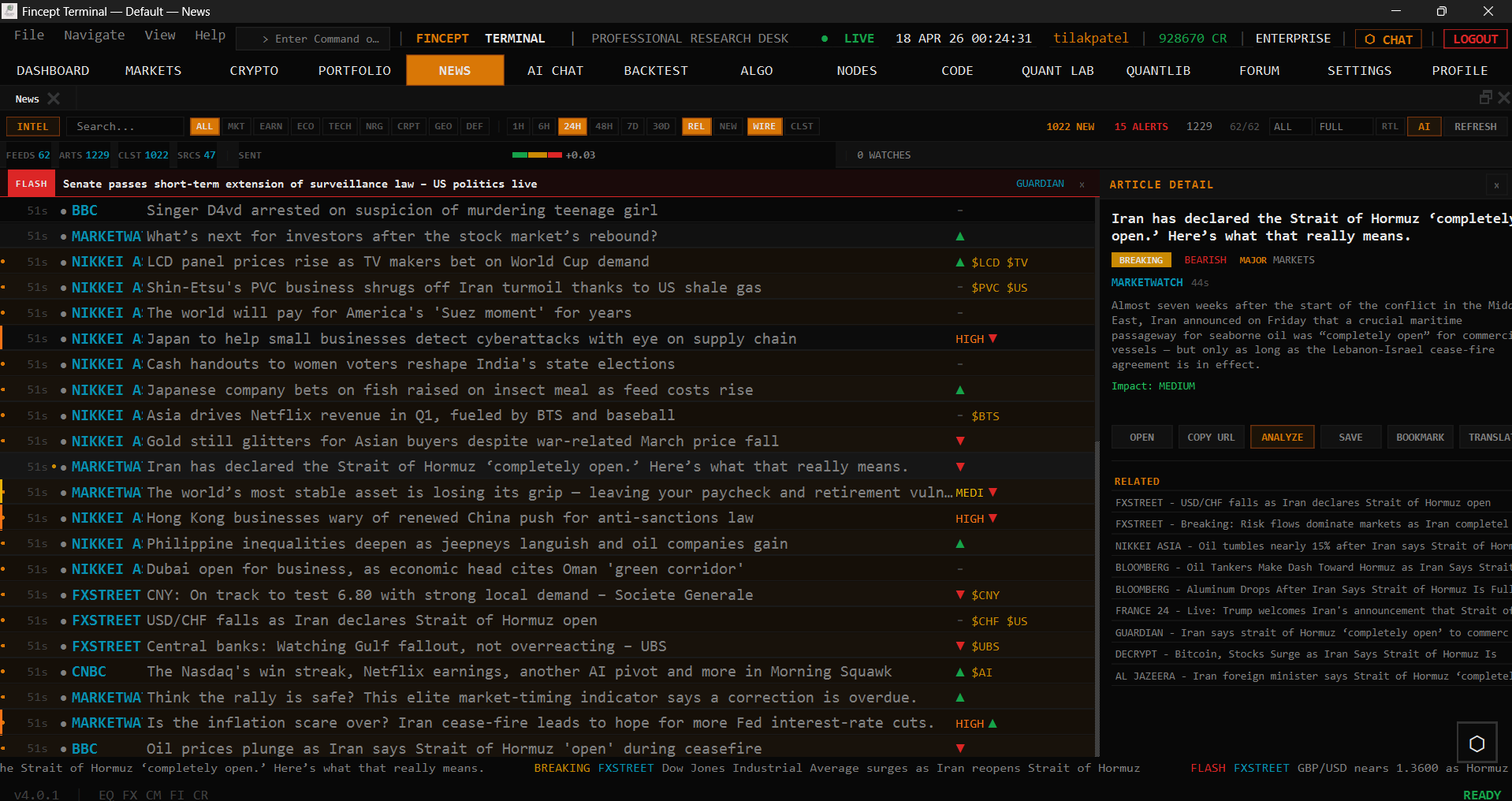
FinceptTerminal connects to a broad ecosystem of data providers through a unified interface. Equity data flows from Yahoo Finance and Polygon. Cryptocurrency data streams via Kraken and HyperLiquid WebSocket connections. Macro and economic data arrives from FRED (Federal Reserve Economic Data), the IMF, the World Bank, DBnomics, and AkShare, as well as a range of government statistical APIs.
This multi-source architecture means the terminal is not dependent on any single data provider. If one source is unavailable or has limited coverage for a specific instrument or region, the system draws from alternatives. For global investors who need consistent coverage across emerging market equities, developed market fixed income, and alternative assets simultaneously, this breadth of integration matters.
AI-powered investment analysis: 37 agents across frameworks
One of FinceptTerminal's more distinctive features is its AI agent layer. The platform includes 37 pre-built analytical agents organized across three frameworks: Trader and Investor, Economic, and Geopolitics.
The investor framework includes agents modeled on the documented investment philosophies of practitioners including Warren Buffett, Benjamin Graham, Peter Lynch, Charlie Munger, Seth Klarman, and Howard Marks. Each agent applies a systematic interpretation of its associated philosophy to the security or portfolio being analyzed.
The platform supports local large language model inference through Ollama as well as cloud-based providers including OpenAI, Anthropic, Gemini, Groq, DeepSeek, MiniMax, and OpenRouter. The AI analysis layer can run entirely on local hardware for users with privacy or regulatory constraints on data leaving their infrastructure. Agent sentiment and an overlay data layer from Adanos supplement the quantitative feed with market sentiment signals — an alternative data layer that is usually only available through paid add-ons elsewhere.
Quantitative analytics and risk modeling
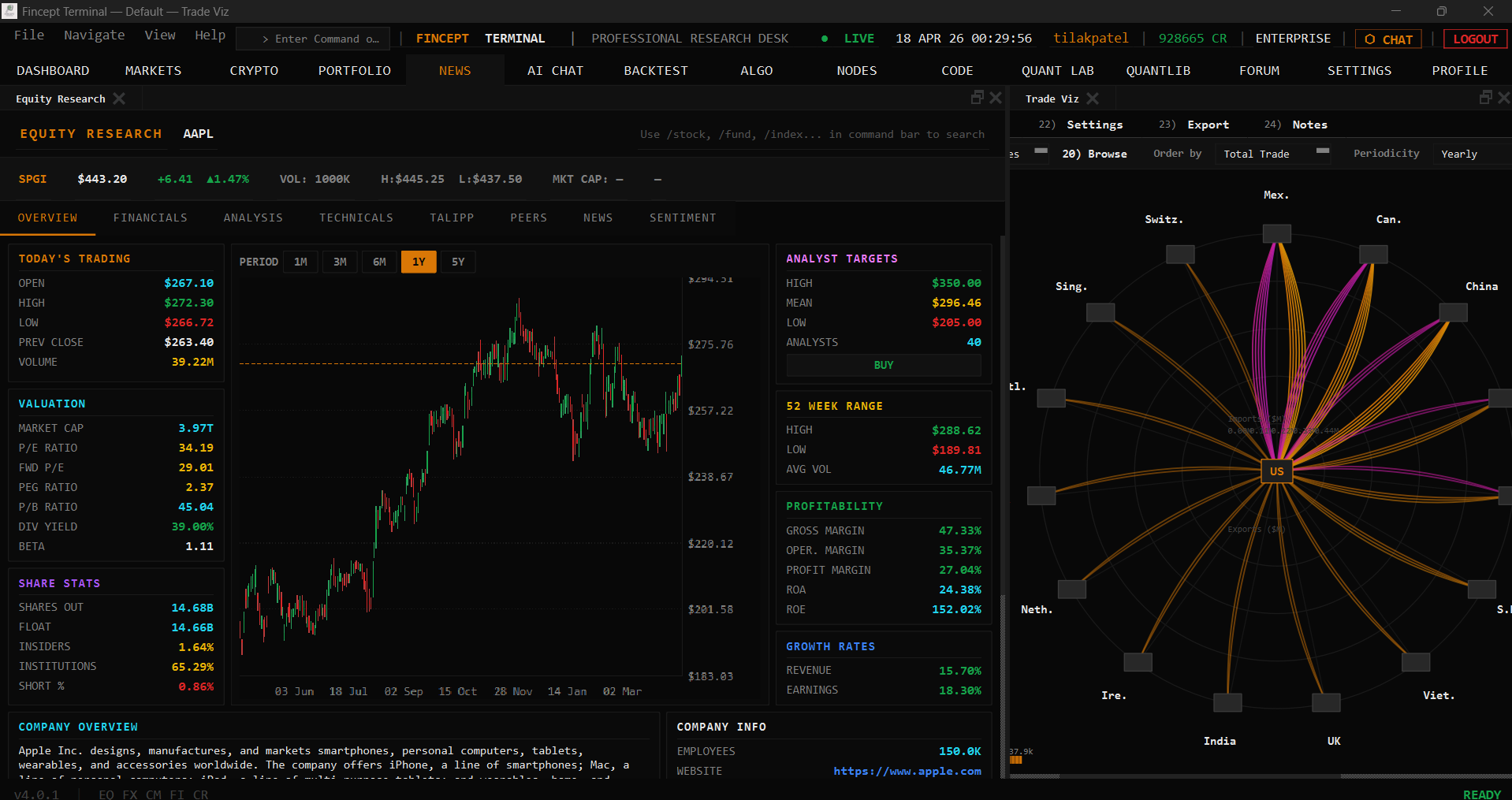
For quantitative practitioners, FinceptTerminal includes a suite of analytical tools through its embedded Python engine:
- Discounted cash flow (DCF) valuation models with customizable assumptions
- Portfolio optimization using modern portfolio theory frameworks
- Risk metrics including Value at Risk (VaR), Sharpe ratio, and related measures
- Derivatives pricing models embedded directly in the desktop application
These capabilities are implemented in Python — the standard language for quantitative finance — embedded directly in the terminal application. Analysts familiar with NumPy, Pandas, and scipy can extend the built-in models with custom analysis without leaving the terminal environment. In practice this means a risk team can prototype a new VaR methodology against the live data layer in the same window they run it from.
Algorithmic trading and broker integration
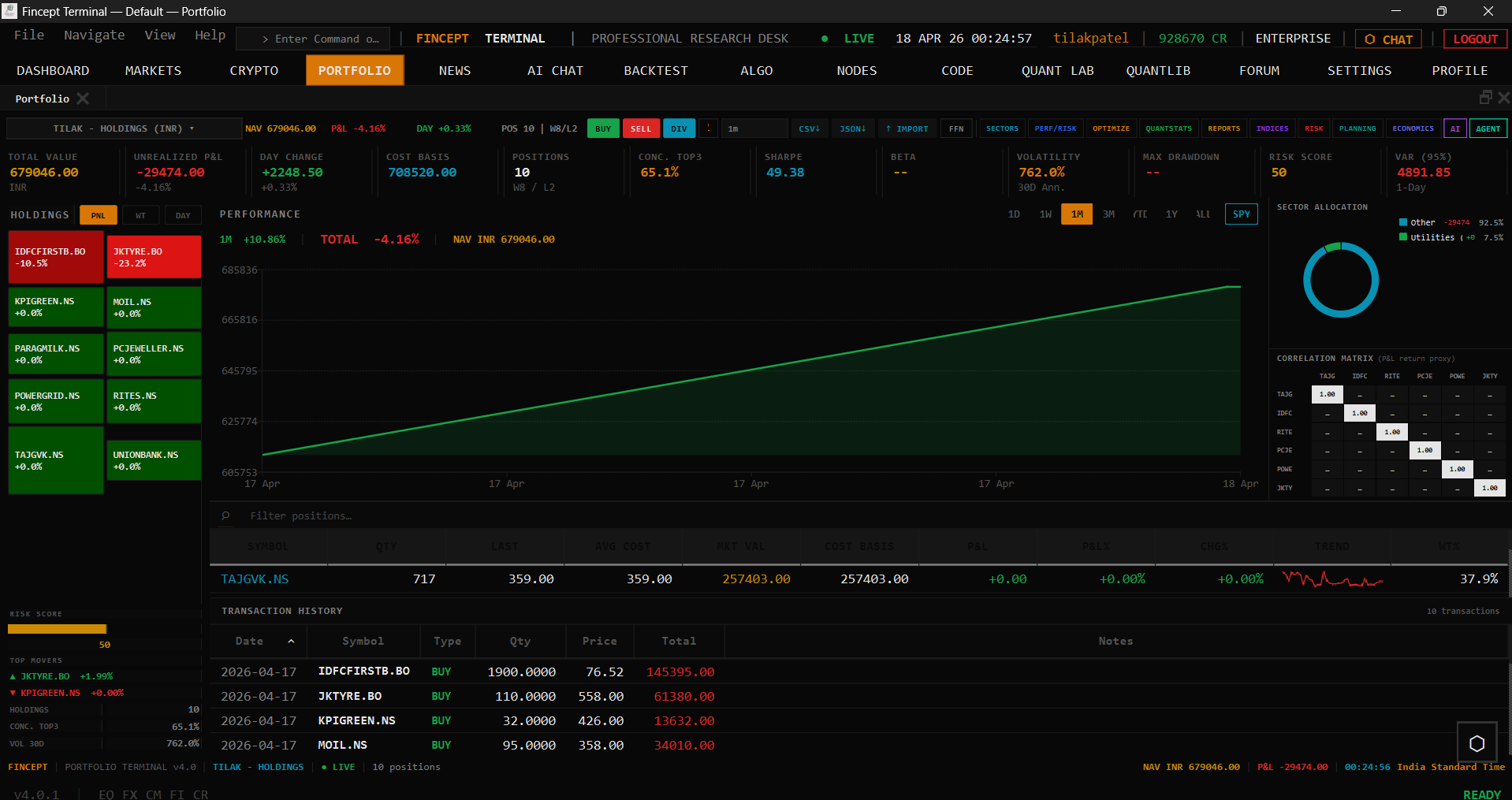
FinceptTerminal includes a paper trading engine for strategy testing and 16 live broker integrations covering both Indian and international markets. Indian broker integrations include Zerodha, Angel One, Upstox, Fyers, Dhan, Groww, Kotak, IIFL, 5paisa, AliceBlue, Shoonya, and Motilal. International integrations cover Interactive Brokers (IBKR), Alpaca, Tradier, and Saxo Bank.
The paper trading capability allows strategy backtesting and live simulation before committing capital, which is standard practice in institutional algorithmic trading workflows. IBKR's documentation on algorithmic trading notes that strategy simulation and paper trading are considered essential steps before live deployment — FinceptTerminal makes this workflow accessible without proprietary software fees.
How to Install FinceptTerminal
The simplest path to running FinceptTerminal is the pre-compiled binary releases, available for all major platforms.
Windows: Download the .msi installer from the releases page. Run the installer and follow the prompts. Python 3.12 and Bun are downloaded automatically during setup, which takes roughly two to five minutes.
macOS (Apple Silicon, M1–M4):
# After downloading the DMG, run:
xattr -cr ~/Downloads/FinceptTerminal-v3.2.0-macOS-arm64.dmg
# Open the DMG and drag to Applications
xattr -cr /Applications/FinceptTerminal.app
macOS (Intel): Same process with the x64 DMG file.
Linux (Debian/Ubuntu):
# Download the .deb package and install:
sudo dpkg -i FinceptTerminal-v3.2.0-Linux-x64.deb
Linux (Universal): The AppImage format runs without installation on any Linux distribution.
For developers who want to build from source, FinceptTerminal v4 requires Qt 6.7.2, CMake 3.27.7 or later, and a C++20-compatible compiler (MSVC 2022 on Windows, GCC or Clang on Linux, Xcode on macOS). The full getting started guide covers the complete build process.
Who Benefits Most — Five Professional Profiles
Independent portfolio managers and family offices. The $27,000 annual Bloomberg fee is a meaningful operational expense for a boutique operation managing under $100 million. FinceptTerminal provides equivalent data coverage — real-time equities, macro indicators, AI-assisted equity research — at zero marginal cost. The savings go directly to investment capacity.
Emerging hedge fund analysts. Early-stage hedge funds often face a bootstrapping problem: institutional-grade analytical infrastructure requires institutional-grade fees before generating institutional-grade returns. FinceptTerminal removes this constraint, enabling rigorous quantitative analysis from day one — a pattern that fits neatly with the sector-rotation research workflow we covered in New AI Trades: Navigating Sector Rotations.
Academic researchers in finance and economics. University research departments gain access to FRED, IMF, and World Bank data alongside equity market data through a unified interface. The open-source architecture means researchers can inspect the data processing pipeline, reproduce results exactly, and extend the analytical framework with custom code.
Quantitative developers. The embedded Python environment and open codebase (AGPL-3.0 on GitHub) make FinceptTerminal an extensible platform for building custom analytical tools. Developers can add data sources, build new analytical agents, and contribute improvements back to the community.
Financial educators. Teaching investment analysis, derivatives pricing, or macroeconomic modeling requires access to real market data. FinceptTerminal gives students and instructors the same data environment used by practitioners, without requiring institutional affiliation or budget.
The Web Terminal and API Access
In addition to the desktop application, FinceptTerminal offers a browser-based terminal at analytics.fincept.in for users who prefer not to install software locally. This web interface provides core market data and analytics capabilities accessible from any device.
For developers building applications on top of FinceptTerminal's data infrastructure, a public REST API provides programmatic access to market data, financial statement data, and the AI assistant endpoints. This enables integration with custom portfolio management tools, automated reporting systems, or research pipelines without requiring the desktop application.
From Financial Analysis to Professional Presentation: Closing the Loop With Tosea.ai
FinceptTerminal handles the data intelligence layer — real-time feeds, AI-assisted research, quantitative modeling, economic indicator tracking. What it produces is analytical output: research notes, portfolio reports, risk assessments, economic briefs.
In most professional contexts, that analytical output needs to become a presentation. An investment committee expects a structured deck. A potential limited partner wants a polished report. A board of directors needs a quarterly summary with clear visual hierarchy and professional formatting. The same gap exists in adjacent workflows we have covered — see Market Performance Monitoring to Executive Presentations and AI Presentations for Startups for how other teams bridge it.
This is where Tosea.ai fits. Upload the research document or analytical report that FinceptTerminal helped you produce, and Tosea.ai's Spatial Semantic Perception engine reads the logical structure of your content — identifying the investment thesis, the supporting analysis, the risk factors, the valuation conclusions — and generates a consulting-grade presentation that follows the narrative logic of your research.
The Absolute Traceability feature ensures every figure in the generated presentation links back to the source document. When an investor asks where a specific return projection came from, you can trace it to the underlying analysis in your FinceptTerminal-generated report — the same defensibility pattern we walked through in our zero-hallucination AI slides guide. The output is a native .pptx file, editable in PowerPoint or Google Slides, formatted to the standards that institutional audiences expect.
FinceptTerminal opens the financial intelligence layer. Tosea.ai opens the professional communication layer. Together, they give independent analysts and boutique investment operations the complete workflow — from raw market data to boardroom-ready presentation — that was previously available only to well-funded institutional teams.
Frequently Asked Questions
Is FinceptTerminal a true replacement for Bloomberg? For research, screening, economic data tracking, quant modeling, and AI-assisted equity analysis, yes — for most independent and boutique workflows. It does not replace Bloomberg's IB messaging network, its proprietary datasets, or its integrated pre-trade compliance tooling used by sell-side desks. If your workflow depends on those specific features, FinceptTerminal is a complement rather than a full substitute.
How reliable is the real-time data? Equity quotes come from Yahoo Finance and Polygon, which carry standard exchange-delivery latencies rather than Bloomberg's direct exchange feed. For discretionary research and swing trading horizons, this is fine. For high-frequency strategies that depend on microsecond-level ticks, it is not the right tool.
Do I need Python experience to get value out of it? No — the GUI and web terminal cover most screening, charting, and AI-agent workflows without touching code. Python becomes useful when you want to extend the DCF, VaR, or portfolio optimization models or integrate custom data sources, but it is not required for baseline use.
How does the AGPL-3.0 license affect me? For personal use, internal research, and teaching, AGPL-3.0 is essentially unrestricted. If you build a derivative product that you expose as a network service to users, AGPL requires you to release the source of your modifications under the same license. For most buy-side research teams, this has no practical impact.
Can the AI agents really stand in for Buffett-style analysis? The agents encode documented investment frameworks — FCF yield, return on invested capital, margin of safety, quality-of-earnings checks. They are a structured screening layer, not an actual portfolio manager. Treated as a disciplined first-pass filter, they are genuinely useful; treated as a prediction engine, they will disappoint.
Getting Started
The full repository is available at github.com/Fincept-Corporation/FinceptTerminal under the AGPL-3.0 license. Pre-compiled installers for all platforms are on the releases page. The web terminal is accessible at analytics.fincept.in without installation. For institutional inquiries, Fincept Corporation can be reached at [email protected].
When your analysis is ready to become a presentation, upload the research output directly to Tosea.ai — the citation trace and slide structure carry through from the report into the deck, so the work you do in FinceptTerminal is what ends up in front of the investment committee.
From FinceptTerminal Analysis to Investor-Ready Slides
Equity research, due-diligence work, and portfolio commentary all share the same last-mile problem: the analysis is finished, but the deliverable a portfolio manager or investment committee actually consumes is a slide deck. FinceptTerminal handles the analysis layer well — the AGPL terminal produces clean DCF outputs, screener exports, factor decompositions, and quant-style memos. What it does not do is produce the polished, on-brand investment committee deck that the analysis needs to land inside.
This is the gap that pairs naturally with a document-first AI presentation tool. The export flow looks like: run the screen and DCF inside FinceptTerminal → export the report as PDF or markdown → feed it into a PDF-to-PowerPoint pipeline → review and adjust the resulting deck. The result is a citation-traceable presentation where every chart number, valuation assumption, and screening criterion in the slides maps back to a specific line in the FinceptTerminal output. For teams that build investor decks regularly, our present sales data to executives framework and market performance monitoring guide walk through the structural decisions that matter most.
Tosea.ai is built for exactly this last-mile step. The PDF-to-PowerPoint pipeline ingests the FinceptTerminal output, preserves tables and formulas without re-rendering errors, and produces a slide structure that maps naturally to investment committee or pitch-deck conventions — the same structural problems explored in our AI presentations for startup pitch decks guide and our zero-hallucination AI slides guide. For analysts who would rather not spend the last two hours of a working day inside PowerPoint, the pairing collapses that step from hours to minutes while preserving the citation rigor the upstream FinceptTerminal work depends on.
Sources
- FinceptTerminal on GitHub — Fincept Corporation, official repository (AGPL-3.0)
- Fincept Terminal project page — SourceForge mirror
- Installation & Setup — DeepWiki
- Getting Started guide — Fincept Corporation docs
- Web Terminal — browser-based Fincept analytics
- Bloomberg Professional product page — Bloomberg LP (for reference pricing)
- World Bank Financial Sector research — information-asymmetry background