


Brand positioning map prompt for PowerPoint
A PwC-style prompt for one brand positioning map built from customer data. It plots six brands on Premium versus Value and Specialist versus Generalist axes, sizes bubbles by market share, highlights your brand and names one credible white space with three implications.
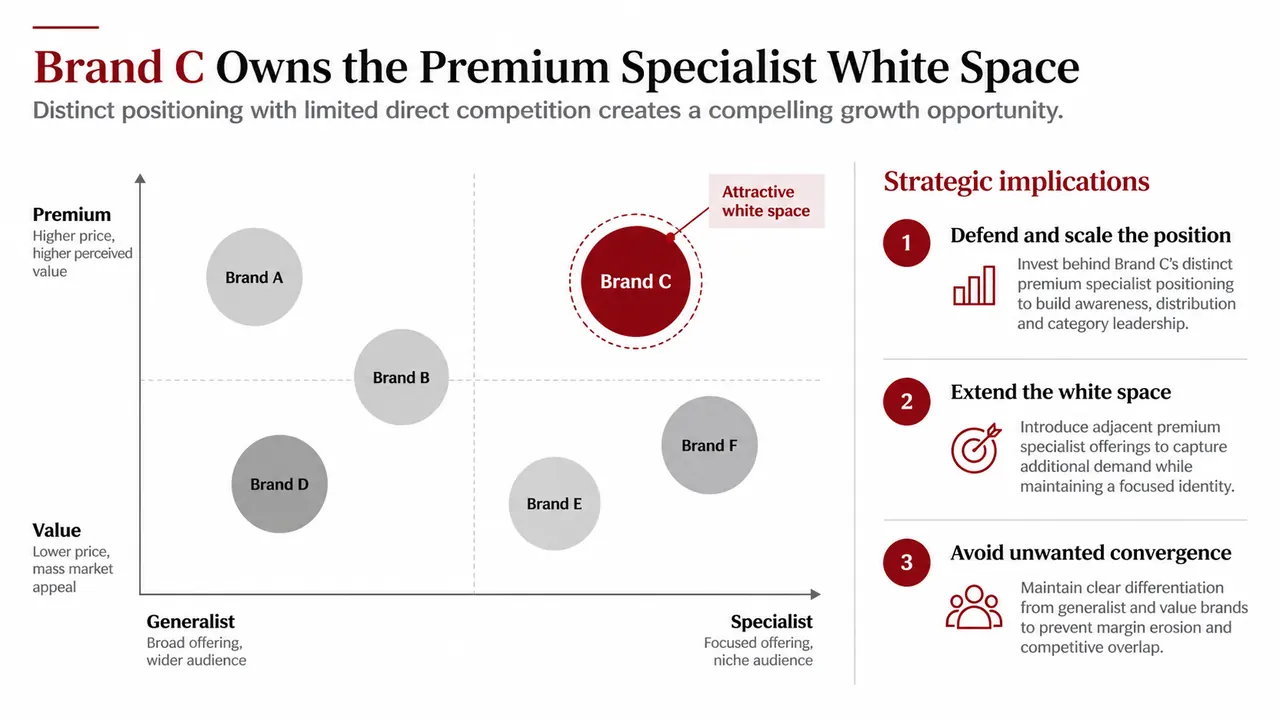
Brand positioning map prompt
Fill in any highlighted fields, then copy or run it.
Create a 16:9 brand positioning map from the supplied customer data. Plot six brands on Premium versus Value and Specialist versus Generalist axes. Size bubbles by market share, highlight our brand, identify one credible white space, and state three strategic implications without inventing data.
Why this prompt works
Axes are fixed up front
Premium versus Value and Specialist versus Generalist are set in the prompt, so the model cannot drift into vague axes like quality or innovation.
Share sets bubble size
Sizing bubbles by market share shows whether an empty-looking area is truly open or just occupied by small players.
One white space, not five
The prompt asks for one credible white space. A single defended gap is easier to act on than a map covered in question marks.
Built from customer data
Placement comes from the supplied customer data and invented data is ruled out, so positions reflect how buyers see the brands, not internal opinion.
Adapt it to your own deck
Use your survey results
Attach the brand perception survey and add "Place each brand at its mean score on both axes and state the sample size in the footer."
Choose axes for your market
Premium and specialist suit many consumer categories. For B2B software you might write "Use ease of use versus depth of features as the axes." Keep both measurable.
Change the brand count
Six brands keep labels readable. In a crowded market, add "Plot the top eight by share and group the rest as Other."
Brand positioning map FAQ
What is a brand positioning map?
A two-axis chart, also called a perceptual map, that places brands by how customers rate them on two attributes. It shows which brands compete head to head and where a gap in the market may exist.
Is this an official PwC template?
No. Positioning maps are a standard marketing tool, and "PwC-style" refers only to the red, gray and white layout. Tosea is not affiliated with PwC.
Can I use ChatGPT, Claude or Gemini instead?
You can, and they will propose placements and implications as text. Tosea uses the prompt and your attached customer data to draw the map as an editable slide that exports to PowerPoint.
PwC-style describes a common consulting framework. Tosea is not affiliated with PwC. Figures on the example slides are illustrative.
Prefer not to write a prompt?
Upload the document. Tosea drafts the deck, you edit and export.
Start for free