


Journal club presentation prompts for PowerPoint
Four prompts that turn one research paper into the slides a research group needs: a journal club summary, a teaching schematic, a lab meeting results slide and an evidence review. Each keeps reported numbers, cites figure and page, and says what the data does not prove.
Journal club presentation prompt
Pick a slide, fill in any highlighted fields, then copy or run it.
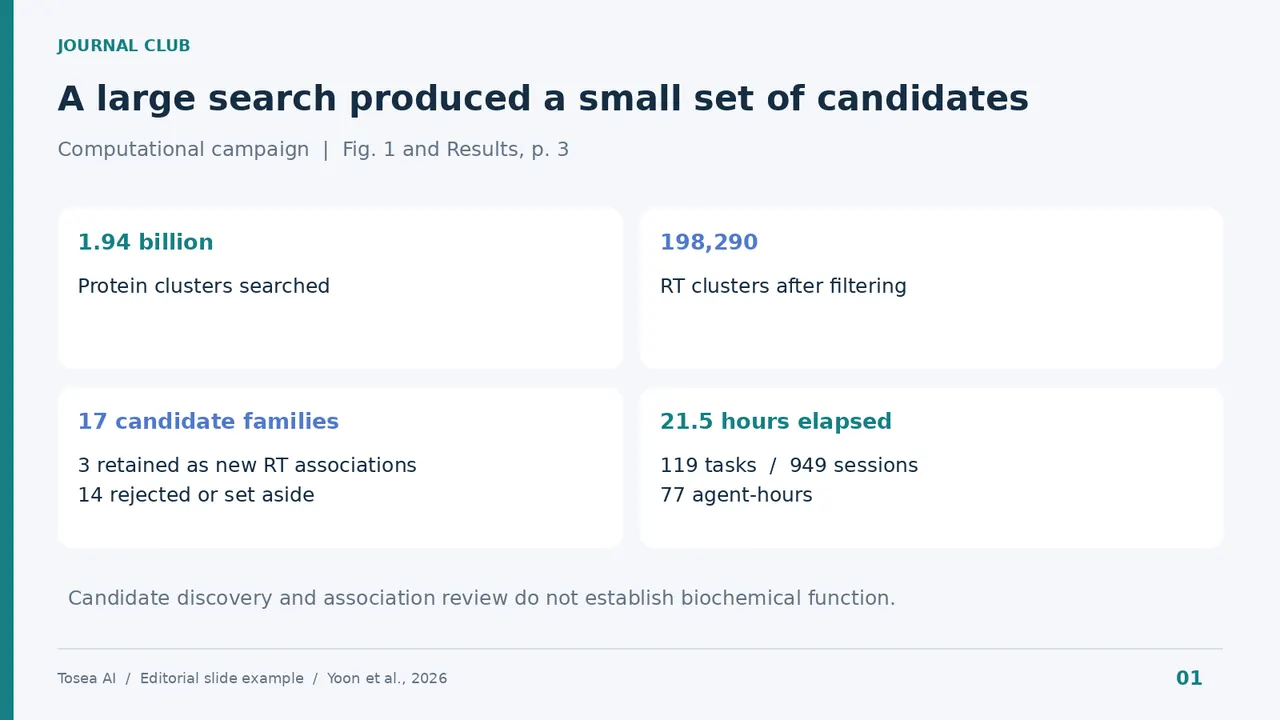
Using the uploaded Yoon et al. report, create a journal-club slide explaining the discovery campaign. Show 1.94 billion protein clusters searched, 198,290 RT clusters after filtering, 17 candidate partner families, and 3 retained new associations. Add 119 tasks, 949 sessions, 77 agent-hours, and 21.5 elapsed hours. Keep these units distinct. Cite Figure 1 and page 3. Explain the repeat-array observation without claiming biochemical validation.
Create an educational slide illustrating ART genomic architecture from the uploaded paper. Show an upstream non-coding repeat array, the reverse transcriptase gene, and a downstream partner gene. Distinguish repeats from spacers and label the schematic not to scale. Include 28 detectable arrays among 95 RT clusters, 3-21 repeat copies, and 120-220 nucleotide spacers. Cite Figure 2 and page 6. Do not depict DNA editing or confirmed molecular interactions.
Build a results slide from Figure 3 and the accompanying text. Highlight that SA1 array-derived RNAs account for up to 8% of phage RNAs at 15 minutes after infection. Separately summarize discrete short RNAs observed after expression of SA1 ART constructs in E. coli. Identify the experimental contexts and cite pages 6-8. State that RNA expression does not demonstrate RT activity or editing. Preserve original labels if using source panels.
Create an R&D review slide with three columns: observed, proposed, and unresolved. Place the distinct ART family, associated arrays, partner families, and RNA expression under observed. Place retron-like complexes, the predicted RT-partner interface, and multiple RNA templates or baits under proposed. Place RT activity, substrate identity, confirmed interaction, biological role, and editing utility under unresolved. Cite the Discussion on page 13. End with a research decision without asserting a working gene-editing platform.
Why these prompts work
Units stay separate
The journal club prompt lists protein clusters, tasks, sessions, agent-hours and elapsed hours, then says "Keep these units distinct." Search scale and compute effort never blur into one headline number.
Every number has a location
Each prompt names what to cite: Figure 1 and page 3, Figure 2 and page 6, pages 6-8, the Discussion on page 13. Anyone in the room can find the source while you talk.
Claims stop where evidence stops
The prompts rule out claiming biochemical validation, depicting DNA editing or treating RNA expression as proof of RT activity. That is the gap a journal club is supposed to probe.
Evidence is sorted by status
The R&D review prompt puts each finding under observed, proposed or unresolved and ends with a research decision, so the discussion closes on what to test next.
Adapt it to your own deck
Swap in your own paper
Attach your PDF and replace the example values with the ones your paper reports. Add: "Use only values printed in the attached paper and cite figure and page for each."
Build a full journal club talk
The four prompts make one slide each. To fill a longer slot, add: "Before these slides, add background and study design; after them, add a limitations slide and three discussion questions."
Match the audience
For undergraduates, ask for "a one-line definition under every technical label" on the teaching schematic. For an industry R&D review, lead with the evidence-status slide and drop the compute effort figures.
Journal club presentation FAQ
What is a journal club presentation?
A session where one member presents a published paper to colleagues, covering its question, methods and results, then leads a critical discussion of design, evidence and limitations. Journal clubs are common in graduate programs, research labs and clinical departments.
Do I need the same paper as the example?
No. The example slides use Yoon et al. (2026) on array-associated reverse transcriptases. Replace the figures, page numbers and values with your own paper's and keep the instructions about units, citations and evidence limits.
Can I use these prompts in ChatGPT, Claude or Gemini?
Yes. A chat assistant returns slide text and a layout description that you then build by hand. In Tosea you attach the paper PDF with the prompt and get slides you can edit and export to PowerPoint (.pptx).
How do I add critical appraisal to these slides?
These prompts focus on presenting the evidence accurately. For appraisal, add a slide covering design, bias, generalizability and reproducibility, and mark anything the paper does not report as "not reported" rather than guessing.
Figures on the example slides are illustrative.
Prefer not to write a prompt?
Upload the document. Tosea drafts the deck, you edit and export.
Start for free