


Parenting advantage prompt for PowerPoint
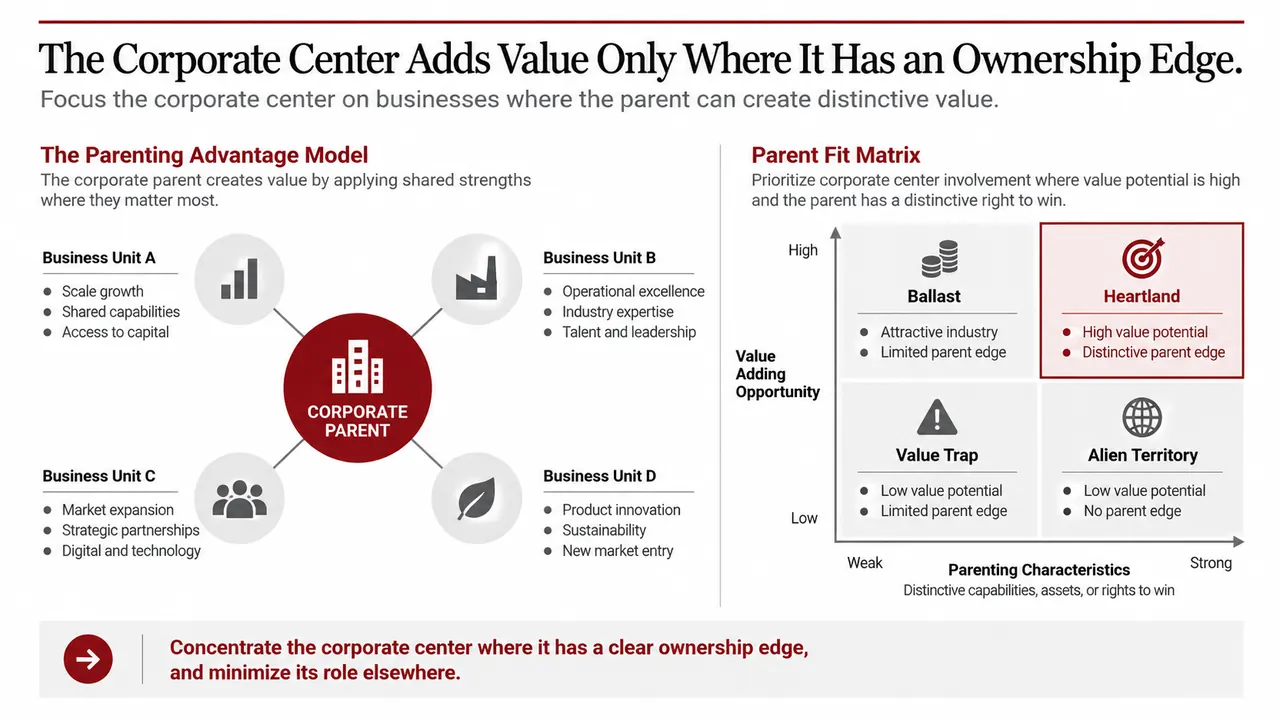
A PwC-style prompt for one corporate strategy slide on parenting advantage. It links the corporate parent to four business units, plots each on a parent-fit matrix with heartland, ballast, value trap and alien territory zones, and says where the center should intervene or step back.
Parenting advantage prompt
Fill in any highlighted fields, then copy or run it.
Build a 16:9 Parenting Advantage slide. Show the corporate parent connected to four business units and plot each unit on a parent-fit matrix. Label heartland, ballast, value trap, and alien territory. Recommend where the center should intervene, enable, monitor, or step back.
Why this prompt works
The center is the subject
Most portfolio slides judge the businesses. This one judges the parent: whether the corporate center adds value to each unit, which is the question parenting advantage asks.
Zones use standard names
Heartland, ballast, value trap and alien territory are named in the prompt, so the slide uses the vocabulary readers of the framework expect.
Four roles for the center
The prompt asks where the center should intervene, enable, monitor or step back. A fit assessment becomes an operating model choice.
Group and matrix on one page
A hub-and-spoke view of the parent and its units sits beside the matrix, so the audience sees the group structure and each unit's fit together.
Adapt it to your own deck
Define the axes before plotting
Tell the model what to score: "X axis: fit with each unit's critical success factors. Y axis: fit with each unit's parenting opportunities." This follows the original framework.
Use your real units
Replace the four generic units with your own and attach the segment report or group structure. Add "Base each placement on two cited facts."
Add the edge of heartland
The original matrix also has an edge-of-heartland zone for units that fit in some respects but not others. Ask for it if several units sit near a boundary.
Parenting advantage FAQ
What is parenting advantage?
A corporate strategy idea from Michael Goold, Andrew Campbell and Marcus Alexander of the Ashridge Strategic Management Centre. A parent company should own a business only if it adds more value to it than other owners could. Their parenting-fit matrix sorts units into heartland, edge of heartland, ballast, value trap and alien territory.
What do the zones mean?
Heartland units fit the parent's skills and offer chances to add value. Ballast units fit but offer little to add. Value traps look like chances to add value, but the parent does not understand what drives success there. Alien territory fits on neither count and is often a candidate for exit.
How does ChatGPT, Claude or Gemini compare with Tosea here?
Chat assistants return the fit assessment and center roles as text and an outline. Tosea turns the prompt plus an attached group report into an editable slide with the matrix drawn, ready to export to PowerPoint.
Is this an official PwC template?
No. Parenting advantage comes from Ashridge research, and "PwC-style" describes only the visual style. Tosea is not affiliated with PwC.
PwC-style describes a common consulting framework. Tosea is not affiliated with PwC. Figures on the example slides are illustrative.
Prefer not to write a prompt?
Upload the document. Tosea drafts the deck, you edit and export.
Start for free