How to Build an Investment Committee Memo Deck: Complete Guide (2026)
Complete 2026 guide to building an investment committee (IC) memo deck — structure, slide-by-slide content, how partners actually read it, common mistakes, and a Tosea workflow.
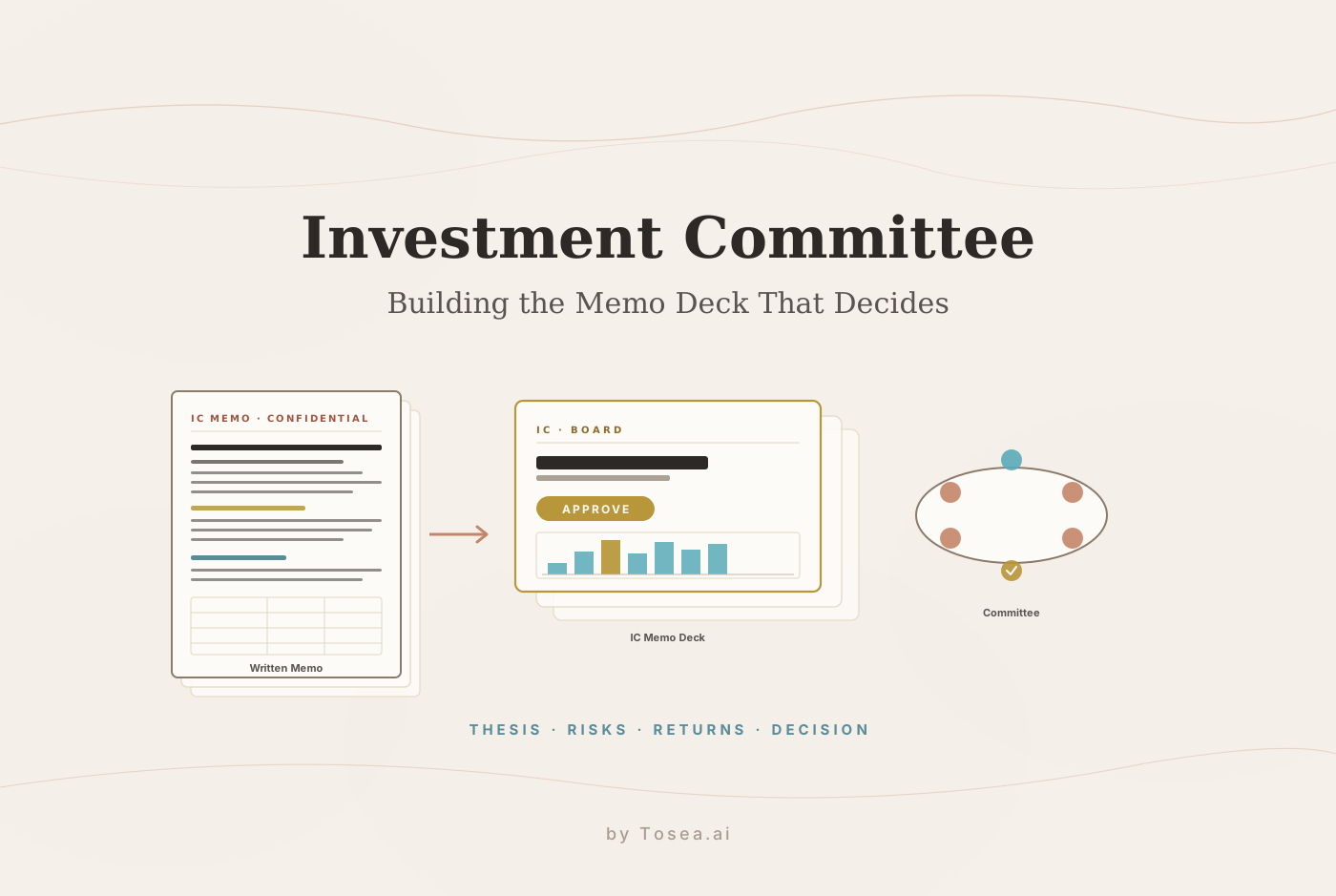
An investment committee (IC) memo deck is the document that decides whether a deal happens. The partners have read the data room. They have spent weeks on diligence. They will sit in a room — or on a Zoom — for 60 to 90 minutes and decide whether to commit your fund's capital. The deck is what they look at while they do it.
Get it right and the committee converges on the call. Get it wrong and even a strong opportunity gets stuck in conditional approvals, follow-up requests, and "let's revisit next quarter" — which is usually how good deals die. Most analysts and associates learn IC memo craft by being marked up in red by an MD; this guide tries to compress what that markup teaches you, with a slide-by-slide structure, the conventions across PE, VC, growth, and hedge funds, and a Tosea.ai workflow that takes the diligence memo you already wrote and renders the committee deck without rebuilding the financial model in PowerPoint by hand.
What an IC Memo Deck Actually Is (and Isn't)
An investment committee memo deck is the presentation version of the written investment memo. The full written memo can run 30–80 pages: thesis, market, business, management, financials, model, references, appendix. The deck condenses that into 15–25 slides plus an extensive appendix, structured for a live decision conversation rather than a solo read.
It is not a pitch deck. A pitch deck sells a company. An IC memo deck argues a position to colleagues who can challenge any assumption you make. The audience already trusts you; they are not deciding whether to be impressed. They are deciding whether to commit capital based on the work you did. The frame is "here is what I found, here is what I conclude, here is what could go wrong." It is closer to a McKinsey board recommendation than a Sequoia partner pitch.
The standard appears across asset classes with minor variations:
- Private equity (buyout) IC: thesis, deal economics, financial model, value-creation plan, risks, returns waterfall
- Venture capital IC: thesis, market, team, product, traction, terms, returns scenarios
- Growth equity IC: a hybrid — more traction data than VC, less LBO modeling than PE
- Hedge fund IC (single-name long/short): thesis, variant view, model, catalysts, risks, sizing
- Corporate strategy / M&A IC: thesis, strategic fit, synergies, integration, valuation, decision
The structure below works for all of them with light adaptation. We will flag where the asset class matters.
The Standard IC Memo Deck Structure
A 15–25 slide deck plus a 30–60 slide appendix. The body is what the room reads aloud; the appendix is what survives the questions.
| # | Slide | Purpose | Time |
|---|---|---|---|
| 1 | Cover | Deal name, sector, deal size, recommendation | 30s |
| 2 | Executive summary | Thesis in 3 bullets, ask, recommendation | 2 min |
| 3 | Transaction overview | Sources/uses, ownership, structure, key dates | 1 min |
| 4 | Investment thesis | The 3–5 reasons we should own this | 3 min |
| 5 | Market context | Size, growth, structural dynamics | 2 min |
| 6 | Business overview | What the company does, unit economics | 2 min |
| 7 | Management team | Backgrounds, references, alignment | 1 min |
| 8 | Competitive position | Moat, share, competitor map | 2 min |
| 9 | Historical financials | Revenue, margins, cash flow trends | 2 min |
| 10–12 | Operating model | Base / bull / bear projections, key drivers | 4 min |
| 13 | Value-creation plan | What changes under our ownership | 2 min |
| 14 | Returns | MOIC, IRR by scenario, sensitivity | 3 min |
| 15 | Key risks | 3–5 risks with mitigants, scored | 3 min |
| 16 | Diligence summary | What we did, what we found, gaps | 2 min |
| 17 | Recommendation & ask | Approval requested, conditions | 1 min |
| 18+ | Appendix | Full model, references, memos, KYC, legal | — |
Every slide should pass the "action title" test: the title should be a claim, not a category. Not "Market Overview" — "Market grows 14% CAGR through 2030; we underwrite to 11%." Not "Competitive Landscape" — "Three incumbents control 71% share; our target is the only digital-native player." This is the McKinsey convention, and IC memos that come out of the consulting feeder are noticeably easier for committees to read. Our McKinsey way to present research findings covers the underlying logic.
What Goes on the Thesis Slide
The thesis slide is the slide your IC chair will return to during the discussion. It should answer three questions in three bullets:
- Why now. What is the catalyst — a market unlock, a management change, a structural shift — that makes this deal time-sensitive?
- Why us. What is the specific edge we bring — sector relationship, operational playbook, prior investment, regulatory expertise?
- Why this price. What is the gap between the price we pay and the value we underwrite?
If a senior partner can read those three bullets and not immediately know whether to approve, the thesis is too soft and the slide needs to be rewritten. Specificity wins. "Strong management team" is not a thesis. "Founder-CEO ran the same playbook at Company X to a 4.3x outcome; we have personal references from his prior CFO and lead investor" is a thesis.
The Financial Model Slides
Three slides minimum: historical, projection, and sensitivity.
Historical (slide 9). Five years of revenue, gross margin, EBITDA margin, free cash flow. Annotate the inflection points (price increase in Y2, lost customer in Y3, channel expansion in Y4). Auditors' or quality-of-earnings adjustments below the line, in italics. Do not present a single year — committees discount single-year snapshots as cherry-picked.
Projection (slides 10–12). Three cases — base, bull, bear. The same KPI rows in each so the committee can compare. The assumptions row at the bottom: revenue growth, EBITDA margin, capex intensity, exit multiple. This is the single most contested set of slides; expect the committee to question every assumption. The right discipline is to anchor each assumption to a comparable transaction, a historical analog, or a specific operational lever — not to underwriting "best practice."
Sensitivity (slide 14). A 5×5 sensitivity table: x-axis exit multiple, y-axis EBITDA growth. Color-code IRR. The committee will look at the corners (worst-case bear, best-case bull) and the diagonals (where do the cases break even). Make sure the bear case still clears your fund's minimum IRR — if it doesn't, you have a structuring problem the deck has to acknowledge.
For a deeper dive on data presentation conventions that translate from sales review to IC, see our presenting sales data to executives framework — the title-as-claim and sensitivity-table conventions are shared territory.
Key Risks: The Slide Partners Actually Read First
Junior analysts often treat the risks slide as a compliance section. Senior partners read it first. The point is not to enumerate every conceivable risk; it is to demonstrate that you have thought about what could go wrong and that the deal still works.
Three to five risks. For each:
- Risk description — specific, not generic ("regulatory" is not a risk; "FDA Class II reclassification expected Q3 2027 could compress gross margin by ~600bps" is a risk)
- Probability — Low / Medium / High, with one-line basis
- Severity — quantified in IRR impact if possible
- Mitigant — what we have done or will do
- Trip wire — the leading indicator we will monitor
The mitigant column is where the IC chair looks. "Hedged via earnout" is good. "Will monitor" is not good — that is the absence of a mitigant.
How Partners Actually Read the Deck
The first 60 seconds matter disproportionately. Most committees follow a similar pattern:
- Cover slide — 5 seconds. Title, sector, size, recommendation.
- Executive summary — 30 seconds. Thesis bullets, ask, returns headline.
- Then they flip directly to: risks, financials, comp set. Almost always in that order. The thesis comes back later, in the discussion.
This means three slides do disproportionate work — executive summary, risks, returns. If those three are tight, the deck has done most of its job before the room actually walks through it.
A second pattern worth knowing: most senior partners read the appendix on their own, before the meeting, on the way in or the night before. The body deck has to be defensible on its own; the appendix is where the actual diligence sits. If a partner spots that the body contradicts the appendix, the deal is dead before the room opens.
Common Mistakes IC Memo Decks Make
A non-exhaustive list of the marks every senior partner has made in red on someone's draft:
- Burying the recommendation. The cover slide should state the recommendation. Not "for committee consideration" — "RECOMMEND: APPROVE $250M EQUITY CHECK at $1.4B EV." The room reads it in five seconds and the rest of the deck has to defend it.
- One-year financial snapshots. Always show trends. A single trailing-twelve-months figure looks engineered.
- Apples-to-oranges comps. If your comp set mixes growth-stage and mature businesses, label the multiples by stage and apply the discount. Do not present a 14x EV/EBITDA average without flagging the 28x growth outlier.
- A returns slide with one scenario. Base only is not enough. Bear-case IRR is what the room actually underwrites to.
- Risks without mitigants. Every risk on the page needs a corresponding action. "We will monitor" is not an action.
- Management slides without references. "Strong management team" is a thesis bullet, not management diligence. Names of references, who took the call, what they said — that goes in the appendix and gets cited on the slide.
- Hidden conflicts of interest. Existing portfolio overlap, banker relationships, prior employment. Disclose on the cover or right after the executive summary. Surfacing later destroys trust.
- Charts that do not match the model. This is a fatal mistake. Every number on every slide has to tie to a single audited file. If a partner spots a $50M difference between the chart and the cell on tab 4, the deal becomes about your competence, not the company.
How Tosea.ai Builds an IC Memo Deck from the Written Memo
In most firms, the bottleneck is not the analysis — it is the day or two an associate spends rebuilding the written memo in PowerPoint while the model is still being stress-tested. Slides go stale within hours of being made. By the time the IC reads them, half the numbers have moved.
Tosea.ai is built for exactly this handoff. Drop the written memo (Word, PDF, or markdown) plus the model export and the engine reads the logical structure — thesis sections, financial tables, references, citations — and renders a 15–25 slide IC deck that follows the structure above, with every claim traceable back to the paragraph or model cell it came from. We unpack the underlying source-first architecture in our zero-hallucination AI slides guide, and the document-to-deck pattern more broadly in hallucination-free document-to-PPT conversion.
The practical workflow:
- Upload the written memo and the model. Tosea reads both and builds an outline aligned to the IC structure (thesis → market → business → financials → risks → recommendation).
- Pick an IC-grade template. Templates such as
boardroom_amber,executive_platinum,strategy_navy, ortendercarry the restrained, decision-oriented aesthetic IC decks require. The choice between code-driven HTML slides and image-rendered slides is covered in our HTML vs image AI slide generation guide; for IC memos HTML mode is the right call because of citation discipline and last-minute number swaps. - Refine. Edit any slide, swap any chart, regenerate any section. Every number is linked back to the cell or paragraph that produced it — when the model updates Friday morning, you re-import and the deck regenerates instead of being rebuilt by hand.
- Export. Native
.pptxopens in PowerPoint or Google Slides, with text as text, charts as shapes, and citation footnotes preserved. - Print the appendix. IC chairs still print the appendix. Make sure the .pptx exports it.
For firms that ship dozens of IC decks a quarter, the same pattern scales to a massive slide deck workflow.
IC Variations by Asset Class
The base structure adapts. A few notes per asset class:
PE buyout IC. Add a sources-and-uses slide and a debt sizing slide between the transaction overview and the thesis. Add an LBO sensitivity slide alongside the returns slide (leverage as the y-axis). The diligence summary slide gets bigger — quality of earnings, commercial diligence, legal, environmental all need a line.
VC IC. Replace the financial model slides with a unit economics slide (CAC, LTV, payback, gross margin trajectory) and a traction slide (cohort retention, expansion). The returns slide is scenario-based with a power-law distribution implicit in the framing — bear case is loss, bull case is fund-returning. Address rounds and dilution explicitly on the deal structure slide.
Growth equity IC. A hybrid: rule-of-40 framing on the financials, ARR cohort retention on the traction slide, secondary versus primary on the deal structure slide. Returns slide uses MOIC, not IRR, as the primary metric — growth deals on average take longer than buyouts.
Hedge fund single-name long IC. Replace the operating model slides with a variant-view slide (what we believe versus what the market prices), a catalyst calendar (what unlocks the gap), and a sizing slide (position size relative to portfolio, liquidity, and conviction). The risk slide structures around drawdown rather than capital loss.
Corporate M&A IC. Add a strategic-fit slide and an integration risk slide. The synergies slide separates revenue synergies (which the committee will discount) from cost synergies (which the committee will believe). Include a do-nothing comparison — what happens to the business if we don't acquire.
Pre-IC Rehearsal Plan
Two weeks out, generate the deck draft and circulate to the deal team. One week out, schedule a pre-IC with the sponsor partner — that is where the killer questions surface for the first time. Most decks get rewritten between the pre-IC and the IC, especially on the risks and projection slides.
Three days out, schedule a "kill the deal" session with someone outside the deal team — another partner, a senior analyst from a different fund, a sector advisor. Their job is to spend 45 minutes trying to talk you out of the deal. Every objection they raise either gets addressed on a slide or goes into your Q&A prep.
Day before, stop editing. Read the deck through silently, page by page. Confirm every number ties to the model. Print the appendix. Sleep.
Morning of, calibrate against the committee mood. If the IC chair has had two contentious deals this week, lead even harder with the risks slide. If the committee just lost on a similar deal, do not bury the lesson — name it on slide 4 and explain why this one is different.
Final Checklist
Before you walk in:
- Cover slide states sector, deal size, and the explicit recommendation
- Executive summary fits on one page and answers thesis, ask, returns
- Every body-slide title is a claim, not a category
- Bear-case IRR clears the fund minimum or you explain why not
- Three to five risks, each with probability, severity, mitigant, trip wire
- Every chart number ties to the model file
- Conflicts of interest disclosed up front
- Appendix printed for the IC chair
- Pre-IC done; kill-the-deal session done; objections addressed
- You can defend any assumption on any slide without flipping to the model
If you can check all ten, you have done the work. The committee will see it.
Sources
- American Bar Association — investment committee governance — committee process conventions
- CFA Institute — investment policy and decision frameworks — analytical conventions referenced in this guide
- Bain Global Private Equity Report — industry conventions for buyout IC structure
- Sequoia Capital Writing a Business Plan — adjacent reference on pitch-vs-IC document structure