Microsoft VibeVoice: Complete Guide to the Open-Source Voice AI for Professionals
A complete guide to Microsoft VibeVoice, the open-source voice AI family covering ASR for 60-minute meetings, multi-speaker TTS, 300ms streaming, and meeting-to-presentation workflows.
You record a two-hour product review meeting. The discussion is dense with decisions, action items, and technical specifications. Afterward, you spend three hours manually listening back, pausing, rewinding, and typing notes — and you still miss things. By the time the summary reaches the team, half the context has evaporated.
This is the audio gap in professional workflows. Voice is the most natural medium for complex human communication, and it has historically been the hardest to work with at scale.
Microsoft VibeVoice is a notable open-source release in voice AI in 2026. With 33,500 GitHub stars and a family of three models covering speech recognition, speech synthesis, and real-time streaming TTS, it represents a genuine leap forward in what open-source audio AI can do.
Before we get into the technical details: once VibeVoice converts your meeting or lecture audio into a structured transcript, the next challenge is turning that transcript into something you can actually present — a slide deck, a briefing document, an executive summary. That final step is where Tosea.ai fits into the picture. By the end of this guide, you will see how the two tools complement each other in a practical workflow.
What Is VibeVoice?
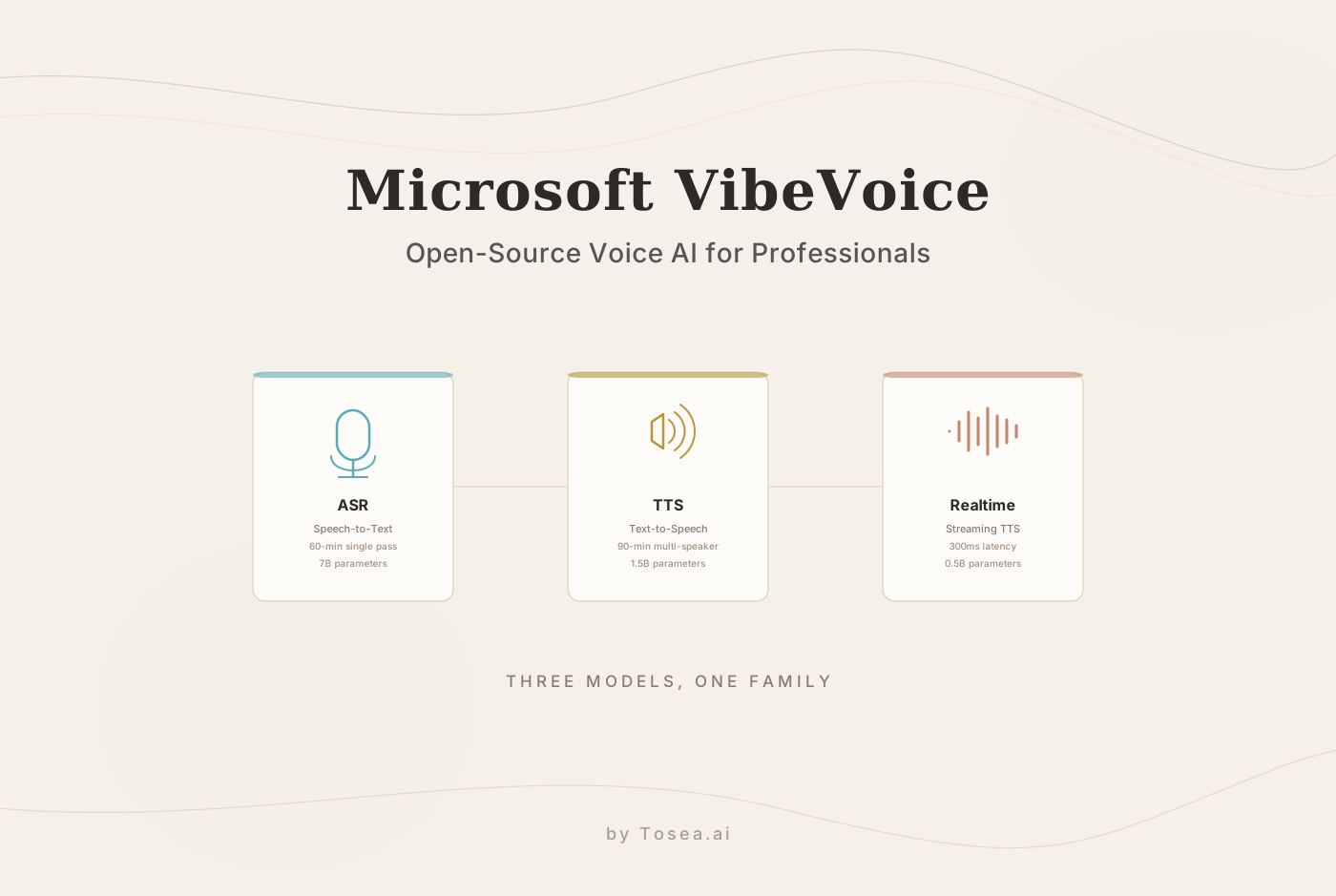
VibeVoice is a family of open-source frontier voice AI models developed by Microsoft Research. The repository covers both directions of audio intelligence: converting speech to text and converting text to speech. It contains three distinct models, each optimized for a different use case.
The core technical innovation behind all three is a pair of continuous speech tokenizers — one acoustic and one semantic — that operate at an ultra-low frame rate of 7.5 Hz. This low frame rate is not a compromise. It allows the models to efficiently represent long audio sequences within manageable token budgets, enabling processing lengths that would be computationally prohibitive with conventional approaches. On top of these tokenizers, VibeVoice uses a next-token diffusion framework: a large language model handles the textual context and dialogue flow, while a diffusion head generates high-fidelity acoustic output.
The result is a family of models that handles the two problems that have historically made voice AI impractical for real professional work — length and speaker complexity.
VibeVoice-ASR: Transcribing 60 Minutes of Audio in a Single Pass

The first and most widely adopted model is VibeVoice-ASR-7B, which became available on Hugging Face in January 2026 and was integrated into the Hugging Face Transformers library in March 2026.
The Problem With Conventional ASR
Traditional automatic speech recognition systems process audio by cutting it into short segments — typically 30 seconds or less — running recognition on each chunk independently, and then stitching the results together. This architecture creates several compounding problems for long-form audio.
Speaker tracking breaks at segment boundaries. A speaker identified as Person A in minute 12 may be re-identified as Person B in minute 13 after a chunk boundary. Global context is lost — the model does not know what was said ten minutes ago when processing the current segment. And multi-step pipelines create fragility: a separate diarization step, a separate timestamping step, and a separate transcription step each introduce their own error rates that multiply across the full pipeline.
As MarkTechPost's analysis of the release notes, VibeVoice-ASR solves these problems through a unified end-to-end architecture that eliminates the need for post-processing steps entirely.
What VibeVoice-ASR Does Differently
VibeVoice-ASR accepts up to 60 minutes of continuous audio within a 64K token context window. It does not chunk. It processes the entire recording in a single inference pass, maintaining consistent speaker tracking and semantic coherence from the first word to the last.
The output is structured around three dimensions that answer the questions any professional needs answered when reviewing a long recording:
Who — speaker identification and diarization, assigning each segment of speech to a distinct speaker identity tracked consistently throughout the recording.
When — precise timestamps for every utterance, enabling navigation to specific moments in the source audio.
What — the transcribed content of each utterance.
These three outputs are generated jointly in a single inference step, which means the model's understanding of who is speaking at any moment is informed by the same context that shapes what it hears — rather than being applied as a blind post-processing step over an already-completed transcript.
Customized Hotwords
One feature that makes VibeVoice-ASR genuinely useful in professional settings is Customized Hotwords. Users can provide lists of domain-specific terms — product names, technical jargon, people's names, organizational acronyms — that the model will use to guide its recognition process.
For a legal firm, this means the model can correctly recognize opposing counsel names, case citations, and procedural terminology without retraining. For a medical practice, clinical terms and drug names can be injected at inference time. For a technology team, internal project codenames and technical specifications stay intact in the transcript.
This capability matters because the failure mode of generic ASR in professional settings is not random garbling — it is systematic substitution of domain-specific terms with phonetically similar common words. Customized hotwords address that failure mode directly.
Multilingual Support and Hugging Face Integration
VibeVoice-ASR natively supports over 50 languages without requiring explicit language specification. The model detects the language of the audio and handles code-switching — utterances that mix languages — within and across segments.
As of March 2026, VibeVoice-ASR is available directly through the Hugging Face Transformers library. Installation and basic usage looks like this:
pip install transformers torch soundfile
from transformers import AutoProcessor, AutoModelForSpeechSeq2Seq
import torch

processor = AutoProcessor.from_pretrained("microsoft/VibeVoice-ASR")
model = AutoModelForSpeechSeq2Seq.from_pretrained(
    "microsoft/VibeVoice-ASR",
    torch_dtype=torch.float16
).to("cuda")

# Pass your audio file path
inputs = processor(audio_array, sampling_rate=16000, return_tensors="pt")
with torch.no_grad():
    outputs = model.generate(**inputs)
transcript = processor.batch_decode(outputs, skip_special_tokens=True)
For faster inference in production environments, VibeVoice-ASR also supports vLLM inference. Finetuning is supported through LoRA (Low-Rank Adaptation), allowing teams to adapt the model to highly specialized domains without full retraining.
The model is available as a Gradio demo for experimentation:
python demo/vibevoice_asr_gradio_demo.py --model_path microsoft/VibeVoice-ASR --share
VibeVoice-TTS: 90-Minute Multi-Speaker Speech Synthesis
The second model in the VibeVoice family, VibeVoice-TTS-1.5B, addresses the generation side of voice AI. It can synthesize conversational speech up to 90 minutes long in a single pass, supporting up to four distinct speakers with natural turn-taking and consistent speaker identity across the full duration.
This was accepted as an Oral presentation at ICLR 2026 — one of the most competitive acceptance categories in machine learning research — reflecting its technical significance.
What Makes Long-Form Multi-Speaker TTS Hard
Maintaining speaker consistency over long durations is technically challenging because the model must track the acoustic characteristics of each speaker — their voice quality, speaking pace, emotional register — while simultaneously managing the flow of a multi-party conversation. Conventional TTS systems degrade in speaker consistency and naturalness over long sequences because they were designed for short utterances.
VibeVoice-TTS maintains coherence across 90-minute sessions by working in the token space rather than directly in the audio waveform, using the LLM backbone to preserve dialogue context and speaker state across the full generation window.
Practical Applications
The most immediate professional applications are in content production. Audiobook narration with multiple character voices, podcast production where interview content needs to be synthesized or voice-cloned for editing flexibility, corporate training material that requires consistent multi-speaker audio at scale, and localization workflows where speech needs to be generated in multiple languages with consistent speaker mapping.
Note that the TTS model code was removed from the public repository in September 2025 following misuse concerns around deepfakes and unauthorized voice synthesis. The research weights are available through Hugging Face, but responsible use of voice synthesis technology is non-negotiable — particularly given the risk of impersonation and disinformation that high-quality synthetic speech enables.
VibeVoice-Realtime: Streaming TTS at 300ms Latency
The third model, VibeVoice-Realtime-0.5B, targets the real-time edge of the deployment spectrum. At 0.5 billion parameters, it is designed to be deployment-friendly on consumer hardware while delivering the first audible audio output within approximately 300 milliseconds of receiving text input.
It supports streaming text input — meaning it can begin generating speech before the full input text is known — which is essential for integration with conversational AI systems where the language model is generating text in real time.
The experimental voice library includes multilingual voices in nine languages (German, French, Italian, Japanese, Korean, Dutch, Polish, Portuguese, and Spanish) and 11 distinct English style voices. It handles long-form generation up to approximately 10 minutes, making it suitable for voice assistant responses, customer service interactions, and live narration scenarios.
For developers building real-time voice applications, the Hugging Face model page and the associated Colab notebook provide working inference examples to get started immediately.
Real-World Use Cases for VibeVoice
Enterprise Meeting Intelligence
The combination of 60-minute single-pass processing, speaker diarization, and structured output makes VibeVoice-ASR directly applicable to enterprise meeting transcription. The output — structured by speaker, timestamped, and enriched with domain-specific terminology through hotwords — is the kind of clean, navigable record that previously required dedicated transcription services or significant manual effort.
For teams that run frequent client calls, board meetings, design reviews, or cross-functional planning sessions, VibeVoice-ASR can generate meeting records that are immediately useful rather than requiring extensive post-processing.
Academic and Research Applications
Lectures, conference talks, panel discussions, and interview-based research all benefit from VibeVoice-ASR's long-form handling. A 90-minute seminar produces a structured, speaker-attributed transcript that is searchable and referenceable without any intermediate processing steps. Researchers who regularly turn papers and notes into slide presentations will find that structured transcripts make a natural starting point for that workflow.
Researchers using VibeVoice-ASR for qualitative data analysis — interviews, focus groups, oral histories — gain structured data that can be analyzed directly rather than requiring manual transcription as a prerequisite. Many academic researchers are already cutting their presentation prep time dramatically with AI tools, and VibeVoice adds the audio-to-text layer that feeds those downstream workflows.
Legal and Medical Transcription
The Customized Hotwords feature is particularly significant in regulated industries where precise terminology is non-negotiable. Legal depositions, medical dictation, and clinical trial recordings all contain domain-specific vocabularies that generic models handle poorly. VibeVoice-ASR's ability to inject hotwords at inference time, without retraining, makes it adaptable to specialized professional contexts at significantly lower cost than custom model development.
Content Production Pipelines
For content teams producing podcast, video narration, or training material, VibeVoice-TTS enables multi-speaker audio generation that was previously achievable only through dedicated voice actors or expensive synthetic voice platforms.
Responsible Use and Limitations
Microsoft's documentation is explicit about the risks associated with high-quality voice AI. Synthetic speech can be misused to create convincing audio impersonations, to spread disinformation, or to commit fraud. Microsoft recommends disclosing AI generation when sharing synthesized content and using the models only in contexts consistent with applicable law.
The TTS model is currently marked as for research and development purposes, not for commercial deployment without additional testing and safety work. The ASR model inherits potential biases from its base model architecture (Qwen2.5).
VibeVoice-ASR finetuning is supported for teams that need to adapt the model to specific domains or languages beyond the out-of-the-box capabilities. The finetuning code and a detailed guide are available in the repository.
From Audio to Actionable Output: Completing the Workflow With Tosea.ai
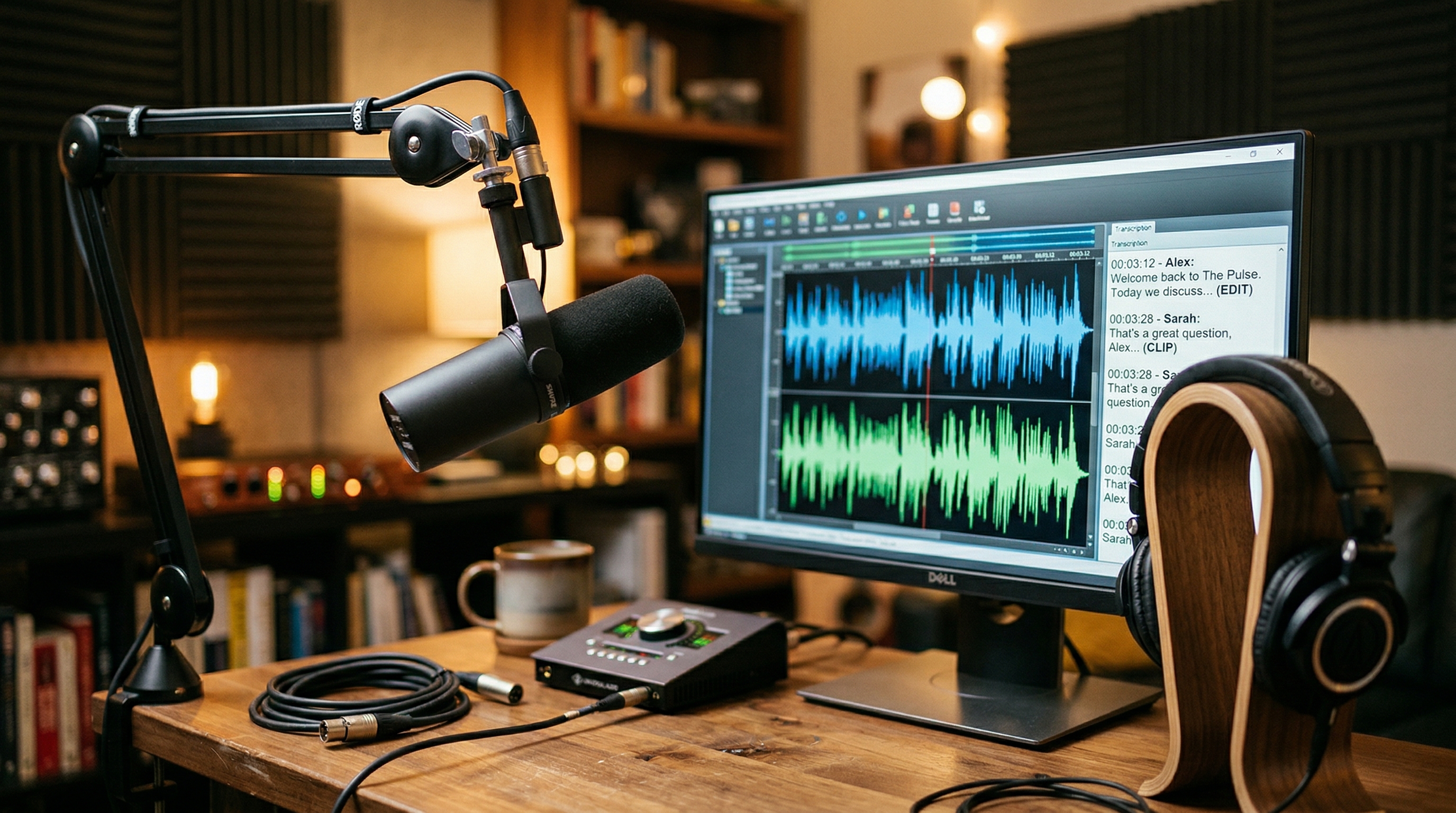
VibeVoice transforms the hardest part of working with professional audio — the transcription and structuring step — into an automated, reliable output. A 60-minute client discovery call becomes a speaker-attributed, timestamped, searchable record.
But a transcript is not a deliverable. When the output of that meeting needs to become a client-facing summary, a board briefing, or a project status presentation, the next step is turning structured text into a professional slide deck. The challenge of converting documents into faithful PowerPoint slides is well-documented, and it applies equally to transcripts.
This is where Tosea.ai closes the loop. Upload the VibeVoice transcript — or any document derived from it — and Tosea.ai's Spatial Semantic Perception engine analyzes the content's logical structure, identifies the key decisions and action items, and generates a consulting-grade presentation. Every claim in the output links back to the source document through Absolute Traceability, delivering the kind of hallucination-free document-to-PPT conversion that professional settings demand. If you are evaluating where Tosea.ai fits among the best AI presentation makers in 2026, the transcript-to-slides pipeline is a strong differentiator.
The complete professional workflow looks like this: VibeVoice-ASR transcribes and structures the audio. You review and refine the structured output. Tosea.ai transforms that output into a boardroom-ready presentation in under a minute. Under the hood, Tosea.ai uses a multi-agent architecture for slide generation that preserves the logical structure of your source material through each step.
Audio intelligence handles the capture. Tosea.ai handles the delivery.
Get Started With VibeVoice Today
The full VibeVoice repository is available at github.com/microsoft/VibeVoice under the MIT License. Model weights for VibeVoice-ASR are available directly on Hugging Face. The online playground allows you to test ASR capabilities without any local setup.
When your transcripts are ready to become PowerPoint or Google Slides presentations, Tosea.ai handles that step — from structured transcript to finished deck, with every claim traceable back to what was actually said.