How to Build a Fundable Startup Pitch Deck: 3 Principles Every Founder Needs
A practical guide to building investor-ready pitch decks. Learn the 3 core principles — clarity, credibility, and memorability — that separate fundable decks from forgettable ones.
Raising money from investors feels a lot like going on a first date where the other person has already looked you up online, reviewed your last three relationships, and formed a preliminary opinion before you even sit down. Most investment decisions about whether to continue the conversation happen within the first few minutes of reviewing a pitch deck. Not during the meeting. Before it.
If your deck does not pass that initial screen, there is no meeting. There is no conversation. There is no term sheet.
If you already have a business plan, a market research document, or a financial model but not a professional deck to match, Tosea.ai can transform those documents into investor-ready presentations in under a minute. Register now — by the end of this guide you will understand exactly what your deck needs to accomplish and how to build it. For more on how AI is reshaping startup presentations specifically, see our deep dive on AI presentations for startups and pitch decks.
Why Your Pitch Deck Is the Most Important Document You Will Write
A pitch deck is not a condensed version of your business plan. That is the most common and most costly misunderstanding founders carry into fundraising.
A pitch deck is a filter-passing device. Its job is not to tell your complete story. Its job is to give a time-pressed investor sufficient signal to conclude that your opportunity is worth a real conversation.
The data on investor behavior makes this clear. According to Storydoc's analysis of 1.3 million investor reading sessions, 82% of investors who reach slide four finish the entire presentation. The battle is not in the back half of your deck — it is in the first three slides. If you lose the reader before slide four, the quality of your financial model and the depth of your competitive analysis are irrelevant.
DocSend's research, cited across multiple fundraising studies, found that investors spend an average of three minutes and 44 seconds reviewing a pitch deck before deciding whether to take the conversation further. The average VC analyst reviews approximately 3,000 decks annually and invests in roughly nine of them — a 0.3% selection rate. Every slide in your deck is competing against that reality.
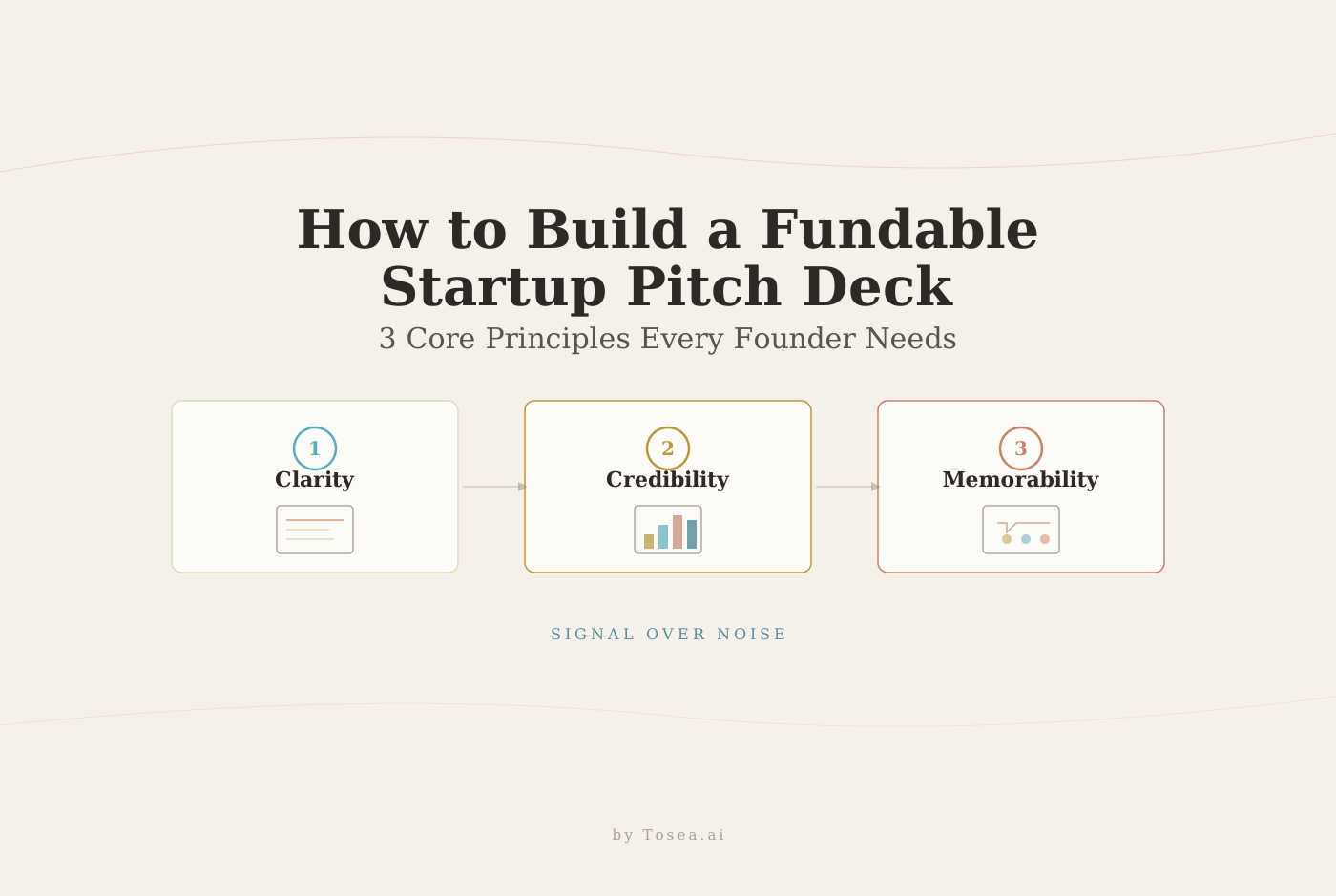
The three principles below are what separate decks that advance the conversation from decks that end it.
Principle One: Clarity

The single most important discipline in pitch deck construction is ruthless subtraction. Not addition.
A deck should not exceed 15 slides. Every slide that does not advance your core argument is a slide that dilutes investor attention and signals that you have not done the hard editorial work of deciding what actually matters. Dense bullet points, walls of text, and crowded diagrams all communicate the same thing to an experienced investor: this founder has not made decisions yet.
Funding Blueprint's analysis of how VCs actually consume pitch decks is direct on this point: investors are not reading — they are pattern matching. When fatigue is high, they rely heavily on scanning. Your deck must be optimized for five-second slide comprehension. If the central message of any individual slide cannot be absorbed in that window, the slide is not ready.
The practical test for clarity is simple. Point to any slide in your deck and ask: what is the single thing I want an investor to understand or feel after looking at this for five seconds? If you cannot answer that question immediately, the slide needs to be redesigned. If the answer requires two sentences, you have two slides. For more practical slide design tactics, our top 10 business presentation tips for 2026 covers the visual side in detail.
The corollary to slide count is word count. Clarity in pitch decks is not about having fewer ideas — it is about having fewer words per idea. Every line of text that an investor has to read is cognitive work you are asking them to perform. The best decks minimize that work while maximizing the signal delivered.
Principle Two: Credibility
Investors are not evaluating your deck in isolation. They are evaluating it with pattern-recognition trained on hundreds of previous decks, many of which contained exactly the kind of unsupported claims, inflated market sizes, and generic industry statistics that professional due diligence dismantles in minutes.
Credibility in a pitch deck is earned through three specific practices.
The first is source attribution. Every data point, market size figure, and industry statistic should have a clearly labeled source. Not a footnote that nobody will read — a visible attribution on the slide itself. This does the opposite of what most founders fear: it does not make the deck look academic or over-qualified. It signals that you did real research and that you are confident your numbers will survive scrutiny. This principle of traceability is something we take seriously in our own product — see how Tosea.ai ensures reliable document-to-PPT conversion without hallucinating data.
The second is specificity. As laventino.com's analysis of $10M pitch decks describes, investors in 2026 are operating in a data-driven, risk-conscious environment shaped by tighter capital cycles. Vague financial projections do not signal ambition — they signal inexperience. Present your own data wherever possible. Your actual customer acquisition cost. Your real retention metrics. Your specific pipeline numbers. A precise figure from your own business carries more weight than a large number from an industry report, because it is yours and it is verifiable.
The third is professional vocabulary. Financial terminology exists for a reason: it is the shared language of the investment community, and using it correctly signals that you understand the commercial context of what you are building. Gross margin, ARR, LTV/CAC ratio, runway, burn rate — these terms should appear naturally and correctly throughout your deck, not because they make you sound sophisticated, but because they communicate precise information efficiently.
One practical note on data: do not use broad industry statistics as a substitute for your own traction data. A market size figure sourced from a three-year-old report with unclear methodology is not evidence of your company's potential. It is noise. Experienced investors recognize it immediately, and it erodes confidence in everything else you present.
Principle Three: Memorability
Investors review enough pitch decks that most of them blur together within days of being seen. The decks that advance to follow-up meetings are the ones that left a specific, retrievable memory — a striking insight, a number that reframed the opportunity, a story that made the problem viscerally real.
Memorability in a pitch deck comes from three sources: story, data, and design. The best decks deploy all three. If you can only master one, master story.
Story: The Problem-to-You Arc
The narrative logic that works reliably in pitch decks follows a four-stage structure: Problem, Solution, Why Now, Why You.
The problem stage should make the pain specific and urgent. Behavioral science research suggests that investors form anchoring impressions within the first three to four slides. The problem slide is where that anchor is set. A real-world story, a startling specific metric, or a scenario that makes the problem impossible to ignore — these create the emotional and intellectual frame through which investors evaluate everything that follows.
The Why Now question is where many decks fail silently. Market opportunity exists in many directions at any given time. Investors want to understand why this particular opportunity is more available, more urgent, or more achievable right now than it was three years ago. Regulatory changes, infrastructure shifts, new enabling technologies, demonstrated consumer behavior shifts — these are the factors that make a market window specific rather than generic.
Why You is the most important answer in your deck and often the least developed. The investors are not just evaluating the idea — they are evaluating whether this specific team is the most likely group of people to capture this specific opportunity. Domain expertise, network access, technical capability, prior execution evidence — this is what Why You means.
Data: Your Numbers, Not the Internet's
Use fewer data points than you think you need. Each one should be specific, verifiable, and yours wherever possible.
The most common data mistake in pitch decks is using large, round numbers from generic industry reports: a $500 billion total addressable market from a consulting firm's overview, a growth rate figure that appears in every competitor deck in the category. These numbers are not compelling to investors — they are immediately recognizable as filler. They also invite due diligence scrutiny that rarely benefits the founder.
Your own data — even if it is modest — is more persuasive than borrowed scale. Fifty paying customers with 90% retention and a 3x year-over-year growth trajectory tells a more compelling story than a market size figure that cannot be directly connected to your business's path to capturing it.
Design: Diagrams Over Words
Visual hierarchy is not decoration. It is communication architecture. Relationships between components, competitive positioning, business model flows, product architecture — these are concepts that diagrams communicate in seconds and that prose requires paragraphs to approximate. The McKinsey approach to deck logic is a masterclass in this principle — every visual element earns its place.
The principle is: if a logical relationship or business structure can be shown visually, it should be shown visually. Text descriptions of how your platform connects suppliers to buyers are harder to process and harder to remember than a diagram that shows the same thing. This is not about aesthetics — it is about cognitive efficiency.
Design consistency — unified fonts, a coherent color system, consistent use of white space — signals organizational maturity. As Storydoc's data shows, 31% of investors bounce from a pitch deck within the first ten seconds, making your opening slide the most critical design decision in the entire document. That figure is entirely about first impression.
The Standard Structure: 11 Slides That Cover Everything

The industry-standard pitch deck structure exists because it mirrors the sequence of questions that investors work through as they evaluate an opportunity. Deviating from it without good reason creates unnecessary friction.
| Slide | Purpose | Key Principle |
|---|---|---|
| Cover | Company name, one-line description, contact info | Clarity — immediate understanding |
| Market Problem | The specific, urgent, financially significant problem | Memorability — anchor the narrative |
| Your Solution | What you have built and how it addresses the problem | Clarity — show, don't tell |
| Current Traction | Revenue, growth rate, retention, customer count | Credibility — your numbers |
| Competitors | Landscape awareness and your differentiation | Credibility — never claim no competitors |
| Business Model | How you make money, unit economics, margin trajectory | Credibility — financial literacy |
| Financial Forecast | 3-5 year model with clear assumptions | Credibility — realistic over aggressive |
| Valuation & Ask | What you are raising, at what terms | Clarity — be direct |
| Use of Funds | Specific allocation tied to milestones | Credibility — capital converts to progress |
| Exit Opportunities | Credible paths to liquidity | Credibility — alignment with fund goals |
| Team | Relevant experience, complementary skills, execution evidence | Memorability — bet on the people |
For founders who already have their content in documents but need the visual structure to match, the executive summary master slide guide covers how to distill complex information into a single authoritative slide.
The Three Mistakes That Kill Otherwise Good Decks
Every practitioner who has reviewed hundreds of pitch decks has seen the same patterns of failure. Three deserve specific attention.
Building a business plan instead of a pitch deck is the most common. A pitch deck is a selection device. It should leave the investor wanting more, not feeling they have seen everything.
Substituting industry statistics for company traction is the most damaging to credibility. Your numbers are what an investor will verify in due diligence. Generic market figures cannot be verified — they can only be questioned.
Treating the team slide as an afterthought is the most strategically costly. Investors know that markets shift, products pivot, and financial models change. They are betting on the team's capacity to navigate that uncertainty. A cursory team slide signals that the founder does not understand what investors are actually evaluating. For founders struggling with this specific problem, our piece on escaping the founder trap through systems thinking addresses how to present yourself as a scalable operator, not just a domain expert.
From Business Plan to Pitch Deck With Tosea.ai
You have the business — the research, the financial model, the market analysis, the competitive landscape. Translating that into a pitch deck that is clean, professional, and visually compelling is where most founders lose weeks of time and considerable money.
Tosea.ai was built to close exactly that gap. Upload your business plan, your financial summary, or your market research, and the platform's Spatial Semantic Perception engine analyzes the logical structure of your documents — identifying the strategic pillars, the supporting evidence, and the narrative arc — then generates a consulting-grade presentation that follows the structure investors expect.
Every claim in the output links back to your source documents through Absolute Traceability. When an investor asks in due diligence where a specific figure came from, you can point directly to the original document. The output is a native .pptx file, editable in PowerPoint or Google Slides, ready to present or share before your next investor meeting.
If your research deserves to be seen, it deserves a deck that does it justice.