AI Product Management in 2026: A Complete Guide to the New Playbook
AI product management in 2026 is shifting from PRDs to product judgment. Lessons from Cat Wu (Head of Product, Claude Code at Anthropic) plus a 7-step framework for building AI products users trust.
AI product management in 2026 is no longer mainly about writing PRDs, aligning stakeholders, and waiting for engineering teams to execute. AI has made code cheaper to write, prototypes faster to build, and documents easier to generate. That does not mean product managers disappear. It means the valuable part of product work moves upstream: deciding what is worth building, what should be shipped first, what should be ignored, and how quickly real users can test it.
This shift became clearer after Cat Wu, Head of Product for Claude Code and Cowork at Anthropic, discussed how AI-native product teams work in the Lenny's Podcast episode "How Anthropic's product team moves faster than anyone else" (also summarized by Agent Skills Dev). Her point is simple but uncomfortable: when engineering speed increases dramatically, the bottleneck is no longer writing code. The bottleneck is product judgment.
That has consequences for every AI product team, including teams building presentation AI, AI slide generators, AI PPT tools, and document-to-presentation workflows like Tosea AI.
Quick Overview
AI will not remove product managers. It will remove the version of the PM role that only passes information between teams.
The AI-era PM needs to become a product builder. That means:
- Understanding what models can and cannot do
- Knowing where users are actually stuck
- Defining a narrow first use case
- Shipping faster than a traditional roadmap would allow
- Watching failure modes closely
- Cutting product complexity when the model improves
- Turning insight into working product, not just documentation
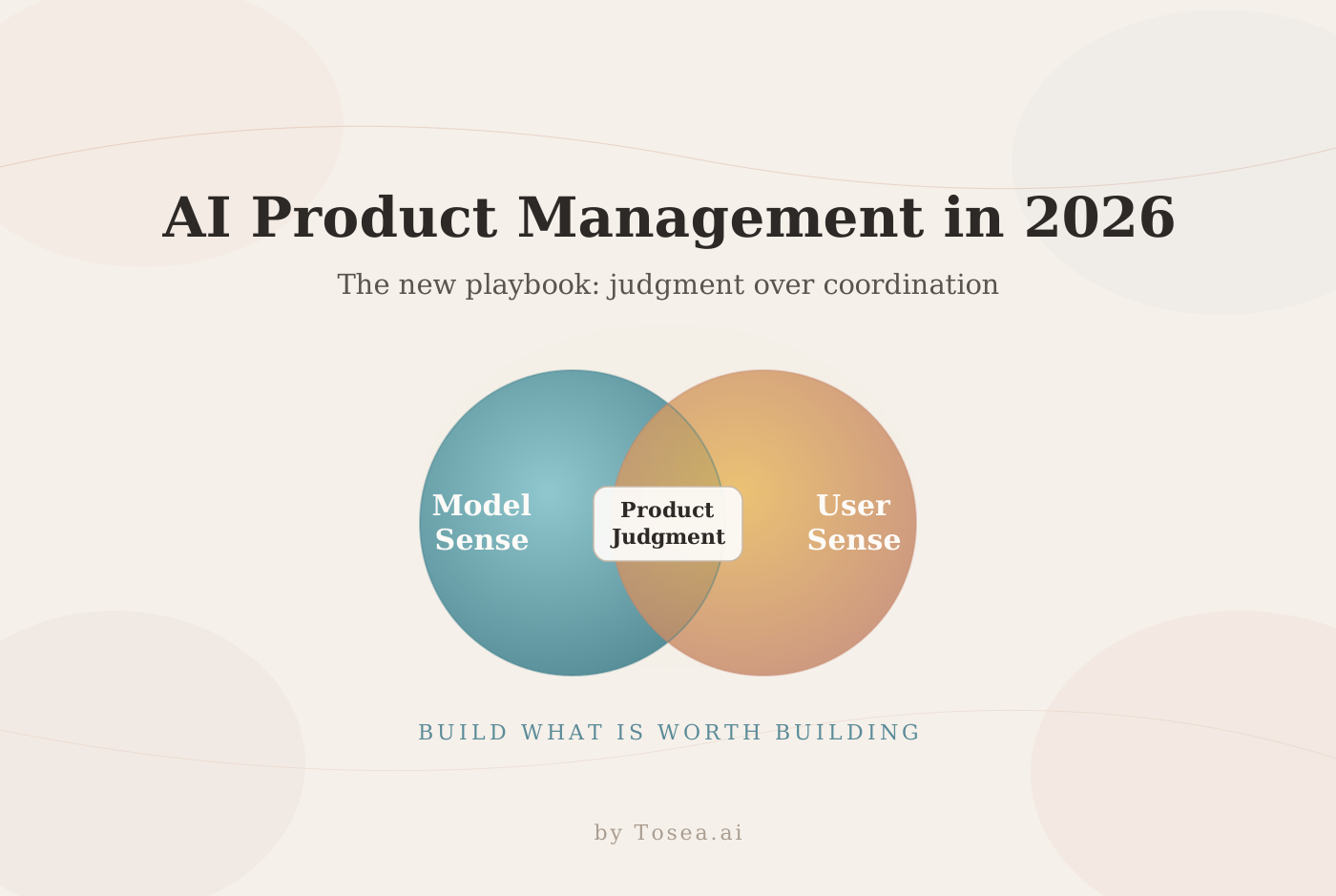
In AI product management, two skills matter more than ever:
- Model sense: understanding model capability, limitations, costs, latency, failure modes, and reliability
- User sense: understanding the user's real workflow, urgency, trust threshold, and decision context
When these two senses come together, PMs stop asking whether the product should include AI. They ask where AI removes friction from a real workflow.
What Cat Wu's Interview Reveals About AI Product Teams
Wu's interview is useful because Anthropic is not discussing AI as an abstract trend. The team is building products that are changing how people build products.
Claude Code is described by Anthropic as an agent that can read codebases, edit files, and run commands across terminal, IDE, desktop app, and browser. That means engineers can move from idea to implementation much faster than before.
In the conversation, Wu explains that product cycles inside AI teams have compressed sharply. Features that used to take months can now move in weeks or days. She also describes a broader role shift: PMs do some engineering, engineers do product work, and designers may also write code.
The important lesson is not that every PM must become a full-time engineer. The lesson is that product boundaries are getting blurry. The people who create the most value are the ones who can see a gap, choose the right tool, and push the work forward without waiting for a perfect process.
Why the Old PM Playbook Is Breaking
The old PM workflow looked something like this: collect requirements, write a PRD, align with stakeholders, run planning meetings, wait for engineering capacity, review design, track implementation, and launch after several cycles.
That process made sense when writing software was expensive and slow. If engineering time was the scarcest resource, then planning had to be careful and heavy.
AI changes the cost structure. Now an engineer can use Claude Code, Cursor, Codex, or other AI coding tools to build a working prototype quickly. A designer can generate interface options faster. A PM can draft documents, analyze feedback, and create launch materials with AI. Many tasks that once justified long coordination cycles are now much cheaper.
So the PM who only coordinates becomes less central. The PM who can judge becomes more central. The question is no longer whether someone can produce a document. The question is whether the document points toward the right product.
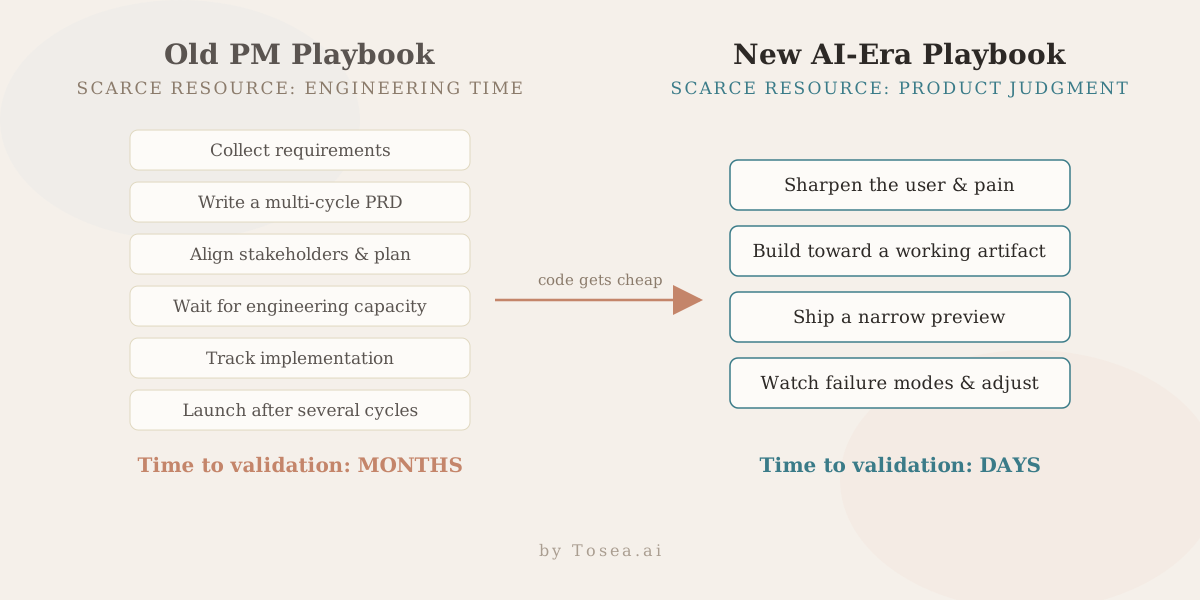
The shift is not subtle. When the scarce resource changes from engineering hours to product judgment, almost every default in the old playbook flips:
| Dimension | Old PM playbook | New AI-era PM playbook |
|---|---|---|
| Scarcest resource | Engineering time | Product judgment |
| Core activity | Coordinating handoffs | Building toward a working artifact |
| Primary artifact | Multi-cycle PRD | One-page decision memo (when that is enough) |
| Time to validation | Months | Days to weeks |
| Success signal | Spec shipped on plan | Real users testing the core workflow |
| Biggest risk | Wrong feature shipped slowly | Wrong feature shipped fast |
The right column is harder, not easier. Speed removes the excuse of a long process, so judgment has nowhere to hide.
The New PM Role: Product Builder
A product builder does not wait for every requirement to be complete. A product builder tries to get from user pain to working artifact as quickly as possible.
This does not mean shipping randomly. It means reducing the distance between insight and validation. A product builder asks:
- Who is the exact user?
- What workflow is broken?
- What task must work out of the box?
- What does good enough look like for a first release?
- What failure would make users lose trust?
- What can be shipped as a preview?
- What feedback would change the roadmap?
This matters most in AI products because model behavior changes quickly. If a team spends six months designing around a model limitation, the next model may make that workaround obsolete. AI product teams need to ship, observe, and adjust.
The product builder is not anti-PRD. They simply know when a one-page decision memo is enough and when a full PRD is worth the overhead.
Model Sense and User Sense
AI PMs need both model sense and user sense.
Model sense means understanding the technology well enough to make product calls. A PM does not need to train the model, but they should understand what the model can reliably do, where it fails, what context it needs, how expensive it is, and when users should be asked to verify output.
User sense means understanding what users actually need — not what sounds good in a demo, not what looks impressive in a launch video. The real question is where the user's workflow breaks.
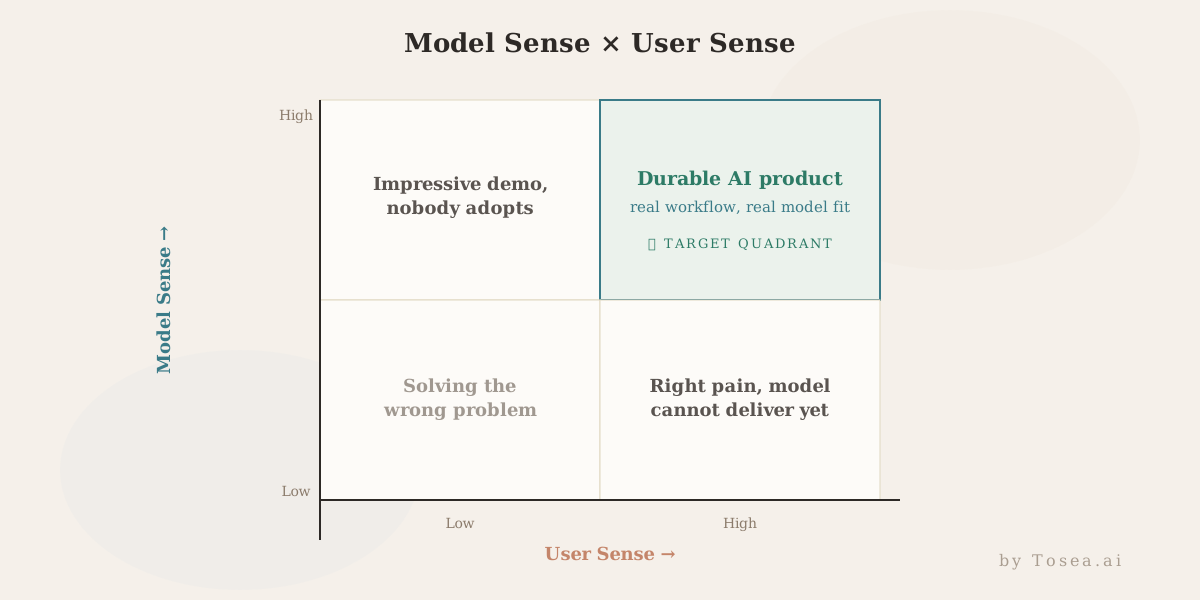
Plot a product on these two axes and the failure modes become obvious. High model sense with low user sense produces impressive demos that nobody adopts. High user sense with low model sense produces a thoughtful design the model cannot actually deliver. Durable products sit in the top-right quadrant, where deep model understanding meets a real, painful workflow.
Many AI products fail because they confuse novelty with value. Common mistakes include:
- Adding a chatbot to every screen
- Using AI only as a cost-cutting story
- Generating content without verification
- Creating more review work for users
- Optimizing for demos instead of repeat usage
- Hiding uncertainty behind polished output
A good AI product removes friction. A weak AI product creates a new interface layer around the same old problem.
Product Taste Becomes More Valuable
One of the most useful ideas from Wu's interview is that when code becomes cheaper, deciding what to build becomes more valuable. This is product taste.
Product taste is not aesthetic preference. It is the ability to decide what matters. It includes knowing when a feature is too early, when a workflow is too complicated, when a user will not trust the output, and when a smaller version is more useful than a larger one.
In AI, product taste is also about restraint. Just because a model can generate something does not mean the product should show it. Just because a tool can automate a workflow does not mean users will trust it. Just because the product can do ten things does not mean the onboarding should mention all ten. We argued a related point in our piece on how AI agents are redefining slides beyond the template: more options rarely beat better defaults.
The best AI products often feel simple because the hard judgment happened behind the scenes.
What This Means for AI Presentation Products
This lesson applies directly to AI presentation tools. Many AI PPT products compete on surface features: more templates, more themes, more icons, more one-click generation, more AI slide maker options, more pitch deck template libraries.
Those features can be useful. But professional users often care about a deeper question: can I trust this deck?
For a student, researcher, analyst, consultant, founder, or finance team, the hard part is not always making slides look good. The hard part is converting source material into a clear, accurate, editable presentation — which is why zero-hallucination AI slides are a different problem from pretty templates.
That is where Tosea AI makes a deliberate product-judgment call. As the document-to-deck orchestration layer, it focuses on turning complex documents into accurate, editable slides: extracting figures and formulas from PDFs, building outlines step by step, generating speaker notes, and reproducing charts and data from the source rather than inventing them.
Instead of trying to be every kind of content creation tool, Tosea narrows in on high-trust, document-to-PPT workflows:
- Research paper to slides
- Financial report or 10-K to presentation
- Convert a financial report PDF to PowerPoint without losing tables
- Equity research and consulting reports to slide decks
- AI presentations that preserve tables, charts, and formulas
That is what good AI product management looks like: choose a painful workflow, understand the trust requirement, and design around the user's real job rather than the longest feature list.
A Practical Framework for AI PMs
Here is a simple operating framework for AI product management in 2026.
1. Define the Real User
Do not say "knowledge workers." Say "equity research analyst preparing an investment committee deck." Say "PhD student turning a paper into a conference talk." Say "product marketer preparing a launch narrative." The sharper the user, the sharper the product.
2. Define the Blocked Workflow
Avoid vague pain points. Look for blocked workflows. For example:
- I have a 60-page PDF and need a 12-slide deck by tomorrow.
- I need to convert a financial report PDF to PowerPoint without losing tables.
- I need a research paper presentation that preserves figures and methods.
- I need an AI PPT with no hallucination because the deck goes to senior leadership.
3. Define the Out-of-Box Task
What must work the first time? For a document-to-deck product, the out-of-box task might be: upload a source document, extract key material, build a useful outline, generate editable slides, and preserve source facts. That is much clearer than "build an AI presentation maker."
4. Ship a Narrow Preview
AI products benefit from fast feedback. A narrow preview lets users test the core workflow without forcing the team to overcommit too early. The preview should make its limitations clear. Users tolerate early products when the promise is honest and the use case is sharp.
5. Measure Failure Modes
In AI products, failure modes matter more than feature count. For presentation AI, track:
- Did the model invent numbers?
- Did it drop key tables?
- Did it misread figures?
- Did the outline match the user's goal?
- Were the slides actually editable?
- Did the user need heavy cleanup?
- Did the deck save time or create more review work?
6. Remove Product Crutches as Models Improve
AI products often add features to compensate for current model weaknesses. That is fine, but those features should be revisited. As models improve, some controls, prompts, or manual steps become unnecessary. The product should get simpler over time, not more cluttered.
7. Build a Repeatable Launch System
Fast teams do not just move fast because of better tools. They move fast because the launch path is clear. For AI PMs, that means a tight loop between engineering, design, documentation, marketing, sales, customer feedback, support, and evals. The PM's job is to reduce friction so good ideas reach real users faster.
Why This Matters for Analysts, Researchers, and Consultants
AI product management is not only relevant to software teams. It changes the tools professionals use every day.
Analysts do not want a generic AI slideshow maker; they want output they can defend in front of a committee. Researchers do not want a decorative slide generator; they want a research paper or financial report turned into slides with source fidelity. Consultants do not want a free AI presentation maker that produces generic pages; they want editable, client-ready output. Finance teams do not want a beautiful deck with wrong figures; they want a tool that preserves tables and charts and supports verification, the same standard we describe for presenting performance data to executives.
The same principle applies across all of them: the winning product is not the one with the longest feature list. It is the one with the clearest judgment about the user's workflow.
Frequently Asked Questions
Will AI replace product managers?
AI will replace some PM tasks, especially drafting, summarizing, and routine coordination. It is less likely to replace strong product judgment, user understanding, stakeholder awareness, and prioritization. PMs who only pass messages between teams will struggle. PMs who become product builders will become more valuable.
What skills matter most for AI product managers?
The most important skills are model sense, user sense, product taste, first-principles thinking, fast validation, and low-ego execution. AI PMs need to understand technology, but they also need to understand trust, workflow, and timing.
What is model sense?
Model sense is the ability to understand what an AI model can do reliably, where it fails, what context it needs, how expensive it is, and what users should verify. It helps PMs design products around real model behavior instead of demos.
What is user sense?
User sense is the ability to understand the user's real job, pain, constraints, trust threshold, and success criteria. In AI products it matters because users do not just want AI — they want a difficult workflow to become easier.
Are PRDs still useful in AI product teams?
Yes, but they are no longer always the center of the process. For ambiguous or infrastructure-heavy work, PRDs can still be valuable. For fast AI previews, a focused one-pager with goals, user, success criteria, and failure modes may be enough.
What is a product builder?
A product builder is someone who can move from insight to working artifact quickly. They can define the user, shape the idea, use AI tools, coordinate launch, test with users, and revise based on feedback.
How does this apply to AI presentation tools?
AI presentation products should not only generate pretty slides. They should solve a specific workflow. For document-heavy users, that workflow is turning complex source material into accurate, editable, presentation-ready slides.
Final Takeaway
AI product management in 2026 is not about whether PMs survive. It is about whether PMs evolve.
The old PM role centered on requirements, alignment, and process. The new AI PM role centers on judgment, speed, model understanding, user insight, and rapid validation. As AI makes coding, writing, prototyping, and content generation cheaper, the scarce skill becomes deciding what should exist.
That applies to every AI product category, presentation AI included. For professional workflows, the winning product is not just a powered PowerPoint tool or a free presentation maker. It is the product that understands the user's source material, preserves the truth in it, and produces work people can trust. For document-to-slide work where source fidelity, tables, charts, formulas, and editable output matter, that is exactly the judgment Tosea AI is built around — so analysts, researchers, and consultants can spend less time formatting and more time making the right decisions.
Sources
- How Anthropic's product team moves faster than anyone else — Cat Wu (Head of Product, Claude Code) — Lenny's Podcast, April 23, 2026
- Cat Wu episode (video) — Lenny's Podcast on YouTube
- Cat Wu on the evolving role of AI product managers — Agent Skills Dev (episode summary)
- Claude Code — Anthropic