Earnings Call Presentation Guide: How to Structure an Investor Deck (2026)
How to structure an earnings call presentation deck — financial highlights, KPIs, guidance, Safe Harbor, and non-GAAP reconciliation slides, plus how sell-side analysts actually read it.
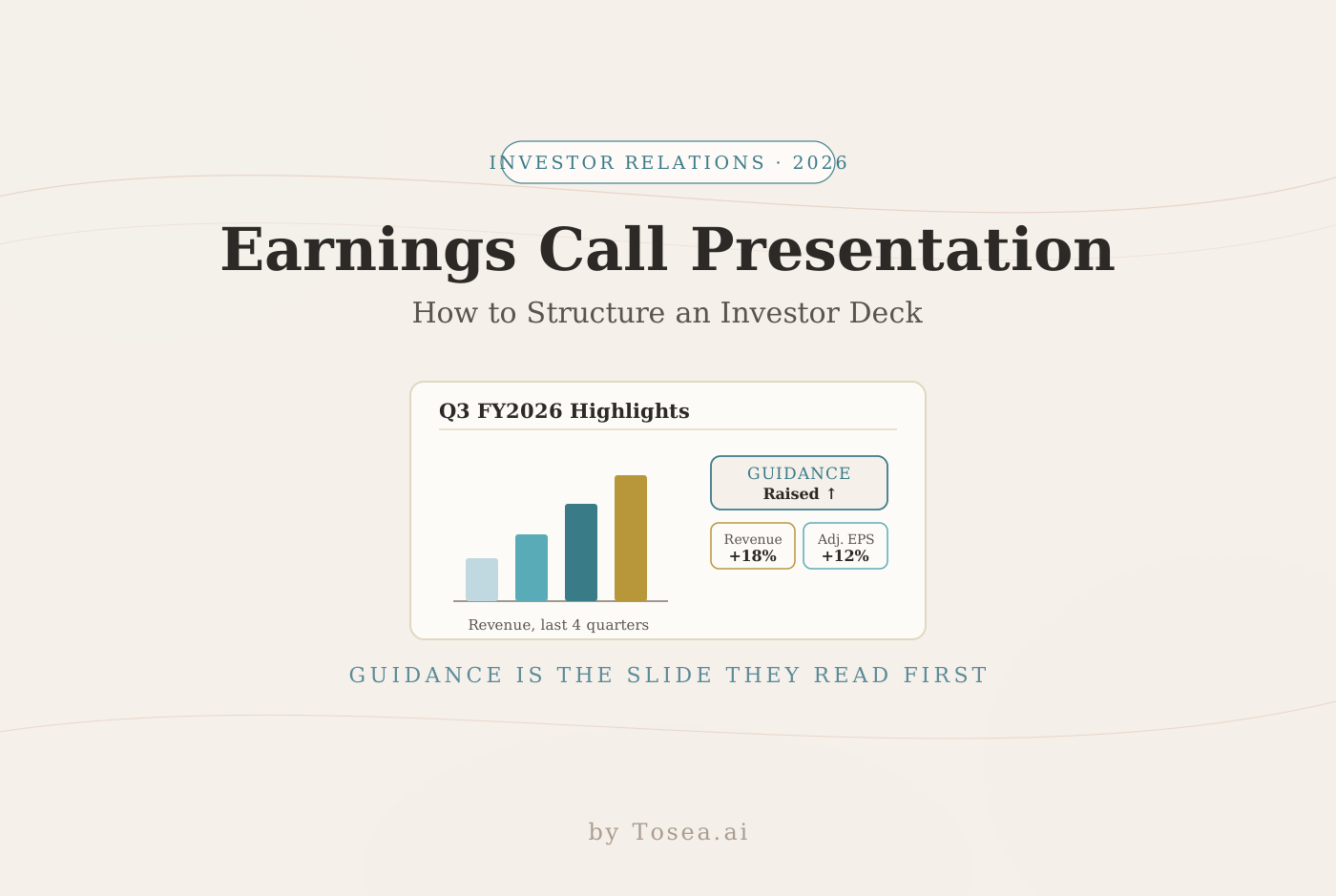
Four times a year, a public company gets roughly sixty minutes to explain its results to the people who set its stock price. The earnings call presentation — the slide deck that accompanies the quarterly call — is the single document that anchors that conversation. Get it right and the call reinforces your narrative; get it wrong and you spend the Q&A defending slides instead of explaining the business.
Unlike a pitch deck or a board deck, the earnings call deck operates under real regulatory constraints and a hyper-informed audience: sell-side analysts who have already read your filings, buy-side investors holding millions of dollars of your stock, and a transcript that becomes part of the permanent record. This guide walks through the standard structure, the compliance slides you cannot skip, how analysts actually read the deck, the mistakes that quietly erode credibility, and the workflow for turning your 10-Q and management commentary into a finished deck. It is written for IR teams, CFO offices, and investor-relations consultants who build these decks under deadline every quarter.
What an Earnings Call Deck Is — and Isn't
The earnings call deck is one of three documents a public company releases around results, and confusing their jobs is the first mistake teams make. Each has a distinct audience and legal weight.
| Document | Primary purpose | Audience | Legal status |
|---|---|---|---|
| Earnings press release | Announce results, headline numbers, guidance | Wire services, media, all investors | Furnished on Form 8-K (Item 2.02) |
| Earnings call deck | Visualize and frame the quarter's story | Analysts and investors on the call | Furnished/posted alongside the release |
| 10-Q / 10-K | Complete, audited-quality financial disclosure | Analysts, regulators, the record | Filed with the SEC |
The press release carries the official numbers and the GAAP statements. The 10-Q is the exhaustive legal disclosure. The deck is the only one of the three built to be presented — it exists to give shape to the quarter, direct attention to what changed, and set up the guidance discussion. It is not a re-typed press release, and it is not a condensed 10-Q. When a deck simply mirrors the press-release tables, analysts ignore it and read the release instead.
A critical compliance point frames everything: under the SEC's Regulation FD (Fair Disclosure), any material information you put in the deck must be disclosed publicly and simultaneously — you cannot show analysts a number on a slide that is not also available to every investor. In practice, companies post the deck to their IR website and furnish it on an 8-K at the moment the call begins.
The Standard Earnings Call Deck Structure
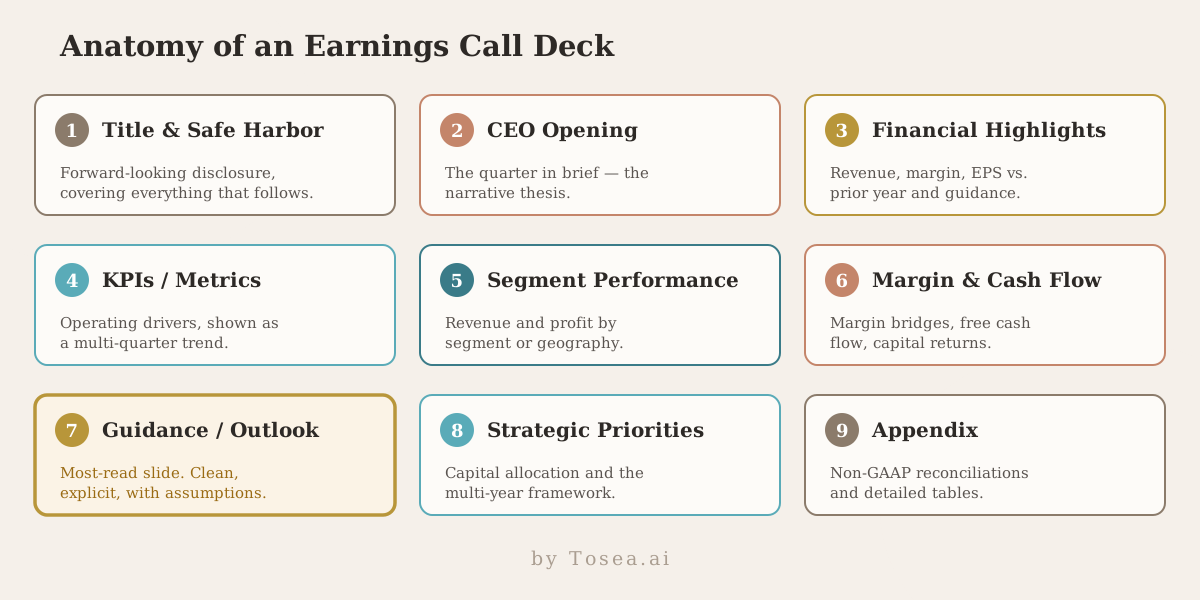
A clean earnings deck runs 15–25 slides and follows a predictable spine. Predictability is a feature here, not a weakness: analysts build quarterly models, and a deck that keeps the same structure quarter over quarter lets them update their numbers in minutes. The standard flow looks like this.
1. Title and Safe Harbor
The opener: company name, quarter, fiscal year, and the forward-looking statements disclosure (covered in detail below). The Safe Harbor slide almost always comes first so it legally covers everything that follows.
2. CEO Opening / Quarter in Brief
One slide that frames the quarter in the CEO's voice — the two or three things that defined the period. This is the narrative thesis the rest of the deck supports.
3. Financial Highlights
The headline scorecard: revenue, gross margin, operating income, net income, and EPS, each shown against the prior-year quarter and, where useful, against guidance. Keep it to one slide. If you reported $2.4B in revenue up 18% year over year and $0.42 in adjusted EPS, those numbers live here, large and unmissable.
4. Key Performance Indicators (Operating Metrics)
The operating metrics that drive the financials — the leading indicators analysts use to forecast future quarters. For a software company that is net revenue retention and ARR; for a retailer, same-store sales and traffic; for a bank, net interest margin and deposit growth. Show the trend, not just the point: a four-to-eight quarter trendline tells the story a single number cannot.
5. Segment Performance
Revenue and profitability by business segment or geography, matching the segment reporting in your filings. This is where analysts decide whether growth is broad-based or concentrated, and it is the slide most likely to drive a Q&A question about a lagging segment.
6. Margin and Cash Flow
Gross and operating margin bridges, free cash flow, and the balance-sheet items that matter — cash, debt, and any buyback or dividend activity. If margins moved materially, a bridge chart that walks from last year's margin to this year's, by driver, preempts the obvious question.
7. Guidance / Outlook
The single most-scrutinized slide. Next-quarter and full-year guidance for revenue, margin, and EPS, with the assumptions behind it. Never bury guidance deep in the deck or fold it into a wall of text — analysts flip here first, and ambiguity here is what moves the stock after hours.
8. Strategic Priorities / Closing
A forward-looking slide on capital allocation, strategic initiatives, or the longer-term framework — the bridge from this quarter's numbers to the multi-year story.
9. Appendix
Non-GAAP reconciliations, detailed segment tables, and definitions. The appendix carries the regulatory weight (see below) and the granular tables analysts pull into their models, without cluttering the main narrative.
The Forward-Looking Statements and Safe Harbor Slide
Every earnings deck opens with a Safe Harbor slide, and it is not boilerplate you can copy carelessly. The protection comes from the Private Securities Litigation Reform Act of 1995 (PSLRA), which shields companies from liability for forward-looking statements — guidance, projections, expectations — provided those statements are identified as forward-looking and accompanied by "meaningful cautionary language" about the risks that could cause actual results to differ.
In practice, the slide must do three things: explicitly identify that the presentation contains forward-looking statements, reference the risk factors in your most recent 10-K and 10-Q, and state that the company undertakes no obligation to update them. Many teams also note here that the deck contains non-GAAP measures and points to the reconciliations in the appendix.
The mistake to avoid is treating Safe Harbor as a slide nobody reads. If your guidance later proves wrong and the cautionary language was generic or missing, the PSLRA protection weakens. The disclosure should be specific enough to be meaningful — which is why IR teams have securities counsel review it, especially in quarters with new guidance or a major announcement.
Non-GAAP Reconciliation: The Convention You Cannot Skip
Most earnings decks lead with non-GAAP or "adjusted" numbers — adjusted EPS, adjusted EBITDA, free cash flow — because they strip out one-time items and better reflect operating performance. The SEC permits this, but under Regulation G and Item 10(e) of Regulation S-K, with firm rules:
- Every non-GAAP measure must be reconciled to the most directly comparable GAAP measure, with the reconciliation shown.
- The GAAP measure must be presented with equal or greater prominence — you cannot show adjusted EPS in 60-point font and hide GAAP EPS in a footnote.
- Adjustments must be consistent across periods and not misleading.
For the deck, this means two things. First, the headline slides can feature adjusted numbers, but the comparable GAAP figure must appear alongside, not buried. Second, the appendix must carry full reconciliation tables — adjusted EBITDA walked back to net income, free cash flow walked back to operating cash flow, line by line. Analysts check these. A deck that features a flattering adjusted number without a clean reconciliation invites both a skeptical Q&A question and, in the worst case, an SEC comment letter.
How Sell-Side Analysts Actually Read Your Deck
The IR team builds the deck to tell a story. The analyst reads it to update a model and find the question they will ask on the call. Understanding that gap is what separates a deck that controls the narrative from one that gets picked apart.
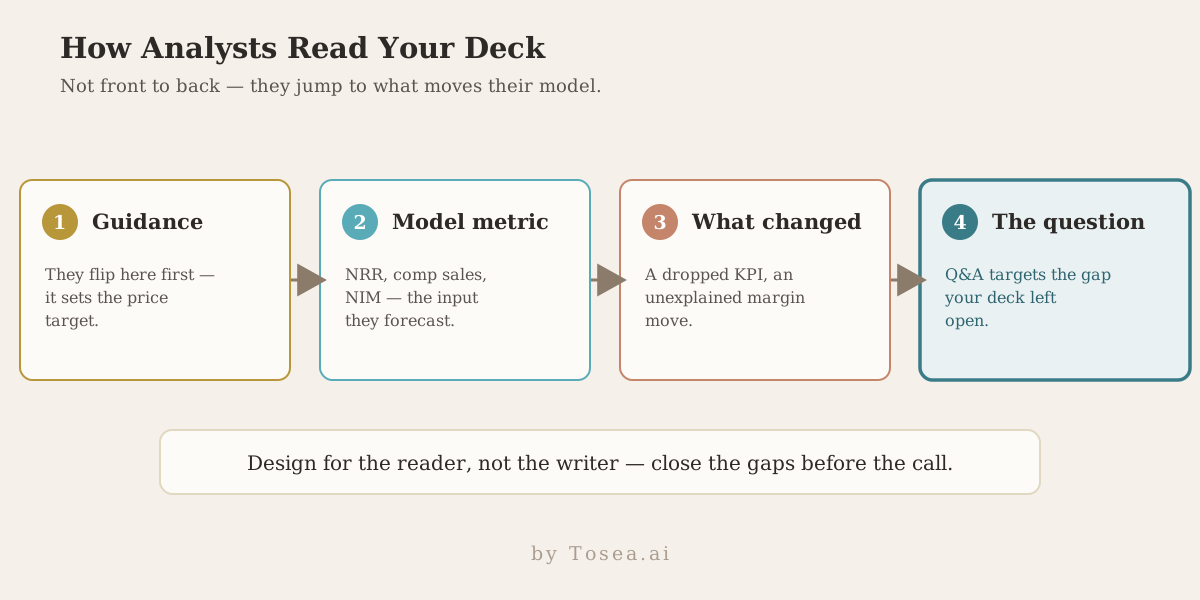
Here is the analyst's actual sequence. They flip to guidance first — that is the input that changes their price target. Then they go to the metric that drives their model: net revenue retention for SaaS, same-store sales for retail, net interest margin for a bank. Then they hunt for what changed and what's missing — a KPI you reported last quarter but dropped this quarter, a margin that moved without explanation, a segment that decelerated. The question they ask in Q&A is almost always the gap your deck left open.
This has direct design consequences:
- Keep metric definitions and reporting consistent quarter to quarter. If you change how you calculate a KPI, call it out explicitly and restate prior periods. Silently changing a definition is the fastest way to lose analyst trust.
- Explain deltas, don't just report levels. A margin bridge or a "drivers of growth" callout answers the question before it's asked.
- Anticipate the lagging-segment question. If one segment underperformed, address it in the deck rather than letting the analyst raise it cold.
For the underlying logic of structuring data so a numerate audience reaches your conclusion quickly, our guide on the McKinsey way to present research findings and our framework for presenting sales data to executives both apply directly to the financial-highlights and segment slides.
Common Mistakes That Undermine an Earnings Deck
These are the recurring errors that quietly cost credibility with the analyst community.
Burying or softening guidance. Guidance that is hard to find, hedged into vagueness, or inconsistent with the press release creates uncertainty — and uncertainty is priced as risk. Put it on a clean, clearly labeled slide.
Missing or sloppy non-GAAP reconciliations. Featuring adjusted numbers without equal-prominence GAAP figures and full appendix reconciliations is both a compliance risk and a trust problem.
Inconsistent KPIs across quarters. Dropping a metric the quarter it turns negative, or changing a definition without restating, reads as hiding something — even when it isn't.
Re-typing the press release. If the deck adds no visual framing or trend context beyond the release tables, it wastes the one document built to be presented.
Overcrowded slides. Earnings calls move fast. A slide with twelve numbers and no hierarchy means the audience reads instead of listening to the CFO. One message per slide, with the supporting numbers subordinate.
Generic Safe Harbor language. Boilerplate that doesn't reference your actual risk factors weakens the PSLRA protection it exists to provide.
Numbers that don't tie out. The deck, the press release, and the 10-Q must agree to the dollar. A single inconsistency between documents is the kind of thing an analyst flags publicly — and it undermines every other number in the deck.
Industry-Specific Notes
The spine is consistent, but the KPI and guidance slides change shape by sector. Match the metrics analysts in your industry actually model.
SaaS and software. ARR, net revenue retention (NRR), gross retention, customer count, and the Rule of 40 (growth rate plus profit margin). Analysts care intensely about NRR as a leading indicator; show it as a trend and define it precisely. Guidance usually centers on revenue and operating margin, with billings as a watched supplementary metric.
Biotech and pharma. Earnings are often secondary to pipeline and catalysts. The "guidance" slide is frequently a clinical and regulatory milestone timeline — upcoming trial readouts, PDUFA dates, and cash runway. Cash runway in quarters is itself a critical metric, since many names are pre-revenue.
Retail and consumer. Same-store (comparable) sales, traffic versus ticket, gross margin, and inventory levels. Comp sales is the number the market reacts to; decompose it into traffic and average transaction value so analysts can see the driver.
Banks and financials. Net interest margin, net interest income, deposit growth, loan growth, efficiency ratio, and credit metrics like net charge-offs and provisions. The guidance discussion centers on NIM and credit normalization.
For ongoing monitoring decks between earnings dates, the same metric discipline carries into our guide on market-performance monitoring for executive presentations.
The Workflow: From 10-Q to Earnings Deck
The hard part of building an earnings deck is not the design — it is assembling accurate numbers from source documents under a tight close-to-call window, then making them presentable without introducing a single transcription error. The traditional process has an IR analyst manually pulling figures from the 10-Q, the press release, and the close package into a slide template, which is exactly where tie-out errors creep in.
This is where a document-to-presentation workflow changes the economics. Tosea.ai is an AI presentation tool built for converting source documents — a 10-Q, an earnings press release, management commentary, the financial close package — into a structured slide deck with every figure traceable back to the source material. Instead of starting from a blank template and re-keying numbers, you upload the quarter's documents and generate a draft deck that already carries the financial highlights, segment tables, and KPI trends, organized along the standard structure above.
Because the deck is generated from the source documents rather than retyped, the figures tie back to the filing by construction — the property that matters most when the audience is checking your numbers against the 10-Q in real time. Source grounding is the whole point: our zero-hallucination AI slides guide and our breakdown of hallucination-free document-to-PPT conversion explain why traceability is non-negotiable for financial decks. The IR team's time then goes where it should — on the narrative framing, the guidance assumptions, and the Q&A prep — rather than on copy-paste and reconciliation.
The same document-to-PPT pipeline supports adjacent finance decks; if your team also prepares investment materials, see our investment committee memo deck guide, which shares the same source-grounding discipline.
The Pre-Call Rehearsal Plan
The deck is only half the deliverable. The call itself is a live performance under scrutiny, and the strongest IR teams rehearse it like one. A four-step pre-call plan:
-
Internal tie-out (T-minus several days). IR, accounting, and FP&A confirm every number in the deck matches the press release and the 10-Q to the dollar. This is the non-negotiable step.
-
Legal and disclosure review. Securities counsel reviews the Safe Harbor slide, the non-GAAP presentation and reconciliations, and confirms nothing material in the deck is undisclosed elsewhere — the Regulation FD check.
-
CFO and CEO briefing. Walk the executives through the deck slide by slide, aligning on the narrative and the exact framing of guidance. The CFO should be able to speak to every number without reading the slide.
-
Q&A war-gaming. The IR team drafts the twenty hardest questions analysts will ask — the lagging segment, the guidance assumption, the margin delta, the dropped metric — and rehearses answers. The best preparation assumes the analyst has already found the gap in your deck, because they have.
For a structured rehearsal cadence that applies to any high-stakes recurring deck, the approach in our QBR deck guide translates well to the earnings context.
Frequently Asked Questions
How long should an earnings call deck be?
Most run 15–25 slides for the main presentation, plus an appendix of reconciliations and detailed tables. The constraint is the call length: at roughly one to two minutes per slide of speaking time, a 20-slide deck fits a typical 45–60 minute call with room for Q&A.
Do we have to file the earnings deck with the SEC?
The deck is typically furnished (not filed) on Form 8-K under Item 2.02 alongside the earnings release, and posted to the IR website. "Furnished" carries slightly different liability than "filed," but under Regulation FD the material information must be public and simultaneous. Confirm the exact mechanics with your securities counsel.
Can we lead with non-GAAP (adjusted) numbers?
Yes, and most companies do, but under Regulation G the comparable GAAP measure must be presented with equal or greater prominence, and full reconciliations must appear (usually in the appendix). You cannot feature adjusted EPS while hiding GAAP EPS.
What is the single most important slide?
Guidance. It is the input analysts use to set price targets and the slide they flip to first. Make it clean, clearly labeled, consistent with the press release, and explicit about assumptions.
How do we keep the deck consistent quarter over quarter?
Lock the structure and the KPI definitions, and restate prior periods whenever a definition changes. A consistent template lets analysts update models quickly and signals discipline. Generating the deck from source documents each quarter, rather than editing last quarter's file, reduces drift and transcription error.
Bringing It Together
An earnings call deck is a financial document, a compliance artifact, and a piece of storytelling at the same time. The structure is standardized for good reason — analysts reward predictability — and the compliance slides (Safe Harbor, non-GAAP reconciliations) are not optional. The teams that do this well treat the deck as the spine of a rehearsed performance: numbers that tie out to the filing, guidance that is impossible to miss, KPIs that stay consistent, and a Q&A plan built around the questions the deck is most likely to provoke. Build it from the source documents, rehearse it like a live event, and the quarterly call becomes a chance to reinforce your narrative rather than defend it.
Sources
- SEC — Regulation FD (Fair Disclosure), Final Rule — U.S. Securities and Exchange Commission
- SEC — Non-GAAP Financial Measures (Regulation G) Compliance & Disclosure Interpretations — U.S. Securities and Exchange Commission
- Private Securities Litigation Reform Act of 1995 — Safe Harbor for Forward-Looking Statements — U.S. Congress
- National Investor Relations Institute (NIRI) — investor-relations standards and best practices
- SEC — How to Read a 10-Q — U.S. Securities and Exchange Commission