Sora Shutdown: What OpenAI's Pivot Means for Practical AI in 2026
OpenAI shut down its Sora video app to cut costs and refocus on enterprise AI. Here's what the pivot means for professionals.
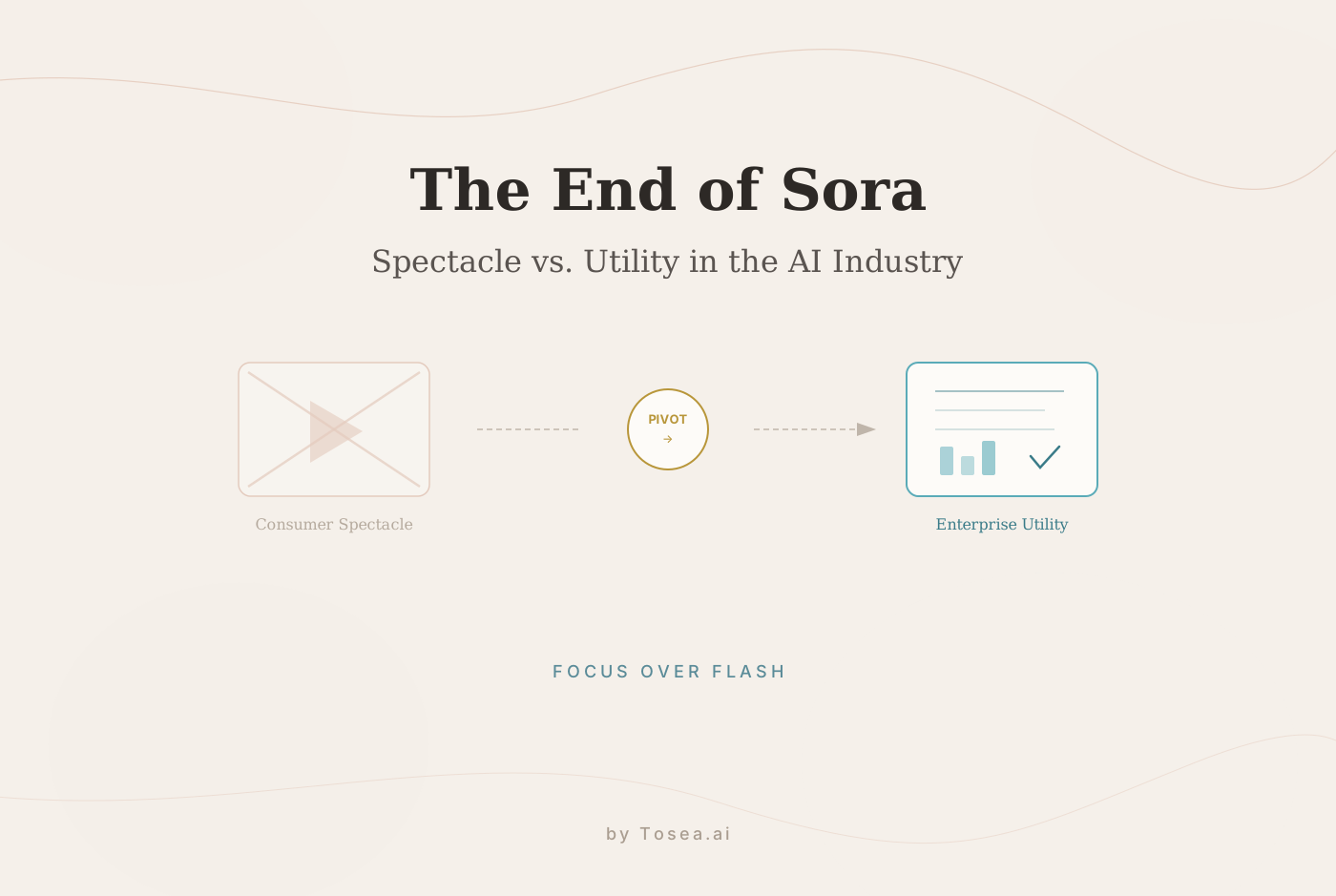
On March 24, 2026, OpenAI officially announced it was shutting down Sora, its viral AI video-generation app. Only months after a high-profile, $1 billion partnership with Disney promised to reshape entertainment, the plug has been pulled. The decision signals a broader reckoning in the AI industry: compute resources are finite, and companies are being forced to choose between spectacle and utility.
The Shutdown and Its Immediate Fallout
The announcement was blunt. "We're saying goodbye to the Sora app," the company posted on X — marking the end of an ambitious experiment in AI-driven social media.
As CNN Business reports, OpenAI is shuttering the standalone app to focus on other priorities. An OpenAI spokesperson stated the company needed to make trade-offs on products with high compute costs, with the Sora research team pivoting to world simulation research for robotics.
TechCrunch described Sora as having functioned like an AI-first TikTok, with a vertical video feed and a deepfake feature called "characters." Despite the underlying Sora 2 model being technically impressive, there was not sustained interest in an AI-only social feed.
CNBC notes that while Sora proved popular with users — hitting one million downloads less than five days after its September launch — OpenAI has been retreating from costly projects as it tries to reel in costs ahead of a prospective IPO.
Why the Disney Deal Collapsed
The most visible casualty of this pivot is the Walt Disney Co. deal. As Bloomberg reports, the deal centered on Disney licensing iconic characters to OpenAI for use on Sora, with Disney agreeing to take a $1 billion stake — structured entirely in stock warrants rather than a cash licensing fee.
With the shutdown of the Sora app and its API, that deal is now dead. A Disney spokesperson stated: "As the nascent AI field advances rapidly, we respect OpenAI's decision to exit the video generation business and to shift its priorities elsewhere."
The move reflects a broader industry realization: video generation remains too resource-intensive, too legally risky, and too difficult to moderate against deepfakes and copyright infringement to be a sustainable consumer product in 2026. The Hollywood Reporter points out that the closure puts Google in a position of power for AI video generation, making it essentially the only remaining player with scale.
The Anthropic Factor: Why Focus Wins
The shutdown comes as OpenAI faces intense pressure from Anthropic. As NBC News reports, Anthropic's AI systems have soared in popularity among leading businesses and software engineers. Anthropic, with its Claude family of AI models, has eschewed products like image and video generation to instead focus scarce computational resources on text and code generation.
According to IndieWire, OpenAI is refocusing its efforts on coding and enterprise priorities ahead of a planned IPO — a strategic concession that in an era of limited chip supply, you cannot be everything to everyone. This tension between consumer spectacle and enterprise utility is a theme we explored in our analysis of the SaaS-pocalypse and agentic workflows.
What Sora's Economics Tell Us About AI Sustainability
The Sora shutdown is not an isolated event — it reflects a structural problem facing every AI company that pursues compute-intensive consumer products. Video generation at Sora's quality level required dozens of GPU-hours per minute of output. At OpenAI's reported infrastructure costs, each Sora video session consumed resources that could have served hundreds of enterprise text queries.
This math problem is not unique to OpenAI. Other companies in the generative video space — including Runway, Pika, and Kling — face similar cost pressures. The difference is that OpenAI, with its IPO timeline and investor scrutiny, was the first to publicly acknowledge the trade-off.
For professionals evaluating AI tools, the lesson is straightforward: tools that require massive compute per task carry shutdown risk. Tools that deliver high value per compute cycle — document analysis, presentation generation, code assistance — are structurally more sustainable.
The pattern extends beyond video. AI image generation tools have also faced pressure, with several startups quietly reducing output quality or increasing pricing to manage GPU costs. The companies that thrive will be those whose revenue per GPU-hour justifies continued operation. For a broader perspective on how this dynamic is reshaping the software industry, see our analysis of the fear of AI obsolescence and professional stakes.
How We Evaluated This Story
This analysis draws on reporting from seven major news outlets (CNN, CNBC, TechCrunch, Bloomberg, NBC News, IndieWire, The Hollywood Reporter) published on March 24-25, 2026. We cross-referenced claims about compute costs, user metrics, and the Disney deal across multiple sources to ensure accuracy. Market context on AI resource allocation comes from publicly reported infrastructure spending by OpenAI and Anthropic.
Practical AI vs. Spectacle AI: A Comparison
The Sora shutdown crystallizes a divide that has been forming across the AI industry throughout 2025-2026.
| Dimension | Spectacle AI (e.g., Sora) | Practical AI (e.g., Document Tools) |
|---|---|---|
| Compute cost | Extremely high (GPU-hours per video) | Low to moderate (text processing) |
| Revenue model | Consumer subscriptions, uncertain ROI | Enterprise SaaS, measurable ROI |
| Legal risk | High (deepfakes, copyright) | Low (user-owned source documents) |
| Output lifespan | Minutes of entertainment | Months of professional reuse |
| Shutdown risk | High (Sora, Jasper Art, etc.) | Low (tied to daily workflows) |
This pattern helps explain why tools focused on professional document workflows — such as AI-powered presentation generators — continue to grow while high-compute consumer products face cutbacks.
What This Means for Professional Workflows
The closure of Sora marks a turning point. Companies can no longer afford to burn billions on products that generate more controversy than revenue. The AI tools that will survive 2026 are those that solve concrete professional problems with reasonable compute budgets.
For knowledge workers, the implication is clear: invest your workflow in tools that are sustainable. A multi-agent slide generation system that converts your research into professional presentations uses a fraction of the compute that video generation requires — and delivers output you can use in Monday's meeting.
Tosea.ai is one example of this practical approach. Rather than simulating the physical world or rendering thousands of video frames, it focuses on the logic of business communication: taking your PDFs, Word documents, or research notes and rebuilding them into structured PowerPoint presentations with consulting-grade layouts.
Why Sustainable AI Tools Matter
- Low compute, stable service: Text-to-presentation logic requires far less GPU time than pixel-to-video rendering, which means the service is not at risk of being shut down due to chip shortages.
- Professional traceability: Every slide can be traced back to your original document, supporting the kind of hallucination-free conversion that high-stakes environments demand.
- Native .pptx output: The result is a fully editable PowerPoint file, not a proprietary format that locks you in.
The Broader Pattern: Which AI Products Survive
Sora is not the first high-profile AI product to be discontinued, and it will not be the last. A pattern is emerging: AI tools that solve recurring professional problems with efficient compute usage tend to survive, while those that prioritize novelty over utility face pressure as soon as investor scrutiny increases.
Products in the "survival" category share common traits: they integrate into existing workflows rather than creating new habits, they produce output that users can immediately apply (documents, code, presentations), and their compute cost per user session is predictable and manageable. Products in the "risk" category tend to be compute-intensive media generators, consumer-facing entertainment apps, or tools that require users to adopt entirely new workflows without clear productivity gains.
For professionals building their AI toolkit, the Sora shutdown reinforces a practical principle: choose tools whose business model aligns with your use case. An enterprise productivity tool with paying customers has a different risk profile than a consumer app subsidized by venture capital.
Timeline: From Sora Launch to Shutdown
| Date | Event |
|---|---|
| Sep 2025 | Sora app launches; hits 1M downloads in 5 days |
| Nov 2025 | Disney partnership announced ($1B in stock warrants) |
| Jan 2026 | Anthropic's Claude usage surges among enterprise customers |
| Feb 2026 | OpenAI begins internal cost review of high-compute products |
| Mar 24, 2026 | Sora shutdown announced; Disney deal collapses |
Who Should Pay Attention
- Startup founders evaluating which AI tools to build their workflows around — the Sora shutdown is a cautionary tale about depending on high-compute consumer products.
- Researchers and consultants who need reliable, long-term tools for converting documents into presentations. The trend toward research paper to slides workflows reflects this demand.
- AI enthusiasts tracking industry consolidation — the shift from broad experimentation to focused enterprise AI is accelerating.
- Enterprise buyers assessing vendor stability — compute sustainability is now a legitimate procurement criterion.
Frequently Asked Questions
Is Sora completely gone?
OpenAI has shut down the standalone Sora app and its API. The underlying video research will continue internally, focused on world simulation for robotics rather than consumer content.
Will other AI video tools shut down too?
Not necessarily, but the economics are challenging. Video generation requires orders of magnitude more compute than text or document processing. Tools with clear enterprise ROI are on firmer ground than consumer-facing video apps.
Does this affect AI presentation tools?
No. Document-to-presentation tools operate at a completely different compute scale. If anything, the Sora shutdown reinforces the viability of focused, practical AI tools that solve specific professional problems.
What should I look for in a sustainable AI tool?
Look for tools with clear professional use cases, reasonable compute requirements, native file format output, and a business model tied to measurable productivity gains rather than consumer engagement metrics.
What does this mean for AI investment decisions?
Companies and individuals choosing AI tools should now evaluate vendor sustainability alongside feature sets. Key indicators include: revenue model clarity (subscription vs. speculative), compute efficiency (text processing vs. media generation), and market position (enterprise utility vs. consumer engagement). The Sora shutdown demonstrates that technical capability alone does not guarantee product longevity.
How does Tosea.ai avoid the same fate as Sora?
Tosea.ai focuses on text-to-presentation logic, which requires a fraction of the compute budget that video generation demands. Its revenue model is tied directly to professional productivity — a use case with clear, measurable ROI for users. The service processes documents using text-based AI models rather than GPU-intensive rendering pipelines, making it structurally sustainable even as compute costs remain high across the industry.