Board Deck (Board Book) Structure Guide for Founders & CEOs (2026)
How to structure a board deck for founders and CEOs in 2026 — the standard board-book spine, the decisions slide, cash and hiring slides, how directors read it, and an AI workflow.
A board deck is not a pitch deck. A pitch deck sells a story to investors who do not yet own a piece of the company. A board deck reports to directors who already do. Your audience has skin in the game, has seen last quarter's numbers, and will measure this meeting's slides against the commitments you made at the previous one. That single difference — recurring accountability instead of a one-time sale — changes what belongs on every slide.
This guide covers how to structure a board deck (often called a board book or board package) for a startup or growth-stage company: the standard spine, the slides that actually carry weight, how directors read the material, the mistakes that quietly erode board confidence, and how to assemble the deck efficiently each cycle. If you are raising rather than reporting, our startup pitch deck guide and AI presentations for startups cover that case; if you need the single-slide version for one decision, see the executive summary master-slide guide. This is the recurring-governance document.
The Board Deck Audience: Directors With Skin in the Game
A typical early- and growth-stage board includes the CEO, one or two co-founders or senior executives, the investor directors who led your priced rounds, and — as the company matures — one or more independent directors. Some boards also seat non-voting observers from smaller investors. Three traits define how this audience reads:
- They already know the business. Nobody at the table needs the "what we do" slide from your seed pitch. Re-explaining the company signals that you do not know who you are talking to.
- They are fiduciaries. Directors carry a legal duty of care and loyalty. They are not just cheerleaders; they are accountable for oversight, and they read for the things they are obligated to catch — cash, compliance, key-person risk, material changes.
- They read fast and comparatively. A good director skims the deck the night before, then reads it again at the table against the numbers and promises from last meeting. Inconsistency between quarters is the fastest way to lose their trust.
Three rules follow from that profile. First, skip the re-introduction and lead with the delta — what changed since the last meeting. Second, write conclusions, not labels: a slide titled "Q2 Sales" tells a director nothing, while "Net new ARR slowed to $1.4M as two enterprise deals slipped to Q3" tells them exactly what to think and ask. (That conclusion-first discipline is the heart of the McKinsey way to present findings.) Third, make the asks explicit — directors are in the room to decide, govern, and advise, and a deck with no clear ask wastes the most expensive hour on your calendar.
Board Deck vs Pitch Deck vs Executive Summary
These three formats get conflated constantly. They serve different audiences and answer different questions.
| Dimension | Pitch Deck | Board Deck | Executive Summary Slide |
|---|---|---|---|
| Audience | New investors (no stake yet) | Existing directors (fiduciary stake) | Any decision-maker, one topic |
| Cadence | Once per raise | Every 4–8 weeks, recurring | Ad hoc, per decision |
| Goal | Win a term sheet | Report, govern, decide | Resolve one question |
| Tone | Persuasive, aspirational | Candid, accountable | Conclusive, compressed |
| Numbers | Projections forward | Actuals vs plan, both ways | The one metric that matters |
| Bad news | Minimized | Surfaced early and owned | Stated if material |
| Length | 10–15 slides | 15–30 pages + appendix | One slide |
The board deck is the only one of the three where hiding a problem is a governance failure rather than a sales tactic. Investors who sit on your board already model the company; if your slide is rosier than their spreadsheet, you have not fooled them — you have told them you cannot be trusted with the bad news. The investors' own internal version of this discipline is the investment committee memo, which is worth reading to understand how the people across the table think.
The Standard Board Deck Structure
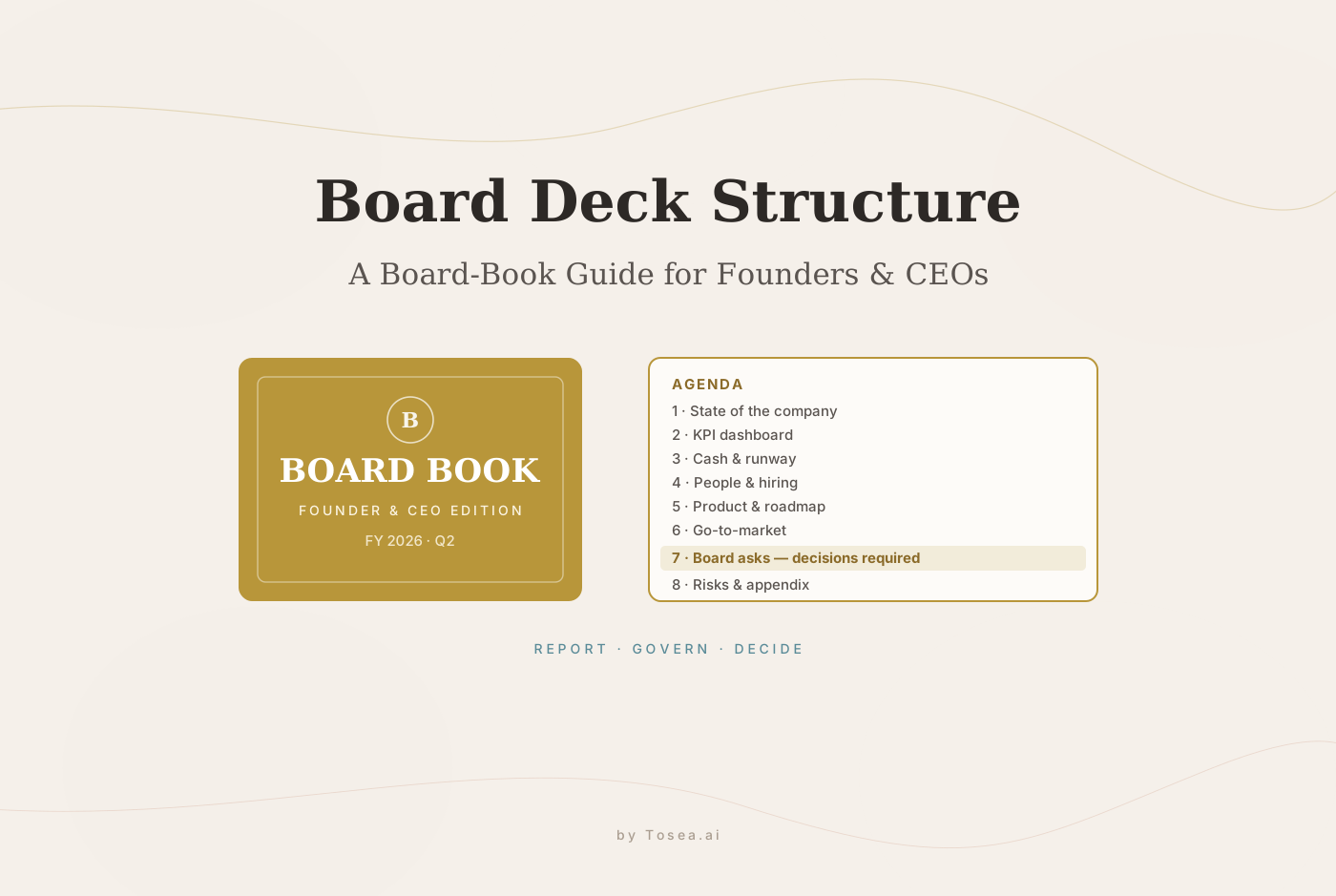
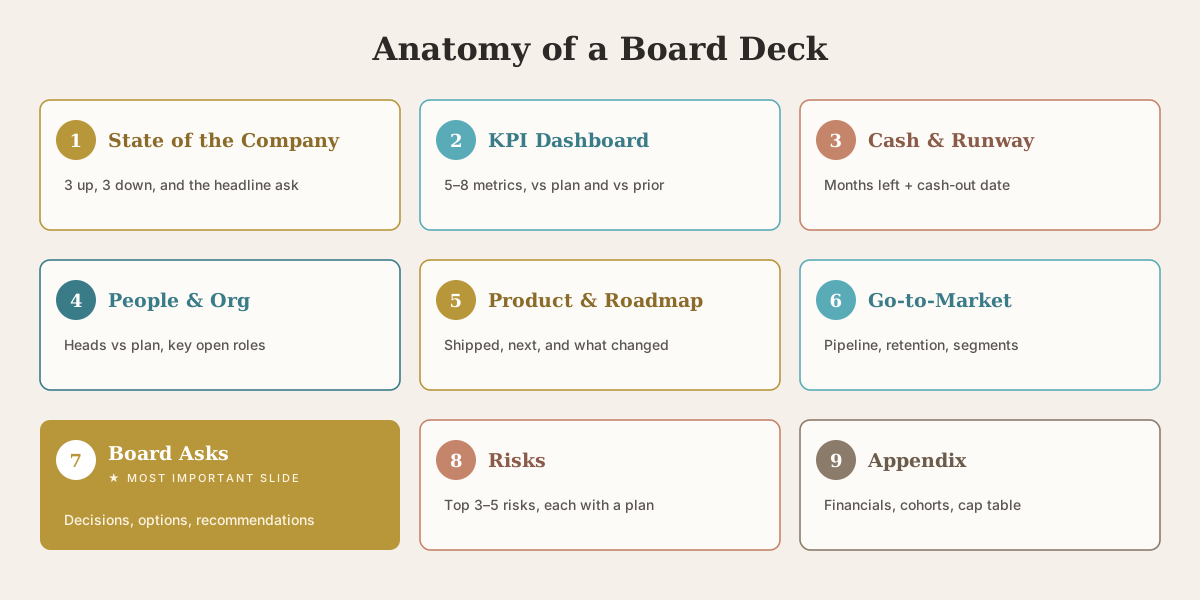
Most effective board books follow a recognizable spine. The order matters: directors want the state of the business and the decisions up front, with supporting detail behind them.
- Cover and agenda. Date, attendees, and the meeting agenda — including which items are for discussion, which are for decision, and which are consent-agenda (approved without debate).
- CEO summary — "state of the company." One page: the three things going well, the three things that are not, and the headline ask. If a director read only this page, they should know whether to be calm or concerned.
- KPI dashboard. The five to eight metrics that define the business, each shown against plan and against the prior period.
- Financials and cash. P&L summary, cash balance, monthly net burn, and runway in months — the slide directors scrutinize most.
- People and org. Headcount versus plan, key hires made, critical open roles, and any leadership or retention risk.
- Product and roadmap. What shipped, what is next, and where the roadmap changed and why.
- Go-to-market / business units. Pipeline, conversion, retention, and segment or channel performance — the operational engine behind the KPIs.
- Strategic decisions and board asks. The decisions you need the board to make or weigh in on, each framed with options and a recommendation.
- Risks. The top three to five risks and what you are doing about each.
- Appendix. Detailed financials, cohort tables, the cap table, option-pool status, and anything a director might want to drill into without cluttering the main flow.
Two structural notes. Routine approvals — prior minutes, option grants, standard resolutions — belong on a consent agenda that the board approves in one motion, freeing the meeting for substance. And the most valuable part of the meeting is often the executive session at the end, where the CEO (and then the independent directors alone) talk without staff present; your deck should leave time for it rather than running to the buzzer.
The Most Important Slide: Decisions Required From the Board
If your board deck has one slide that justifies the meeting, it is the decisions slide. Boards exist to make a small number of consequential calls — approve the budget, authorize a new financing, green-light an acquisition, expand the option pool, approve a senior hire's compensation. Everything else is context for those calls.
A strong decisions slide states, for each item: the decision required, the recommendation, two or three options with their trade-offs, and the implication of waiting. "We recommend raising a $15M Series B extension now rather than in Q4; waiting preserves dilution but risks negotiating from nine months of runway instead of fifteen." That is a decision a director can engage with. "Fundraising update" is not.
Put this slide near the front of the discussion (right after the state-of-the-company summary) so the meeting can spend its energy where it matters, and repeat the asks on a closing slide so nothing is lost. The number-one complaint directors voice about founder decks is that they leave a meeting unsure what, if anything, they were actually asked to decide.
The Cash Slide: Runway, Burn, and What Changed
For a venture-backed company, cash is the slide a good director reads first. It should answer three questions without anyone having to ask:
- How much runway is left? State it in months at current burn, with the cash-out date. Not "we have $8M" — "$8M, which is 14 months of runway at the current $570k net monthly burn, taking us to August 2027."
- What is the burn, and is it changing? Show net monthly burn over the last several months as a trend, not a single number. A burn line that is creeping up while revenue is flat is the single most important pattern a board can catch early.
- What changed since last meeting? If burn rose, say why — a planned engineering ramp, a one-time vendor payment, slower-than-modeled collections. Directors forgive variances they understand; they punish variances they discover.
Accuracy here is non-negotiable. A cash figure that does not reconcile with the financials in the appendix — or with the wire balance a director can see — destroys credibility for the whole deck. This is exactly where AI-assisted decks earn their keep or fail: a generated slide must reproduce the actual closed numbers, not a plausible approximation, which is why a source-grounded workflow matters (see our hallucination-free document-to-PPT guide).
The People Slide: Heads vs Plan and Key Gaps
Headcount is the second-largest line in most startup budgets and the leading indicator of both burn and execution capacity, so directors read the people slide closely. Cover four things: total headcount versus the hiring plan, key hires made since the last meeting, the critical open roles still blocking the plan, and any retention or key-person risk you are managing.
Be honest about gaps. "We are three months behind on the VP Engineering search, and it is slowing the platform rebuild" is a slide a board can help with — directors often have networks that close exactly these roles. A people slide that shows only the hires you made, omitting the searches that are stalled, throws away one of the board's most useful functions.
The KPI Dashboard: Consistency Beats Novelty
The KPI dashboard is where founders most often sabotage their own credibility, by changing which metrics they show from quarter to quarter. When growth is good you show ARR; when growth slows you quietly switch to "total customers" or "pipeline." Directors notice instantly, and the switch reads as exactly what it is.
Pick the five to eight metrics that genuinely define your business — for most B2B software companies some combination of ARR, net new ARR, net revenue retention, gross margin, CAC payback, burn multiple, and pipeline coverage — and show the same ones every meeting, each against plan and against the prior period. Resist the urge to add a flattering new metric in a soft quarter. For the underlying discipline of turning operating data into board-grade visuals, our framework for presenting data to executives applies directly. Consistency is what lets a director see the trend, and the trend is what they are there to govern.
How Directors Actually Read a Board Deck
Understanding the reading behavior changes how you build the deck. A board deck is consumed in three distinct passes, and each one has different needs.
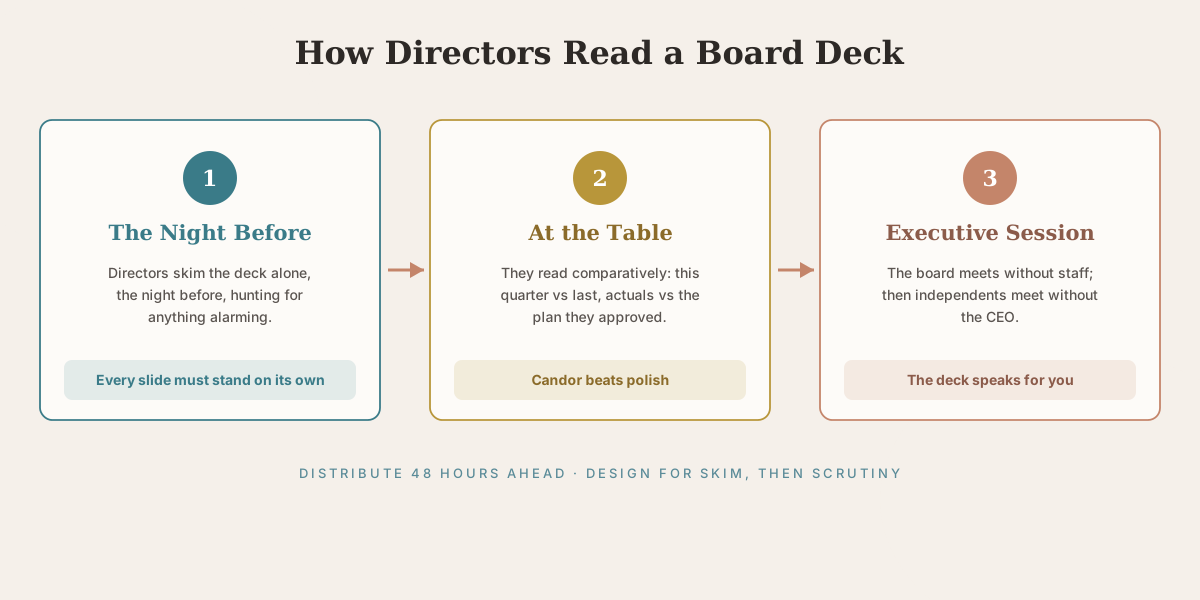
The night before (the pre-read). Conscientious directors read the deck the evening before the meeting, alone, skimming for anything alarming. This pass rewards a deck that is self-explanatory on the page — clear conclusion titles, numbers labeled, no slide that only makes sense with your narration. If the deck is distributed at the meeting instead of days ahead, you forfeit this pass entirely and spend the meeting watching directors read instead of discuss.
At the table. During the meeting, directors read comparatively — this quarter against last quarter, actuals against the plan they approved, your framing against their own model. They are listening for the gap between what you say and what the numbers show. This is why a candid deck that names its own bad news outperforms a polished one that buries it: you want to be the one who surfaces the variance, not the one caught hiding it.
The executive session. After the formal agenda, the board often meets without management, then the independent directors meet without the CEO. You are not in the room, so the deck speaks for you. A clear, honest board book is what shapes that conversation in your favor when you are not there to steer it.
The practical takeaway: distribute the deck at least 48 hours ahead, make every slide stand on its own, and design for skim-then-scrutinize rather than for live presentation.
Board Deck Cadence, Length, and the Pre-Read
Most early-stage boards meet every four to eight weeks; growth-stage boards often move to quarterly with lighter monthly updates in between. Match the deck to the cadence — a monthly update can be ten to fifteen pages, while a full quarterly board book runs twenty to thirty pages plus appendix.
Whatever the cadence, protect the pre-read. Send the deck 48 to 72 hours before the meeting so directors arrive having read it. The meeting is then for discussion and decisions, not for narration — the worst board meetings are the ones where the CEO reads thirty slides aloud while directors follow along. A short cover email that names the two or three things you most want the board's input on primes them to engage on the right items. Related recurring-reporting formats — the quarterly business review and the earnings call deck for public companies — follow the same pre-read-then-discuss logic.
Common Board Deck Mistakes
Most weak board decks fail in predictable ways. Watch for these:
- Only good news. A deck with no problems is a deck no director believes. Surfacing your own bad news, with a plan, builds far more confidence than a flawless-looking quarter.
- No clear ask. Directors leave unsure what they decided. Every meeting should have an explicit decisions slide and a closing recap of the asks.
- Comparing to the wrong cohort. Benchmarking against the easiest comparison instead of the relevant one. Show actuals against the plan the board approved, not against a softened internal target.
- Switching metrics. Changing the KPI set when results soften. Keep the dashboard constant.
- Numbers that do not reconcile. A headline cash or ARR figure that disagrees with the appendix. One inconsistency taints the whole deck.
- Reading the deck aloud. Treating a pre-read document as a live script. Distribute early; spend the meeting on discussion.
- No runway clarity. Burying or omitting months of runway and the cash-out date. For a venture board, this is the number that has to be unmissable.
- Drowning the signal in appendix. A 60-page deck with no clear main flow. Keep the spine tight and push detail to the appendix.
Building the Board Deck Efficiently
The board deck is recurring work: the same spine, refreshed with new numbers, every four to eight weeks. That repeatability is exactly what makes it a good fit for a document-first AI workflow, provided the numbers stay grounded in your actual source data.
The efficient pattern starts from your real sources — the monthly financial close, the metrics export from your data warehouse or BI dashboard, the ATS headcount report — rather than from a blank slide and a prompt. A tool like Tosea.ai is built for this source-first path: you upload the closed financials and the operating exports, it parses the tables and figures, you review the extracted numbers, and it assembles them into the standard board-deck structure with every figure traceable to the document it came from. Because the prior quarter's deck shares the same spine, each cycle becomes an update rather than a rebuild.
The non-negotiable is fidelity. A board deck is the one presentation where an invented or rounded-wrong number is a governance problem, not a typo — which is why the source-grounded approach matters more here than anywhere else. We cover the underlying standard in our zero-hallucination AI slides guide. The goal is to spend your prep time on the narrative and the asks — the parts only the CEO can write — not on rebuilding the same charts by hand every cycle.
The Pre-Board Rehearsal
For consequential meetings — a financing decision, a pivot, a budget approval — rehearse before the board sees the deck. A practical sequence:
- Internal dry run. Walk the deck with your leadership team. The CFO pressure-tests every number; the heads of function confirm their slides are accurate and that nothing is being oversold.
- Lead-director preview. Many strong boards have a lead or presiding director. Previewing the deck and the key asks with them a few days ahead surfaces objections early and means you walk into the meeting with an ally who understands the decisions.
- Audit-committee chair check (when relevant). If the meeting touches financials, controls, or compliance, give the audit-committee chair a look at those sections first so technical questions are resolved before the full board.
- Anticipate the hard questions. For each ask, write the toughest question a skeptical director will pose and your answer. The night-before objection you cannot answer is the one that derails the decision.
The previews are not about managing the board — they are about arriving with a deck that has already absorbed the obvious objections, so the meeting can spend its time on the genuinely hard calls.
Board Deck Checklist
Before you send the board book, confirm:
- Deck distributed at least 48 hours before the meeting
- Agenda flags each item as discussion, decision, or consent
- State-of-the-company summary fits on one page
- Every slide title states a conclusion, not a label
- KPI dashboard uses the same metrics as last meeting, shown vs plan and vs prior period
- Cash slide states runway in months and the cash-out date
- Burn shown as a trend, with any increase explained
- People slide names the critical open roles, not just the hires made
- A dedicated decisions slide with options and recommendations
- Asks repeated on a closing slide
- Top risks named with mitigations
- Every headline number reconciles with the appendix
- Bad news surfaced and owned, with a plan
- Appendix holds the detail; the main flow stays tight
Frequently Asked Questions
How long should a board deck be?
Match it to cadence. A monthly update runs ten to fifteen pages; a full quarterly board book runs twenty to thirty pages plus an appendix for detailed financials and cohort tables. Length is less important than a tight main flow — push detail to the appendix and keep the spine readable in a single pass.
What is the most important slide in a board deck?
The decisions slide — the explicit list of what you need the board to decide, each with options, a recommendation, and the cost of waiting. Boards exist to make a few consequential calls; a deck that does not clearly ask for them wastes the meeting.
How is a board deck different from a pitch deck?
A pitch deck persuades new investors to invest; a board deck reports to existing directors who already own a stake and carry fiduciary duty. The board deck is candid rather than aspirational, shows actuals against plan in both directions, and surfaces bad news early instead of minimizing it.
When should I send the board deck?
At least 48 to 72 hours before the meeting, so directors can pre-read. Distributing it at the meeting forfeits the most valuable reading pass and turns the session into narration instead of discussion.
Should I include bad news in the board deck?
Yes — early and owned, with a plan. Directors already model your business; a deck that looks better than their spreadsheet costs you trust. Being the one who surfaces a variance, rather than the one caught hiding it, is how founders build board confidence over time.
How do I build a board deck faster each cycle?
Standardize the spine and start from your real sources — the financial close, metrics exports, and headcount reports — rather than a blank page. A source-first tool like Tosea.ai parses those documents and assembles them into the recurring structure with traceable numbers, so each meeting is an update rather than a rebuild.
Final Thoughts
A board deck earns its keep by doing three things well: reporting the state of the business honestly, making the cash and people picture unmistakable, and asking the board for the decisions only it can make. The founders who run the best board meetings are not the ones with the most polished slides — they are the ones whose decks are candid, consistent quarter over quarter, and clear about the ask.
Build the spine once, keep the metrics constant, surface the hard news before a director finds it, and protect the pre-read so the meeting can be spent on judgment rather than narration. When the numbers come straight from your closed financials and operating data — traceable, reconciled, and refreshed each cycle rather than rebuilt — you spend your preparation where it counts: on the strategy and the decisions. For the source-first path from your financial close and ops exports to a board-ready deck, Tosea.ai is built for exactly this recurring workflow.
Sources
- Writing a Business Plan — Sequoia Capital, on structuring the founder narrative directors expect
- Bessemer Venture Partners — Atlas — BVP, partner memos and board-reporting best practices
- Director Resources and Board Governance — National Association of Corporate Directors (NACD)
- First Round Review — First Round Capital, operating guidance on running board meetings