Academic Conference Presentation Guide: How to Structure a 15-Minute Talk (2026)
How to structure a 15-minute academic conference talk: timing, slide count by discipline, the methodology trap, Q&A tactics, backup slides, and a four-stage rehearsal plan for PhDs and postdocs.
The 15-minute conference talk is the most common, and most underestimated, format in academic life. It is what almost every PhD student, postdoc, and early-career faculty member first gets to deliver in front of an external audience — and it is also the format where the gap between "this person knows their work" and "this person can communicate their work" is most visible.
A 15-minute talk is not a compressed thesis defense. It is not a long lab meeting. It is not a one-slide-per-minute reading of the paper. It is its own genre, with its own conventions, and treating it like any of those adjacent formats is the single most reliable way to lose the room before minute six.
This guide walks through the structure that actually works at conferences, the time allocation that senior faculty expect, the moment in your talk where they decide whether to stay engaged, and the rehearsal plan that turns a rough first draft into a confident delivery. For the related — but very different — case of defending a dissertation, see our Thesis Defense Presentation Guide.
The 15-Minute Talk Is Its Own Genre
Three formats get confused with the 15-minute conference talk. They share surface features and almost nothing else.
Thesis defense is 45–60 minutes of presentation followed by 60–90 minutes of committee Q&A. The audience is three to five people who have read your dissertation. The standard is can you defend every choice you made. Slide count is high (40–60), text density is high, every methodology decision is fair game.
Lab meeting / brown bag is 30–60 minutes with a friendly audience. You can show messy figures, ask the room for opinions, and leave threads unresolved.
15-minute conference talk is none of these. The audience is 30–300 people, most of whom have read at most your abstract, and many of whom are deciding in the first three minutes whether your work is in their conversation or someone else's. The Q&A is 3 to 5 questions in 3 to 5 minutes, often dominated by one or two senior people in the room.
Treating a 15-minute talk like a compressed defense is the most common failure mode. The compression strips the explanatory connective tissue and leaves only the parts that needed the connective tissue. The result is a 15-minute version of a 60-minute talk that nobody can follow.
The 15-minute talk needs to be designed from scratch for its audience and its time budget. The structure below is that design.
Time Allocation: 3 · 4 · 6 · 2
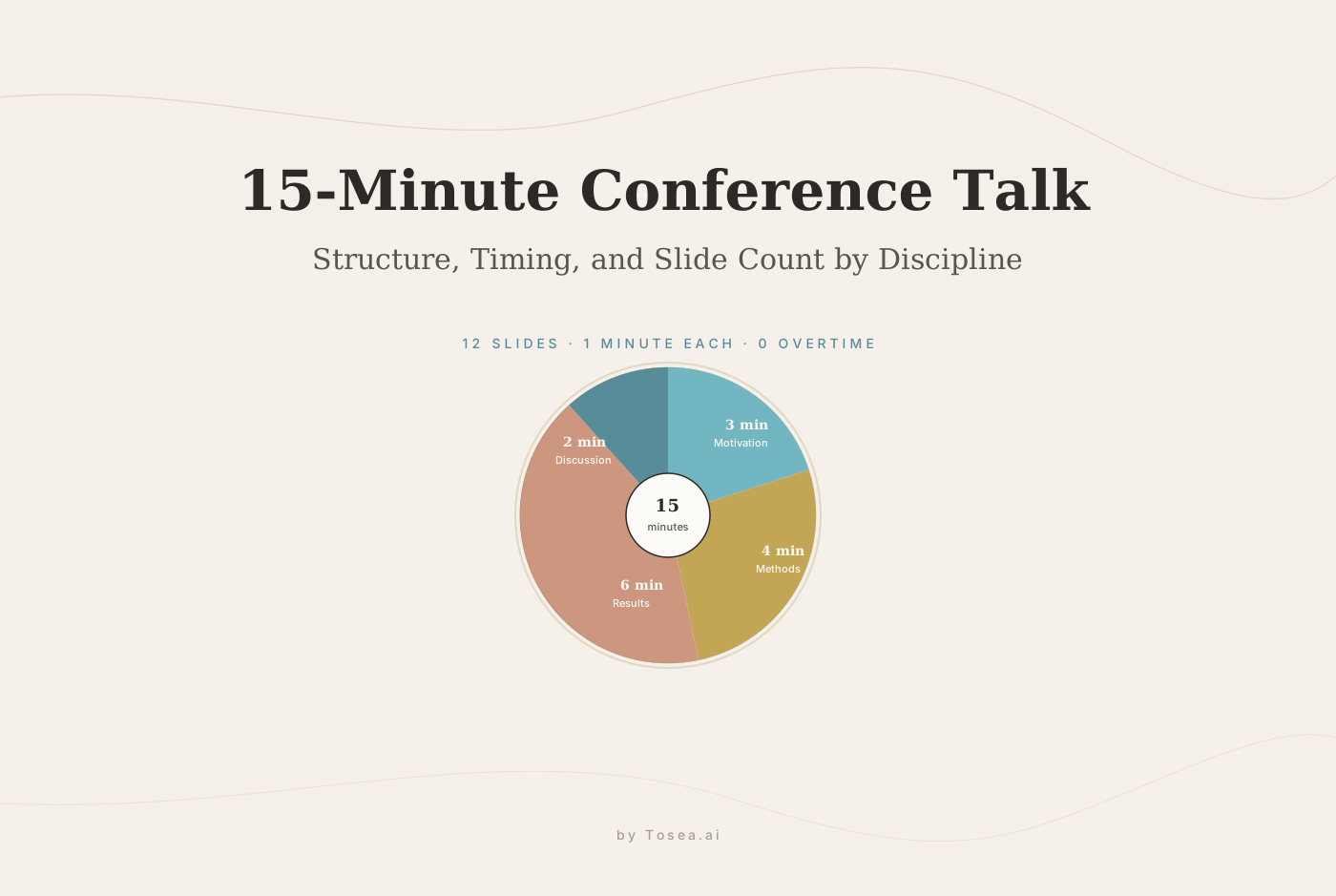
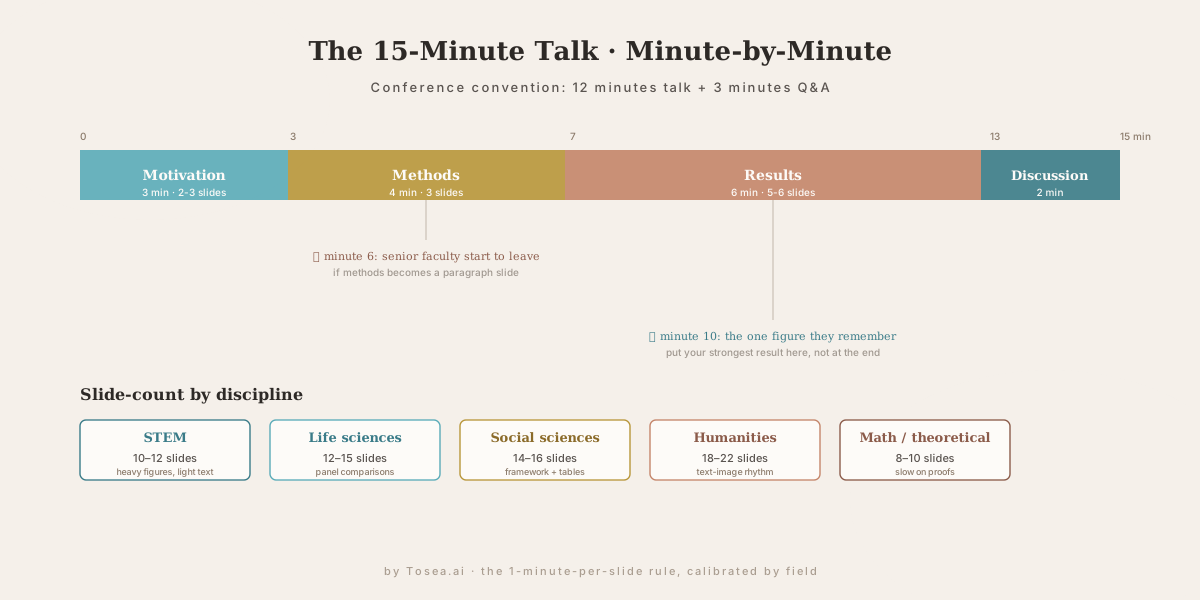
The convention that works across most empirical disciplines is 3-4-6-2:
- Motivation: 3 minutes. Why this question matters and what is missing in current understanding.
- Methods: 4 minutes. How you investigated it — at the level a peer in your subfield can evaluate.
- Results: 6 minutes. What you found, with the strongest result given the most time.
- Discussion: 2 minutes. What it means, limitations, what's next.
Of the 15 minutes, the convention at most conferences is 12 minutes of talk plus 3 minutes of Q&A. Some venues run 10+5 or 8+7. Read the call for papers before you draft. The 3-4-6-2 ratio scales — if you have 10 minutes, it becomes 2-3-4-1.
A few less-obvious calibration notes:
- The motivation slot is the smallest you can defend. Senior faculty will tolerate a thin methods section if motivation is strong; they will not tolerate a thin motivation even if methods are flawless.
- Discussion is the most likely section to get cut by the chair. If you run long, you will lose discussion time. Put your single most important takeaway sentence at the start of discussion, not the end.
- Q&A is part of your talk. Plan answers to the two or three questions you know are coming. Do not improvise the answer to the question every member of your committee has already asked you.
For the underlying logic of which takeaway should be the takeaway, The McKinsey Way to Present Research Findings covers the conclusion-first principle that applies as cleanly to a conference talk as it does to a consulting deck.
Slide-Count Formulas: The 1-Minute Rule and When to Break It
The one-minute-per-slide rule is the most widely repeated rule in academic presentation training. It is approximately correct, and it is wrong in two specific places.
The default: 12 slides for a 12-minute talk. One title, one motivation, one gap, one methods overview, one to two methods detail, three to five results, one discussion, one acknowledgments.
Break the rule by going slower on:
- Theorem statements and proof sketches in math and theoretical CS. A single proof slide may need two minutes.
- Apparatus / experimental setup diagrams in physics and chemistry. The audience needs to actually understand the geometry before you talk about the result.
- The single most important results figure. It is fine to spend 90 seconds on the one slide your talk is really about.
Break the rule by going faster on:
- The roadmap / outline slide. Skip it entirely, or use 10 seconds. Outline slides are a relic of times when audiences could not see the talk title on a printed program.
- Section dividers. They look professional in a defense but waste time in a conference talk.
- Acknowledgments and questions. 15 seconds. The audience is already deciding which question to ask.
Discipline-specific slide-count conventions — the rule does not scale linearly across fields:
| Discipline | Typical slide count for 12-min talk | Why it differs |
|---|---|---|
| STEM (CS, applied physics, engineering) | 10–12 | Heavy figures, light text; high information density per slide |
| Life sciences | 12–15 | Panel comparisons (A/B/C/D) treated as one slide-equivalent |
| Social sciences | 14–16 | Framework diagrams plus regression tables need separate slides |
| Humanities | 18–22 | Text-image rhythm; each quote often gets its own slide |
| Math / theoretical | 8–10 | Slow pace on definitions and proofs |
If your subfield has a standard, follow it. Showing 22 slides at a CS conference looks unprepared; showing 9 slides at a literature conference looks lazy.
The Methodology Trap (Why Senior Faculty Leave at Minute 6)
There is a specific failure mode that recurs in 15-minute talks: at around minute six, the room loses interest. Eye contact drops, phones come out, the senior faculty in the front row start checking the program for the next talk.
The cause is almost always the same: the methods section turned into a paragraph slide.
The trap: The presenter, anxious that their methods will be judged, tries to pre-empt every possible question by including every parameter, every preprocessing step, every model variant, every robustness check, every hyperparameter range. The result is a slide with eight bullets and twelve sub-bullets, and a presenter who reads each one aloud.
What the audience needs: Enough method to evaluate your result at the level of do I trust this number. Not enough method to reproduce your code from the slide. Reproducibility lives in the appendix and the paper.
The fix: Two methods slides, maximum, in a 15-minute talk. The first slide says here is what we did, in one figure. The second slide says here are the two or three design choices a reviewer would push on, and here is why we made them. Everything else is in backup.
This is the most important paragraph of this guide. If you do nothing else, do not let your methods section become a wall of text.
Q&A: Three to Five Questions in Three to Five Minutes
Conference Q&A is fundamentally different from defense Q&A. At a defense, your committee has read your dissertation and is testing whether you can defend every page. At a conference, the audience has heard your 12-minute talk and is asking what occurred to them in the last 12 minutes.
This means three things:
-
The questions are predictable. Most conference questions fall into four categories: did you consider this confounder, how does this compare to that other paper, what happens at the limit, and what is the next step. Prepare one or two slides for each. Have them in backup so you can pull them up if asked.
-
The first question is rarely the hardest. It is usually the most senior person warming up. The second or third question is often the one that decides whether the talk goes well. Do not relax after answering question one.
-
Answer concisely, then stop. A long answer eats Q&A time and signals defensiveness. A 30-second answer signals confidence. If the questioner wants more, they will ask.
The single best Q&A move is to repeat the question before answering. It buys you 5 seconds to think, it makes sure the audience heard the question, and it lets you reframe a hostile question into the version you can answer.
Backup Slides: The Invisible Infrastructure
Every well-prepared 15-minute talk has 10 to 30 backup slides. The audience never sees them unless asked. This is what makes the difference between a presenter who looks confident and a presenter who looks lucky.
Standard backup slides:
- The methods appendix. Full hyperparameter table. Preprocessing pipeline. Computational cost. Hardware. Random seed handling.
- The robustness checks. Three or four robustness checks of your main result, with the figure for each.
- The counterfactuals. "What if you used the other dataset / metric / specification?" Pre-prepared answers.
- Comparison with the obvious adjacent paper. If there is a paper everyone in the room has read that your work relates to, have one slide that compares.
- The limitation slide you didn't show. Your true list of limitations, longer than the one in the main talk.
Backup slides should be numbered (e.g., A1, A2, A3) so you can jump to them by slide number rather than scrolling. Most conference setups allow this.
Discipline-Specific Notes
Computer science (NeurIPS, ICML, CVPR, ACL). The audience expects benchmark numbers on screen by minute four. If your single best benchmark comparison is not visible by then, you have lost the senior reviewers who came specifically to compare your method to theirs.
Life sciences (ASCB, Society for Neuroscience). Audience expects experimental design diagrams up front. Methods slides without a clear schematic are read as sloppy. Statistical annotation (n, p-value, error bar definition) is expected on every quantitative figure — its absence is read as the result not surviving review.
Economics and finance (AEA, NBER, AFA). Identification strategy slide is critical. The room cares more about whether your causal claim is identified than about the size of the effect. If you have a clean instrument, RD design, or DiD setup, that slide deserves a full minute.
Math (JMM, SIAM). Slow down on definitions. The audience will tolerate fewer slides if each slide is one clean idea. The room will leave if you skip over a definition because "we all know this" — the audience varies in seniority more than you think.
Humanities (MLA, AHA). Text-image rhythm matters more than slide count. A primary-source quote deserves its own slide, with the quote large enough to be read from the back row.
Building the Conference Deck From Your Paper
Once you have a full paper, the conversion to a conference talk is not a copy-paste operation. The paper's structure is wrong for the talk:
- Abstract → not a slide.
- Introduction → becomes the motivation slide (1 slide, not 6 paragraphs).
- Literature review → becomes a single "what was missing" slide, or no slide at all.
- Methods → becomes 1–2 slides (full methods stays in backup).
- Results → becomes 5–6 slides, ordered by importance to the audience, not order in the paper.
- Discussion → becomes the takeaway slide.
Tosea.ai handles this restructuring directly. Upload the paper (PDF, Word, or LaTeX export) and the platform reads the logical structure of the document — which sections carry the evidentiary weight, where the data tables and figures are, and what the paper's central contribution is. It then generates a conference-format deck (not a compressed paper) with every slide element traceable back to the source section. We covered this workflow in more detail in Research Paper to Slides Workflow and Academic Researchers Cutting Presentation Time with AI.
For PhDs and postdocs who present at multiple conferences a year, this is the part of the workflow that compounds. Each new conference deck no longer starts from the paper; it starts from the previous deck with adjusted emphasis for the new audience. The free-trial path for academics is documented in our Ultimate AI Slides Tool Free Trial Guide for Academics, and the broader case for AI-assisted academic decks is in Mastering High-Quality Presentations with AI.
The Rehearsal Plan: Four Stages
A well-rehearsed 15-minute talk has been delivered, in full, at least four times before the actual conference:
Stage 1 — Solo, recorded, week of conference. Stand up, set a timer, deliver the full talk to an empty room while recording your screen. Watch the recording. Note where you slow down, where you speed up, where the slide does not match what you are saying. Edit slides accordingly.
Stage 2 — Lab / departmental practice talk, 5–7 days out. A real audience of 4 to 10 colleagues. They will catch the things you missed. The most valuable feedback is not about the science — it is about which slides confused them and where the energy dropped.
Stage 3 — Advisor / senior collaborator review, 2–3 days out. This is the meeting where the talk's framing gets fixed. Senior researchers will tell you if your contribution is being undersold, if your comparison-to-prior-work slide is missing a paper that the audience will care about, or if your motivation slide is too inside-baseball.
Stage 4 — Day-before solo, in the venue if possible. A final timed run with the actual slides, the actual clicker, and ideally on a screen the same size as the conference room. Test the laser pointer. Test the timer. Test the transition animations that might break on the conference projector.
The single most common cause of a talk going badly is not the science — it is that the presenter has only delivered the talk once, in their head, on the morning of. Four stages, no exceptions.
For posters that complement the talk (common in life sciences and engineering), see our Free Academic Poster Template PPT Guide.
FAQ
Q: My conference allows 20 minutes instead of 15. Does the 3-4-6-2 ratio still hold?
Approximately, yes. Scale to 4-5-8-3 for a 20-minute slot. The motivation slot scales sub-linearly — even with 20 minutes, motivation should not exceed 4 minutes, because the marginal minute on motivation adds less than the marginal minute on results.
Q: How do I handle the case where my "result" is actually three separate results?
Pick one. Lead with it. Treat the other two as backup if they come up in Q&A. A 15-minute talk that tries to convey three separate findings conveys none of them. Choose the result that is most surprising to the audience or that most directly addresses the gap you opened in motivation.
Q: What if I have a co-author and we are splitting the talk?
Don't, if you can avoid it. Two presenters in a 15-minute talk is almost always worse than one. If institutional constraints require it (e.g., advisor and student both expected to speak), have the advisor do the 1-minute motivation and the 1-minute discussion, and the student do everything in between. The handoff cost is high; minimize it.
Q: How is the conference talk different from the thesis defense?
The defense has a small expert audience, allows long methodology, expects defense of every choice, and runs 45+ minutes. The conference talk has a large mixed audience, requires compressed methodology, expects clarity of contribution, and runs 12 minutes plus Q&A. The structures are not interchangeable. See our Thesis Defense Presentation Guide for the defense format.
Q: I'm presenting at an interdisciplinary venue. Whose conventions do I follow?
Default to the conventions of the audience's median discipline, not your own. A computer scientist presenting at a clinical conference uses clinical conventions (CONSORT, K-M curves, blue-gray palette), not NeurIPS conventions. Your discipline can wait for your subfield's conference.
Closing Thought
A 15-minute talk is not a small thing. It is the most common piece of academic communication you will deliver across your career, and it is the format in which your work is most often introduced to a new audience.
The structure above — 3-4-6-2, 12 slides, two methods slides maximum, backup slides for the predictable questions, four rehearsal stages — is not the only way to do a conference talk. It is the way that works most reliably across disciplines, audiences, and career stages.
When the paper is finished and the conference deck needs to be built, Tosea.ai is the document-to-deck layer for the restructuring step. The rest — the rehearsal, the Q&A prep, the calibration to your audience — is the part that still belongs to you.
Sources
- Nature Career Toolkit: How to give a great scientific talk — Nature, on time allocation and slide design for conference presentations
- AEA Conference Presentation Guidelines — American Economic Association, on identification-strategy emphasis in economics talks
- SIAM Conference Speaker Guidelines — Society for Industrial and Applied Mathematics, on pacing for mathematical talks
- Cambridge Researcher Development Programme: Presentation Skills — University of Cambridge, on discipline-specific conventions
- HHMI Making the Right Moves: Presenting Your Research — Howard Hughes Medical Institute, on rehearsal protocols for early-career researchers
- Academic Conferences in 2026: A Reference List — ACM and adjacent professional societies on conference Q&A norms