How to Present a Grant Proposal: NIH/NSF Slide Structure Guide (2026)
How to present an NIH or NSF grant proposal as slides: turn Specific Aims, Significance, Innovation, and Approach into a deck for mock study sections, chalk talks, and program-officer meetings.
A grant proposal is a written document, but it almost never stays on the page. Before it reaches a study section, you present it — to a mock review panel in your department, to colleagues in a pre-submission review, to a program officer who wants to hear the concept before you commit a year of effort, sometimes to a hiring committee during a chalk talk. In each of those rooms, the people deciding your fate are reading slides, not your twelve-page Research Strategy. The deck that wins funding is the one that mirrors the logic reviewers will eventually score — and surfaces it fast enough to survive a tired reviewer's attention span.
This guide covers how to structure a grant proposal presentation for the two systems most U.S. researchers face: the National Institutes of Health (NIH) and the National Science Foundation (NSF). We map each section of the proposal to specific slides, explain how the 2025 NIH simplified review framework and NSF's two merit-review criteria change what belongs on screen, and show a source-first workflow for turning the proposal you already wrote into a deck without inventing claims. If you also present finished science, our guides to the academic conference 15-minute talk and the thesis defense presentation cover the adjacent formats.
Where You Actually Present a Grant Proposal
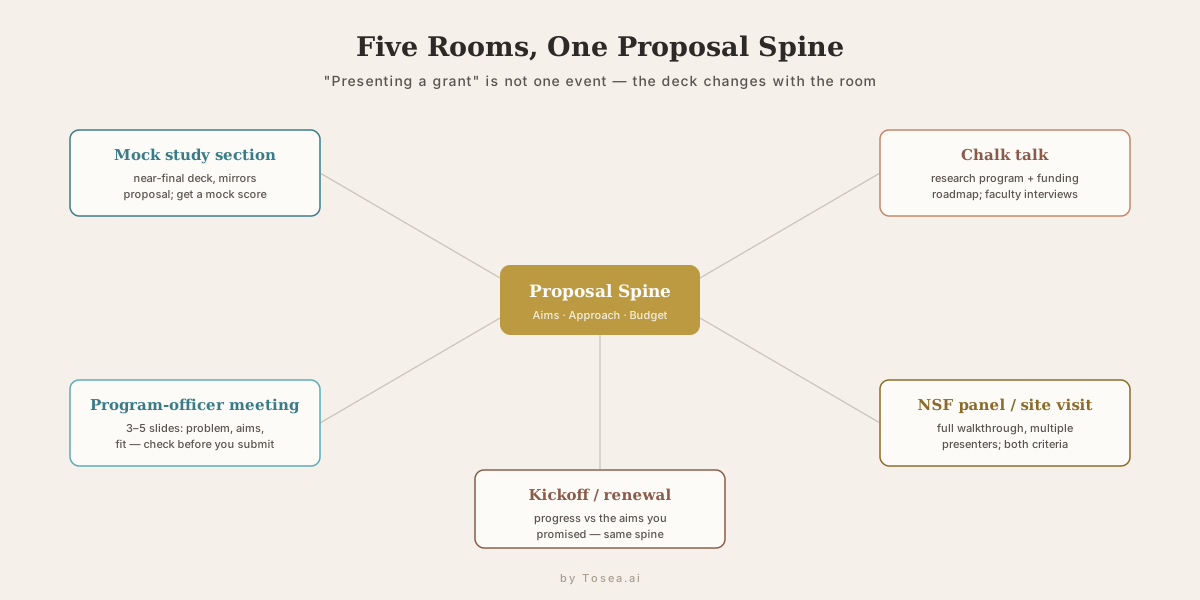
"Presenting a grant" is not one event. The deck changes depending on the room, and confusing the contexts is the first mistake.
- Internal pre-submission review / mock study section. Your department, center, or grants office assembles colleagues to role-play reviewers weeks before the deadline. This is the highest-leverage rehearsal you get — the audience reads like a real panel and gives you a preliminary impact score. Your slides should be near-final and mirror the proposal exactly.
- Chalk talk. Common in faculty job interviews and for early-career investigators, the chalk talk pitches your research program and the grants that will fund it. It is sometimes literally a whiteboard with no slides, but a clean backup deck of Specific Aims and a funding roadmap is increasingly expected.
- Program officer meeting. Before you submit, you email a one-page Specific Aims or a short concept and ask a program officer whether it fits the institute or directorate. If a call happens, three to five slides — problem, aims, fit — are plenty.
- NSF panel and reverse site visits. Large center grants, training grants, and some NSF mechanisms involve a live panel or a site visit where the team presents. Here the deck is a full proposal walkthrough delivered by multiple people.
- Funded-project kickoffs and renewals. Once funded, you present progress against the aims you promised — a different deck, but built on the same spine, which is why getting the structure right the first time pays off for years.
The common thread: in every context, reviewers map what you say onto the criteria they are required to score. So before building slides, you have to know exactly what those criteria are.
How NIH and NSF Reviewers Actually Score You
Your slides are not graded on design. They are graded against published criteria, and the two agencies score differently. If your deck doesn't visibly answer each criterion, reviewers have to hunt for it — and hunting lowers scores.
NIH: the 2025 simplified review framework
For application due dates on or after January 25, 2025, NIH reorganized its five regulatory criteria (Significance, Investigators, Innovation, Approach, Environment) into three factors, under the policy notice NOT-OD-24-010:
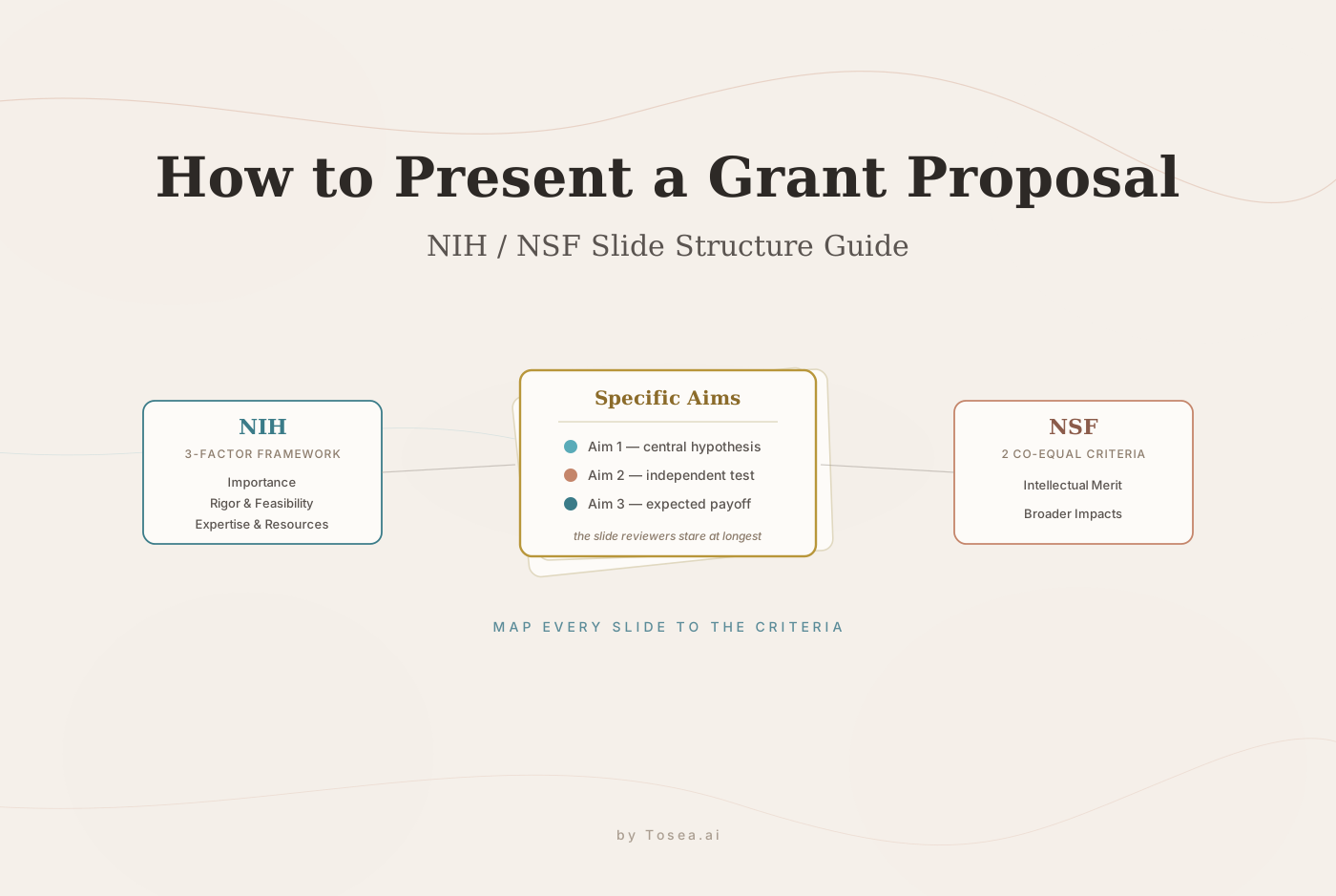
- Factor 1 — Importance of the Research (Significance + Innovation). Scored 1–9. Is this worth doing, and is the approach to the problem novel?
- Factor 2 — Rigor and Feasibility (Approach). Scored 1–9. Are the methods sound, rigorous, and likely to work?
- Factor 3 — Expertise and Resources (Investigators + Environment). Not scored numerically — evaluated only as sufficient or not for the proposed work, with an explanation required if not.
These roll into an Overall Impact score from 1 (exceptional) to 9 (poor), and only roughly the top half of applications discussed get a score at all. Rigor and reproducibility — including consideration of relevant biological variables such as sex — live inside Factor 2, so your Approach slides carry double weight.
NSF: two co-equal merit-review criteria
NSF (under the Proposal & Award Policies and Procedures Guide, PAPPG) uses two criteria of equal weight: Intellectual Merit (potential to advance knowledge) and Broader Impacts (potential to benefit society). Reviewers consider the same five elements for each: what you want to do, why it matters, how you'll do it, how you'll know whether you succeeded, and what benefits would result. The decisive difference from NIH is that Broader Impacts is not a footnote — a brilliant idea with a thin broader-impacts plan gets dinged hard.
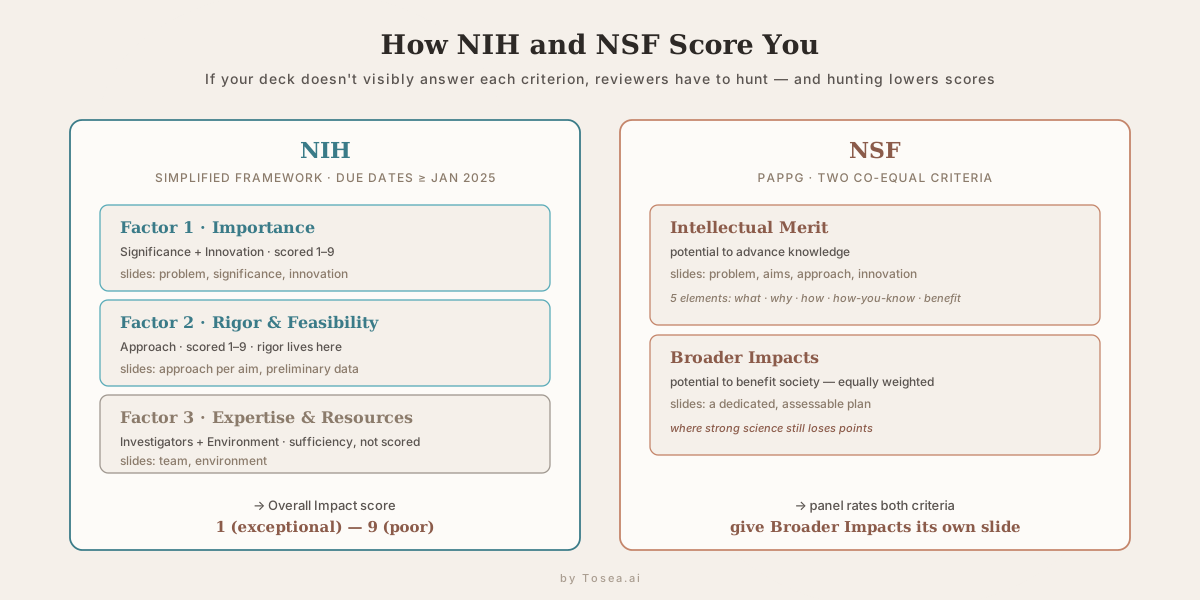
The practical takeaway: an NIH deck is weighted toward importance and rigor, while an NSF deck must give Broader Impacts its own real estate, not a single bullet at the end.
The Grant Proposal Deck Spine
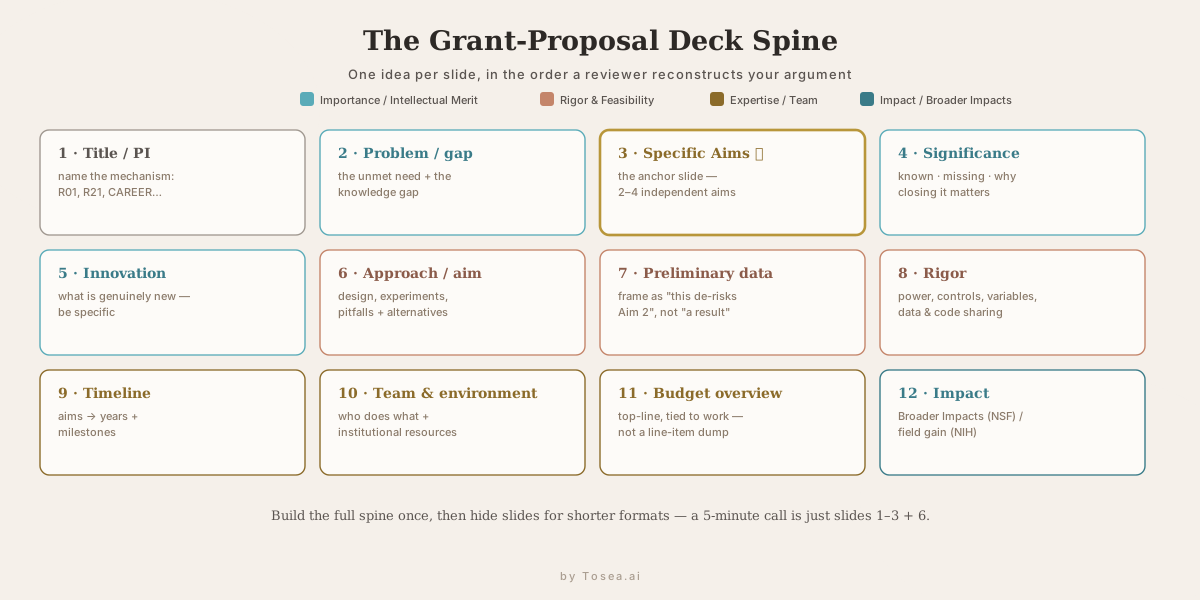
A strong proposal deck follows the same spine as the written proposal, one idea per slide, in the order a reviewer reconstructs your argument. For a 20–30 minute mock study section, aim for roughly 15–22 content slides; for a 5-minute program-officer call, the first four slides below are the whole deck.
- Title / PI slide. Project title, PI and key personnel, institution, mechanism (R01, R21, NSF CAREER, etc.). Reviewers want to know the funding vehicle immediately because it sets their expectations.
- The problem / gap. One slide that states the unmet need and the knowledge gap. This is the opening of your Significance argument.
- Specific Aims. The single most important slide (covered in depth below).
- Background & Significance. What's known, what's missing, why closing the gap matters. Maps to NIH Factor 1 / NSF Intellectual Merit.
- Innovation. What is genuinely new — concept, method, model, or tool. Be specific; "novel" is not an argument.
- Approach, one slide per aim. For each aim: hypothesis, design, key experiments or analyses, expected outcomes, and — critically — potential pitfalls with alternative strategies. This is NIH Factor 2 territory and usually the longest stretch.
- Preliminary data. Evidence that you can do what you propose and that your hypothesis is plausible. Frame each figure as "this de-risks Aim 2," not "here is a result."
- Rigor & reproducibility. Sample-size justification, controls, blinding, biological variables, data and code sharing. Reviewers now look for this explicitly.
- Timeline & milestones. A Gantt-style view tying aims to years and decision points.
- Team & environment. Who does what, complementary expertise, institutional resources. Maps to NIH Factor 3 / NSF qualifications.
- Budget overview. Top-line numbers tied to the work, not a line-item dump (see formatting note below).
- Broader Impacts (NSF) or impact statement (NIH). For NSF, a dedicated slide with a concrete, assessable plan. For NIH, a closing statement of what the field gains.
You do not present every slide in every room — but you build the full spine once, then hide slides for shorter formats. The same source-to-structure discipline we describe for turning a research paper into slides applies here: the proposal is the source of truth, and the deck is a faithful compression of it.
The Specific Aims Slide: Your Most Important Slide
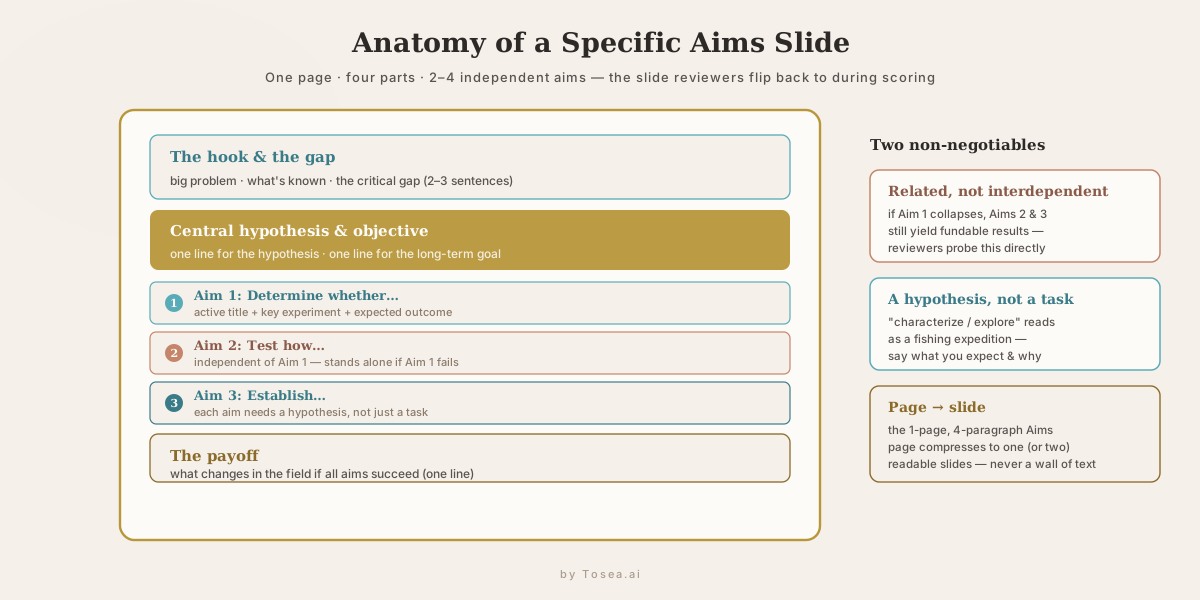
In the written proposal, the Specific Aims page is one page, four paragraphs, and 2–4 aims. In the deck, it is the slide reviewers stare at longest and the one they flip back to during scoring. Get it right and the rest of the deck is a guided tour; get it wrong and reviewers are lost for the next fifteen minutes.
The classic four-paragraph Aims page maps cleanly onto one or two slides:
- Paragraph 1 — the hook and gap. Two or three sentences: the big problem, what's known, the critical gap. On a slide, this is a single headline plus one visual of the gap.
- Paragraph 2 — the central hypothesis and overall objective. State the hypothesis in one line and the long-term goal it serves.
- The aims themselves — 2 to 4, each with an active title. "Aim 1: Determine whether…" not "Aim 1: Experiments on…". Under each, one line on the key experiment and the expected outcome.
- Paragraph 4 — payoff. What changes in the field if all aims succeed.
Two non-negotiable rules carry over from the page to the slide. First, aims must be related but not interdependent — if Aim 1 collapses, Aims 2 and 3 should still produce fundable results. Reviewers actively probe this dependency. Second, each aim needs a hypothesis, not just a task; an aim that only "characterizes" or "explores" reads as a fishing expedition.
A common and effective layout is a central hypothesis box with the aims arranged around or beneath it, plus a one-line payoff. That single visual does more work than any other slide in the deck.
NIH vs NSF: What Changes in Your Deck
The spine is shared, but four things shift between agencies.
- Where the weight goes. NIH decks lean into Significance/Innovation (Factor 1) and Approach/rigor (Factor 2). NSF decks must balance Intellectual Merit against an equally weighted Broader Impacts.
- Broader Impacts. NSF wants a concrete, assessable plan — outreach, training, broadening participation, curriculum, public engagement — with a mechanism to measure success. Give it a full slide. On the NIH side, the closest analog is the public-health or field-level impact statement, which is lighter.
- Rigor language. NIH reviewers are trained to look for scientific rigor, sex as a biological variable, authentication of key resources, and a data-management/sharing plan. Build a slide for it. NSF's data-management-and-sharing plan and (for many programs) mentoring plans are supplementary documents, but reviewers expect to see them acknowledged.
- Page and time discipline. An NIH R01 gives you a one-page Aims and a twelve-page Research Strategy; an NSF proposal typically allows a fifteen-page Project Description. Your deck should compress, not transcribe — reviewers have read the document, and the talk is where you make the argument land.
How Reviewers Read Your Deck
Understanding the room changes what you put on each slide.
In an NIH study section, only two or three assigned reviewers read your full application; the rest of the panel hears a few minutes of discussion and votes. That means your assigned reviewers need slides dense enough to defend you, while the wider panel needs a clear story they can absorb in three minutes. The opening problem slide and the Aims slide do most of the work for the panel; the Approach and preliminary-data slides arm your advocates.
In an NSF panel, reviewers discuss your proposal against both criteria and a panel summary is written. The Broader Impacts slide is where proposals with strong science still lose points, because teams treat it as an afterthought.
In a mock study section, the goal is to earn an honest preliminary score and a list of the objections real reviewers will raise — so you can fix them before submission. Treat every hard question as a gift. The discipline of presenting to a skeptical room is the same one we describe in the McKinsey way to present research findings: lead with the answer, structure the evidence, and make the logic inspectable.
Common Mistakes That Cost Scores
- A wall-of-text Aims slide. If reviewers have to read four paragraphs, you've lost the room. Compress to a headline, a hypothesis, and active aim titles.
- Interdependent aims. If Aim 2 can't happen unless Aim 1 works, the whole proposal is one risky bet. Restructure so each aim stands alone.
- Aims without hypotheses. "Characterize," "explore," and "investigate" signal a fishing expedition. State what you expect to find and why.
- Preliminary data presented as results, not as de-risking. Every figure should answer "why should reviewers believe this approach will work?"
- Skipping rigor. No sample-size justification, no controls, no mention of biological variables — Factor 2 reviewers will notice the absence.
- Thin Broader Impacts (NSF). A single bullet about "training students" is not a plan. Name the activity, the audience, and how you'll measure it.
- Budget that doesn't match the work. If the Approach implies three postdocs and the budget funds one, reviewers see a feasibility problem.
- Inconsistent numbers across slides. A KPI or sample size that differs between the Aims slide and the Approach slide destroys trust — the same consistency discipline that makes hallucination-free document-to-deck conversion matter for any high-stakes deck.
Discipline-Specific Notes
- Biomedical (NIH R01/R21). Lead with the disease burden and the mechanistic gap. Reviewers expect rigor, sex-as-a-biological-variable, and a clear translational arc. R21s are exploratory — don't over-promise preliminary data you don't have.
- NSF STEM (CAREER, standard grants). For CAREER awards, the integration of research and education is the whole point; your education plan is not a bolt-on. Make Broader Impacts a first-class slide.
- Social and behavioral sciences. Sampling, measurement validity, and analysis plans get scrutinized. Show your power analysis and how you'll handle confounds.
- Training grants (T32, F, K) and fellowships. The "deck" is often about the candidate and the training environment as much as the science. Mentors, milestones, and career trajectory deserve their own slides.
- Large center and program-project grants. Multiple PIs present; the integration slide — how cores and projects connect — is the one reviewers remember.
From Proposal Document to Deck: A Source-First Workflow
The slowest, most error-prone part of grant presentation is rebuilding the deck by hand from a document you already wrote — copying the Aims, re-typing the budget, re-drawing the timeline, and quietly introducing version drift between the proposal and the slides. That drift is exactly what reviewers catch.
A source-first AI workflow inverts the order: start from the finished proposal — the Specific Aims page, the Research Strategy or Project Description, the budget justification — and generate a draft deck whose structure is anchored to that document, not to a one-line prompt. Because the slides are built from your actual text, the numbers, aim titles, and timeline stay consistent with what reviewers will read. Tosea.ai works at this layer as a document-to-deck orchestration step: it takes the proposal PDF or draft and produces a structured slide deck — Specific Aims, Approach-by-aim, preliminary data, budget — that you then refine, rather than building from a blank canvas.
For grant work specifically, the priority is fidelity over flourish. Our guide to zero-hallucination AI slides explains why a deck that invents a statistic is far more dangerous in a study section than an ugly one, and our overview of mastering high-quality presentations with AI covers the refinement pass. If you want to test the workflow on a real proposal before a deadline, the AI slides free-trial guide for academics walks through a first run, and researchers who've adopted this approach describe cutting presentation prep from hours to minutes. For the prompt patterns that work on academic content, see our field-specific academic slide prompts.
The rule is the same one that governs the proposal itself: every claim on a slide must trace back to a source you can defend. AI accelerates the build; your judgment owns the science.
Pre-Submission Rehearsal Plan
Treat the presentation as a dress rehearsal for the review, not a formality.
- Solo run-through (2–3 weeks out). Time it, and cut any slide that doesn't advance the Aims. If you can't explain a slide in 30 seconds, simplify it.
- Advisor or co-PI review (2 weeks out). Focus on whether the aims are independent and the hypotheses are testable.
- Mock study section (10–14 days out). Recruit colleagues to score you against the actual NIH factors or NSF criteria. Collect every objection. This is where you find the fatal flaw while you can still fix it.
- Grants office / compliance check (1 week out). Budget, biosketches, data-management plan, human-subjects or animal sections — the administrative pieces that sink otherwise-fundable proposals.
- Day-before solo polish. Verify number consistency across slides, check that every figure has a one-line takeaway, and confirm your backup slides answer the predictable hard questions.
Final Checklist
- Title slide names the mechanism (R01, CAREER, etc.)
- One problem/gap slide before the Aims
- Specific Aims on one readable slide; aims have active titles and hypotheses
- Aims are related but independent
- One Approach slide per aim, each with pitfalls + alternatives
- Preliminary data framed as de-risking, not just results
- Rigor & reproducibility slide present (NIH) / acknowledged (NSF)
- Broader Impacts gets a full slide (NSF)
- Timeline ties aims to years and milestones
- Budget matches the scope of work
- Numbers are identical across every slide
- Backup slides ready for predictable objections
Frequently Asked Questions
How many slides should a grant proposal presentation have?
For a 20–30 minute mock study section, aim for 15–22 content slides — roughly one per proposal section plus one Approach slide per aim. For a 5-minute program-officer call, four slides (problem, aims, approach summary, fit) is enough. Always build the full spine, then hide slides for shorter formats.
What is the most important slide in a grant deck?
The Specific Aims slide. Reviewers stare at it longest and flip back to it during scoring. It must show the gap, the central hypothesis, 2–4 independent aims with active titles, and a one-line payoff.
How is presenting an NIH grant different from an NSF grant?
NIH (post-2025) scores three factors — Importance, Rigor and Feasibility, and Expertise/Resources — so decks lean on Significance, Innovation, and Approach. NSF uses two co-equal criteria, Intellectual Merit and Broader Impacts, so an NSF deck must give Broader Impacts its own dedicated, assessable slide.
Do I present the whole proposal or just the Specific Aims?
It depends on the room. A program-officer meeting wants the Aims and the fit in a few minutes; a mock study section or NSF panel wants the full spine. Build once, present the subset the context calls for.
Can AI build my grant deck from the proposal?
AI can turn your finished proposal into a structured draft deck quickly, which removes the version drift that comes from rebuilding slides by hand. Use a source-first tool that anchors slides to your actual text, then verify every number and claim yourself — in a study section, an invented statistic is worse than a plain slide.
Sources
- Simplified Peer Review Framework — NIH Grants & Funding
- NOT-OD-24-010: Simplified Review Framework for NIH Research Project Grant Applications — NIH
- Overview of the NSF Proposal and Award Process / Merit Review — U.S. National Science Foundation
- Chapter III: NSF Proposal Processing and Review (PAPPG) — NSF
- Merit Review Criterion: Broader Impacts — NSF
- The Anatomy of a Specific Aims Page — Ohio State University, Institute for Population Research
- Howard Hughes Medical Institute (HHMI) — researcher training and presentation resources