GPT Image 2.5 or GPT Image 3? How OpenAI's Next Image Model Was Named
Settled September 8, 2026: OpenAI shipped ChatGPT Images 2.5 with two API models, gpt-image-2.5-flare and sunburst. The evidence tracker that called it, and what the codenames turned out to be.
Resolved — September 8, 2026. OpenAI announced ChatGPT Images 2.5, with two models on the Images API:
gpt-image-2.5-flareandgpt-image-2.5-sunburst. There is no baregpt-image-2.5model ID and nogpt-image-3; both return a model-not-found error. The "2.5" camp was closer than the "3" camp, but neither predicted a two-model split. We benchmarked both againstgpt-image-2the following morning — see How to Use GPT Image 2.5: Complete Guide to Sunburst and Flare for latency, token, and cost measurements, and for the renamed quality ladder that breaks a naive model-string swap. Everything below this line is the pre-launch record, kept as written on August 22 apart from dated update notes.
Something new is generating images inside Arena's blind battle mode, and nobody outside OpenAI knows what it is called. Since August 9, testers have surfaced two anonymous codenames — mona-lisa-1 and, eleven days later, luna-lisa-alpha — and the community has split into two camps: half are calling it GPT Image 2.5, half are betting on GPT Image 3. Neither name appears in any official OpenAI source.
This page is an evidence tracker, not a hype post. Every claim below is labeled confirmed (primary source we checked directly) or speculation (someone's guess, however popular). We will update it as facts land, and replace it with a full guide the day the model ships — the same way we published our GPT Image 2 complete guide on launch day in April.
Quick Answer
"GPT Image 2.5" is not an official name. As of August 22, 2026, it appears nowhere in OpenAI's SDKs, API changelog, or documentation. What is real: two unnamed image models attributed to OpenAI are in blind testing on Arena, OpenAI has used a .5 version step before (gpt-image-1.5 shipped in December 2025), and the last time Arena codenames appeared, the finished model — GPT Image 2 — launched about fifteen days later. If that pattern repeats, a release could land within days.
Timeline: What Appeared, and When
August 9, 2026 — mona-lisa-1. First reported on X: "A new GPT image model just appeared on Arena called mona-lisa-1. It's extremely better than Image 2." The sighting was amplified the same day by the AI-battle tracking account @AiBattle_ and picked up by prompt testers over the following days. The model appears only in Arena's anonymous battle mode — it has never been listed on the public leaderboard.
August 20, 2026 — luna-lisa-alpha. Reported by @chetaslua, one of the more prolific Arena testers: "luna-lisa-alpha is being tested, this is new checkpoint, last one was monalisa." Within a day it was echoed by several large AI-news accounts. Again: battle mode only, no leaderboard entry, and testers report they hit it in only a small fraction of battles.
What is not on the record. Neither codename appears on Arena's public text-to-image leaderboard, which we pulled directly while writing this: 76 models, with gpt-image-2 (medium) at #1 on 1381±5 Elo. The specific Elo figures circulating in SEO blog posts — "1,393 text-to-image, 1,467 editing" for mona-lisa-1 — have no traceable source anywhere. Treat them as fabricated until someone shows a screenshot with provenance.
The Evidence Audit
Is it OpenAI's model?
For mona-lisa-1 — one hard-evidence-shaped claim, secondhand. On August 9, @AiBattle_ reported that images generated by the model carry an OpenAI SynthID watermark according to OpenAI's own verification tool. We could not independently re-verify this — the attached media was not retrievable, and nobody has published a raw C2PA manifest. Worth knowing: a positive result from OpenAI's provenance tooling means "this image passed through OpenAI infrastructure," not "this is model X specifically."
For luna-lisa-alpha — no metadata evidence at all. Attribution rests entirely on the name rhyming with mona-lisa, testers asserting it feels like a GPT image model, and one genuinely interesting naming observation: OpenAI's current text-model family is gpt-5.6-sol / gpt-5.6-terra / gpt-5.6-luna, where Luna is the low-cost tier. If the luna prefix is meaningful, this could be the small variant of whatever is coming — which would make "GPT Image 2.5" the wrong frame entirely.
The strongest counter-evidence nobody is discussing. A tester ran a knowledge-cutoff probe on mona-lisa-1 and found its world knowledge ends before September 2025 — earlier than GPT Image 2's reported cutoff. That is hard to square with a clean next-generation flagship, and easier to square with a re-tuned checkpoint or a distilled variant.
The skeptics are worth hearing
Not everyone testing these models is impressed. The author of one of the most-read GPT Image 2 field guides asked bluntly whether the community is "suffering from mass delusion," noting GPT Image 2 already does most of what luna-lisa-alpha is being praised for. Another respected tester called the "GPT-Image-2.5" label "obviously insane," arguing the quality delta doesn't even justify a 2.1. And a Japanese fact-check thread reached the same conclusion we did: 公式ソースはゼロ — zero official sources.
How We Verified This
Method matters more than conclusions on a topic where most coverage is recycled guesswork, so here is exactly what we checked, all on August 22, 2026.
For naming: the ImageModel type literal in openai-python (v3.3.1, src/openai/types/image_model.py) and its counterpart in openai-node, read from the repositories directly — not from a blog summarizing them; a GitHub code search across the OpenAI organization for the strings "gpt-image-2.5" and "gpt-image-3"; and OpenAI's API changelog, whose most recent image entry is transparent-background support for gpt-image-2, dated August 20. For the leaderboard claim: Arena's public text-to-image rankings, pulled the same day. For the sightings: the original X posts, opened and read in full rather than quoted from screenshots — which is how we caught one widely shared "OpenAI tease" that turns out to be about Codex usage milestones and never mentions images.
Two things we tried and could not do: independently re-verify the SynthID watermark claim (the attached media was not retrievable), and query Arena's model API for the codenames (the relevant routes return 403). We say so rather than rounding those gaps up to certainty — and that is the standard this page will hold itself to as it updates.
The Naming Question — Why the Keyword Itself Is a Gamble
OpenAI's actual image-model naming history, verified against its documentation and SDK source code:
| Name | API id | Shipped |
|---|---|---|
| GPT Image 1 | gpt-image-1 | April 23, 2025 |
| GPT Image 1 Mini | gpt-image-1-mini | October 6, 2025 |
| GPT Image 1.5 | gpt-image-1.5 | December 16, 2025 |
| GPT Image 2 | gpt-image-2 | April 21, 2026 |
Two things follow. First, the .5 step is genuinely OpenAI's own convention — the December 2025 launch post literally carries a section titled "GPT Image 1.5 in the API," so "GPT Image 2.5" is a plausible real name, not just community invention. Second, nothing confirms it: we checked the ImageModel type in both openai-python and openai-node on the day of writing, and the model list ends at gpt-image-2 plus the evergreen alias chatgpt-image-latest. GitHub code search across the OpenAI org returns zero results for "gpt-image-2.5" and zero for "gpt-image-3."
Four outcomes remain live, ranked by our read of the evidence:
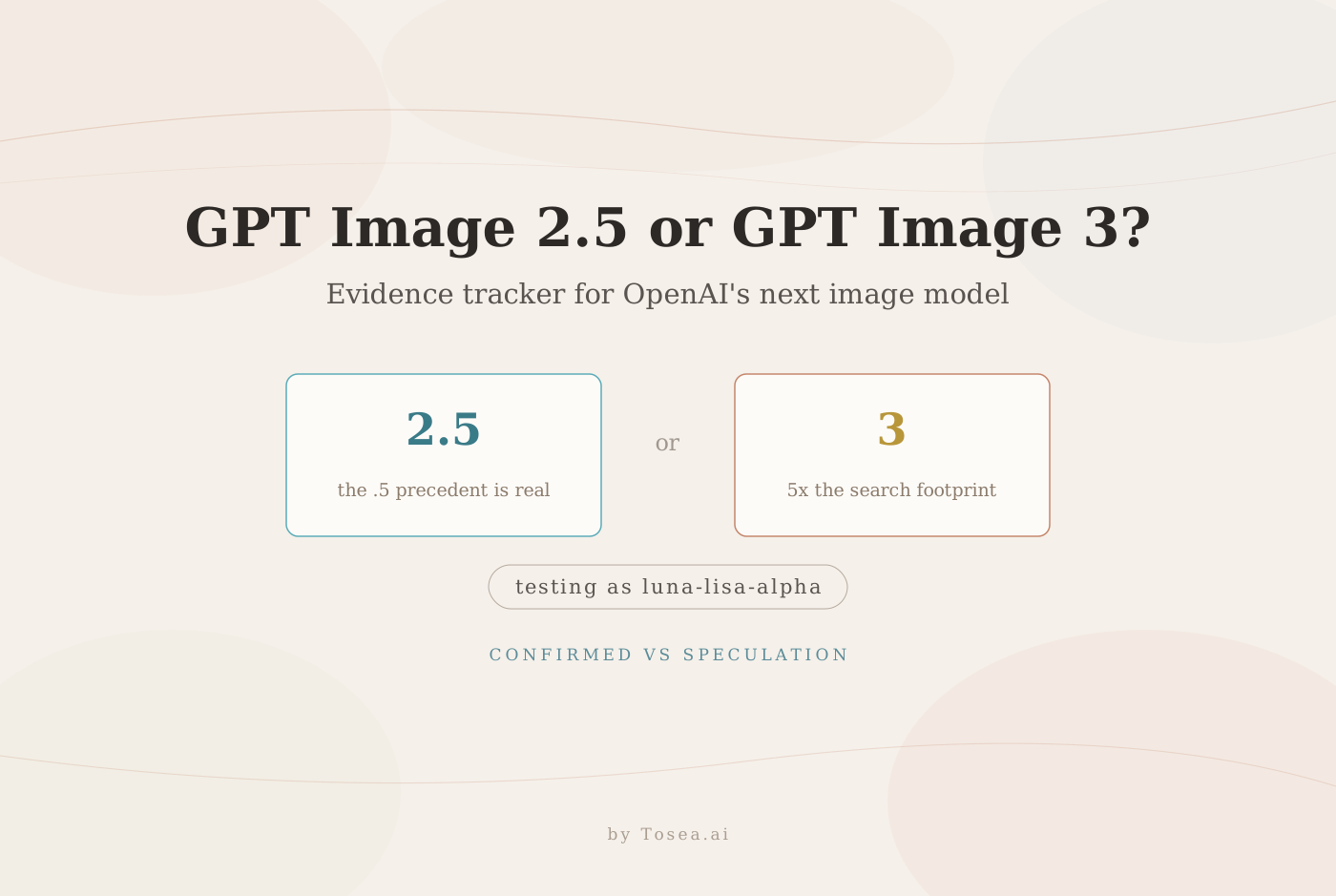
gpt-image-2.5— precedent exists, and 1.5 was itself a mid-cycle bump four months after 1.gpt-image-3— what the other half of the community expects, and the version string with a far larger existing search footprint.gpt-image-2-minior2.1— the reading iflunareally signals a cheap tier; consistent with the older knowledge cutoff.- No new name at all — a silent snapshot bump (
gpt-image-2-2026-XX-XX) rolled intochatgpt-image-latest, marketed as "the new ChatGPT Images." OpenAI has done exactly this before.
Timing: Why This Could Be Days Away
The best signal is precedent. Before GPT Image 2 launched on April 21, 2026, three anonymous codenames — maskingtape-alpha, gaffertape-alpha, packingtape-alpha — ran on Arena starting around April 5–6. Codename to launch: about fifteen days. mona-lisa-1 surfaced on August 9; fifteen days lands on August 24. luna-lisa-alpha, carrying the same -alpha suffix as the tape-era codenames, surfaced August 20.
Supporting cadence: OpenAI has shipped an image model roughly every four months (April 2025, October 2025, December 2025, April 2026), and it has now been four months since GPT Image 2. The next scheduled stage moment is DevDay on September 29, 2026.
What does not exist: staged changelog entries, new SDK strings, new rate-limit tiers, or briefed journalists. One widely shared "tease" from an OpenAI lead turned out, on reading the full post, to be about Codex usage milestones — nothing to do with images. If someone cites it as an image-model signal, they didn't read it.
What the Next Model Has to Beat
Whatever ships will be measured against GPT Image 2, which currently tops Arena's public text-to-image leaderboard. Its strengths are well documented: strong in-image text rendering, reliable instruction following, an editing endpoint that respects references, and predictable per-image token pricing. Its known weaknesses — the areas testers claim the new codenames improve — are fine typographic control at small sizes, texture realism under harsh light, and consistency across multi-image edit chains.
We use GPT Image 2 in production every day to generate presentation visuals, so we hold a live baseline: fixed prompt sets, fixed reference images, measured latency and per-image cost. The day the new model gets an API identifier, we will run the same suite against it and publish the deltas rather than adjectives. Our GPT Image 2 guide documents the current baseline in detail, and our prompt gallery holds the test prompts themselves.
What GPT Image 2.5 (or 3) Would Mean for AI Slide Generation
Image models matter to presentations in one specific way: they decide whether a slide visual is usable or merely pretty. The binding constraints today are in-image text rendering — chart labels, diagram callouts, cover typography — and edit-chain consistency, where a deck needs eight visuals that look like they belong to one design system, not eight lottery tickets.
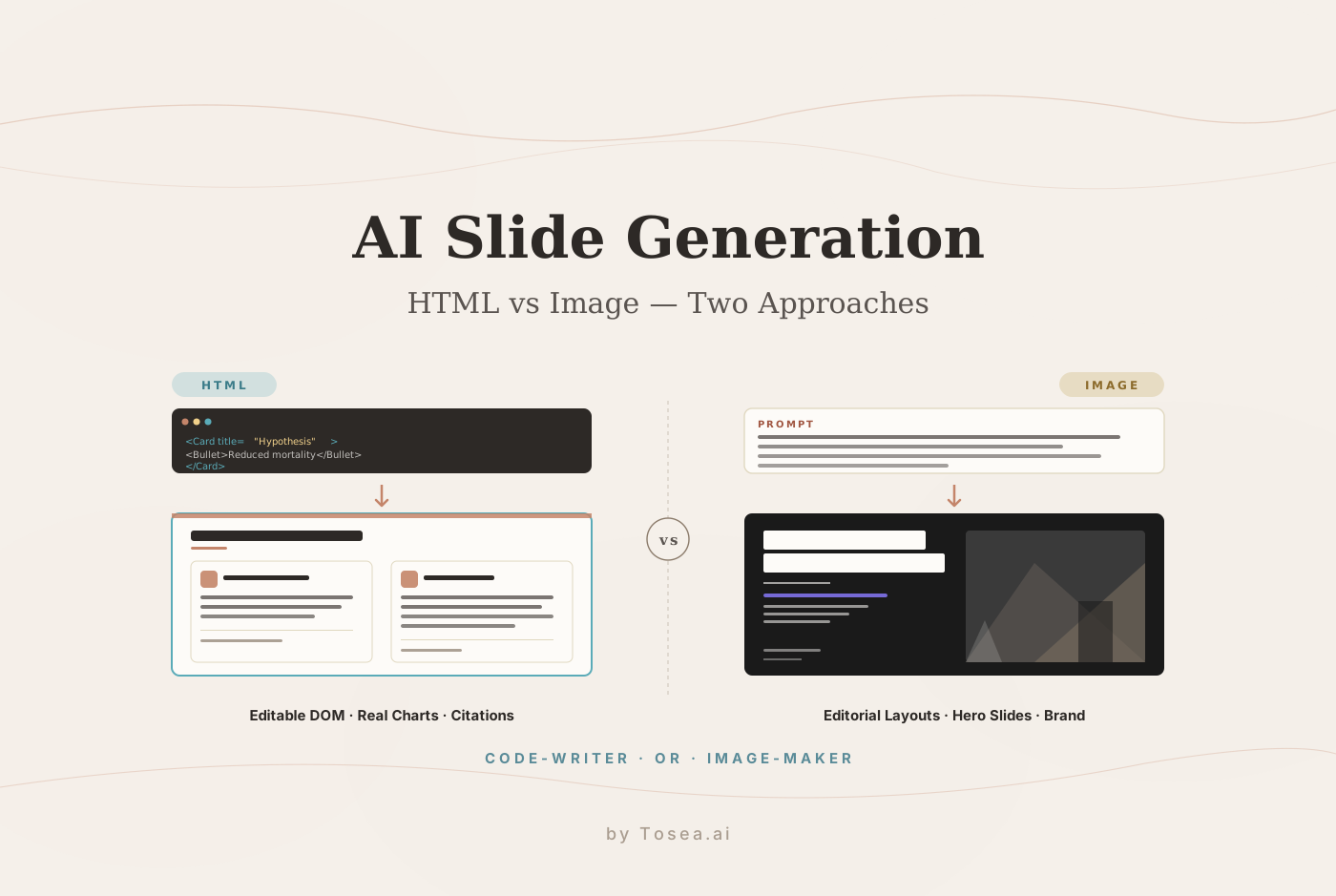
That is why an incremental image-model release can move presentation quality more than a flagship text-model release does. When GPT Image 2 improved text rendering over 1.5, AI-generated slide covers went from "regenerate until legible" to dependable; we wrote up that shift in our HTML vs image slide generation guide. A 2.5-class bump that tightens small-type control and cross-image consistency would compress the remaining gap between generated covers and designed ones — and change the economics of converting generated slides into editable PPTX, where re-render loops are the main cost.
For Tosea AI, the document-to-deck layer sits above whichever image model wins a given month — we swapped image backends twice this year without users noticing, the same way we cover Google's side of this race in our Nano Banana 2 vs Pro comparison. When the new model ships, it gets benchmarked against the same slide-generation suite, and if it wins, it goes into production. That is the practical meaning of a new image model for anyone whose deliverable is a slide deck: not a leaderboard number, but whether your next presentation's visuals need one generation pass or five.
What Launch Day Will Look Like, If April Is a Guide
GPT Image 2's launch is the useful template. On April 21, 2026, the model went live in the API on day one with published per-image pricing, a same-day developer-community announcement, and immediate availability in ChatGPT image generation. There was no waitlist period and no staged regional rollout worth mentioning. Within a day, the Arena codenames were retired and the model appeared on the public leaderboard under its real name; within a week, the launch-day blog posts that ranked were the ones with real parameter tables and real outputs, not the speculation pages that had been squatting the keyword.
Expect the same shape this time: an API identifier appearing in the SDKs within hours of the announcement, pricing that answers the cost question definitively, and a fast collapse of search interest from the codenames onto the official name plus the practical modifiers — api, pricing, prompts, vs. If you are deciding what to read when it ships, the reliable signal will be pages showing measured outputs against GPT Image 2 baselines rather than restated press-release claims. That is also precisely what we will publish, because the baseline suite already exists and runs in production.
How to Try the Codenames Yourself
There is exactly one legitimate way: Arena's image battle mode. Enter a prompt, vote between two anonymous outputs, and occasionally one of the hidden models will be a codename — testers report hit rates around ten percent, so expect to grind. Anything claiming to sell "GPT Image 2.5 API access" today is reselling something else or lying; there is no such API identifier. That includes the exact-match domains already squatting the name.
Frequently Asked Questions
Is GPT Image 2.5 real?
Not officially. No OpenAI source — SDK, changelog, documentation, or employee statement — has used the name as of August 22, 2026. Two unnamed models attributed to OpenAI are in blind testing on Arena, and "GPT Image 2.5" is one of several community guesses about what they will be called.
What is luna-lisa-alpha?
An anonymous image model that appeared in Arena's blind battle mode on August 20, 2026, following the related codename mona-lisa-1 on August 9. Testers attribute it to OpenAI, though no metadata evidence has been published for it. The -alpha suffix matches the codenames OpenAI's GPT Image 2 used during its own pre-launch testing.
When will GPT Image 2.5 be released?
Unknown. The only usable signal is precedent: GPT Image 2's Arena codenames appeared about fifteen days before its April 21, 2026 launch. Applied to mona-lisa-1's August 9 appearance, that points to late August or early September 2026 — and OpenAI DevDay falls on September 29. Treat all of this as pattern-matching, not a schedule.
Could it be called GPT Image 3 instead?
Yes, and the community is genuinely split. OpenAI's own history supports either: it shipped a .5 interim model (gpt-image-1.5) four months before the full version jump to 2. A mini/2.1 tier or an unnamed snapshot update are also live possibilities.
Is mona-lisa-1 the same model as luna-lisa-alpha?
Nobody outside OpenAI knows. Testers describe luna-lisa-alpha as a newer checkpoint of the same line, but there is no published evidence they even share a provider. The knowledge-cutoff probe on mona-lisa-1 (pre-September 2025) suggests at minimum that it is not a straightforward next-generation flagship.
Can I use these models through an API today?
(Answered August 22, 2026.) No. Neither codename has an API identifier, and the OpenAI SDK model list ends at gpt-image-2. Any service selling access to "GPT Image 2.5" today is not selling what it claims.
Update, September 8, 2026: the API models now exist and are named gpt-image-2.5-flare and gpt-image-2.5-sunburst. A bare gpt-image-2.5 still does not resolve.
Sources
- The new ChatGPT Images is here (GPT Image 1.5 launch) — OpenAI, December 16, 2025
- OpenAI API changelog — OpenAI Developers
- GPT Image 2 model documentation — OpenAI Developers
- OpenAI DevDay 2026 — OpenAI
- Arena text-to-image leaderboard — Arena
- First mona-lisa-1 sighting thread — @AiBattle_, August 9, 2026
- luna-lisa-alpha sighting — @chetaslua, August 20, 2026
- On the luna prefix and GPT Luna — @mark_k, August 20, 2026
- Three tape-codename models on Arena before GPT Image 2 — OfficeChai, April 2026
- Introducing gpt-image-2 — OpenAI Developer Community, April 21, 2026
- Introducing ChatGPT Images 2.5 — OpenAI, September 8, 2026 (the answer)