AI and Academic Hiring: What a Game-Theory Model Shows and How to Present It
A new game-theory model of AI and academic hiring: why more papers may signal less understanding, how to read Table 3 correctly, and four slide examples with reusable AI prompts.
AI and academic hiring create a difficult signaling problem: when impressive research output becomes easier to produce, what does a long publication list tell a committee about genuine understanding? A new game-theory preprint examines how applicants and recruiters respond to that uncertainty. Its most useful lesson is about incentives and assessment, not a blanket judgment about AI users. Here is how to explain the model accurately and turn it into four practical presentation scenarios.
What the paper studies
Saptarshi Pal and Peter S. Park of Harvard develop the argument in Game theory of academic effort and hiring in the age of AI, submitted to arXiv on October 26, 2026 (the title page is dated October 27). It is theoretical research with learning simulations, not an employer survey or a hiring experiment. The abstract frames the starting point plainly: a well-written paper with a strong theoretical result used to be "a reliable signal" of deep understanding, and now that AI is widely accessible, "such signals have become cheaper to produce."
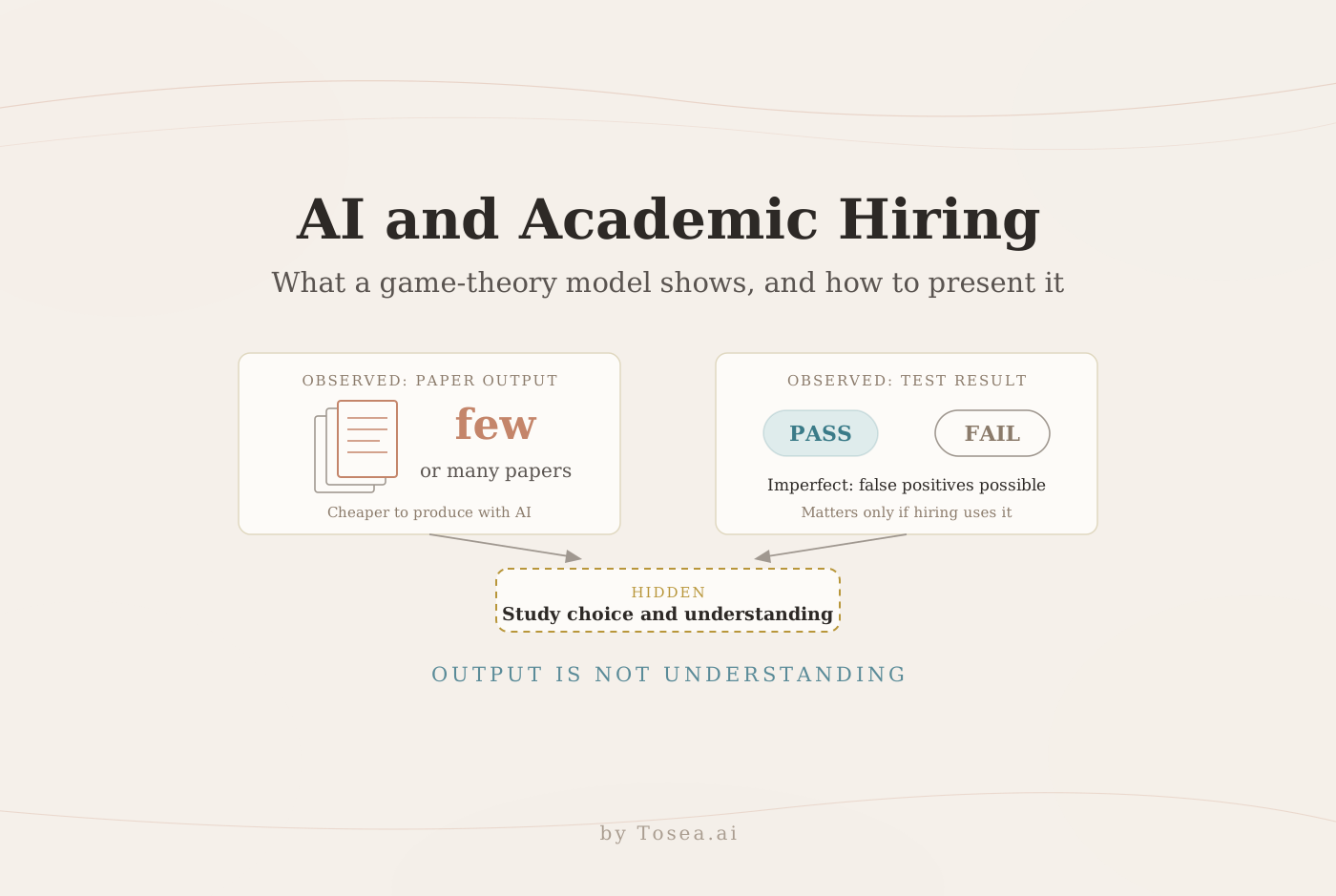
The model distinguishes research output from understanding. High- and medium-potential applicants choose between costly deep study and a cheaper shallow route supported by AI; low-potential applicants are treated as non-strategic. Recruiters observe only paper output and the result of a possibly imperfect test, while each applicant's potential and study choice remain hidden.
Recruiters value output and understanding, weighted by parameters the paper calls A and B, against an outside option r of not hiring. Applicants respond to the rewards those decisions create. The researchers classify five pure-strategy equilibrium patterns in the baseline model, then examine an extension in which high-potential applicants who use AI can produce "super-output," which adds two further equilibria. Simulated imitation and rare exploration examine which behaviors populations may learn; several equilibrium outcomes can coexist. The authors share their simulation code on GitHub.
The study at a glance
| Item | What the paper does |
|---|---|
| Type | Game-theoretic signaling model plus evolutionary learning simulations (30 pages, four figures, three tables) |
| Players | Applicants of high, medium, or low potential; recruiters deciding whether to hire |
| What recruiters see | Paper output and a pass/fail test result |
| What stays hidden | Applicant potential, study choice, and actual understanding |
| Baseline result | Five possible pure-strategy equilibrium patterns (E1–E5) |
| Extension | Super-output from high-potential applicants using AI adds E6 and E7 |
| Simulations | Populations of 30, pairwise-comparison imitation with rare exploration, test accuracy τ of 0.5, 0.9, or 0.99 |
| ArXiv categories | cs.AI, cs.CY, cs.GT |
The assumption that must stay visible
In this model, deep study always creates understanding, while the shallow AI-supported route never does. The authors explicitly exclude learning through AI-assisted research ("We have excluded this case from our model," Section 5.2). Real researchers can use AI while developing expertise, so this simplification is central to interpretation.
Understanding and output are simplified categories; the test has false positives, while candidates who understand always pass. Applicant composition, study costs, and test accuracy are externally fixed. The results identify conditional incentive mechanisms, not measured properties of real applicants.
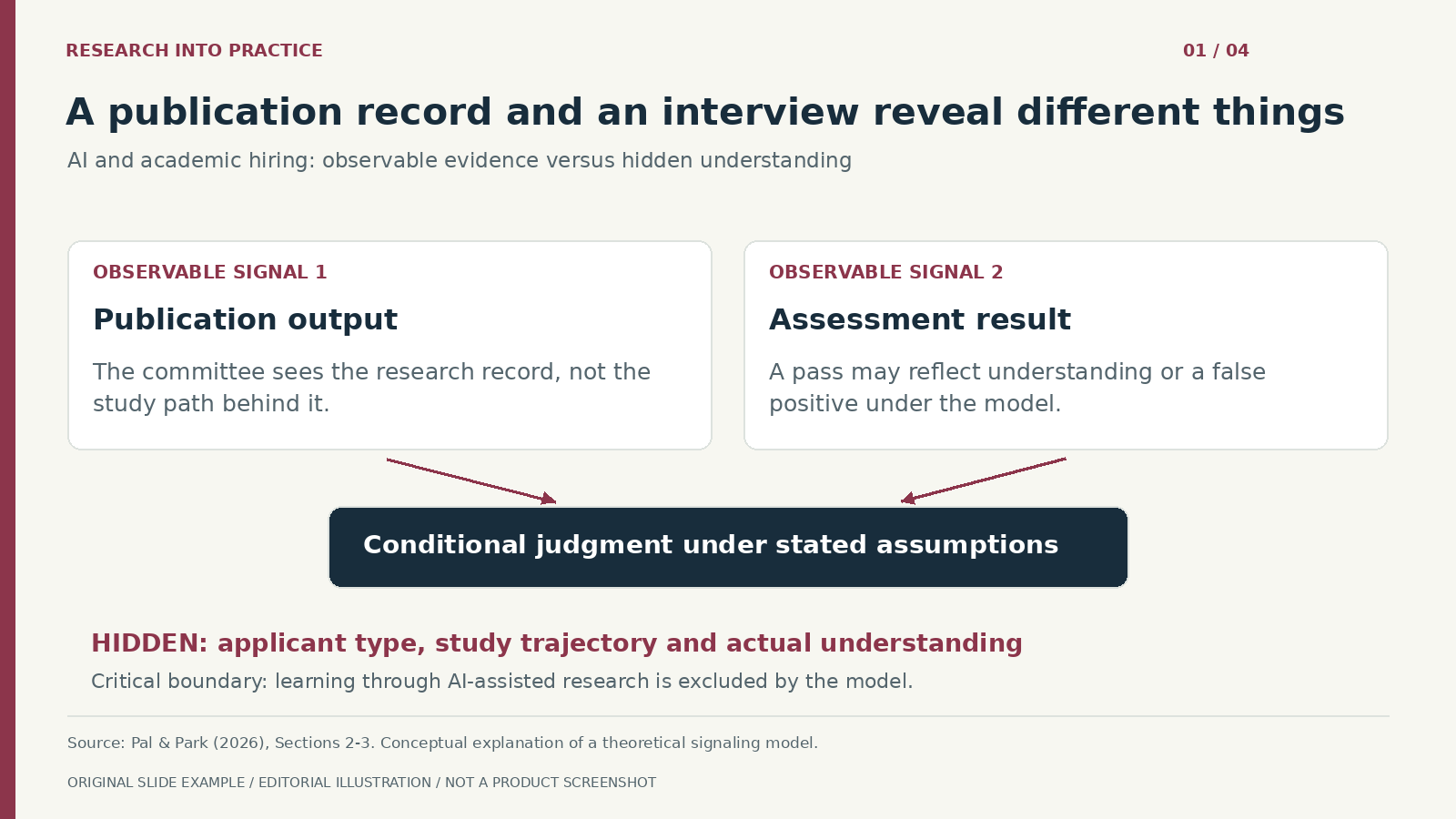
Conceptual explanation based on Sections 2–3. Output and assessment are observable; actual understanding remains hidden in the model.
Three findings worth discussing
First, valuing understanding is not enough if output alone already pays. When the recruiter's weight on output A is at least as large as the outside option r, the paper finds that the all-shallow pattern E5 is the only equilibrium, "because output alone already makes a hire worthwhile, which empties the test of any consequence" (pp. 8–9). Depth then disappears regardless of how accurate the test is. Super-output makes this worse: it moves the threshold at which high-potential applicants abandon understanding from A = r down to A = r/2 (p. 12).
Second, a passed test is interpreted in the context of what recruiters expect applicants to do. Expectations and applicant responses can reinforce one another, so the same fundamentals can support different patterns of effort and hiring. The authors note that every pure-strategy equilibrium with deep study coexists with one in which all strategic applicants study shallowly, and conclude that "departments must commit together, and in advance, to rewarding demonstrated understanding" (p. 20).
Third, hiring more candidates and hiring a larger share with understanding are separate outcomes. Which hiring pattern produces the higher share of understanding among hires depends on the applicant pool, not on test accuracy: accuracy "changes how large the errors are but not which equilibrium does better" (p. 13). The paper does not establish one universally best selection rule.
The discussion section also names practical levers in the model's terms. Oral defenses and chalk talks raise test accuracy τ; caps on publication counts lower the weight on output A. When super-output is possible, the authors suggest that stating in advance that output volume alone will not secure a job "may therefore protect depth more effectively than better tests" (p. 22).
Five mistakes to avoid when presenting this paper
- Presenting it as evidence about real researchers. It is a model. No applicant was surveyed, and no hiring outcome was observed.
- Calling the hire rates "Table 3 values." Table 3 prints the understanding shares (0.857 and 0.976) and the formulas for hire rates. The 35% and 82% figures are computed from those formulas with the illustrative inputs; label them that way.
- Reading E2 versus E3 as a policy effect. The two equilibria differ in applicant behavior as well as the hiring rule. Switching the rule while holding behavior fixed would not reproduce the comparison.
- Dropping the AI-assisted learning exclusion. Without it, the slide implies that AI users cannot understand their work, which the paper does not claim.
- Treating "better interviews" as the whole answer. In the model, an assessment changes incentives only when it is known to be accurate and the hiring rule actually uses its result.
Four ways to turn the model into useful slides
The examples below distinguish source findings from proposed applications. Each image is an original editorial slide, not a Tosea AI screenshot. No real candidate is assigned a model type, and no illustrative probability should be read as an observed hiring statistic.
Scenario 1: Help a hiring committee separate two signals
Use the two-signal slide above when a committee is discussing how much weight to place on publication volume. Show the publication record and the assessment result as distinct observations, then explain that neither reveals the study trajectory directly.
Copyable AI presentation prompt
Using the uploaded Pal and Park paper, create one 16:9 committee briefing slide distinguishing publication output from an assessment of understanding. Show two observable signals feeding a conditional judgment, with study choice and true understanding explicitly marked as unobserved. Add a note that AI-assisted learning is excluded by the model. Use burgundy, ivory, and navy. Cite Sections 2-3. Do not claim that prolific applicants lack expertise or assign real candidates to theoretical types. Label the diagram as a conceptual model.
Scenario 2: Compare hiring outcomes without misusing the percentages
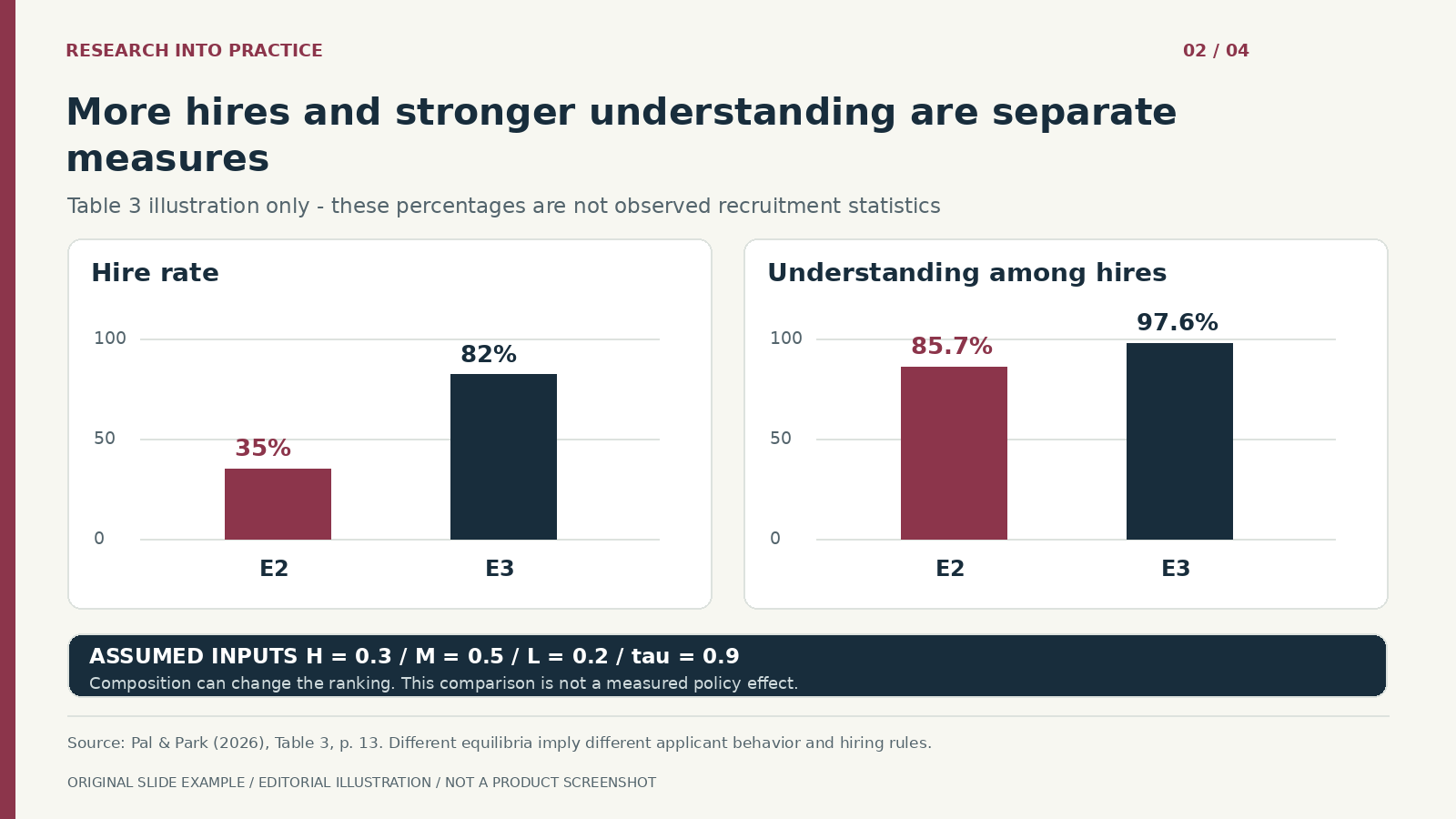
Table 3 illustration: assumed pool shares H 0.3, M 0.5, L 0.2; test accuracy τ 0.9. Understanding shares are printed in Table 3; hire rates are computed from its formulas. These are model values, not recruitment data.
A methods seminar or policy workshop can use Table 3 to show why two outcome measures must be reported separately. With the paper's illustrative inputs, E2 hires 35% of the applicant pool (0.3 + 0.1 × 0.5) and approximately 85.7% of those hires understand. E3 hires 82% (0.3 + 0.5 + 0.1 × 0.2), with approximately 97.6% understanding among hires.
These equilibria involve different applicant behavior as well as different hiring rules. The ranking can also reverse: by the paper's condition on page 12, E3 has the higher share of understanding among hires only when H × L ≤ M × (H + M), where H, M, and L are the pool shares. With the illustrative pool that is 0.06 ≤ 0.40, so it holds; a pool with H = 0.5, M = 0.1, and L = 0.4 gives 0.20 > 0.06, and the ranking flips.
Copyable AI presentation prompt
Create one 16:9 methods slide using Table 3. Label every value illustrative model output. Use assumed shares H=0.3, M=0.5, L=0.2 and tau=0.9. In two zero-based 0-100% panels, compare E2 versus E3: hire rates 35% versus 82% (computed from the Table 3 formulas), and understanding among hires approximately 85.7% versus 97.6%. Explain that applicant behavior differs across equilibria and rankings depend on pool composition. Do not describe the difference as an experimentally measured policy effect. Include the assumptions visibly and cite Table 3, page 13.
Scenario 3: Design a research interview around defensible reasoning
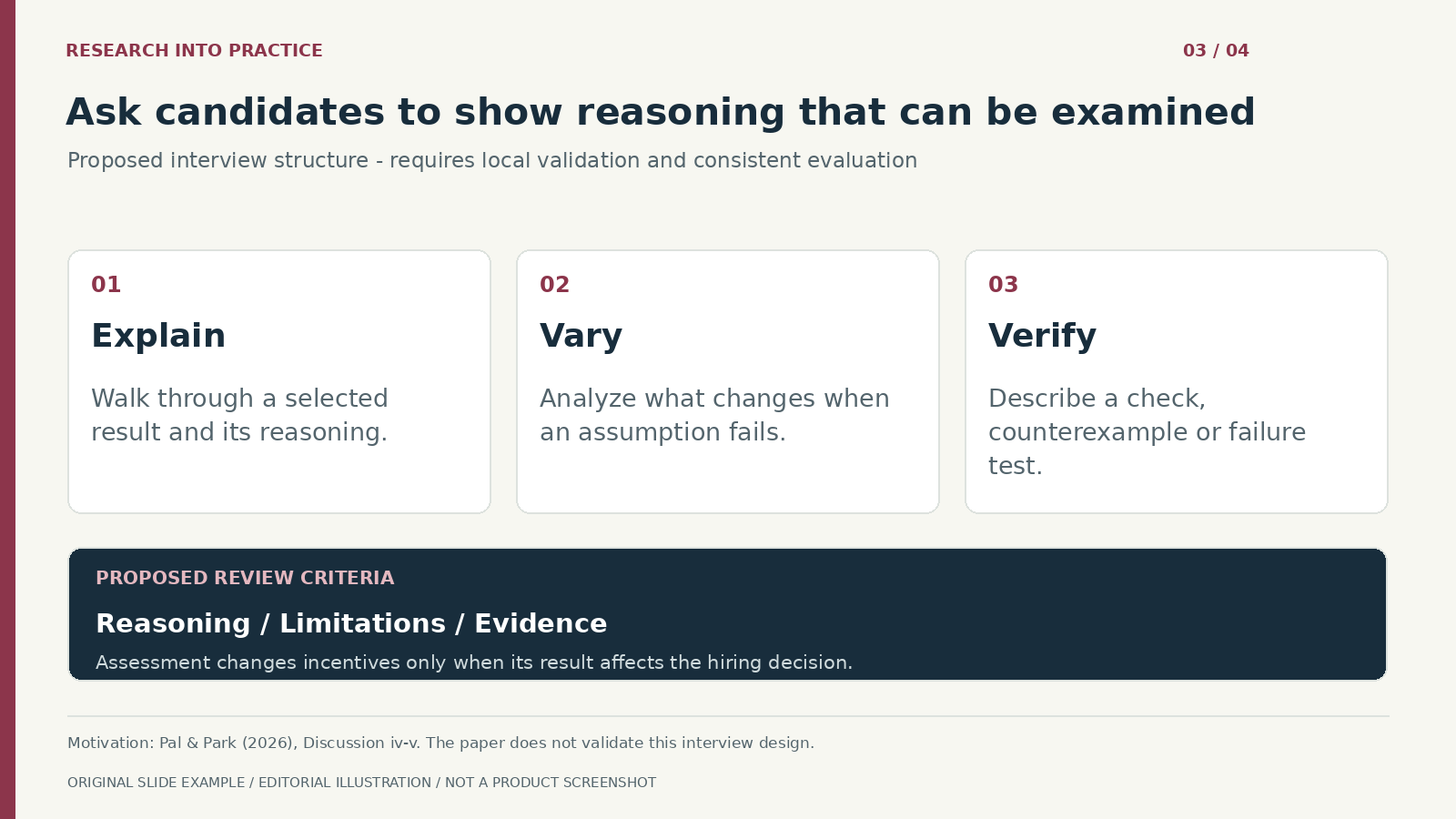
Proposed interview design inspired by the discussion of assessment accuracy; the paper does not validate this rubric.
The paper makes a practical point: an assessment influences preparation only when applicants know it is accurate and its result affects hiring. That suggests discussing both the task and the decision rule, rather than merely adding a harder interview. The authors name oral defenses and chalk talks as ways to raise test accuracy, but they do not test any specific format.
A proposed research discussion can ask candidates to explain a selected result, examine a changed assumption, and describe how they would check a failure. Give candidates clear expectations and use a consistent rubric for the role's requirements.
Copyable AI presentation prompt
Create one 16:9 slide proposing an understanding-focused research interview. Use three stages: explain a selected result, analyze a changed assumption, and describe a verification or failure-checking step. Add review criteria for reasoning, limitations, and evidence, leaving scores blank. State that this rubric is proposed and unvalidated. Include the paper's point that assessment matters only when hiring decisions use its result. Cite Discussion items iv-v. Avoid candidate rankings, psychological labels, and any assertion that AI use proves a lack of understanding.
Scenario 4: Make a candidate presentation demonstrate depth
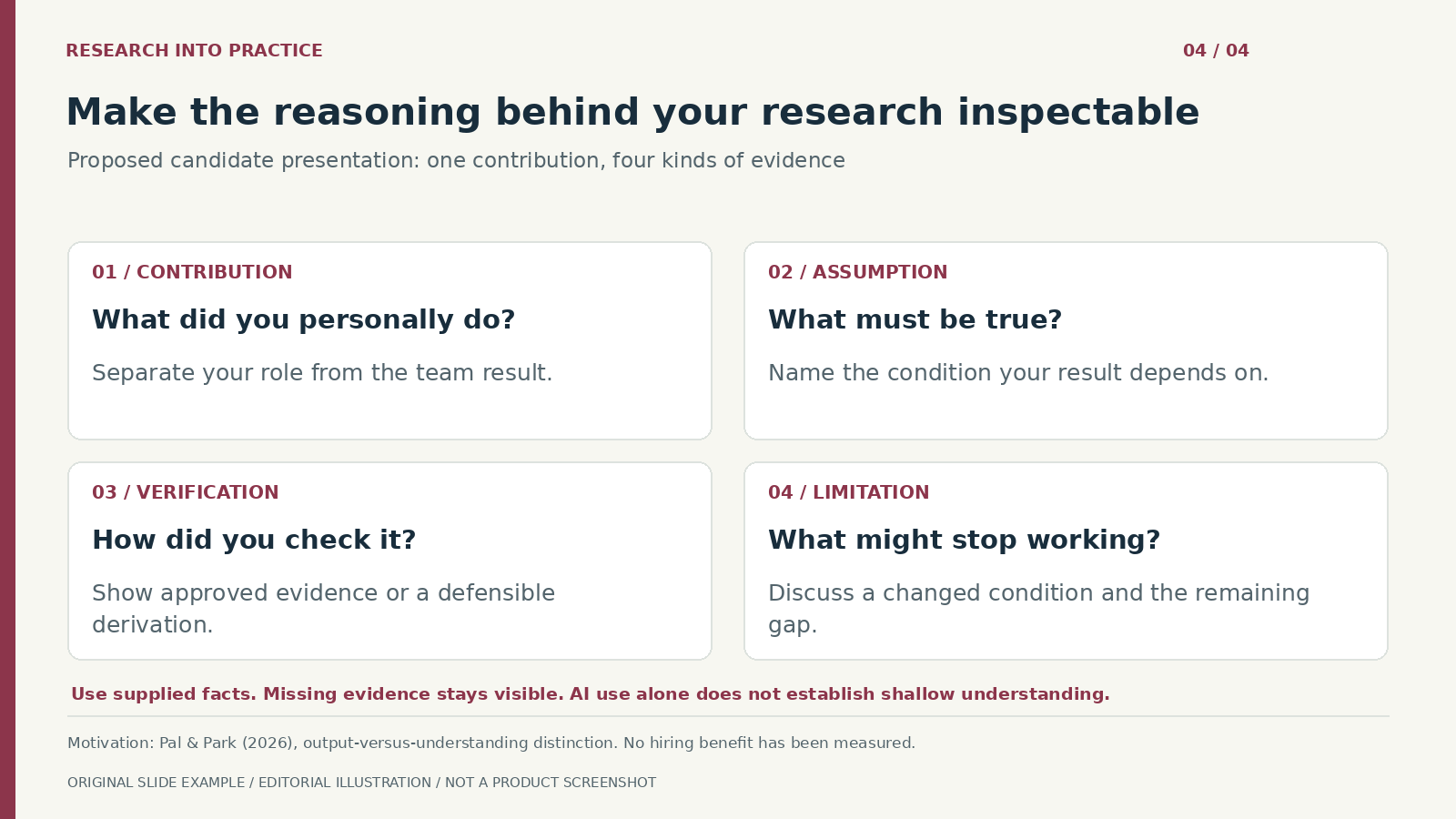
Proposed research-talk structure informed by the distinction between output and understanding. It is guidance, not a tested hiring intervention.
For early-career researchers, a presentation can make the reasoning behind an output inspectable. Choose one relevant contribution and explain the question, your role, the assumptions, the evidence or derivation, and the remaining limitations.
Include a changed-condition example: what would stop working if an assumption failed? Keep individual contributions separate from team achievements, and describe tool assistance consistently with applicable disclosure expectations. The purpose is to give the audience material it can evaluate. Our job talk and portfolio presentation guide covers the same evidence-first structure for industry applications, and the thesis defense guide shows how to prepare for questions that probe assumptions.
Copyable AI presentation prompt
Create one 16:9 candidate research-talk slide from my approved project notes. Structure it around contribution, key assumption, verification, and limitation. Include one changed-condition question that I must answer from my own work. Distinguish my contribution from the team's and report tool assistance only from supplied facts. Label missing evidence as not supplied. Cite the uploaded hiring paper only as conceptual motivation, not proof that this slide improves hiring chances. Use four evidence cards and a concise conclusion. Invent no publications, outcomes, or personal experience.
Tailor the same evidence to each audience
| Audience | Their question | Lead with | Keep visible |
|---|---|---|---|
| Hiring committee | How much should publication volume count? | Two signals, one hidden variable | AI-assisted learning is excluded |
| Department chair or dean | What should our hiring policy commit to? | Coordination finding (p. 20) and policy levers (p. 22) | Model, not measured outcome |
| Methods seminar | How do the equilibria compare? | Table 3 with both outcome measures | Hire rates are computed; ranking depends on the pool |
| Early-career researchers | How do I show depth? | Contribution–assumption–verification–limitation structure | No hiring benefit has been measured |
For a broader method of turning a paper into a talk, see our research paper to slides workflow and the 15-minute academic conference talk guide.
Build the presentation with Tosea AI
Upload the paper to Tosea AI and identify whether the audience is a hiring committee, methods seminar, or early-career workshop. Ask for separate sections covering model assumptions, findings, limitations, and proposed applications. That separation keeps editorial advice from appearing to be a research result, which matters more for a theoretical paper than for most PDF-to-PowerPoint jobs.
During the outline stage, choose the layout or diagram for each page: a signal diagram, two-panel comparison, interview sequence, or research-evidence cards. Tosea AI also lets you continue adjusting layout and diagram treatments after rendering. Its layout and diagrams guide explains the page-structure controls.
Use Layout Only after the wording is approved. Check that qualifications stay beside the relevant claims and that all illustrative percentages retain their denominators. For charts, use the controls of the appropriate generation mode; the current documentation lists consulting charts in HTML mode and Layout and Diagram options in Image mode.
Export an editable PPTX where supported, then inspect the equations, references, and labels in the actual presentation environment. A cleaner diagram should improve explanation without implying that hidden understanding is directly observed.
Q&A
Does the paper prove that AI users understand less than other researchers?
No. The shallow AI-supported route lacks understanding by assumption. The authors explicitly exclude learning through AI-assisted research. This theoretical study explores incentives under that setup; it does not measure the expertise of actual AI users or compare real hiring outcomes.
Can Tosea AI redesign my existing PowerPoint without changing the content?
Yes. Upload the PPTX or a PDF with Beautify PPT/PDF (available on Pro and above) and keep the default "Keep source pages" option, which preserves the page count, order, and content while redesigning the layout. Use Layout Only for later visual changes. Check that every label, footnote, and slide element remains complete.
How do I upload a PowerPoint and ask Tosea AI to redesign each slide?
Upload the PPTX or PDF with Beautify, keep the source pages, and choose a template or describe the visual direction. Inspect every slide before exporting the revised presentation.
Can I upload my own PowerPoint template to Tosea AI?
Yes, custom templates are available on eligible paid plans. The current workflow places the upload in the Image mode template picker. Confirm the required layouts, fonts, colors, logo placement, and master-slide rules before sharing the generated deck.
Can Tosea AI use custom brand colors, fonts, and a logo?
Yes. Specify colors and fonts and upload the logo or use a custom template where supported. Custom logo and template features require eligible plans. After export, verify font availability, color values, logo spacing, and contrast in PowerPoint.
Can Tosea AI match the style of my old company presentations?
A representative deck can provide design guidance; that does not imply permanent model training. Use an approved custom template for stronger consistency, then compare the generated presentation with your original brand guidelines before distribution.
Does Tosea AI preserve PowerPoint formatting after export?
Editable PPTX export aims to stay close to the generated preview while retaining editable elements. Results can vary with fonts, complex graphics, and presentation software. Test the file in the exact PowerPoint environment used for delivery.
Can I tell AI to edit the layout only and keep the exact wording?
Yes. Layout Only changes visual structure without intentionally rewriting content. After editing, compare the slide with the approved source to confirm that wording, labels, citations, footnotes, and line breaks remain correct.
Present the reasoning behind the research
Tosea AI helps researchers, educators, and professional teams transform source PDFs and approved work samples into structured, editable presentations. Use its outline controls and one-click layout tools to make both the argument and its limits easy to inspect.
For related examples, read Tosea's analysis of AI classroom engagement research, the guide to presenting the BIS findings on AI and population ageing, and the image-and-PDF-to-editable-PowerPoint workflow.
Sources
- Game theory of academic effort and hiring in the age of AI — Saptarshi Pal and Peter S. Park, arXiv preprint, October 26, 2026
- Full paper PDF — arXiv (Table 3 on p. 13; discussion on pp. 19–22; limitations in Section 5.2)
- Effort-Hiring-AI-Game simulation code — Saptarshi Pal, GitHub
- Layout and diagrams and Beautify an existing PPT or PDF — Tosea AI Help Center