100+ Best Psychology Topics for Students, Research, and Classroom Presentations
110 psychology topics across 11 areas, each with a starting paper, plus how to narrow one into a testable question and build a journal club presentation from your sources.
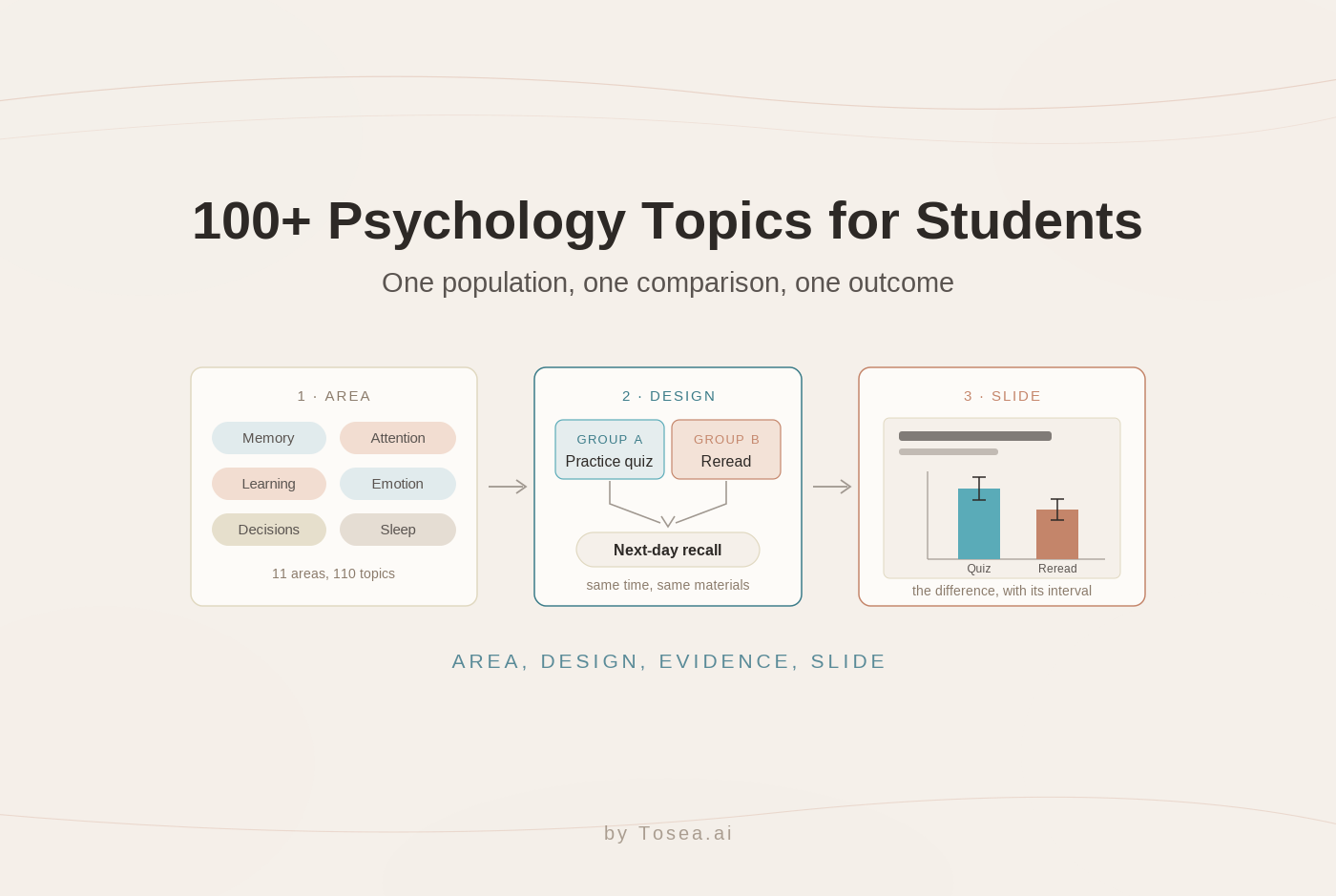
The best psychology topics for students have a question you can answer with the time, evidence, and participants you can actually access. Start with 110 ideas across 11 areas, from whether practice quizzes improve next-day recall to how AI labels affect trust in feedback. Each group includes a journal starting point and a practical way to investigate it. Once your sources are ready, use Tosea AI to draft a literature review or journal club presentation from your papers and figures.
If your project sits next to another discipline, see our lists of sociology and political science topics, economics topics, and biology and medical topics.
- Choose a topic that fits your assignment
- Browse 110 psychology research and presentation topics
- Build a literature presentation with Tosea AI
- Read the Q&A
- Check the sources
Choose a Topic That Fits Your Assignment
| Assignment | Good starting topic | What to show |
|---|---|---|
| Five-minute classroom talk | Gain versus loss framing | One choice vignette and its predicted outcome |
| Undergraduate experiment | Retrieval versus rereading | Random assignment and a delayed recall test |
| Literature review | Adolescent screen use and well-being | Differences in exposure, sample, and outcome |
| Secondary-data project | Personality scale length and reliability | Item availability, scoring rules, and uncertainty |
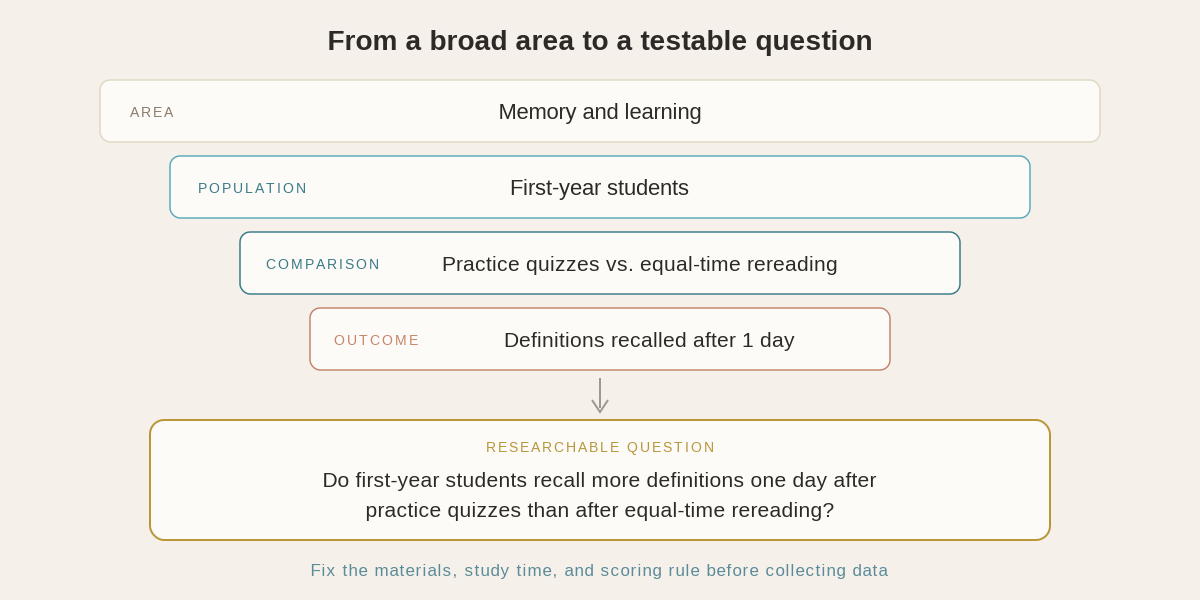
Use one population, one comparison, and one primary outcome. For example, narrow memory and learning to whether first-year students recall more definitions one day after practice quizzes than after equal-time rereading. Keep materials and study time comparable. Define the scoring rule before collecting data, and if your course allows it, record that plan as a preregistration (APA preregistration guidance).
110 Psychology Research and Presentation Topics
The journal links anchor each theme. The numbered entries are proposed research questions and adaptations, not published findings. Use published evidence or permitted datasets for topics involving minors, clinical symptoms, or sensitive records, and follow your institution's review process for participant research.
1. Attention and Cognitive Control
Start with a controlled task and report response time alongside accuracy. Starting paper: Ward et al. (2017) on smartphone presence.
- Phone on desk versus in bag and working-memory accuracy
- Notification sounds versus silence and proofreading errors
- Background speech versus instrumental music and serial recall
- Task-switch versus repeat trials and response latency
- Visual clutter and search time for a target icon
- Time pressure and the trade-off between speed and accuracy in word recognition
- Stroop congruency and color-naming latency
- Predictable versus random cues and missed targets
- Scheduled breaks and attention lapses during proofreading
- Video captions and recall under background noise
2. Memory and Eyewitness Cognition
Use neutral clips or word lists and score correct recall and false alarms separately. Starting paper: Loftus and Palmer (1974) on question wording and memory.
- Leading versus neutral wording and speed estimates
- Post-event misinformation and false detail recognition
- Immediate versus delayed recall of a neutral scene
- Speaker identity cues and source-memory accuracy
- Related word lists and false recognition of missing words
- Pictures versus words and delayed recognition
- Matched versus changed study context and cued recall
- Semantic versus alphabetical grouping and free recall
- Retrieval confidence and accuracy across question types
- Open versus specific questions and witness detail accuracy
3. Learning and Educational Psychology
Hold study time constant and separate immediate performance from delayed retention. Starting paper: Roediger and Karpicke (2006) in Psychological Science.
- Practice quizzes versus rereading and next-day recall
- Spaced versus massed study and vocabulary retention
- Interleaved versus blocked practice and problem classification
- Worked examples and transfer to unfamiliar problems
- Immediate versus delayed feedback and error correction
- Concept maps versus outlines and inference accuracy
- Self-explanation prompts and reasoning on transfer questions
- Peer instruction and changes in answer accuracy
- Predicted versus actual quiz scores and calibration
- Confidence ratings after highlighting versus retrieval practice
4. Social Psychology and Communication
Use matched vignettes or recordings and vary one social cue at a time. Starting paper: Lev-Ari and Keysar (2010) in Journal of Experimental Social Psychology.
- Speaker accent, intelligibility, and perceived credibility
- Unanimous versus divided groups and public agreement
- Anonymous versus named feedback and dissent
- Shared group identity and willingness to help
- Number of bystanders and vignette-based helping intentions
- Descriptive norms and reusable-container intentions
- Apology specificity and willingness to trust again
- Camera-on versus camera-off calls and perceived warmth
- Peer endorsement and credibility of identical advice
- Perspective-taking prompts and blame in workplace disputes
5. Emotion and Emotion Regulation
Published studies can support reviews of emotional experiences without inducing distress in class. Starting paper: Gross (1998) in Journal of Personality and Social Psychology.
- Reappraisal versus suppression and immediate affect
- Emotion labeling and distress ratings in published experiments
- Anticipatory worry and perceived task difficulty
- Emotional versus neutral headlines and delayed recognition
- Daily rumination and next-day concentration in diary data
- Emotion differentiation and momentary coping choices
- Positive event recall and persistence on puzzles
- Emotional intensity and accuracy of memory for details
- Reappraisal instructions and confidence after setbacks
- Perceived control and frustration during task interruptions
6. Development and School Adjustment
Compare published cohorts or age groups and check whether the measures are comparable. Starting paper: Yeager et al. (2019) on growth mindset and school context.
- Growth mindset effects across different school contexts
- Peer belonging and adjustment during school transitions
- Age differences in distinguishing appearance from reality
- Adult guidance and preschool problem-solving persistence
- Feedback wording and responses to mistakes by age
- Parent and child conversation and narrative detail
- Early vocabulary and later reading comprehension
- Adolescent autonomy support and classroom engagement
- Peer presence and adolescent risk choices in experiments
- Age differences in accuracy of emotion recognition
7. Digital Media, Misinformation, and AI
Define the activity and comparison. Total screen time and active messaging capture different behaviors. Starting papers: Orben and Przybylski (2019) in Nature Human Behaviour and Pennycook et al. (2021) on accuracy prompts.
- Logged versus self-reported screen time and agreement
- Active messaging versus passive browsing and perceived connection
- Accuracy prompts and intentions to share misleading headlines
- Source labels and credibility ratings for identical posts
- Prior exposure and perceived truth of repeated headlines
- AI versus human authorship labels and perceived feedback quality
- AI explanations and verification of incorrect recommendations
- Visible engagement counts and willingness to share
- Nighttime notifications and next-morning alertness
- Educational video playback speed and inference accuracy
8. Judgment and Behavioral Decision-Making
Keep the underlying numbers identical when testing different descriptions. Starting paper: Tversky and Kahneman (1981) on framing.
- Gain versus loss framing and preference for risk
- High versus low anchors and numerical estimates
- Opt-in versus opt-out defaults and hypothetical enrollment
- Sunk costs and willingness to continue a project
- Absolute versus relative risk and perceived intervention benefit
- Natural frequencies versus probabilities and screening comprehension
- Choice-set size and post-choice satisfaction
- Fixed deadlines versus flexible deadlines and task completion
- Confidence prompts and revision of initial estimates
- Recommendation order and selection of identical options
9. Sleep, Health Behavior, and Habits
Compare published designs or examine naturally occurring variation in diaries. Starting papers: Lim and Dinges (2010) in Psychological Bulletin and Lally et al. (2010) on habit formation.
- Sleep duration and morning attention lapses
- Bedtime variability and daytime sleepiness
- Sleep timing and delayed vocabulary recall
- Cue consistency and automaticity of a walking habit
- Reminder timing and adherence to personal goals
- Planning prompts and follow-through on scheduled walks
- Self-monitoring and completion of daily activity goals
- Perceived stress and self-reported sleep quality
- Social support and persistence with activity routines
- Concrete versus abstract goals and weekly completion
10. Work and Organizational Psychology
Vignettes suit individual judgments. Team-level claims require a team-level design. Starting paper: Edmondson (1999) on psychological safety and learning behavior.
- Manager response to mistakes and employee speaking-up intentions
- Feedback specificity and revision quality
- Meeting interruptions and perceived inclusion
- Role clarity and reported coordination problems
- Visible workload and willingness to request help
- Remote onboarding touchpoints and newcomer belonging
- Interview structure and agreement between evaluators
- Schedule autonomy and perceived control at work
- Chat response expectations and perceived availability pressure
- Weekly psychological safety and team learning behavior
11. Personality and Measurement
Use an established measure and check what the selected form can support. Starting paper: Soto and John (2017) in Journal of Research in Personality.
- Conscientiousness and on-time assignment submission
- Extraversion and preference for synchronous teamwork
- Openness and exploration of unfamiliar course material
- Trait self-ratings versus peer ratings and agreement
- Short versus full personality scales and score reliability
- Reverse-worded items and inconsistent responses
- Response scale length and completion time
- Social desirability and self-reported study habits
- Stability of personality ratings across two time points
- Trait scores and momentary behavior across social settings
Build a Psychology Literature Presentation with Tosea AI
For topic 21, assign participants to practice quizzes or rereading, using identical definitions and study time. Score next-day recall with a fixed answer key and report the between-group difference with its confidence interval. For a literature-only version, compare published experiments with different retention intervals and explain how each study defines successful recall.
Upload the papers and relevant supplements. For a single-paper journal club, plan six slides covering the question, design, main result, interpretation, limitations, and discussion. For a multi-paper review, compare studies by sample, design, measure, effect estimate, and uncertainty before choosing figures. That comparison helps explain why two studies on the same topic might reach different conclusions. The Tosea getting-started guide covers the upload, figure selection, and outline steps.
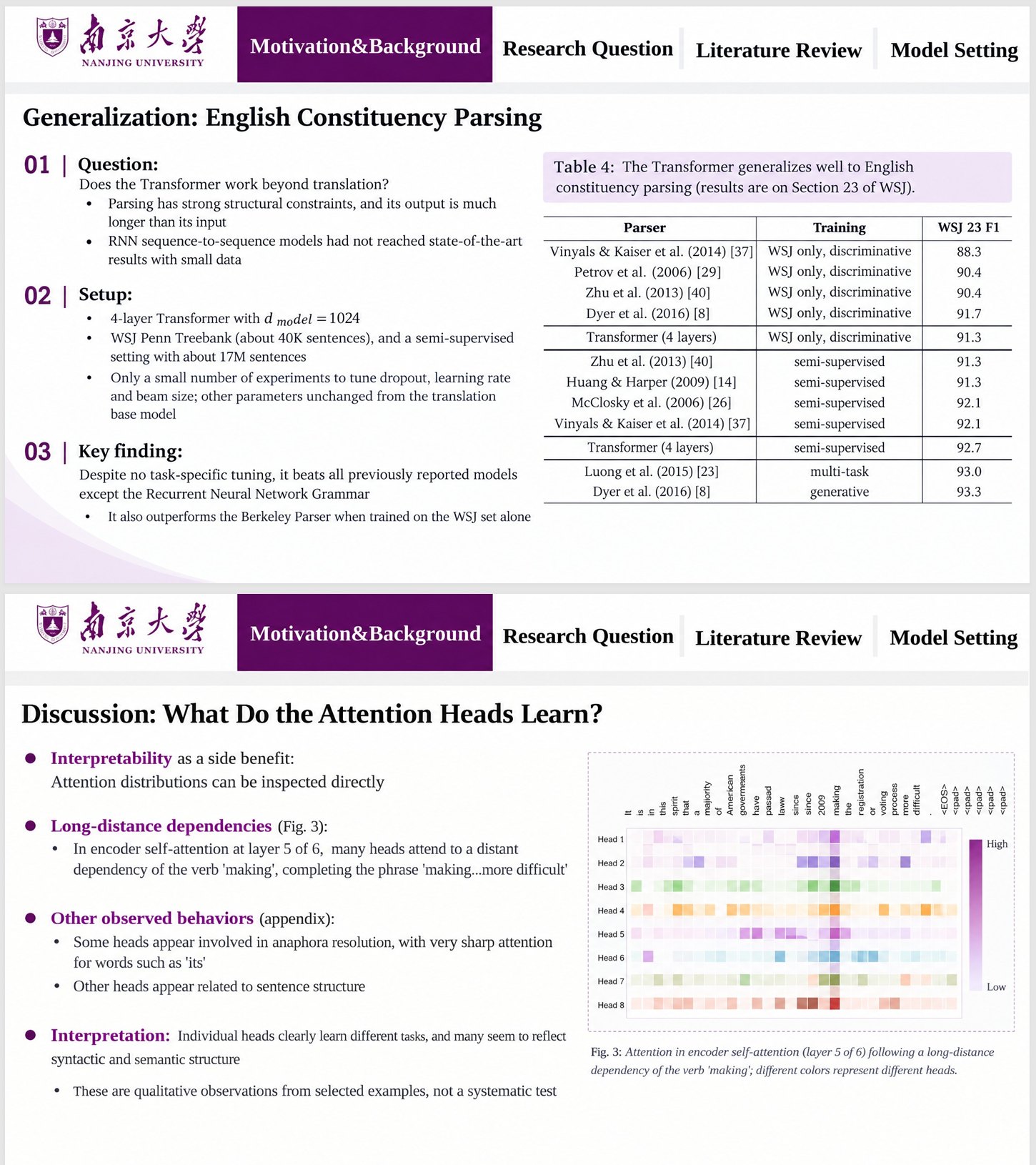
Two unedited slides that Tosea generated from a different field's paper, "Attention Is All You Need," using a university-branded custom template. Tosea is not affiliated with Nanjing University. The first slide pairs the question, setup, and key finding with the paper's results table. The second places the discussion beside a heatmap. A psychology journal club can follow the same pattern. The heatmap is the model's redraw of the paper's Figure 3, and its token labels contain errors, so check redrawn figures against the PDF.
Paste this prompt with your source PDFs:
Create a six-slide psychology journal club outline for an eight-minute classroom presentation.
Use the uploaded papers. Cover the question, sample and design, primary result, interpretation, limitations, and one discussion question.
Include a proposed visual and a page, figure, or table reference for each substantive claim.
Keep sample sizes, outcomes, effect estimates, and reported uncertainty intact. Mark missing details as unreported. Use causal wording only when the design supports it.
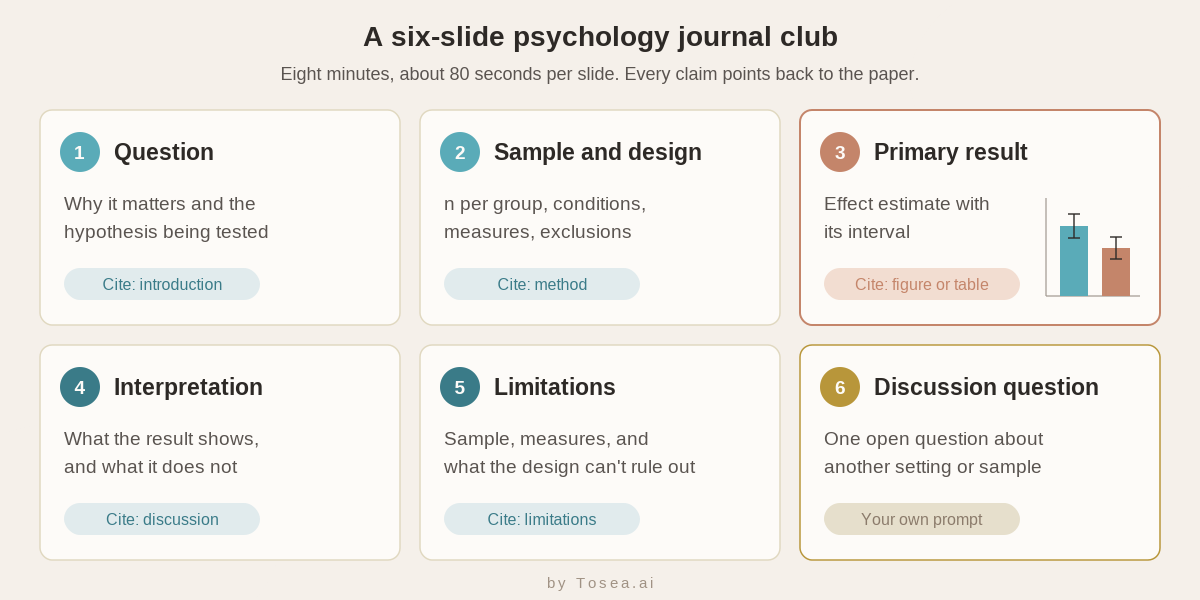
Review the outline before rendering. Pick an extracted figure or a clear comparison layout and check the units, groups, and intervals against the PDF. After rendering, refine individual pages and use Layout Only for visual changes to approved content. Export an editable PPTX and rehearse in the app you will present from. Full-deck editable export is on Pro and Max; the free plan can export a few selected pages a month as editable PPTX, with a watermark. For research-paper features in one place, see the Tosea AI presentation maker for research papers.
What the Review Step Catches
The example above shows why checking matters. We compared both slides with the arXiv version of the paper. The results table matches Table 4 of the paper value for value, from 88.3 to 93.3 F1, and the setup bullets match the text (about 40K training sentences, about 17M in the semi-supervised setting). The heatmap does not hold up as well. The paper's Figure 3 draws attention as lines between two rows of tokens, while the slide redraws it as a heatmap. Several token labels are misspelled ("passad," "laww," and a garbled "governments"), "new" is missing from "passed new laws since 2009," and "since" appears twice.
A psychology deck fails in the same places. Before you present, check:
- Condition labels: "Practice quiz" and "Reread" must match the paper's terms and group order.
- Sample sizes: Report n per group, not only the total, and note exclusions.
- Error bars: Confirm whether bars show standard errors, standard deviations, or 95% confidence intervals, and say which in the caption.
- Axis scale: A truncated y-axis can make a small effect on recall look large.
- Causal wording: Use "caused" only for randomized comparisons, and "was associated with" for correlational or diary data.
For a longer walk-through of the paper-to-slides workflow, see how to turn a research paper into a presentation.
Frequently Asked Questions
What is an easy psychology topic for a classroom presentation?
Gain versus loss framing works well in five minutes. Present two descriptions of an identical choice, show how the conditions compare in the published study, and end with a question about whether the result would generalize to another setting.
Do I need ethics approval for a class psychology experiment?
It depends on your institution. Many universities require review for any data collected from people, and some cover classroom exercises through a course-level process. Ask your instructor before recruiting anyone. For minors, clinical symptoms, or sensitive records, work from published evidence or permitted datasets instead.
Can Tosea AI redesign my existing PowerPoint without changing the content?
Use Beautify PPT/PDF, available on Pro and above, with the original deck or a PDF export. Turn on Keep source pages to preserve content and order. Check every label, footnote, and visual against the original. Our PowerPoint redesign guide walks through the process.
How do I upload a PowerPoint and ask Tosea AI to redesign each slide?
Upload the PPTX or its PDF export in Beautify PPT/PDF. Request the original wording and sequence, choose a template or describe the visual direction, then review each slide before exporting.
Can I upload my own PowerPoint template to Tosea AI?
Yes, on Pro and Max plans. Upload the template through the template picker and check the generated layouts, fonts, logo placement, and master-slide conventions.
Can Tosea AI use custom brand colors, fonts, and a logo?
Specify the colors and fonts. Use an approved custom template or upload the logo where supported. After export, check contrast, logo clear space, and font availability.
Can Tosea AI match the style of my old company presentations?
Use a representative deck as design guidance for the project. For recurring work, use an approved custom template and review the output against the current brand guidelines.
Does Tosea AI preserve PowerPoint formatting after export?
Editable PPTX aims to stay close to the preview. Test the file in the delivery app, as font substitutions and complex graphics can affect appearance. The Tosea export guide lists the export options.
Can I tell AI to edit the layout only and keep the exact wording?
Choose Layout Only for visual edits to approved content. Compare the result with the original slide and check labels, citations, footnotes, and line breaks.
Turn One Psychology Topic Into Your Next Presentation
Choose one question, read its starting paper, and identify the figure or table that best answers it. Bring that evidence to Tosea AI to draft a literature presentation with a reviewable outline and editable PowerPoint export.
Continue with AI prompts for research presentations. If the topic grows into a thesis, our thesis defense presentation guide covers the longer format.
Editorial Note
The numbered topics are proposed research questions, not published findings. On November 26, 2026, we checked each starting paper against its publisher, Crossref, or PubMed record. The example slides are unedited Tosea output, and we checked their table and figure against the source paper.
Sources
- Brain Drain: The Mere Presence of One's Own Smartphone Reduces Available Cognitive Capacity — Ward, Duke, Gneezy, and Bos, Journal of the Association for Consumer Research, 2017
- Reconstruction of Automobile Destruction: An Example of the Interaction Between Language and Memory — Loftus and Palmer, Journal of Verbal Learning and Verbal Behavior, 1974
- Test-Enhanced Learning: Taking Memory Tests Improves Long-Term Retention — Roediger and Karpicke, Psychological Science, 2006
- Why Don't We Believe Non-Native Speakers? The Influence of Accent on Credibility — Lev-Ari and Keysar, Journal of Experimental Social Psychology, 2010
- Antecedent- and Response-Focused Emotion Regulation — Gross, Journal of Personality and Social Psychology, 1998
- A National Experiment Reveals Where a Growth Mindset Improves Achievement — Yeager et al., Nature, 2019
- The Association Between Adolescent Well-Being and Digital Technology Use — Orben and Przybylski, Nature Human Behaviour, 2019
- Shifting Attention to Accuracy Can Reduce Misinformation Online — Pennycook et al., Nature, 2021
- The Framing of Decisions and the Psychology of Choice — Tversky and Kahneman, Science, 1981
- A Meta-Analysis of the Impact of Short-Term Sleep Deprivation on Cognitive Variables — Lim and Dinges, Psychological Bulletin, 2010
- How Are Habits Formed: Modelling Habit Formation in the Real World — Lally et al., European Journal of Social Psychology, 2010
- Psychological Safety and Learning Behavior in Work Teams — Edmondson, Administrative Science Quarterly, 1999
- Short and Extra-Short Forms of the Big Five Inventory–2: The BFI-2-S and BFI-2-XS — Soto and John, Journal of Research in Personality, 2017
- Attention Is All You Need — Vaswani et al., arXiv, source paper for the example slides
- Preregistration — American Psychological Association, journal resources