How to Build a BCG-Style Storyline for a Strategy Consulting PowerPoint
Build a BCG-style storyline for a strategy deck: SCQ opening, governing thought, action titles, chapter structure, ghost deck, a 14-slide worked example, and three reusable AI prompts.
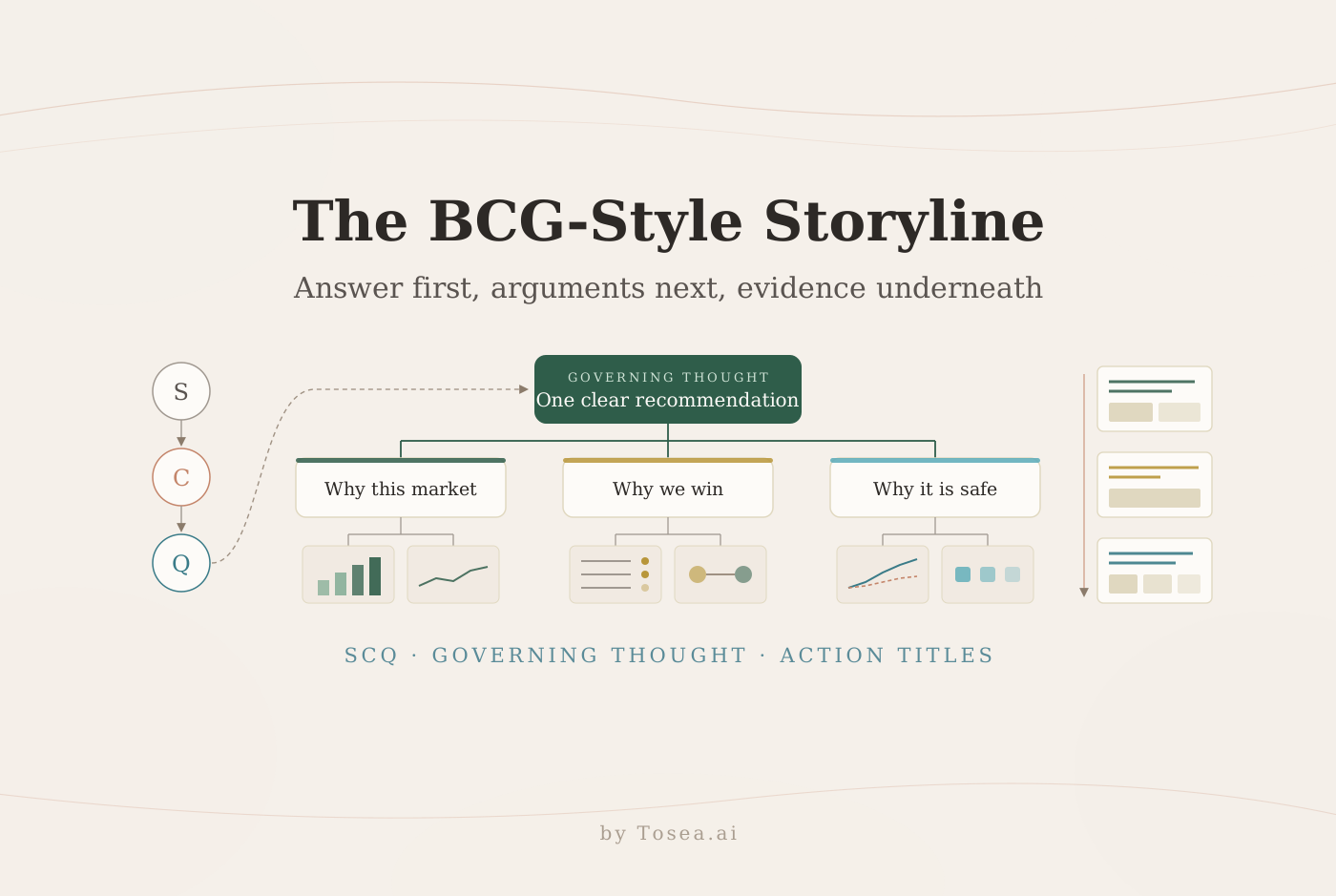
A BCG-style storyline is the sequence of conclusions that carries a strategy consulting PowerPoint from evidence to a decision. The green palette and the clean grid are the visible part; the storyline is what gets an executive to agree. This guide shows how to define the decision, write a governing thought, organize the supporting arguments into chapters, write action titles that read as an argument, and match each conclusion with the right evidence.
It is the structural companion to our BCG strategy consulting PowerPoint templates guide. That article covers individual frameworks and what each exhibit must show. This one covers the layer above: which conclusions the deck makes, in what order, and how many slides each one gets. A framework is one page; the storyline decides whether that page belongs in the deck at all.
Tosea AI carries the workflow from source material to editable PowerPoint: upload reports, PDFs, spreadsheets, or an existing deck, review the storyline in the outline, choose layouts before rendering, and export an editable PPTX. The slides below are original editorial examples with illustrative figures. They are not BCG templates, and Tosea AI is not affiliated with or endorsed by Boston Consulting Group.
Quick answer
Define the audience and the decision. Open with situation, complication, and question, then state the answer as one governing thought. Break it into two to four supporting arguments, give each its own chapter, and write every slide title as a conclusion. Build top-down when the answer is known and bottom-up when the evidence is fragmented. Before designing anything, read the titles alone: if they do not make the case, no exhibit will.
Contents
- Decisions to make before opening PowerPoint
- Five steps: SCQ, pyramid, action titles, chapters, ghost deck
- Top-down versus bottom-up construction, with three AI prompts
- A 14-slide worked storyline
- Common failures, Tosea AI workflow, and a quality checklist
- Frequently asked questions
What to decide before opening PowerPoint
| Question | Working answer | What changes in the deck |
|---|---|---|
| Who | Name the decision-maker and other readers | Depth, terminology, objections to address |
| What | Define the situation, scope, and required content | The evidence boundary |
| Why | State the decision the presentation should produce | The ending and the call to action |
| How | Presented live, workshop, or read-ahead | Sequence and page density |
Audience labels should be specific. A CFO reviewing a cost program needs cash timing, accounting treatment, and confidence ranges; a board wants the decision, the downside, and the conditions for coming back. The purpose needs a verb: "approve the first-year investment" gives the deck a finish line, while "update the committee on Southeast Asia" invites a tour of everything the team learned.
Delivery method changes density. A presented deck can be sparse because the speaker fills gaps. A read-ahead must stand alone, so each page needs a fuller title, a labeled exhibit, and a source line.
Step 1: Write the governing thought with SCQ
The governing thought is the single sentence the deck exists to prove. Barbara Minto, who developed the Pyramid Principle at McKinsey, pairs it with the Situation, Complication, Question framework to surface the question already in the reader's mind. Storyline practice across strategy consulting, BCG-style decks included, draws on this logic.
- Situation: agreed facts. "Our home market provides 85% of revenue and has grown below 2% a year since 2022."
- Complication: what changed. "Two global competitors are building plants in Vietnam, and regional customers increasingly require local supply."
- Question: "Should we enter Southeast Asia now, and how do we cap the downside?"
- Answer: "Enter Vietnam first in Q2 2027 through a distributor, and add Thailand only after three volume gates are met."
The situation should contain nothing the audience would dispute; otherwise they debate the setup instead of hearing the answer. A governing thought passes three tests: it contains an action, it has scope and timing, and a reasonable person could disagree with it. If nobody could, it is a truism.
| Weak governing thought | Why it fails | Stronger version |
|---|---|---|
| "Southeast Asia is an attractive opportunity." | No action or scope | "Enter Vietnam first in Q2 2027 through a distributor, then add Thailand after three volume gates." |
| "We need to reduce costs." | No size or mechanism | "Remove 12% of indirect cost within 18 months by consolidating three shared-service centers." |
| "Retention can be improved in several ways." | Lists options instead of choosing | "Fund a redesigned 90-day onboarding program before new acquisition spend." |
For keynote or change-management talks, Nancy Duarte's Resonate alternates between "what is" and "what could be." For a decision meeting, SCQ is tighter because it reaches the answer on page two.
Step 2: Build the pyramid with vertical and horizontal logic
Break the governing thought into the two to four arguments that must be true for it to hold. These key lines each become a chapter, and the evidence sits beneath them.
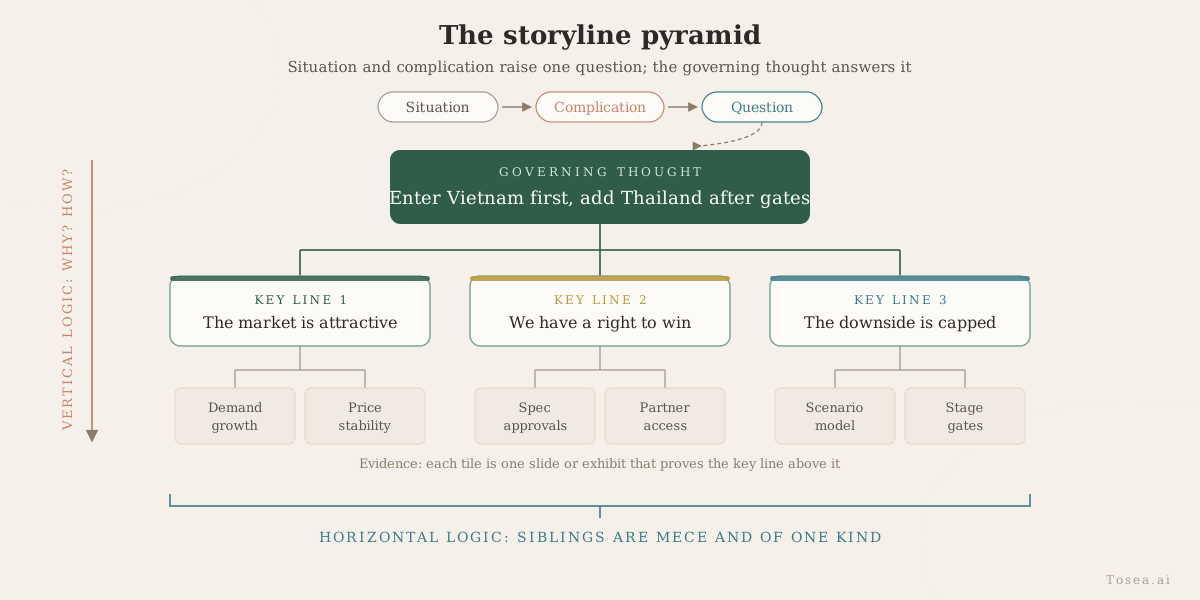
Vertical logic. Each level answers the question raised by the level above. "Enter Vietnam first" raises "why?" The key lines answer: the market is attractive, we have a right to win, and the phased plan caps the downside. Each key line raises its own "why?" or "how?", which the evidence answers. A slide that answers no question from above is off-storyline.
Horizontal logic. Ideas at the same level should be mutually exclusive, collectively exhaustive, and of the same kind. Three reasons for one decision work. A level that mixes a reason, an action, and a risk ("market is attractive," "hire a country manager," "currency exposure") shows the pyramid was assembled from slides rather than designed.
Minto distinguishes inductive groupings — parallel reasons that together support a point — from deductive chains of premise, premise, conclusion. Executive decks usually work better inductively, because a deductive chain makes the audience hold two premises before learning the point. Keep to two to four key lines: five usually means two overlap, and one means the answer was restated rather than supported.
Step 3: Write action titles that carry the argument
An action title states the slide's conclusion as a full sentence; a topic title only names the subject.
| Topic title | Action title | Why it works |
|---|---|---|
| Market overview | Protective coatings demand in Vietnam has grown about 9% a year since 2021 | States the finding and its size |
| Competitor analysis | Two global competitors are adding local capacity, narrowing the entry window to 2028 | Names the implication |
| Financials | The phased plan breaks even in year four and caps the downside at USD 11 million | Answers the board's criterion |
| Customer survey | Setup friction, not price, explains most early churn | Turns data into a cause |
| Next steps | Approving phase one today lets the first tender bid go out in Q3 | Turns the page into a request |
Keep one claim per title — an "and" often signals two slides — and stay within two lines, roughly 15 to 20 words. Include a number when the evidence has one. The exhibit must prove the title, not merely relate to it: a market-size chart under a title about pricing power is a mismatch reviewers catch immediately.
Then run the title read-through. Copy every action title into one document and read it top to bottom. It should read like a one-page memo that makes the whole case, and gaps or repetitions are far easier to see there than in designed slides. Our guide to building a McKinsey-style PowerPoint with AI covers title discipline in more depth.
Step 4: Structure chapters and section pages
Each key line becomes a chapter that answers one sub-question through claim, evidence, implication, and action. Budget slides before designing any. A typical 15-to-20-slide steering committee deck:
| Section | Job | Slides |
|---|---|---|
| Title and executive summary | State the answer and the decision request | 2 |
| Context and decision criteria | Agree on the situation and how the decision is judged | 1–2 |
| One chapter per key line | Prove one supporting argument each | 3–4 each |
| Risks and conditions | Show what could change the answer | 1–2 |
| Roadmap and decisions required | Assign owners, dates, and the ask | 2 |
| Appendix | Source tables, method, backup analysis | As needed |
The executive summary should mirror the pyramid: governing thought on top, one line per key line, the decision request at the bottom. If it cannot be written from the pyramid, the pyramid is not finished. See our guide to writing a high-stakes executive summary slide.
For navigation, a small chapter tracker at the top of each slide is enough for decks under about 20 slides; longer read-aheads benefit from divider pages. Either way, label chapters with the key line as a sentence ("2. We have a credible right to win in marine and power"), not a topic ("2. Capabilities"). PowerPoint sections group slides by chapter, so reordering a chapter becomes a single move.
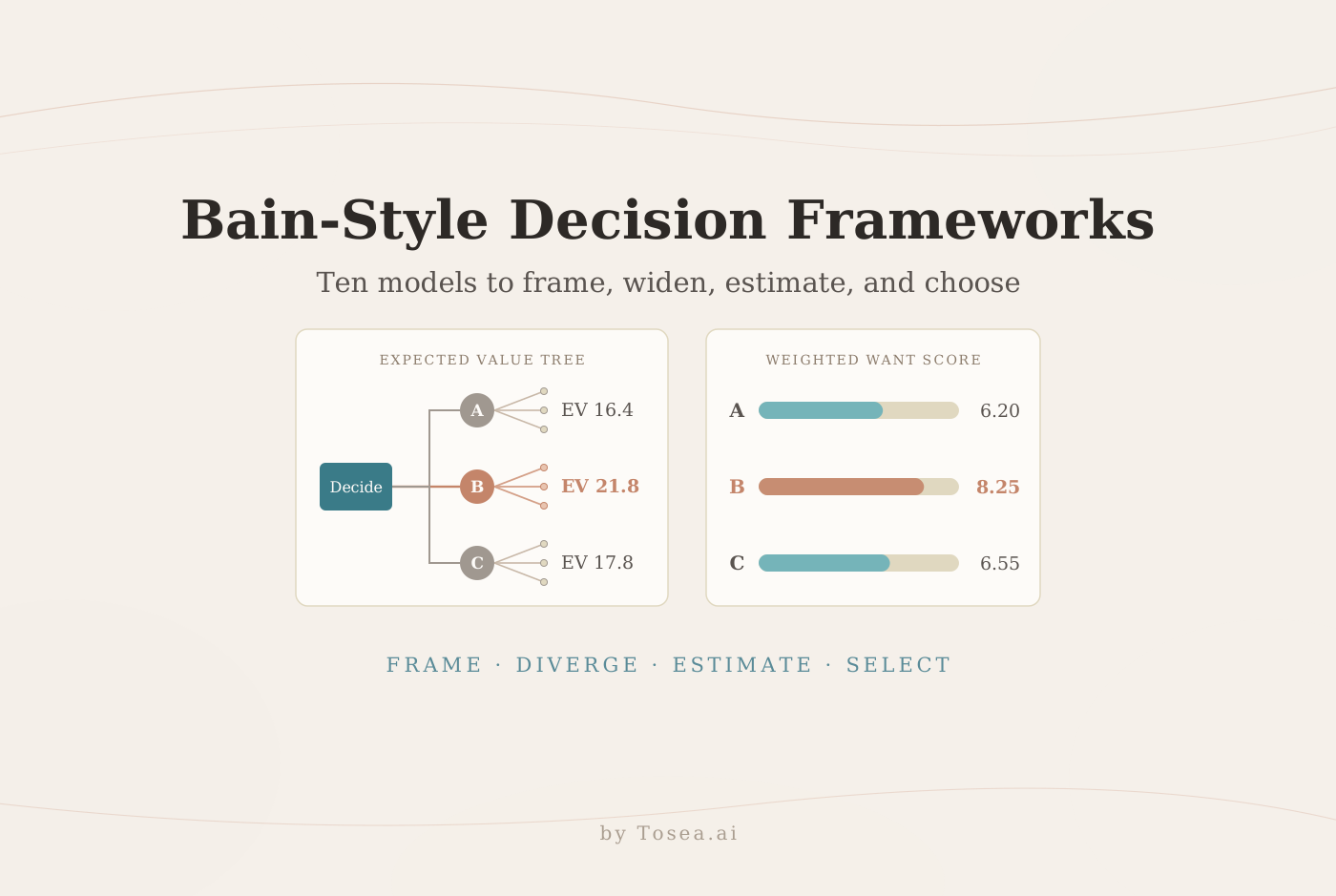
Frameworks enter here, and only where they fit. Five Forces organizes industry pressure; a financial bridge explains period movement; for choosing among defined options, the models in our Bain-style decision-making frameworks guide give the evaluation chapter its structure. The appendix supports the argument without advancing it. It is not a home for slides cut from the story.
Step 5: Draft a ghost deck before the analysis is finished
A ghost deck drafts every slide with an action title and a sketched exhibit before the analysis is complete. It turns a hypothesis into a work plan, because each ghost slide names the data needed to confirm or reject its title.
- Write the governing thought as a hypothesis.
- Sketch every page with a draft title, a rough exhibit, and the data source it needs.
- Tag each title as hypothesis, supported, or contradicted.
- When the data contradicts a title, rewrite the title rather than stretching the chart.
- Review the title read-through with the project lead, then freeze the storyline and render.
The risk is confirmation bias. Assign one person to look for disconfirming facts and keep a visible list of killed titles. A storyline that never changed during a project is more likely under-tested than correct.
Top-down or bottom-up construction
Top-down construction starts with the answer, breaks it into two to four arguments, and lists evidence under each. It suits board recommendations and mature investment cases. Bottom-up construction starts with fragmented interviews, reports, and data: write each material finding, group related findings, name each group with an insight, then combine the insights into a point of view. Label groups by meaning ("onboarding is a make-or-break moment"), not by source ("support ticket data"). Many projects analyze bottom-up and present top-down.
Use case 1: executive decision storyline
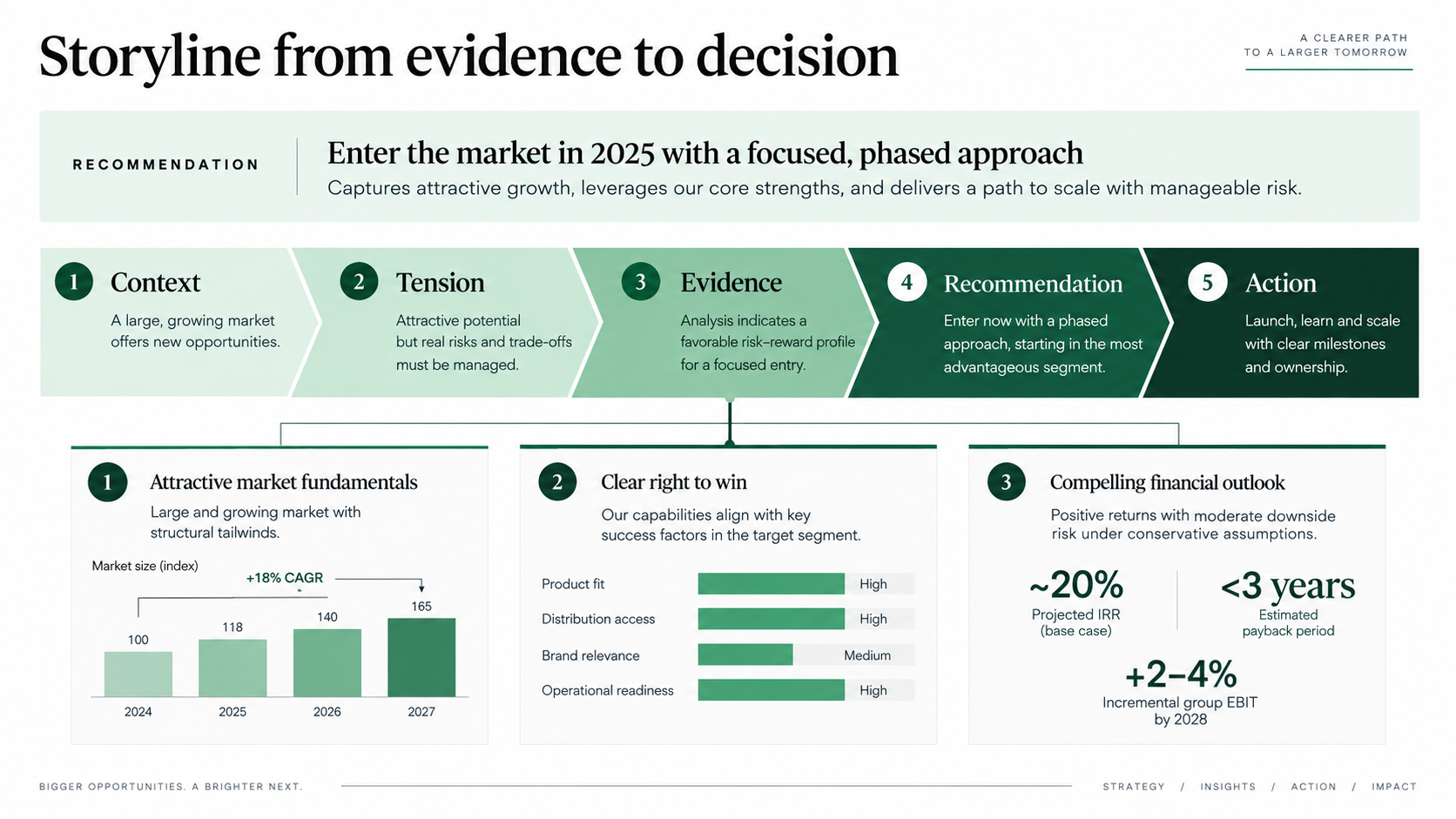
The slide at the top of this guide places the recommendation above the five-step storyline — context, tension, evidence, recommendation, action — with three evidence panels beneath. Reviewers see the conclusion and the logic on one page, which makes it a strong executive summary.
Create a 10-slide executive strategy presentation based only on the attached source material.

Audience: specify the decision-maker by role
Decision: specify the required action
Evidence: preserve numbers, units, dates, definitions, and page references

Build the storyline in this order:
1. Executive answer
2. Context and decision criteria
3. Tension or performance gap
4. Evidence explaining the gap
5. Strategic options
6. Evaluation against explicit criteria
7. Recommendation and expected value
8. Risks and conditions
9. Implementation roadmap
10. Decisions required

Use action titles, a white canvas, forest green accents, charcoal text, mint structures, and gray. Prefer editable charts, tables, matrices, and diagrams. Add source lines and flag missing evidence.
Use case 2: top-down answer-first construction
The top-down page starts with one recommendation, then the arguments that must be true and the evidence under each. It suits cost transformation, market entry, and portfolio strategy.
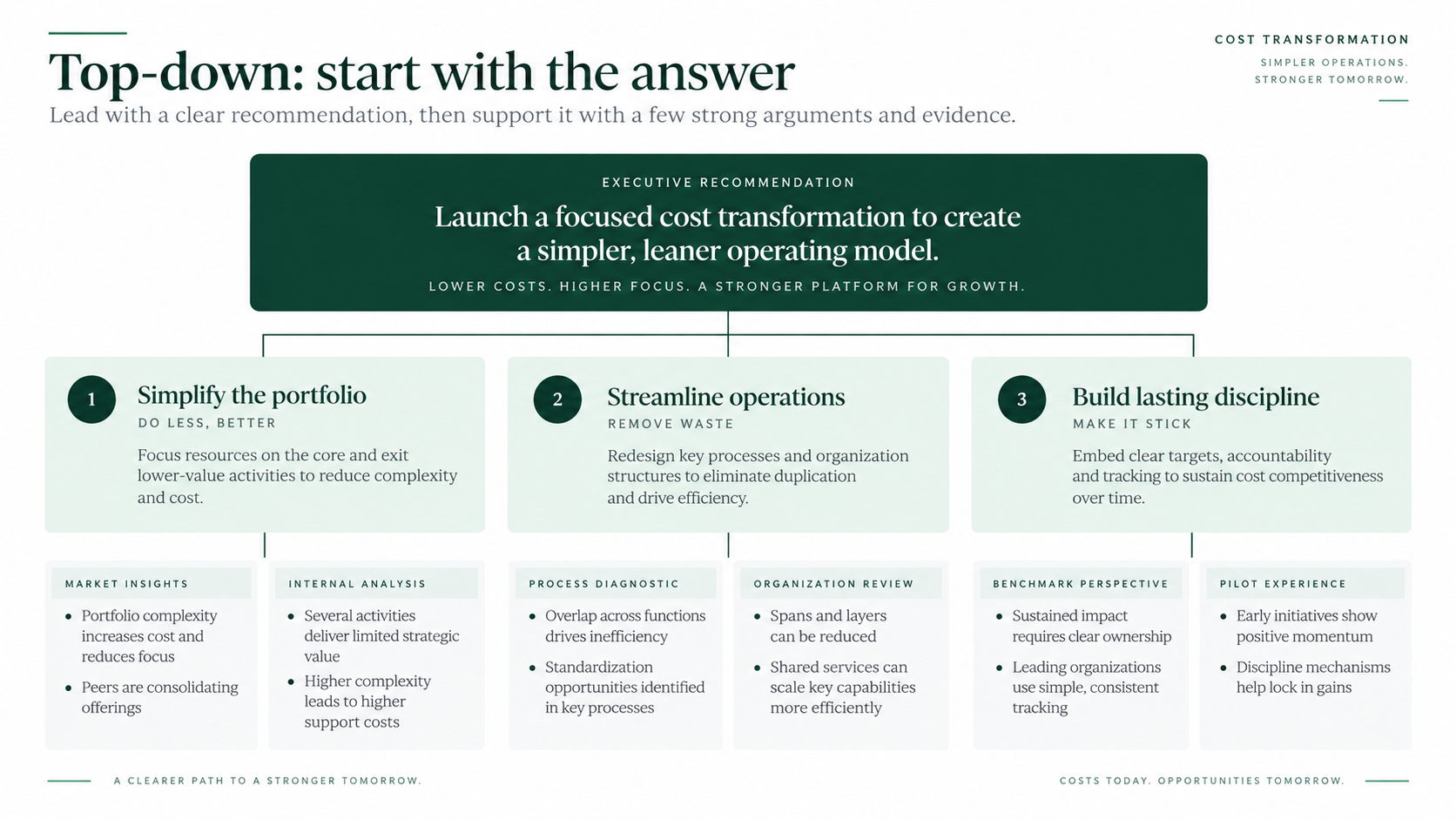
Turn the attached analysis into an answer-first consulting storyline.

Write one recommendation naming action, scope, timing, and expected effect. Break it into three arguments and map source-backed findings under each. Separate facts, assumptions, analysis, and recommendations.

Create one hierarchy summary and one slide per argument. Use conclusion titles, restrained green, thin connectors, consistent margins, and editable objects. Do not add unsupported claims.
Before rendering, merge overlapping branches and reject any grouping generic enough to support the opposite recommendation.
Use case 3: bottom-up synthesis from fragmented evidence
Here nine findings about customer churn collapse into three themes — onboarding, ongoing engagement, and segment differences — and one decision to invest in onboarding. The same pattern works for due diligence, competitor research, and interview programs.
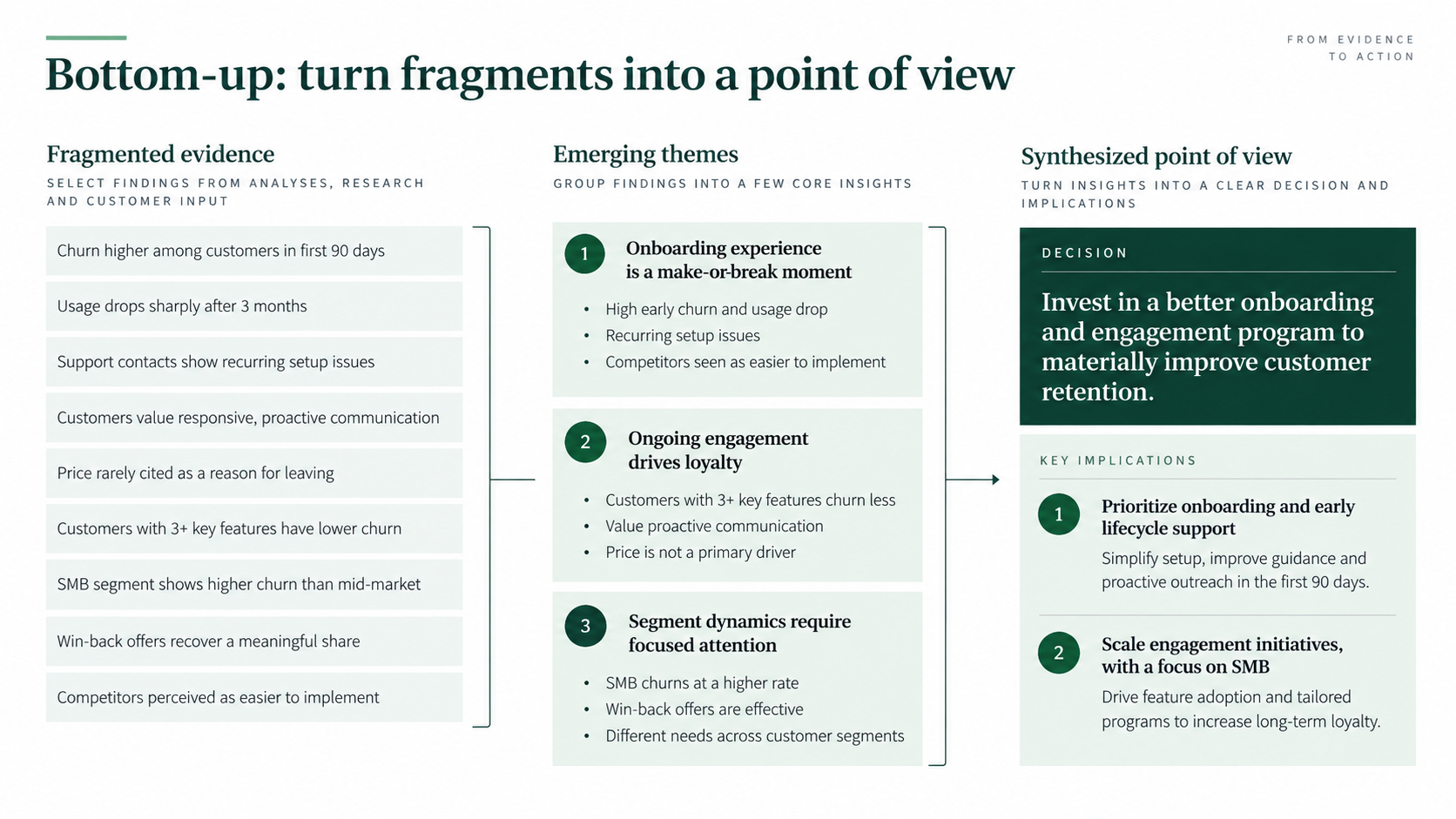
Synthesize the attached research into a bottom-up consulting storyline.

Extract source-linked findings. Remove duplicates but preserve contradictions. Group findings by meaning, name each theme as an insight, then write one point of view, two implications, and a decision.

Before rendering, provide an evidence inventory, proposed groups, gaps, and draft action titles. Create an editable evidence-to-themes-to-decision slide in white, dark green, mint, charcoal, and gray.
Keep contradictions visible until resolved; confidence tags show where evidence is thin.
A worked storyline: 14 action titles for a market-entry decision
A fictional mid-sized industrial coatings manufacturer is deciding whether to enter Southeast Asia. All figures are illustrative. Read the right-hand column alone: it should make the case without any exhibit.
| Slide | Role | Action title |
|---|---|---|
| 1 | Title | Entering Southeast Asian protective coatings: a phased plan for board approval |
| 2 | Executive summary | Enter Vietnam first in Q2 2027 through a distributor, and add Thailand only after three volume gates are met |
| 3 | Situation | Our home market provides 85% of revenue and has grown below 2% a year since 2022 |
| 4 | Complication | Two global competitors are adding local capacity, narrowing the entry window to 2028 |
| 5 | Criteria | The board asked for payback within five years and no more than USD 18 million at risk |
| 6 | Chapter 1 | Power, marine, and infrastructure account for about 70% of addressable demand |
| 7 | Chapter 1 | Specifications, not price, decide most protective-coatings tenders, so margins hold |
| 8 | Chapter 2 | Our certified marine systems already meet the specifications of four of the five largest regional shipyards |
| 9 | Chapter 2 | Distribution is the gap, and a local partner closes it faster than a greenfield sales force |
| 10 | Chapter 3 | Of three entry options, the Vietnam-first path scores highest on return and risk |
| 11 | Chapter 3 | The base case breaks even in year four; the downside loses no more than USD 11 million |
| 12 | Risks | Tender win rate, partner sell-through, and gross margin decide whether phase two proceeds |
| 13 | Roadmap | The first 180 days need four hires, one partner contract, and one toll-manufacturing agreement |
| 14 | Decision | Approve the phase-one budget and authorize partner negotiations today |
Slides 3 to 5 are the SCQ opening and criteria. Slides 6 to 11 are three chapters, one per key line. Slide 11 answers the criterion set on slide 5 directly, and slide 14 turns the argument into a request. The appendix would hold the market model, the shipyard specification matrix, and the scenario assumptions.
Choose the right visual for the relationship
| Information relationship | Recommended visual | Common mistake |
|---|---|---|
| One answer, several arguments | Pyramid or argument tree | Equal cards with no hierarchy |
| Evidence grouped into themes | Affinity map or synthesis flow | Raw notes without interpretation |
| Options against criteria | Scoring table or decision matrix | Pros and cons with no weighting |
| Performance over time | Line, bridge, or variance chart | Icons instead of data |
| Workstreams and owners | Roadmap or swimlane | Activity with no accountability |
Scott Berinato's Visualizations That Really Work in Harvard Business Review sorts charts by whether the information is conceptual or data-driven, and whether the chart declares a point or explores one. Storyline slides are almost always declarative: the title makes the claim and the visual confirms it. For more page structures, see 14 PowerPoint layout patterns.
Microsoft's PowerPoint accessibility guidance recommends sufficient contrast, unique slide titles, and alternatives to color-only coding. If the only thing marking the recommended option is a darker green, add a label.
Common storyline failures
- The chronological deck. "First we interviewed customers, then we built a model." That describes the project, not the answer. Reorder by conclusion.
- The buried answer. The recommendation appears on slide 17 of 20. Put it on slide 2.
- Overlapping key lines. "The market is growing" and "demand is strong" are one argument. Merge them and look for the missing one — usually risk or feasibility.
- Title and exhibit mismatch. Change the chart or soften the title.
- Everything is a key line. Seven equal chapters mean nothing was prioritized. Demote the weakest to supporting evidence.
- No request at the end. Close with the decision, the owner, and the date.
Build and refine the presentation with Tosea AI
Tosea AI separates content planning from rendering, which maps onto the ghost-deck discipline: the outline shows action titles, evidence, and planned visuals before any page is designed.
- Upload the source material — reports, the finance pack, interview notes, or an existing deck exported as PDF.
- State the audience, decision, and evidence boundary, and ask for a decision-led outline with action titles.
- Run the title read-through on the outline and fix sequence and unsupported claims while they are cheap to change.
- Assign an argument tree, synthesis flow, decision matrix, roadmap, or chart-led layout to each slide.
- Render, then swap layouts on dense pages. Layout Only keeps approved wording while changing the visual structure.
- Export an editable PPTX and verify fonts, numbers, sources, and reading order in PowerPoint.
Evidence often arrives as a chart image, PDF page, or spreadsheet. Tosea AI Data Studio recognizes chart and table values, places them in an editable grid, and rebuilds them as presentation charts; Excel and CSV files import directly. Check every recognized value, unit, period, and denominator against the source before updating the slide.
Quality-control checklist
| Check | What good looks like |
|---|---|
| Opening | Slide 2 states the decision, recommendation, and reason |
| Title read-through | Action titles alone form a coherent memo |
| Chapters | One key line per chapter; key lines are MECE |
| Exhibits | Every chart proves the title above it |
| Evidence | Facts, estimates, and assumptions are distinguishable, with units and sources |
| Risks | Each has an owner, trigger, mitigation, and timing |
| Appendix | Source tables and method, not leftovers |
| Export | Green has one meaning; the PPTX is checked in the delivery version of PowerPoint |
Frequently asked questions
What is a governing thought?
The single sentence the deck exists to prove — the answer to the question raised by the situation and complication. It should contain an action, scope, and timing, and be something a reasonable person could disagree with.
How many key lines should a storyline have?
Two to four, each becoming a chapter of roughly three or four slides. Five often means two overlap.
What is a ghost deck?
A full draft in which each slide has an action title and a sketched exhibit before the analysis is complete. It shows which data each slide still needs.
Should I build top-down or bottom-up?
Top-down to prove a known answer, bottom-up when evidence is fragmented. Many projects analyze bottom-up and present top-down.
Can Tosea AI redesign my existing PowerPoint without changing the content?
Yes. Export it as a PDF, upload it, and request a redesign that keeps the wording. Use Layout Only for visual changes, then check labels, footnotes, and citations against the original.
Can Tosea AI use my own template, brand colors, and logo?
Eligible paid plans support custom templates and logos. Specify colors and fonts, then verify font availability, logo spacing, and contrast after export.
Build the argument before polishing the page
A BCG-style storyline is a reasoning process before it is a visual style. Define the decision, write the governing thought, group the arguments into chapters, test the action titles as a memo, and only then choose the visual for each page.
Use Tosea AI to review the outline before rendering, assign layouts, and export an editable PPTX. For the frameworks that fill each chapter, read the BCG strategy consulting PowerPoint templates guide, the BCG-style GE McKinsey Matrix guide, and the BCG-style Wall Method guide.
Sources
- The Minto Pyramid Principle: Concept — Barbara Minto official site
- The Minto Pyramid Principle: Logic in Writing, Thinking and Problem Solving — Minto Books International
- Barbara Minto — Wikipedia
- Resonate: Present Visual Stories that Transform Audiences — Duarte
- Visualizations That Really Work — Harvard Business Review, June 2016
- Organize your PowerPoint slides into sections — Microsoft Support
- Make your PowerPoint presentations accessible to people with disabilities — Microsoft Support